Published: 23 October 2025. The English Chronicle Desk. The English Chronicle Online.
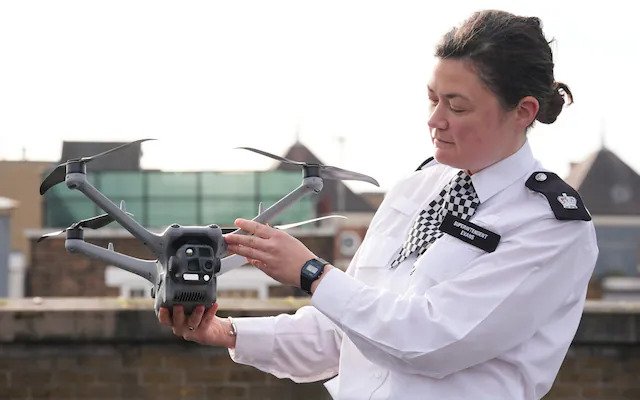
The Metropolitan Police in London is trialling a new programme that will see remote drones launched autonomously from the tops of buildings to respond to 999 calls, providing faster aerial support for officers on the ground. The initiative, named Drone as First Responder (DFR), represents a significant step in using technology to improve policing efficiency, situational awareness, and community safety.
Equipped with high-definition cameras, the drones are designed to attend crime scenes and stream live footage back to officers. The technology is expected to be both cheaper and faster than traditional helicopter deployments, with drones able to reach an incident within two minutes of activation.

The Met anticipates that the drones will be deployed in a variety of emergencies. They could assist in searches for missing persons, track suspects, or provide crucial oversight at major incidents where an aerial perspective offers a clearer understanding of events on the ground. By doing so, officers can make better-informed decisions about the number of personnel needed, the type of response required, and how to secure evidence quickly and efficiently.
Unlike conventional drones, which require operators to control them manually, the Met’s autonomous drones are stationed on rooftops across London. When activated, they fly automatically to the scene, where an officer at a command unit assumes control to capture the necessary footage before the drone returns to its base.
The programme has already been launched in Islington and will soon expand to cover the West End and Hyde Park. While other police forces, including Norfolk, Cleveland, and Hampshire, have experimented with drones, this is the first time the technology will be deployed in such a dense, inner-city environment in the UK.
Assistant Commissioner Laurence Taylor, national lead for drones, emphasised the operational benefits of aerial support. “Aerial support to policing has always added huge value, because it gives us the ability to make informed decisions about deployment and look for people – that is a lot harder to do on the ground,” he said. “By getting that immediate response with a drone, we’re going to have more precise information. We’re capturing the best evidence at the very earliest opportunity, but most importantly, where scenes are chaotic or witnesses are confused, it allows us to inform our own decisions about how many officers, which assets we should deploy, and critically, if suspects or offenders are making away from the scene, we can quickly identify them and bring them into custody without the need for large, expansive area searches.”
Superintendent Taryn Evans, who leads the National Police Chiefs’ Council drones programme, described the initiative as a major advancement in policing technology. “This is an exciting opportunity to bring the many benefits and efficiencies of the Drone as First Responder programme to London, supporting both officer and community safety,” Evans said. “We’ve been running trials of the programme in several different police forces with a range of operating environments from urban to rural, and the technology has proven to be a game-changer in many incidents. This pilot with the Met brings together our two years of learning and development. I look forward to seeing how it can enhance the operational response.”
The DFR programme aims not only to improve operational efficiency but also to enhance public safety. By providing rapid situational awareness, the drones can help de-escalate potentially dangerous situations, ensure that officers arrive equipped with critical intelligence, and reduce the risk to both the public and law enforcement personnel.

While the technology remains in its trial phase, early results suggest it could transform urban policing. The Met’s adoption of autonomous drones demonstrates a growing commitment to integrating innovative solutions into law enforcement, particularly in crowded and complex city environments where traditional methods may be slower or less effective.
If successful, the programme could serve as a model for other UK cities and potentially internationally, illustrating the benefits of rapid-response, drone-based support for police operations. Observers note that as drone technology continues to evolve, the ability to deploy them efficiently, safely, and with minimal disruption could redefine the way emergency services respond to incidents in real time.
Related News:
 British AI Startup Outshines Human Forecasters in Global Prediction Contest
Public Skepticism Over AI Poses Challenge to UK’s Superpower Ambitions, Says Tony Blair Institute
British AI Startup Outshines Human Forecasters in Global Prediction Contest
Public Skepticism Over AI Poses Challenge to UK’s Superpower Ambitions, Says Tony Blair Institute
 UK Energy Firms Complete First Hydrogen Blending Trial
 UK Pupils Fear AI Is Eroding Their Learning Skills
 Waymo to Launch Driverless Taxis in London by 2026
 Runners’ records at risk as Garmin goes to war with Strava
 Harry and Meghan join global AI leaders urging superintelligence ban
 Breath test could ‘revolutionise’ pancreatic cancer treatment
 Mortgages and AI Set to Feature in English Schools
 Valve Opens the Door for Android Games on Steam
 UK launches major AI drive to fight deadly superbugs
 Anglian Water Fined £63 Million Over Sewage Scandal Amid National Outrage
 How to Exit Your Broadband Contract Without Paying Exit Fees
 Michele Dougherty Makes History as the UK’s First Female Astronomer Royal
 Unseen Killers of the Deep Inside the UK Lab Uncovering the Silent Deaths of Sea Creatures
 UK Launches World-First Gonorrhoea Vaccine Amid Record Infection Surge
 Permission Granted for Britain’s First Vertical Rocket Launch at Shetland Spaceport
 Mind the Grab’: Bold Campaign Launched on Oxford Street to Combat Phone Theft
 AI Tools Used by English Councils Found to Downplay Women’s Health Issues, Raising Concerns Over Gender Bias in Care
 UK Quickly Reclaims Leading Role in EU’s Horizon Europe Science Research Programme
 Breakthrough Clinical Trial Lets 12-Year-Old Boy with Rare Skin Disorder Play Football
 Government Expands Electric Car Grant Scheme, Offers Discounts on Five More Models
 From ‘Skibidi’ to ‘Mouse Jiggler’: Cambridge Dictionary Expands with Modern Slang and Social Terms
 Shocking Rise in Children’s Exposure to Violent Online Pornography Raises Alarm
 Ed Davey Urges Government to Block Elon Musk’s Tesla from Supplying UK Home Energy
 Britain’s Butterfly Numbers Rebound but Remain Average
 Apple Unveils Ultra-Thin $999 iPhone Air at “Awe-Dropping” Annual Event
 UK Could Generate Nearly £2bn Annually by Taxing SUVs, New Study Reveals
 Jaguar Land Rover Extends Production Halt Following Cyber-Attack
 Persistent Offenders Owe Over £700m in Ulez Fines as TfL Cracks Down on Evasion
 UK Fighter Jet Purchase Could Breach Nuclear Treaty, Warns CND
 Hackers Allegedly Steal Data of 8,000 Children from Kido Nursery Chain
 Omeprazole Alert: NHS Issues Guidance on Safe Use for Heartburn and Indigestion
 GPs in England Warn of Overload as Nationwide Online Appointment System Approaches
 Royal Mail Owner Acquires Stake in Collect+ and Launches High Street Rebrand
 Russia repeatedly targets UK military satellites, warns Space Command chief
 Jaguar Land Rover to Resume Production After Cyber-Attack, Launches Supplier Support Scheme
 Eligibility Confusion Over COVID Vaccination Leaves Pharmacies Struggling Across the UK
 Millions in the UK at Risk of Cyber-Attacks as Microsoft Ends Windows 10 Updates, Warns Which?
 Majority of UK Men Would Opt for Prostate Cancer Screening, Survey Finds
 Scientists Announce First Potentially Accurate Blood Test for Chronic Fatigue Syndrome
 NHS May Pay 25% More for Medicines Amid US Drug Talks
 Cooper Unveils £4m Cyber Plan Against Russian Hackers
 Survey Shows Most GPs Rushing Appointments
 Yvette Cooper Backs Digital ID Plan for UK Teens
 Genetic Tests May Predict Return of Blood Cancer
 UK Woman Becomes Longest Survivor of Heart-Lung Transplant
 Labour MPs Warn Digital ID Scheme Risks Cost and Support
 Microsoft Study Reveals Jobs Most at Risk from AI
 Watchdog Rules Red Tractor Ad Misled Public on Environmental Claims
 Thousands in the UK sue Johnson & Johnson over alleged talcum powder, linked to cancer
 ‘Game-Changing’ HIV Prevention Jab Set for NHS Approval
 UK to Test Digital ID Scheme with Veteran Card
 Judge Slams Lawyer for Using AI in Asylum Case
 Reform UK candidate fined £19,000 after using AI-generated cases to challenge election
 UK Campaigners Launch Bill to Grant Legal Rights to Nature
 Time to Turn Back the Clock: Celebrating Willett’s Legacy
 Bloomsbury chief: AI will aid authors in beating writer’s block
 How Bringing Forests Into Preschools Boosts Children’s Health
 England Curriculum Review Recommends Major Changes
 Experts Urge Legal Right to Timely Cancer Care
 One of world’s last dinosaurs on sale for £3m
 North Sea oil workers must lose weight or face job loss
 No link found between paracetamol in pregnancy and autism
 Government urges schools to ban phones to curb classroom disruption
 Northern Lights May Illuminate UK Skies Amid Strong Solar Storm
 Stop using ChatGPT to write speeches, AI minister tells MPs
 New laws to bolster UK’s defences against cyber attacks on NHS, transport and energy
 UK Greenlights First Small Nuclear Plant in North Wales
 Higgs Donates Nobel Medal to His Beloved University
 Google Chief Urges Caution: Don’t Trust AI Blindly
 Poll Reveals China Leads World in Trusting AI Technology
 Coffins Now Too Large to Cremate Amid Rising Obesity Crisis
 UK Taskforce Unveils Plan to Streamline Nuclear Reactor Rules
 Thinktank Urges Smaller Hospitals to End NHS ‘Permacrisis’
 NHS paediatric leave parents waiting months for answers
 Ofcom urges platforms to limit abuse and curb online ‘pile-ons’
 AI could replace 3m low-skilled jobs in the UK by 2035
 AI Actress Creator Says Tilly Norwood Won’t Replace Actors
 YouTube Warns Kids Will Be Less Safe Under Australia Ban