Published: 28 November 2025 Friday. The English Chronicle Desk. The English Chronicle Online
Mr Chung still hears the last words his wife said to him: “Hang in there.” Those words, spoken in panic as flames engulfed their 31-storey public housing block in Hong Kong’s Tai Po district, have echoed in his mind as the agonising hours have stretched into days. What began as a desperate phone call has turned into a nightmare with no end in sight, as the death toll from the massive fire climbs and hundreds remain unaccounted for.
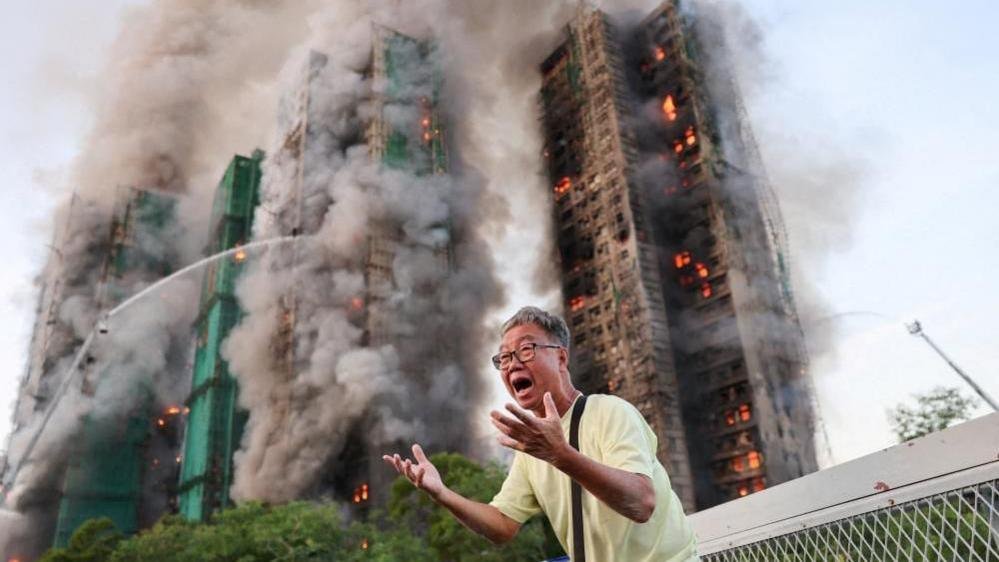
It was around 15:00 local time on Wednesday when his wife phoned, terrified, to say she couldn’t escape their flat. Thick smoke was filling the building, and she was trapped inside with their cat. Mr Chung rushed home from work, only to find the high-rise transformed into an inferno. Black, suffocating smoke poured out of shattered windows. The fire, which ultimately tore through seven tower blocks, raged for almost 24 hours before firefighters managed to contain it. It is now the deadliest blaze Hong Kong has seen in sixty years.
So far, at least 94 people have been confirmed dead. Nearly 300 more remain missing — including Mr Chung’s wife. He has spent every moment outside the still-smouldering ruins, accompanied by his brother, begging firefighters and officers for updates. But emergency workers, overwhelmed by the scale of destruction, can offer no answers.
Throughout the evening and into the night, he and his wife exchanged frantic calls. The last time she spoke, she said the smoke was growing unbearable. She felt dizzy, faint. And then the line went silent.

“I dare not call her again,” Mr Chung said quietly the next morning, his eyes swollen from crying. “She passed away with our cat, who she loves.” He said the words like a man forcing himself to accept what his heart refuses to believe. His wife, the only one in their family who stayed home that day, is now one of the hundreds of people whose fates remain unknown.
The Chungs had lived in Wang Cheong House for ten years — the first of the seven buildings consumed by the fire. Residents say the smoke spread frighteningly fast. On the 23rd floor, where the couple lived, the corridor became pitch-black in less than ten minutes. His wife, disoriented and choking, could not find her way out.
Authorities say the cause of the fire is still under investigation, but early evidence suggests that ongoing renovation work at the complex may have acted as a deadly accelerant. Scaffolding covered in plastic mesh and wrapped with flammable styrofoam helped the blaze leap rapidly between units and buildings. Police have already arrested three executives from the construction company overseeing the controversial renovation project, accusing them of “gross negligence” and using substandard materials.
Wang Fuk Court, the subsidised housing estate where the disaster occurred, was built in 1983. Eight towers stand on the property, home to around 1,800 flats. According to census data, nearly 40% of the residents are aged 65 or older — a demographic that has made the tragedy exponentially more devastating. Many elderly residents struggled to move quickly enough to escape. Many lived alone. Many never even heard an alarm.
That was a grievance echoed by every resident the BBC spoke to: no alarm sounded as the fire spread. People learned of the danger through phone calls, neighbours shouting, or the sudden rush of smoke pushing through their doors.
For Ms Fung, the nightmare began with a call from her neighbour, who said she and Ms Fung’s mother were hiding inside a toilet to escape the smoke. Then communication stopped, just past midnight. “We will think about our next steps after my mum comes out,” she said on Thursday, forcing hope into her voice even as it trembled.
She said she was enraged when police asked whether it was possible her mother had simply escaped without telling anyone. “How could she? You know how badly burnt the building is,” she demanded, her voice sharp with grief and disbelief.
Social media is now overflowing with desperate posts from families searching for news of missing children, grandparents, spouses and pets. One mother wrote: “I still can’t find my baby girl. It’s nearly 30 hours…” Later, she posted again: “I am afraid there is no hope.”
As more details emerge, scrutiny has turned sharply toward the renovation works at Wang Fuk Court. The project cost HK$330 million, with residents charged HK$160,000 to HK$180,000 per household — costs many opposed. But the construction went ahead despite the objections. Now, with suspicions that non-compliant scaffolding materials and improper plastic coverings helped the flames spread, anger is rising.

Some residents say warning signs were present long before the fire. Grandma Chan, a 72-year-old who lived alone, says she had smelled burning occasionally since the renovations began last year. “Will anything happen if I stay home?” she once asked her daughter, who reassured her. On Wednesday, it was that same daughter — calling from South Korea — who told her to run.
82-year-old Grandma Wu had been playing mahjong with neighbours when her husband phoned to warn her of the fire. There was still no alarm. Initially, the women hesitated; three buildings separated theirs from Wang Cheong House. But a second phone call urged them to flee. They took the lift and made it downstairs just before the fire swept across the estate. Even after she reached safety, Grandma Wu refused to go home with her son. “I have lived here 42 years,” she said. “My heart will only be at peace after the fire is extinguished.”
For younger residents, the disaster is also a financial catastrophe. Kyle Ho, 32, moved in with his retired parents three years ago. Despite subsidised pricing, they required a mortgage to buy their unit. “The worst-case scenario is that we have lost our flat,” he said, “but the most important thing is that all of us are safe. We are luckier than many others.”
The Hong Kong government has announced HK$10,000 in immediate relief for displaced families and a HK$300 million emergency assistance fund. But for most survivors, emotional wounds outweigh financial concerns. Those with missing relatives face a torturous wait, as emergency crews continue to search the unstable ruins of the seven charred towers. Authorities insist rescues remain possible, though hopes are fading.
Mr Chung spends every hour outside, refusing to go home. “I want to rescue her,” he said. “Whether she’s alive or gone.”
For him, and for hundreds of other families gathered around the ruins of Wang Fuk Court, the wait is unbearable — but it is all they have left.
Related News:
 Thousands at Risk in Gaza Amid Winter Flooding
 Delhi’s Toxic Air Crisis Leaves Children Sick and Vulnerable
 Sri Lanka Floods Leave 56 Dead, Dozens Missing
 Rare shark attack kills woman, injures man at remote NSW beach
 Tokyo court rules Japan’s same-sex marriage ban constitutional
 Delhi’s Toxic Air Drives Spike in Respiratory Illnesses
 World Whisky Tour: 9 Global Gems
 British Grandmother to Return Home After Death Sentence in Bali
 Parents Urge Home Office to Reunite Daughter After Hurricane
 Second world war veterans honoured as King leads Remembrance Sunday
 Suicide Bombing at Islamabad Court Kills 12, Injures Dozens
 Shook the ground under my feet: Panic as car blast hits near Delhi’s Red Fort
 Delhi Tightens Curbs as Citizens Protest Over Toxic Air
 Mali’s Daily Life Cripples Under Jihadists’ Fuel Blockade
 UK Faces Arctic Blast as Polar Vortex Disruption Brings Heavy Snow
 Delhi Car Blast Kills Eight, Declared Terror Incident
 South Korea’s College Exam Tests Perseverance of Blind Students
 Truck Crashes into South Korean Market, 2 Dead, Dozens Hurt
 Early Trends Suggest Modi’s Alliance Leading in Key Bihar Election
 Bataclan Anniversary: France Remembers but Jihadist Danger Lingers
 Cold Snap Brings Snow Risk as Flood Recovery Continues
 Tragedy Strikes Indian Pilgrims in Saudi Bus Accident
 Irish Hero Parrott Says Goal Brought First Tears in Years
 Snow and Ice Warnings Affect Scotland and Northern England
 Scotland Fans Reflect on France ’98 as World Cup Looms
 Witnesses Recall Tragedy as Couple Die in Flood
 Israeli Strike Kills 13 Near Palestinian Camp in Lebanon
 Trump Says Crown Prince Knew Nothing About Khashoggi Death
 Commuters warned as yellow snow and ice alert hits Northern Ireland
 Arctic Blast Hits UK as Snow and Ice Warnings Trigger Travel Disruption
 Forgotten War, Shattered Lives: Sexual Violence Devastates Women in Ethiopia
 Snow and Ice Cause Travel Chaos in North Yorkshire
 Ethiopia Welcomes Historic Artefacts Returned from Germany
 Turkey to Host COP31 After Breakthrough Deal with Australia
 UK Energy Bills to Rise Slightly in January
 South African Women Call Purple Protest Over Gender Violence
 Australia Launches Major Environmental Law Reforms
 Southern Lebanon reels as Israeli strikes shatter communities
 India’s Labour Law Overhaul Sparks Fierce Debate
 Video shows Israeli troops kill Palestinians after surrender
 Fury After Hong Kong’s Deadliest Fire in Decades
 A Colourful Cultural Escape in Mexico’s Querétaro
 Europe, North America face early wave of bird flu
 Southeast Asia floods claim 241 lives, rescue efforts continue
 Chinese & Japanese Boats Clash Near Disputed Islands
 Hong Kong Orders Probe Into Deadly 151-Death Fire
 Putin Meets US Envoy Amid Key Ukraine Peace Talks
 UK Criticises Gaza Aid Delays as Tents Arrive After Year
 Indonesia to Repatriate Two Dutch Drug Convicts
 Peterborough Mosques Tighten Security After Attack
 Army Officers Orders to Cut Ties with Men-Only Clubs
 Kent village told to remove flags before Christmas lights go up
 BBC to Apologise Over Edited Trump Speech Amid Backlash
 Britain deploys RAF specialists to assist Belgium with drone threats
 Palace May Restore Hyphen to Andrew Mountbatten-Windsor’s Name
 From Lego to Pokémon: How Adults Are Driving UK Toy Market Growth
 Shouting Works Best to Deter Gulls, UK Study Finds
 Reeves rejects £1bn plea for NHS redundancy payouts
 Northern Lights may illuminate UK skies this week
 PM Condemns Leaks, Vows Loyalty to Ministers and Stability
 Senator John Fetterman Hospitalized After Fall from Heart Flare-Up, Keeps Sense of Humor
 Greene Pushes Epstein Files Amid Trump Fallout
 December Run-Off in Chile as Election Produces No Winner
 Zelenskyy Signs Fighter Jet Deal Amid Russian Drone Attacks
 Canada Passes Carney’s First Budget in Tight Parliamentary Vote
 What Now for the Queen’s Childhood Playhouse After Andrew’s Eviction?
 Van Dwellers Face Eviction After Park Misuse Sparks Outcry
 Shadow Fleet at Sea: Europe’s Battle Against Illicit Oil Shipping
 Tiny Curacao Makes History as Smallest Nation to Reach World Cup
 Deadly Russian Strikes Hit Western Ukraine, 20 Killed in Ternopil
 Ukraine Peace Plan: Zelensky Ready for Dialogue
 Director Michael Caton-Jones Reflects on Career and Beginnings
 India’s COP30 Delay Raises Global Climate Concerns
 Royal Navy Shadows Russian Warships Entering the Channel
 Inside the Helpline Protecting Missing Children in the UK
 US Suspends Afghan Immigration After White House Shooting
 Georgians Defy Government Crackdown After Year of Protests
 Fibromyalgia Patients Struggle as NHS Fails to Provide Care
 Virgin Media Fined £23.8m Over Telecare Safety Failures
 Pavarotti statue frozen in Italian ice rink sparks backlash