Published: 20 November 2025 Thursday . The English Chronicle Desk. The English Chronicle Online
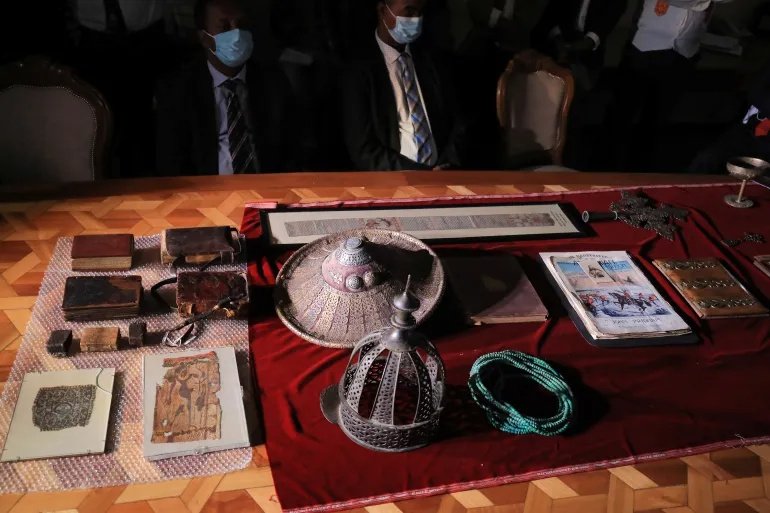
Ethiopia has officially received a remarkable collection of historical artefacts that had been kept in Germany for more than a century, marking a symbolic and emotional moment in the country’s ongoing efforts to recover cultural treasures taken abroad during the turbulent years of colonial expansion and foreign influence across Africa. The twelve artefacts, deeply rooted in Ethiopia’s artistic, political and religious history, were handed over on Wednesday to the Institute of Ethiopian Studies at Addis Ababa University in a ceremony filled with symbolism, gratitude and renewed diplomatic ties.
The artefacts, which include intricately crafted crowns, shields adorned with traditional patterns, and paintings of significant cultural resonance, were taken to Germany in the 1920s by the country’s then-envoy to Ethiopia, Franz Weiss, and his wife Hedwig, who lived in Ethiopia during an important period of early twentieth-century diplomacy. Their presence in Ethiopia coincided with a time when European diplomats, explorers and scholars were collecting African artefacts—some ethically obtained, others not—reflecting the cultural imbalances and unequal power dynamics that characterised the era.
Germany’s current envoy to Ethiopia, Ferdinand von Weyhe, described the formal return as more than a diplomatic gesture. Speaking at the handover ceremony, he said the pieces “still stand as a symbol of the long-standing and friendly relationship between Germany and Ethiopia.” His remarks captured the spirit of reconciliation and cultural respect that underlined the moment, particularly as global discussions about the restitution of African cultural heritage continue to gain momentum.

The items were returned by Professor Ramon Wyss, whose personal connection to Ethiopia extends back to his father’s birth during the Weiss family’s residence in the country. Addressing the audience, Wyss expressed the family’s belief that the artefacts should not remain in private hands, emphasising the importance of restoring them to the nation where their cultural meaning is most deeply rooted. He explained that the family’s intention was not only to honour Ethiopia’s history but also to “share their beauty with the public and preserve the culture and history connected to my father’s birth.” His comments reflected a sense of personal responsibility and respect for Ethiopia’s heritage that had guided the family’s decision.
Tourism Minister Selamawit Kassa welcomed the return with heartfelt appreciation, noting that the gesture demonstrated genuine affection for the country and its people. She emphasised that the items had been carefully preserved by the Weiss family for decades, allowing them to be returned in exceptional condition. “I would like to thank Professor Weiss’s family for practically expressing their profound love for Ethiopia by meticulously preserving these artifacts and crucially ensuring their return to their rightful homeland,” she said.
She added that the artefacts would soon be made available to the Ethiopian public through exhibitions, research access and academic study, describing the handover as a milestone in the national effort to restore and safeguard the country’s heritage. The minister noted that the return of these pieces was part of a broader movement to reclaim historical artefacts from around the world that are vital to understanding Ethiopia’s past, and she pledged continued efforts to bring back additional items from both private collectors and institutions abroad.
Many of these objects were originally acquired by Europeans during years marked by political instability, conflict, diplomatic exchanges and unequal power dynamics. While some were indeed purchased or given as gifts—an important point emphasised by the Weiss family—others taken from Ethiopia and other African nations were forcibly seized or removed under duress during the colonial period. This complex legacy has shaped recent global debates about restitution, prompting a re-evaluation of how artefacts should be interpreted, displayed and owned in the 21st century.
Across Africa, the call for the return of cultural property looted or taken under dubious circumstances has grown louder in recent years, driven by governments, academics, activists and diaspora communities. These efforts have begun to yield success, with several European nations acknowledging the injustices committed during colonial expansion and agreeing to return significant collections. Yet obstacles remain, particularly in countries where national museums and private collectors hold vast numbers of African artefacts dating back several centuries.
Germany has been among the leading nations in addressing this historical imbalance, taking steps to return artefacts and openly confront what it has acknowledged as a “dark colonial history.” In 2022, it became the first country to return a portion of the famed Benin Bronzes to Nigeria, a move widely praised as a turning point in the global restitution debate. That action set an example for other European countries, although many institutions still resist full repatriation, citing conservation concerns or claiming to be the rightful custodians of global heritage.
The return of the Ethiopian artefacts represents another meaningful chapter in this ongoing reconciliation process. For Ethiopia, it is not only an act of cultural restoration but also an affirmation of national identity, pride and continuity. Each artefact, whether a ceremonial crown or a war shield, carries with it a story that contributes to Ethiopia’s enduring narrative as one of Africa’s oldest and most influential civilizations—one that maintained sovereignty during much of the colonial era and possesses a long tradition of artistic, spiritual and political expression.
The items will now be catalogued, preserved and eventually put on public display at the Institute of Ethiopian Studies, allowing scholars, students and citizens to engage with pieces of their history long kept beyond their borders. This return also holds symbolic power for young Ethiopians who are increasingly seeking to reclaim and reinterpret their past. By making these artefacts accessible, Ethiopia strengthens its cultural institutions and ensures that future generations can learn from and appreciate them.

Ethiopia’s cultural restitution efforts extend far beyond this single collection. Over the past two decades, the country has been actively involved in global campaigns to repatriate manuscripts, ceremonial objects, royal regalia, and religious icons held in museums and private hands around the world. Many of these items were taken during the 19th century following conflicts such as the British expedition to Maqdala in 1868, which resulted in the removal of thousands of manuscripts, crowns, tabots and other valuable items.
In recent years, Ethiopia has successfully negotiated the return of several important items, including sacred tabots, ancient manuscripts, and prayer books, some of which had been held in British and European institutions for well over a century. Each return has been celebrated as a moment of healing, reinforcing Ethiopia’s determination to reclaim its dispersed heritage.
The return of the Weiss artefacts is therefore not an isolated event but part of a larger puzzle—one that Ethiopia continues to piece together through diplomacy, research, and international cooperation. The government has reaffirmed its commitment to identifying and retrieving items held both publicly and privately across the globe. Minister Selamawit Kassa’s remarks underscored this ongoing mission, noting that efforts “will continue to bring back ancient artefacts that are found in the hands of individuals and institutions all over the world.”
Germany’s willingness to facilitate these returns, and the Weiss family’s decision to voluntarily hand over the artefacts, reflects shifting global attitudes about cultural ownership, restitution and ethical stewardship. Increasingly, international institutions recognise that meaningful cooperation, transparency and moral responsibility are essential in addressing historical injustices.
For Ethiopia, Wednesday’s ceremony was both a celebration and a reminder. It celebrated the return of priceless cultural objects, the goodwill of a foreign family with deep personal ties to the country, and the growing international recognition of Ethiopia’s cultural significance. At the same time, it reminded many of the tens of thousands of artefacts still held abroad, waiting to be rediscovered and reconnected with their homeland.
As the artefacts begin their new life back in Ethiopia, soon to be displayed and studied by scholars, artists and the public, they stand not only as relics of the past but as symbols of cultural resilience. Their return encourages deeper dialogue about history and heritage while reaffirming the enduring friendship between Germany and Ethiopia—a relationship now strengthened by an act of cultural restitution more than a century in the making.
Related News:
 World Whisky Tour: 9 Global Gems
 British Grandmother to Return Home After Death Sentence in Bali
 Parents Urge Home Office to Reunite Daughter After Hurricane
 Second world war veterans honoured as King leads Remembrance Sunday
 Mali’s Daily Life Cripples Under Jihadists’ Fuel Blockade
 Bataclan Anniversary: France Remembers but Jihadist Danger Lingers
 Irish Hero Parrott Says Goal Brought First Tears in Years
 Scotland Fans Reflect on France ’98 as World Cup Looms
 Thousands at Risk in Gaza Amid Winter Flooding
 Forgotten War, Shattered Lives: Sexual Violence Devastates Women in Ethiopia
 South African Women Call Purple Protest Over Gender Violence
 Families wait in agony for missing after Hong Kong tower blaze
 A Colourful Cultural Escape in Mexico’s Querétaro
 Rare shark attack kills woman, injures man at remote NSW beach
 Europe, North America face early wave of bird flu
 Tokyo court rules Japan’s same-sex marriage ban constitutional
 UK Criticises Gaza Aid Delays as Tents Arrive After Year
 A Third of EU Citizens in UK Report Discrimination by Public Bodies Post-Brexit
 WW2 Pilot’s Long-Lost Crash Site Unearthed in Essex
 Peterborough Mosques Tighten Security After Attack
 Hospice Cuts Raise Alarm Across England Amid Funding Crisis
 UK Woman Loses Child Benefit After Booking Flight She Never Took
 Army Officers Orders to Cut Ties with Men-Only Clubs
 Children to Learn Local History in Major Curriculum Overhaul
 The Lowry Hotel: Manchester’s Iconic Five-Star Retreat
 Prince William Plants Trees with Brazil’s Nature Heroes
 Just Stop Oil Protesters Convicted Amid Climate Defence Row
 Kent village told to remove flags before Christmas lights go up
 Earl of Yarmouth Faces £1.3m Legal Bill Over Family Estate
 BBC to Apologise Over Edited Trump Speech Amid Backlash
 Britain deploys RAF specialists to assist Belgium with drone threats
 How to get help when a child goes missing – call 999 urgently
 Palace May Restore Hyphen to Andrew Mountbatten-Windsor’s Name
 US Senate Passes Funding Bill to End Historic Shutdown
 From Lego to Pokémon: How Adults Are Driving UK Toy Market Growth
 UK Faces Arctic Blast as Polar Vortex Disruption Brings Heavy Snow
 Shouting Works Best to Deter Gulls, UK Study Finds
 Reeves rejects £1bn plea for NHS redundancy payouts
 PM Condemns Leaks, Vows Loyalty to Ministers and Stability
 Son Reveals UK Couple in Iran Resort to Hunger Strike for Help
 Senator John Fetterman Hospitalized After Fall from Heart Flare-Up, Keeps Sense of Humor
 US Justice Department Files Lawsuit Against California Over Partisan Voting Maps
 Greene Pushes Epstein Files Amid Trump Fallout
 Trump Deploys DHS to Charlotte in Major Arrest Operation
 December Run-Off in Chile as Election Produces No Winner
 Mum Calls for New Licence Rules After Teen Road Death
 Zelenskyy Signs Fighter Jet Deal Amid Russian Drone Attacks
 Orban Says Ukraine Has ‘No Chance’ as EU Support Continues
 Mother Watches in Horror as Teen Daughter Dies on Tracks
 Canada Passes Carney’s First Budget in Tight Parliamentary Vote
 What Now for the Queen’s Childhood Playhouse After Andrew’s Eviction?
 Seven Countries, One Winner: Europe’s Best Christmas Market
 Van Dwellers Face Eviction After Park Misuse Sparks Outcry
 Israeli Strike Kills 13 Near Palestinian Camp in Lebanon
 Shadow Fleet at Sea: Europe’s Battle Against Illicit Oil Shipping
 ‘Traumatic Wait’: Northern Ireland Women Face Breast Cancer Delays
 Tiny Curacao Makes History as Smallest Nation to Reach World Cup
 Haiti Qualifies for World Cup Despite Coach Never Visiting Country
 Deadly Russian Strikes Hit Western Ukraine, 20 Killed in Ternopil
 Healthy Habits in Your 30s That Boost Life in Your 70s
 Snow and Ice Cause Travel Chaos in North Yorkshire
 Pentagon Officials in Ukraine to Discuss War End
 Vietnam Battles Deadly Floods as Rains Continue
 Venezuela Threatens Nobel Winner Machado with Fugitive Status
 At Least Three Dead in Bangladesh Earthquake
 Coffins Now Too Large to Cremate Amid Rising Obesity Crisis
 Labour MP claims devolution bill is ‘blatant discrimination’ against Cornwall
 Vicki Fears Losing Motability Car
 Israel Confirms Hamas Returned Dror Or’s Body
 Two National Guard Soldiers Critically Injured Near White House
 Delhi’s Toxic Air Crisis Leaves Children Sick and Vulnerable
 Southern Lebanon reels as Israeli strikes shatter communities
 Mbappe Scores 4 as Real Madrid Edge Olympiakos
 Sri Lanka Floods Leave 56 Dead, Dozens Missing
 India’s Labour Law Overhaul Sparks Fierce Debate
 Fibromyalgia Patients Struggle as NHS Fails to Provide Care
 Scotland Gains 33 New Towns – Life in Growing Communities
 Search underway for British man overboard off Tenerife
 Virgin Media Fined £23.8m Over Telecare Safety Failures
 Pavarotti statue frozen in Italian ice rink sparks backlash