Published: 17 December 2025. The English Chronicle Desk. The English Chronicle Online.
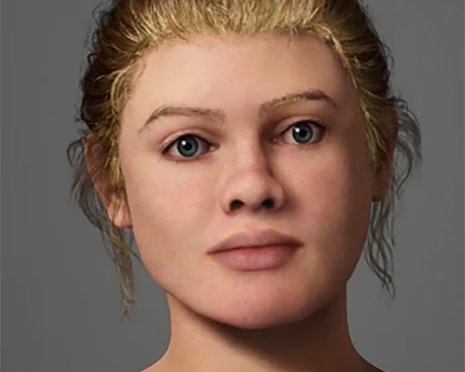
The long-standing mystery surrounding Beachy Head Woman, a Roman-era skeleton, has finally been resolved by modern genetic analysis. Once celebrated as the earliest known black Briton and later speculated to be of Cypriot origin, the remains are now confirmed to belong to a woman from southern England, likely a local resident of Eastbourne. Advances in DNA sequencing allowed scientists to extract a high-quality genetic readout, clarifying the skeleton’s true ancestry and putting decades of speculation to rest.

Initially, forensic anthropologists suggested the woman could have originated from sub-Saharan Africa based on cranial analysis. In 2016, this led to a commemorative plaque being installed to “honour the first black Briton.” Subsequent studies cast doubt on this theory, with preliminary DNA tests hinting at a possible Cypriot origin, although the degraded quality of the genetic material prevented definitive conclusions.
“She’s had quite a journey,” said Dr Selina Brace of the Natural History Museum, London, and senior author of the recent study. “She was held up as a public figure, and now she demonstrates how science evolves. She’s simply a local girl from Eastbourne.”
The skeletal remains were originally discovered in 2012 within Eastbourne town hall’s collections, stored in a box that suggested they were unearthed at Beachy Head in the 1950s. Radiocarbon dating places her death between AD129 and 311, during Britain’s Roman occupation. She was estimated to be 18 to 25 years old at her death, standing just over 4.9 feet tall. Evidence of a healed leg wound indicates a non-fatal injury, while dietary analysis suggests she consumed significant seafood and lived locally.
The skeleton’s story attracted public attention when initial skull morphometry indicated African origins, a finding highlighted in David Olusoga’s 2016 BBC series Black and British: a Forgotten History. Later versions of the programme omitted the segment following updated research. “Several skull features suggested a sub-Saharan origin, but caution was always advised,” noted Professor Caroline Wilkinson of John Moores University, who conducted the original analysis and contributed to the recent findings.
Wilkinson highlighted a broader shift in anthropology away from classifying ancestry based solely on skull morphology, acknowledging that facial variation overlaps significantly across populations. When Brace’s team attempted DNA analysis in 2017, results strongly contradicted African origins. A parish council vote subsequently led to the removal of the commemorative plaque. Although Cypriot ancestry initially seemed plausible, the degraded DNA prevented conclusive verification.
The breakthrough came with the use of capture arrays, a technology designed to extract and reconstruct minute fragments of ancient DNA. This method increased DNA coverage more than tenfold, revealing that Beachy Head Woman descended from Roman-era populations in southern England. “It doesn’t change Britain’s broader history,” Brace emphasized. “It changes her personal story, and she deserved accuracy.”
The revelation closes a chapter of scientific debate spanning over a decade, highlighting both the evolution of forensic methodologies and the challenges of interpreting historical human remains. Beachy Head Woman’s journey from a subject of speculative identity to a verified local resident underscores the precision of modern archaeology and genetic science. It also provides a lesson in careful historical interpretation, reminding researchers and the public alike that preliminary conclusions, particularly regarding identity and ancestry, must be approached with rigorous scrutiny and humility.
The study, now published in the Journal of Archaeological Science, serves as a benchmark in understanding Roman-era populations in southern England. Scholars anticipate that the methodology employed will influence future research, allowing more accurate reconstructions of ancient human lives while preventing misinterpretations based on incomplete or degraded evidence.

Beachy Head Woman, now recognized as a local of Eastbourne, enriches knowledge of everyday life during Roman Britain. Her skeletal remains tell a story of diet, injury, and regional ancestry rather than distant migration, offering insight into the local community and its members. Experts emphasize that she represents countless lives from the era, whose histories often remain buried but whose legacies are increasingly accessible through modern science.
With this revelation, communities and historians alike are encouraged to reflect on how narratives of identity are constructed and the responsibility inherent in commemorating historical figures. Beachy Head Woman’s story, once reshaped by assumptions and partial evidence, now rests on scientifically verified facts, reinforcing the intersection of archaeology, anthropology, and genetics in uncovering Britain’s nuanced past.
Related News:
 How to Exit Your Broadband Contract Without Paying Exit Fees
 Michele Dougherty Makes History as the UK’s First Female Astronomer Royal
 Unseen Killers of the Deep Inside the UK Lab Uncovering the Silent Deaths of Sea Creatures
 UK Launches World-First Gonorrhoea Vaccine Amid Record Infection Surge
 Mind the Grab’: Bold Campaign Launched on Oxford Street to Combat Phone Theft
 AI Tools Used by English Councils Found to Downplay Women’s Health Issues, Raising Concerns Over Gender Bias in Care
 From ‘Skibidi’ to ‘Mouse Jiggler’: Cambridge Dictionary Expands with Modern Slang and Social Terms
 Shocking Rise in Children’s Exposure to Violent Online Pornography Raises Alarm
 Ed Davey Urges Government to Block Elon Musk’s Tesla from Supplying UK Home Energy
 Spectacular ‘Blood Moon’ Illuminates Skies Across the Globe
 Britain’s Butterfly Numbers Rebound but Remain Average
 Apple Unveils Ultra-Thin $999 iPhone Air at “Awe-Dropping” Annual Event
 Weatherwatch: From Astrology to Modern Meteorology
 Merck Abandons £1bn London Research Hub and Cuts 125 Jobs in Blow to UK Life Sciences
 British Pilot Joins Crew Training for Year-Long Mars Simulation Mission
 UK and US Forge Landmark Deals to Build Modular Nuclear Reactors Across Britain
 Big Pharma Investment Freeze Puts UK Life Sciences Sector Under Strain
 UK Could Generate Nearly £2bn Annually by Taxing SUVs, New Study Reveals
 Jaguar Land Rover Extends Production Halt Following Cyber-Attack
 Persistent Offenders Owe Over £700m in Ulez Fines as TfL Cracks Down on Evasion
 British AI Startup Outshines Human Forecasters in Global Prediction Contest
Public Skepticism Over AI Poses Challenge to UK’s Superpower Ambitions, Says Tony Blair Institute
British AI Startup Outshines Human Forecasters in Global Prediction Contest
Public Skepticism Over AI Poses Challenge to UK’s Superpower Ambitions, Says Tony Blair Institute
 UK Fighter Jet Purchase Could Breach Nuclear Treaty, Warns CND
 Google at 27: The Untold Story of Ruth Kedar, the Woman Behind the Iconic Logo
 Omeprazole Alert: NHS Issues Guidance on Safe Use for Heartburn and Indigestion
 Biomethane Found Unfit for Large-Scale UK Home Heating as Study Highlights Limitations
 Royal Mail Owner Acquires Stake in Collect+ and Launches High Street Rebrand
 Russia repeatedly targets UK military satellites, warns Space Command chief
 Eligibility Confusion Over COVID Vaccination Leaves Pharmacies Struggling Across the UK
 Millions in the UK at Risk of Cyber-Attacks as Microsoft Ends Windows 10 Updates, Warns Which?
 Majority of UK Men Would Opt for Prostate Cancer Screening, Survey Finds
 Scientists Announce First Potentially Accurate Blood Test for Chronic Fatigue Syndrome
 Cooper Unveils £4m Cyber Plan Against Russian Hackers
 Survey Shows Most GPs Rushing Appointments
 Yvette Cooper Backs Digital ID Plan for UK Teens
 Genetic Tests May Predict Return of Blood Cancer
 UK Woman Becomes Longest Survivor of Heart-Lung Transplant
 Labour MPs Warn Digital ID Scheme Risks Cost and Support
 Thousands in the UK sue Johnson & Johnson over alleged talcum powder, linked to cancer
 ‘Game-Changing’ HIV Prevention Jab Set for NHS Approval
 Runners’ records at risk as Garmin goes to war with Strava
 Reform UK candidate fined £19,000 after using AI-generated cases to challenge election
 Harry and Meghan join global AI leaders urging superintelligence ban
 UK Campaigners Launch Bill to Grant Legal Rights to Nature
 Met Launches Drones to Respond Rapidly to 999 Calls
 Experts Warn Russia’s Burevestnik Missile Could Destabilise Arms Control
 Virgin Trains Moves Closer to Challenging Eurostar Monopoly
 UK Bans Fake Numbers: Scammers Lose Their Trick
 Vibe coding’ named Collins dictionary’s word of the year
 Experts Urge Legal Right to Timely Cancer Care
 Patients to Test Health at Home to Ease NHS Winter Pressure
 One of world’s last dinosaurs on sale for £3m
 North Sea oil workers must lose weight or face job loss
 Britain deploys RAF specialists to assist Belgium with drone threats
 Government urges schools to ban phones to curb classroom disruption
 Stop using ChatGPT to write speeches, AI minister tells MPs
 Northern Lights may illuminate UK skies this week
 New laws to bolster UK’s defences against cyber attacks on NHS, transport and energy
 Valve Opens the Door for Android Games on Steam
 Hitler’s DNA Confirms He Truly Had Only One Testicle
 Working-Class Men with Prostate Cancer Left Behind by NHS
 Pokémon to open world’s first theme park in Japan next year
 New AI tool could cut wasted efforts in organ transplants
 How Cultures Interpreted the Aurora Through History
 From War to Wales: Teen Innovator Eyes Net Zero Future
 From Baby Teeth to Bioengineering: The Future of Self-Healing Teeth
 Sundar Pichai Cautions on AI Hype and Market Risks
 Google Chief Urges Caution: Don’t Trust AI Blindly
 UK launches major AI drive to fight deadly superbugs
 US Judge Says Meta Did Not Hold Illegal Social Media Monopoly
 Healthy Habits in Your 30s That Boost Life in Your 70s
 Raccoons Could Become America’s Next Pet
 Australia to Ban Social Media for Kids Under-16 Starting December
 Coffins Now Too Large to Cremate Amid Rising Obesity Crisis
 UK Taskforce Unveils Plan to Streamline Nuclear Reactor Rules
 NHS paediatric leave parents waiting months for answers
 Ofcom urges platforms to limit abuse and curb online ‘pile-ons’
 AI Actress Creator Says Tilly Norwood Won’t Replace Actors
 Over 100 UK MPs and Peers Demand Urgent AI Superintelligence Ban
 Starmer’s communications chief to outline media strategy overhaul