Published: 06 February 2026. The English Chronicle Desk. The English Chronicle Online.
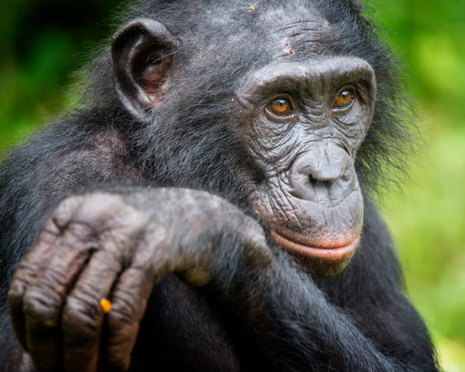
A new scientific study has placed bonobo pretend behaviour at the centre of debate about imagination and evolution. Researchers say controlled experiments now show that bonobo pretend understanding is not just anecdotal observation. The findings suggest that structured bonobo pretend responses can mirror early childhood make-believe patterns seen in humans. This research moves beyond scattered reports and introduces measurable results gathered under strict laboratory conditions. Scientists believe bonobo pretend ability may reshape how experts define imagination across species and evolutionary history today.
For decades, stories have circulated among primate researchers about apes appearing to interact with invisible objects. Some observers described behaviours that looked like dragging imaginary items or serving unseen food portions. However, critics often argued these actions could be learned routines rather than genuine imaginative engagement. A repeated movement might simply reflect past rewards instead of mental representation of something nonexistent. That uncertainty kept imaginative capacity largely classified as a uniquely human cognitive trait until now.

The new experiment focused on a well-known bonobo named Kanzi, who lived under close scientific observation. Kanzi was widely recognised for language comprehension and symbol-based communication skills developed through long research collaboration. Scientists designed a structured test environment to remove guesswork and reduce alternative behavioural explanations during trials. Their goal was to see whether responses showed true comprehension of imagined objects rather than habit. The bonobo pretend framework they built relied on repeatable scenarios and measurable choice outcomes.
Researchers first trained Kanzi to point toward cups that contained real juice as a reward exercise. This step ensured he understood the selection task and the value of choosing correctly each time. After consistent performance, the team changed conditions while keeping visible motions similar for experimental balance. They used an empty jug and visibly pretended to pour liquid into two transparent containers. One container was then “emptied” back into the jug through acted gestures without real liquid present.
Kanzi was then asked to indicate which cup still held juice after the staged pouring performance ended. Across fifty controlled trials, he selected the correct pretend full cup thirty-four times during testing. Statistical analysis showed that result exceeded what random guessing would normally produce in repeated selections. Importantly, researchers did not reward correct answers during these pretend trials with treats or juice. That control step reduced the chance that he followed subtle cues or learned reinforcement patterns.
Scientists added another variation to separate imagined contents from physically present liquid inside the containers. In this version, one cup held actual juice while the other remained empty at the start. Researchers again pretended to pour from an empty jug into the empty container using gestures alone. Kanzi then had to choose between visible reality and the acted scenario he just observed. He selected the genuinely filled cup in fourteen out of eighteen trials conducted under observation.
That outcome suggested he distinguished between bonobo pretend signals and real physical evidence available before him. The research team interpreted this as flexible cognition rather than blind response to human demonstration movements alone. A third experiment extended the concept further using an imaginary grape placed into one container. Kanzi correctly indicated the supposed grape location at rates again exceeding random probability expectations. Together, the three experiments formed a layered test of representation and symbolic scenario tracking ability.
The study authors say this is the first tightly controlled experimental proof involving ape understanding of pretence. Earlier claims depended mainly on informal reports, which left room for alternative behavioural interpretations and observer bias. Controlled repetition and removal of rewards strengthened confidence in the bonobo pretend interpretation drawn from results. The researchers argue this suggests imaginative representation predates modern humans within the evolutionary family tree. That conclusion could push back the timeline for pretend cognition by several million years.
Evolutionary comparison places the common ancestor of humans and bonobos between six and nine million years ago. If bonobo pretend capacity exists today, then its cognitive roots may stretch back to that shared lineage. Such a possibility challenges the long-held belief that imagination emerged only with later human brain development. It also raises new questions about how symbolic thought supports social survival among intelligent primates. Complex cooperation and communication may benefit from flexible mental modelling of unseen possibilities.
Independent experts reviewing the findings describe the work as careful, innovative, and methodologically important for comparative cognition science. They note that Kanzi’s upbringing included extensive human interaction and communication training over many years. That background means results cannot automatically represent every bonobo living in wild social environments today. Even so, specialists say the experiment provides a strong baseline for broader follow-up research across additional groups. Replication with differently raised apes will be the next critical scientific step forward.
Some researchers argue public surprise often reflects underestimation of great ape intelligence rather than unexpected data outcomes. Bonobos and chimpanzees already demonstrate planning, empathy, cooperation, and complex social negotiation in natural settings worldwide. From that perspective, bonobo pretend understanding may fit within an already rich cognitive capability spectrum. The gap between human and ape minds may be narrower and more gradual than once assumed. Each new controlled study helps replace speculation with measured comparison and clearer theoretical models.
There are still open questions about how apes internally experience these pretend scenarios during experimental interaction tasks. Scientists cannot directly access subjective mental imagery, so interpretation relies on consistent behavioural evidence patterns. Future studies may combine brain imaging tools with behavioural trials to deepen understanding of representation processes involved. Researchers also want to test younger apes to compare developmental timing with human childhood pretend play stages. Cross-species timelines could reveal whether imagination follows shared growth pathways across primate evolution.

The wider implication reaches beyond academic debate and touches how humans ethically view other intelligent species today. Demonstrating bonobo pretend competence strengthens arguments that non-human minds hold richer inner worlds than assumed before. That recognition may influence conservation messaging and welfare standards in captive and research environments globally. Understanding cognitive overlap can encourage more respectful policy and public engagement with great ape protection efforts. Scientific humility grows when evidence shows imagination is not exclusively a human mental domain.
As more laboratories repeat and extend these experiments, the discussion around animal imagination will likely intensify. Evidence-based approaches will determine whether bonobo pretend reasoning appears across individuals and social contexts consistently. What began as scattered stories about imaginary objects now enters the realm of measurable cognitive science. The boundary between human and ape imagination looks increasingly like a gradient rather than a wall. That shift could become one of the most important comparative psychology developments in recent years.
Related News:
 How Bringing Forests Into Preschools Boosts Children’s Health
 Virgin Trains Moves Closer to Challenging Eurostar Monopoly
 Biggest Supermoon of the Year to Dazzle Sky on Wednesday
 UK Bans Fake Numbers: Scammers Lose Their Trick
 England Curriculum Review Recommends Major Changes
 Vibe coding’ named Collins dictionary’s word of the year
 Experts Urge Legal Right to Timely Cancer Care
 Patients to Test Health at Home to Ease NHS Winter Pressure
 One of world’s last dinosaurs on sale for £3m
 North Sea oil workers must lose weight or face job loss
 No link found between paracetamol in pregnancy and autism
 Britain deploys RAF specialists to assist Belgium with drone threats
 Government urges schools to ban phones to curb classroom disruption
 NHS frontline staff forced to cover gaps as managers remain scarce
 Northern Lights May Illuminate UK Skies Amid Strong Solar Storm
 Night after night, Belgium is on high alert.
 Stop using ChatGPT to write speeches, AI minister tells MPs
 Northern Lights may illuminate UK skies this week
 New laws to bolster UK’s defences against cyber attacks on NHS, transport and energy
 UK Greenlights First Small Nuclear Plant in North Wales
 Hitler’s DNA Confirms He Truly Had Only One Testicle
 Working-Class Men with Prostate Cancer Left Behind by NHS
 Higgs Donates Nobel Medal to His Beloved University
 New AI tool could cut wasted efforts in organ transplants
 How Cultures Interpreted the Aurora Through History
 From War to Wales: Teen Innovator Eyes Net Zero Future
 From Baby Teeth to Bioengineering: The Future of Self-Healing Teeth
 Sundar Pichai Cautions on AI Hype and Market Risks
 Google Chief Urges Caution: Don’t Trust AI Blindly
 US Judge Says Meta Did Not Hold Illegal Social Media Monopoly
 Poll Reveals China Leads World in Trusting AI Technology
 Healthy Habits in Your 30s That Boost Life in Your 70s
 Raccoons Could Become America’s Next Pet
 Australia to Ban Social Media for Kids Under-16 Starting December
 Coffins Now Too Large to Cremate Amid Rising Obesity Crisis
 UK Taskforce Unveils Plan to Streamline Nuclear Reactor Rules
 Thinktank Urges Smaller Hospitals to End NHS ‘Permacrisis’
 NHS paediatric leave parents waiting months for answers
 Ofcom urges platforms to limit abuse and curb online ‘pile-ons’
 Extraordinary’ Object Found at Orkney Neolithic Site
 Asahi says 1.5 million customers’ data potentially leaked in cyber-attack
 Australians Angry as BOM Website Revamp Backfires
 AI Actress Creator Says Tilly Norwood Won’t Replace Actors
 YouTube Warns Kids Will Be Less Safe Under Australia Ban
 Starmer’s communications chief to outline media strategy overhaul
 TikTok Shop Emerges as a Gamechanger for UK Small Businesses
 UK Car Sales Pass 2 Million as Chinese Brands Surge
 AI Grok Sparks Child Safety Alarm in the UK
 Election Deepfakes Pilot Launched for Scottish and Welsh Votes
 Indonesia blocks Grok chatbot over sexual content risk
 Elon Musk warns of UK clampdown on X free speech
 Lammy and Vance unite against AI abuse images on X
 Google Removes Some AI Health Summaries Over Safety Concerns
 Nasa ISS Medical Evacuation: Crew-11 To Return Early
 UK Threatens Action Against X Over Sexualised AI Images
 US Clears Nvidia AI Chip Sales to China in Policy Shift
 Amazon Milton Keynes closure sparks concern for UK warehouse workforce
 Musk’s X Blocks Grok AI from Creating Sexualized Images
 BP’s Influence Sparks Controversy in UK STEM Education
 AI will transform human jobs, enhancing skills, says minister
 Astronomers Prepare for First-Ever Movie of a Black Hole
 MPs warn AI financial risks threaten UK stability
 MPs warn AI financial risks threaten UK stability
 The Influencer World Cup: Fifa’s TikTok Bet on a New Fan Era
 EU launches Grok AI probe into X over explicit images
 AI job losses UK: Britain faces sharper employment shock
 UK AI avatar firm Synthesia valuation jumps to $4bn
 Ryanair Eyes Starlink Despite Elon Musk Dispute
 ABC Facebook Page Briefly Hacked, Adult Photos Posted
 Pornhub blocks new UK users over age checks dispute
 Amazon mistakenly signals new global layoffs to employees
 US Robotaxis Train for London Streets Before Launch
 Genes May Hold the Secret to Long Life, Scientists Find
 AI breast screening cuts later cancer diagnoses by 12%, study finds
 UK Launches First Rapid-Charging Battery Train This Weekend
 AI News “Nutrition” Labels Proposed for Transparency
 UK New Car Discounts Near £6,000 as Prices Are Slashed
 Meta trial over child exploitation claims begins
 Autistic Girls Often Missed in Childhood Diagnoses, Study Finds
 Baby rhythm sense found in newborn brains