Published: 03 April 2026. The English Chronicle Desk. The English Chronicle Online.
The landscape of modern education is shifting rapidly under the influence of new digital tools. Recent findings suggest that secondary school pupils in England are facing a significant intellectual crisis. A comprehensive survey of teachers indicates that artificial intelligence is dampening the spark of critical thought. Many educators believe that students no longer feel the need to engage with complex problems. This trend is causing a visible decline in the essential skills required for future success. The National Education Union gathered views from thousands of state school staff across the country. Their reports paint a worrying picture of classrooms where technology often replaces genuine human effort. Two-thirds of respondents have noticed a sharp drop in the cognitive abilities of their pupils. This decline is not limited to one subject but spans across the entire academic spectrum. Teachers fear that the very essence of learning is being traded for quick digital answers.
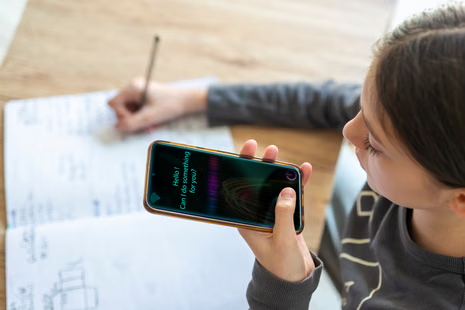
One primary concern highlighted by the study involves the basic mechanics of language and literacy. Children are increasingly moving away from traditional spelling and writing due to voice-to-text software applications. This technology allows them to bypass the fundamental process of learning how words are constructed. Some educators warn that students are losing the ability to hold a meaningful human conversation. The reliance on automated tools seems to be stripping away the necessity for personal creativity. Many teachers expressed their deep frustration during the annual union conference held earlier this week. They argued that problem-solving and collaborative effort are being sidelined by convenient algorithms and bots. One anonymous contributor noted that the joy of discovery is being lost to instant results. Learning is supposed to be a journey of trial, error, and personal intellectual growth. Instead, it is becoming a hollow exercise in managing prompts and generating artificial responses.

The government maintains a very different perspective on the integration of technology in British schools. Ministers have called for a digital revolution to modernize the way children receive their education. Earlier this year, they announced an ambitious plan to roll out sophisticated artificial intelligence tutors. These tools are intended to provide one-to-one support for nearly half a million disadvantaged pupils. Education Secretary Bridget Phillipson believes this initiative will finally level the playing field for all. She argued that tailored support should not be a privilege reserved for the wealthy few. In her view, AI has the power to transform access to high-quality academic guidance. The government hopes that these digital assistants will help every child to achieve their potential. They see technology as a bridge that can close the gap between different social backgrounds. However, this vision is meeting stiff resistance from the people working on the front lines.
The survey of nine thousand teachers revealed a deep chasm between policy and classroom reality. Nearly half of the respondents stated they are firmly opposed to the government’s tutor plan. Only a small fraction of the workforce believes that AI tutors are a good idea. Many worry that these machines will be used primarily as a way to cut costs. There is a fear that the professional value of human teaching is being slowly undermined. Educators argue that struggling students often need far more than just simple academic instructions. They require the emotional intelligence and the nuanced understanding that only a human can provide. An AI tutor cannot recognize when a child is feeling discouraged or mentally overwhelmed. It lacks the ability to build the social bonds that are vital for healthy development. Critics suggest that replacing people with software might lead to increased feelings of social isolation.
Despite these heavy criticisms, the relationship between teachers and technology remains quite complex and nuanced. While they worry about their pupils, many staff members are using AI for themselves daily. Usage has jumped significantly over the past year as workloads continue to grow quite heavy. Over three-quarters of teachers now rely on digital tools to manage their professional responsibilities. They use these systems to create teaching resources and to plan their weekly lesson schedules. Administrative tasks are also being streamlined through the use of various clever automation software programs. Interestingly, only a tiny percentage of teachers are using these tools for marking student work. This suggests a lingering desire to maintain a human touch in the assessment process itself. There is a clear tension between practical utility and the preservation of academic integrity. Teachers are caught between saving time and protecting the quality of the educational experience.
The lack of clear guidance and formal regulation is another major point of deep concern. Roughly half of the schools in England currently operate without any formal AI usage policies. This regulatory vacuum leaves both staff and students in a very difficult and confusing position. Without clear rules, the risk of academic dishonesty and cheating continues to grow much higher. Some teachers reported that the lack of training leads to the production of poor work. They described some of the AI-generated content being used in classrooms as simple, sub-standard slop. There is a desperate call for better training so that everyone understands these powerful tools. Proper regulation could help turn AI into a valuable asset rather than a destructive force. Educators want to see a framework that prioritizes safety, ethics, and genuine intellectual rigor. Without such a structure, the classroom environment risks becoming a chaotic digital wild west.

National Education Union General Secretary Daniel Kebede has been vocal about these emerging systemic risks. He insists that the core of learning must always be the ability to think independently. His members are far from convinced that digital tutors are a magic bullet for success. He warned that the government is taking a massive gamble with the lives of children. Rolling out unproven technology before understanding its long-term impact could be a very grave mistake. The union believes that the focus should remain on hiring more qualified human teaching staff. They argue that the government is distracted by shiny new gadgets instead of fixing basics. Investment should go into reducing class sizes and improving the physical state of school buildings. The human element of teaching is what inspires the next generation of great British thinkers. Technology should be a servant to the teacher rather than a replacement for them.
A government spokesperson responded to these concerns by reaffirming their commitment to the new digital mission. They argued that AI is essential for preparing children for a modern and connected world. The goal is to break the link between a child’s background and their eventual success. They insisted that technology will not replace the foundations of core knowledge and disciplinary thinking. Instead, it is meant to supplement the work of teachers and provide extra help. The official plan emphasizes that AI must be used safely, critically, and very responsibly. Ministers believe that avoiding this technology would leave British students behind their international peers globally. They are determined to ensure that every young person can thrive in a digital economy. The debate continues to rage between those who see progress and those who see loss. Balancing innovation with traditional values remains the greatest challenge for the modern British education system.
Related News:
 Six-Figure Tutors Teach Toddlers to ‘Be British’
 How Bringing Forests Into Preschools Boosts Children’s Health
 Is a two-week half-term a good deal? Some parents in England aren’t so sure
 Posthumous books are messy and fraught – but Virginia Giuffre’s gives her a voice
 Children to Learn Local History in Major Curriculum Overhaul
 UK University Suspends Human Rights Research Following Pressure from China
 UK University Faces Counter-Terror Probe Over China Pressure
 Top Christmas Books Reads: Classics to Cozy Romcoms
 Greta Thunberg Backs Student Facing UK Visa Revocation
 Audio Books deals and promo codes to explore in November 2025
China-critical UK academics face ‘extremely heavy’ pressure from Beijing
Audio Books deals and promo codes to explore in November 2025
China-critical UK academics face ‘extremely heavy’ pressure from Beijing
 Labour immigration crackdown could cost UK £4.4bn
 London’s Childlessness Crisis: Schools Closing as Families Shrink
 No link found between paracetamol in pregnancy and autism
 Government urges schools to ban phones to curb classroom disruption
 Nigeria’s $25m Museum Faces Political Storm Amid Benin Bronzes Debate
 Algeria Pardons French-Algerian Novelist Sansal After Year in Jail
 Phillipson Accused of Appeasing Unions by Diluting EBacc
 ‘I’ve Read 38 Books, but This Is My Standout Favourite’
 England’s Special Needs Support Faces Breaking Point
 Nigerian Education Reversal: Mother-Tongue Teaching Scrapped
 Higgs Donates Nobel Medal to His Beloved University
 UK Schools Face Staff Exodus Amid Wellbeing Crash
 Ex-Harvard President Pauses Teaching Over Epstein Emails
 Scottish Families Take Legal Action Over School CO Leak
 Men Aren’t Vanishing From Fiction, But Misconceptions Persist
 Schools urged to trial four-day week to ease pressure on teachers in England and Wales
 Oxford Names ‘Rage Bait’ Word of the Year
 Cambridge College Faces Backlash Over Private School Recruitment
 Glasgow rector cleared by watchdog in antisemitism case
 Pressure mounts on No 10 over under-16s social media ban
 Jewish MP school visit cancelled after Bristol campaign pressure
 UK Launches First Town of Culture Competition
 Guildford resignation sparks public trust debate in West Midlands
 UK Ministers Drop Foreign Student Targets for Global Education Push
 City & Guilds pay surge sparks backlash amid £22m cuts
 School Suspensions Now Reserved for Only Severe Misbehaviour
 Cambridge Faces Scrutiny Over Arms Investment Transparency
 Harvey Willgoose School Stabbing Red Flags Missed
 Kingsbury stabbing probe led by counter-terror police
 Send spending gap leaves deprived areas behind
 Councils Urge Means Testing for Send School Transport
 NSW to Introduce Minimum Age for Ebike Riders
 Student Loan Crisis Sparks Outrage Among Graduates in England
 Larry Summers Resigns From Harvard Amid Epstein Files
 New Era for UK Special Needs Support
 London Pupils Warned Against ‘School Wars’ Posts
 Adelaide University Faces Backlash Over Event Cancellation
 New Survey Reveals Troubling Rise in Campus Antisemitism
 UK Parents Voice Concerns Over Special Education Support
 Sydney Teacher Arrested in Teenage Grooming Investigation
 Keir Starmer Vows Strong Action Against Online Tech Giants
 Exhibition Revisits Life of 18th-Century Black Court Figure
 Student Loan Interest May Rise Despite 6% Cap
 School Plate Revolution: England Bans Fried Menu Classics
 City & Guilds Sale Sparks Fees and Pay Uproar
 Canadian astronaut French words ease language row
 UK Universities Face Fines for Speech Failures
 NHS Safety Fears as Nurses Cover Doctor Gaps
 Elite School Teacher Claims Misogynistic Culture Fuels Abuse
 Ability Grouping Boosts High-Flyers Without Harming Others
 Older Than Dinosaurs: Secrets of Mayfly Dance Revealed
 Teacher Alleges Misogyny at Elite School
 Germany to Return Rare Irritator Dinosaur Skull to Brazil
 London Schools Harness VR to Tackle Pupil Stress
 Schools Urged to Remove Pupil Photos as AI Threats Rise
 Tractor Breakdown Tests Lincolnshire Farmers
 Cambridge University in Talks With Saudi Ministry
 Victoria Labor Launches Apprenticeship Expansion Plan
 Gen Z Graduates Face Economic Uncertainty
 Public Confidence in University Degrees Plummets in the UK
 Is a University Degree Still Worth the Cost?
 Ban the Smack: New Study Links Hitting to Poor Grades
 The Hybrid School Revolution Defying the Social Media Ban
 Systemic Failure: White Working-Class Pupils Left Behind
 School Bosses Face Strict Pay Cap
 UK Schools Struggle as Classrooms Top 40C
 Brisbane School Stabbing Leaves Teenager Critical
 Pradhan Resigns Amid Protests
 Cambridge Professor Jason Arday Found Dead at Home