Published: 26 May 2026. The English Chronicle Desk. The English Chronicle Online.
A spectacular ancient wonderland hidden inside a deep valley offers a stunning glimpse into history. The roaring West Okement River flows gracefully along the floor of this majestic, steep-sided valley. Here, a magical oasis of woodland suddenly emerges from a bare and heavily grazed landscape. The extraordinary trees look squat and tightly clustered together in this beautiful, isolated sanctuary. Their ancient root systems are heavily covered in a thick blanket of green lichens and mosses. These historic oak trees form the breathtaking Black-a-Tor copse, a truly remarkable natural treasure.
This tiny surviving pocket represents a rare fragment of European temperate rainforest from the bronze age. Today, this beautiful seventy-two acre copse provides an invaluable insight into our ancient natural history. Experts believe similar magnificent oak woodlands once covered about one-fifth of the entire British Isles. Sadly, most of these prehistoric forests have vanished completely over many centuries of human development. The precious remnants that still survive across the United Kingdom face a very precarious future. Extensive livestock grazing over many decades has severely affected the health of these delicate ecosystems.
Black-a-Tor copse is one of just three remaining rainforest pockets left on Dartmoor today. These magical places only survived because granite boulders and spiky gorse offered vital natural protection. Without these rugged physical barriers, the ravenous livestock would have destroyed the trees long ago. Now, passionate environmental campaigners are demanding urgent action to protect and expand these unique habitats. The dedicated members of the Dartmoor Nature Alliance are leading this inspiring new conservation movement. They are publicly calling for the temperate rainforest across the national park to double in size.
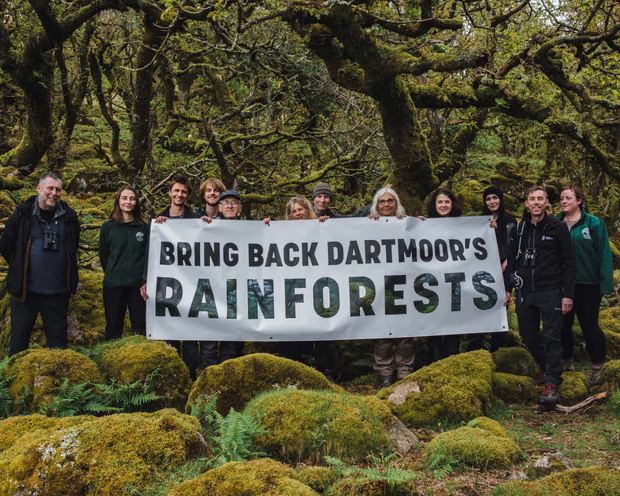
The enthusiastic campaigners recently gathered at the historic copse to unfurl a massive promotional banner. Their emotional plea for environmental action quickly received a very positive response from land managers. The prestigious Duchy of Cornwall owns about one-third of this vast, historic national park. Representatives from the royal estate promptly announced an ambitious new commitment to ecological restoration. They officially promise to double the size of Black-a-Tor copse within the next fifteen years. This exciting plan also includes another famous temperate rainforest pocket known beautifully as Wistman’s Wood.
The estate intends to achieve these highly ambitious environmental targets by the early 2040s. Emma Magee serves as the dedicated head of communities and nature for the royal estate. She stated that the pace of commitment from their partners is increasing very rapidly. The organization warmly welcomes the great focus this brilliant campaign brings to these rare habitats. These unique, beautiful, and ecologically important landscapes definitely deserve the highest level of environmental protection. This significant conservation announcement coincides with a major new funding package from the central government.
Ministers have promised thirty million pounds of ringfenced funding for vital habitat restoration projects. This generous financial support will help create wildlife-rich habitats across many beautiful English landscapes. The funding stretches from the rugged hills of Dartmoor to the majestic Lake District lakes. Farmers can access these substantial grants through the innovative farming in protected landscapes fund. A large portion of this money is specifically designated for ancient woodland restoration schemes. Temperate rainforest remains one of the rarest and most threatened habitats on our entire planet.
Surviving fragments are found in western Scotland, Cornwall, Devon, Wales, and parts of beautiful Cumbria. Unfortunately, most of these isolated rainforest pockets are currently in a very poor state. The Dartmoor Nature Alliance was formed recently to give nature a strong, clear voice. Lisa Schneidau is a prominent spokesperson for this passionate and highly active environmental group. She explains that these magnificent woodlands form a vital part of our shared cultural heritage. They represent some of the absolute best examples of temperate rainforest in all of Europe.
Despite their international ecological importance, these woodlands are not in a healthy or sustainable condition. To extend and regenerate these forests, we must exclude grazing animals from vulnerable areas. Many of these ancient sites are literally dying on their roots due to livestock. Campaigners emphasize that they are not asking for a huge amount of agricultural land. Instead, they view this project as a beautiful, symbolic gesture towards our natural world. We could easily welcome more woodland along steep valleys that are unsuitable for farming.
These marginal valley areas are not particularly good for traditional livestock grazing anyway, she adds. Above the historic copse, near the steep valley top, protective measures are already working. Experts are actively attempting to protect tiny emerging oak trees from hungry roaming animals. Staff from Natural England have carefully installed sturdy metal cactus guards around young tree stumps. These clever metal cages successfully protect the delicate young saplings from destructive sheep and cattle. The campaigners sincerely hope this marks the beginning of a magnificent turning point for nature.
This clever intervention provides a wonderful moment of genuine hope for rainforest regeneration across Devon. Interestingly, the seeds of this future forest are coming directly from the ancient trees. Some of these magnificent, twisted oaks are thought to be several hundred years old. Last autumn, volunteers from the Moor Trees charity collected eight hundred precious local acorns. These harvested acorns are currently growing safely inside the specialized nurseries of the charity. They will be ready for planting at the copse when they become strong saplings.
Helen Aldis serves as the hardworking and inspirational chief executive of the Moor Trees charity. She states that land management practices on the moor greatly impact natural forest regeneration. Her dedicated team is acutely aware of the many challenges facing these precious woodland habitats. They have already carried out similar delicate tree planting work at nearby Wistman’s Wood. Volunteers successfully planted twelve hundred young native saplings there over the last two years. A recent official report from Natural England strongly underlined these serious environmental grazing concerns.
The detailed report clearly stated that livestock browsing suppresses the recruitment of young woodland trees. It concluded that the logical arguments for increasing woodland cover at Black-a-Tor seem absolutely conclusive. However, about two hundred local farmers hold ancient common grazing rights across the wide moor. These traditional agricultural workers, known as commoners, must be part of the final solution. The historic Black-a-Tor copse is currently unfenced and sits between two large commons. Grazing rights in this specific area belong entirely to the traditional Okehampton commoners group.
The Dartmoor Commoners’ Council was approached for a formal comment regarding these new proposals. However, the official administrative body has not provided a response at the time of publication. Renowned author Guy Shrubsole has previously written extensively about these spectacular, forgotten British rainforests. His popular book helped stimulate public interest and inspired this wave of positive environmental action. He warmly welcomed the generous new restoration announcement from the historic Duchy of Cornwall estate. However, he believes we still need a major upping of ambition for rainforest restoration.
The wider campaign wants to see a doubling of rainforest across all Dartmoor commons. This ambitious goal requires significantly more natural regeneration and active tree planting in bare areas. We must restore trees to places where woodland cover has completely disappeared over time. Back at the beautiful copse, Tony Whitehead of the alliance points toward the ground. He highlights tiny oak saplings emerging naturally at the very edges of the wood. This natural growth proves that the valley still provides an optimal habitat for trees.
The emerging saplings provide a wonderful sign of the genuine optimism he now feels inside. The ancient woodland is just waiting patiently for us to help it expand, he says. It has been waiting for a very long time for humans to back off. We simply need to reduce grazing pressure and allow these amazing forests to return. With proper care, these unique rainforests will successfully come back to life for future generations.
Related News:
 Norfolk Coastal Graves at Risk as Erosion Deepens Family Anguish
 Winter plant bloom signals climate breakdown in UK
 Dog Food Emissions: 1% of UK Greenhouse Gas Revealed
 Storm Goretti leaves Cornwall homes without power
 Kent Residents Continue Facing Water Supply Disruptions
 Water firms may avoid fines under UK water reform plan
 No Gas Boiler Ban as UK Warm Homes Plan Backs Heat Pumps
 Judi Dench Champions Fight to Save London’s Green Spaces
 UK joins North Sea wind grid pact with nine European nations
 Devon hosts first high-density hydro power system
 Storm Chandra floods Somerset, triggers major incident declaration
 Storm Chandra flooding leaves England on high alert
 UK Pfas Action Plan Faces Criticism From Environmentalists
 Wigan Dump Crisis Sparks Health and Safety Alarm
 Fish disco plan could save 90% of fish at Hinkley C
 Flood risk homes surge across England builds
 Deer Shooting England: New Plan to Protect Woods
 Illegal Waste Dumping: New Drone Unit Launched
 Group Expands Legal Claim Over South West Water Pollution
 Scotland’s Climate Plans Face Scrutiny Over ‘Science Fiction’ Targets
 Wood burner legal threats spark council row
 South East Water Fined £22.5m for Repeated Supply Failures
 Yorkshire Water Funding Sparks Debate Amid Fines and Pay Row
 Net Zero Cheaper Than One Fossil Fuel Crisis, UK Told
 Welsh Water Faces £44.7m Enforcement Over Sewage Breaches
 London Considers New SUV Charges to Improve Road Safety
 New £10bn rescue plan offered for Thames Water
 MPs Slam Agency Over Failing Fight Against Waste Dumping
 RNLI Beach Rescues Surge as Coastal Popularity Hits New High
 UK Records Earliest Spring as Nature Awakens Fast
 RSPB Urges Summer Bird Feeder Removal to Curb Disease
 Britain Facing Sharp Decline in Rare Butterfly Species
 Toxic ‘Forever Chemicals’ Threaten Southern English Coast
 Toxic Flea Treatments Devastating UK Rivers and Wildlife
 UK Faces Mass Water Shortages by 2055, Lords Warn
 Outrage in Surrey as Vital Nesting Colony of Endangered Swifts is Entirely Demolished
 The Hidden Cost of Our Oceans
 Whitehall Steps In: The Battle Over Thames Water Deepens
 UK Seas Face Extreme Heatwave as Global Temperatures Surge
 UK Pets Face Heatstroke Risks Even While Resting Indoors
 New Debt Limits Proposed for England’s Water Sector
 South East Water Faces £30.5m Penalty for Supply Failures
 Three-Quarters of England’s Riverbanks Still Off Limits
 Reeves Faces Setback as Labour May Miss Homes Target
 Kate Winslet to Narrate Film Highlighting King’s Environmental Mission
 Trump’s UK Ambassador Urges North Sea Drilling to Strengthen US Ties
 UK Bans Fake Numbers: Scammers Lose Their Trick
 Millionaires group urge Reeves to introduce wealth tax to ‘lift kids out of poverty’
 Reeves rejects £1bn plea for NHS redundancy payouts
 PM Condemns Leaks, Vows Loyalty to Ministers and Stability
 Inside the Helpline Protecting Missing Children in the UK
 PlayStation PS5 Deals Hit Lowest Prices Ahead of Black Friday
 Five-Year-Old Dies After Rare Tonsil Surgery Complication
 Starmer Says Labour’s Economic Plan Needs Years to Deliver
 ‘Extinct’ Antelope Returns to Sahara, Bringing Hope
 Starmer Faces Parliamentary Battles Over UK-EU ‘Reset’ Plan
 Met Police Vetting Failures Let Serial Rapists Remain
 Fatal Bolton Taxi Crash Claims Three Teens and Driver
 ScottishPower Tops List of Worst UK Energy Suppliers
 Crowborough Camp Welcomes First Asylum Seekers
 UK Government Poised to Revive Stalled Hillsborough Law
 Home Office Faces Legal Risks Over Asylum Hotel Living
 Crisis in NHS Surgery Scheduling Hits Patients Hard
 Blue Badge Abuse: The Rising Tide of Public Hostility
 Scott Parker Leaves Burnley After Premier League Drop
 Silent Tracks: Rail Line Without Passengers
 RFU Backs Borthwick Despite England’s Poor Six Nations
 Major test for Labour as polls open in Great Britain
 Keir Starmer Struggles to Secure His Grip on Downing Street
 Farage Faces Standards Probe Over Cash Property Purchase
 Closing the Gap: UK Pensions Commission Demands Action
Russian Electronic Attack Targets UK Defence Chief Jet
Closing the Gap: UK Pensions Commission Demands Action
Russian Electronic Attack Targets UK Defence Chief Jet
 UK Shoppers Face Prolonged Price Rises At Tills
 Tube Strike Brings Capital to a Standstill Over Shift Disputes
 Teaching Machines Right From Wrong in the Digital Age
 The Hidden Crisis Eroding Trust in British Communities
 Stolen Mobiles Could Soon Become Useless Bricks
 Clean Air Initiatives Spark Major Fall in London Hospital Admissions
 UK Care Crisis: Row Explodes Over New Visa Settlement Rules
 Sainsbury’s Boss Optimistic As Grocery Inflation Eases