Published: 26 May 2026. The English Chronicle Desk. The English Chronicle Online.
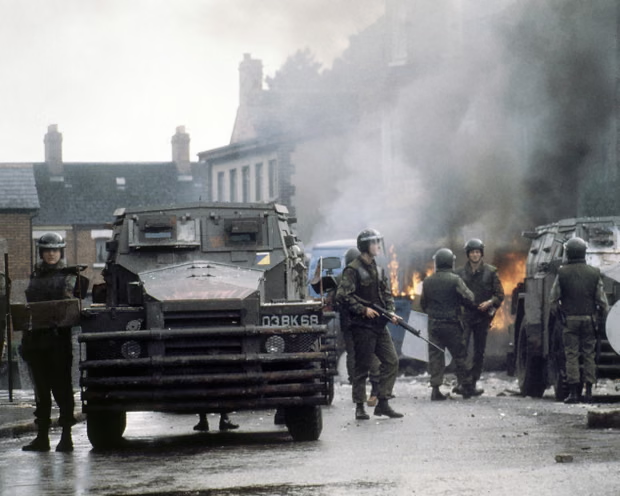
The British security services played a central role in designing the deeply controversial Northern Ireland Legacy Act. This legislation offered conditional amnesty to former soldiers and paramilitaries involved in the decades of the Troubles. Recent disclosures show that MI5 and senior policing figures were active inside a secret policymaking group. This group carefully shaped the legal framework that protected state actors from future criminal prosecution. The revelation has sparked fresh anger among victims’ groups who long suspected backroom government interference. Many families believe the state deliberately shielded its own agents from accountability for historic killings.
An investigation by the Belfast-based newsletter the Detail originally uncovered these highly sensitive documents. The findings were subsequently shared with the Guardian newspaper and verified through independent news channels. The 2023 act faced universal opposition from every major political party in Northern Ireland. Despite this broad political consensus, the previous government pushed the legislation through Westminster anyway. The current administration recently voted to remove the immunity clause after intense public pressure. However, these new documents expose the deep influence of the state security apparatus.
Daniel Holder is the deputy director of the Committee on the Administration of Justice. He fought a grueling eight-month battle under freedom of information laws to secure them. Government officials initially rebuffed his requests to protect the confidentiality of the working group. The released files were clearly marked as official secrets before their eventual public disclosure. Holder stated that the legacy investigations senior working group operated entirely behind closed doors. Its main purpose was to assist Boris Johnson’s government in drafting the legislation.
Legal duties require the government to ensure effective and independent investigations into historic deaths. These legal obligations must naturally include cases where state security forces used lethal force. Instead, the group tasked with advising on policy heavily involved policing and intelligence figures. This composition directly undermined the perceived independence of the entire policy development process. The revelation reinforces long-held public suspicions about the true origins of the Legacy Act. Critics always believed that policing services designed the act to protect their own history.
The secret meetings also led to the creation of a new investigative body. The Independent Commission for Reconciliation and Information Recovery was established to handle outstanding cases. This body replaced the previous Historical Enquiries Team, which folded over a decade ago. The older team was disbanded after failing to properly investigate killings by the state. Holder noted that the new act abruptly shut down hundreds of existing legacy cases. These cases were transferred to the new commission, which has yet to complete one.
The secret working group was first established in the summer of twenty-twenty. Its membership included several highly influential figures from the UK national security establishment. Former Police Service of Northern Ireland Chief Constable George Hamilton was a key participant. Madeleine Alessandri also attended the meetings in her capacity as deputy national security adviser. She was later appointed as the permanent secretary for the Northern Ireland Office. Chloe Squires attended the meetings while serving as director of national security house.
The remaining participants either worked directly for or had close ties to state agencies. This heavy concentration of security personnel has drawn sharp criticism from human rights organizations. Official minutes from one meeting recorded Hamilton making controversial remarks about the victims’ families. He reportedly stated that most families would warmly welcome a process focused on information. Hamilton suggested that only a small vocal minority would present challenges to the plan. He claimed this minority did not speak for a silent majority wanting progress.
These comments provoked a furious reaction from representatives of the victims’ families. Mark Thompson speaks for Relatives for Justice, an organization supporting hundreds of bereaved families. He rejected the description of these families as a small and vocal minority. Over eleven hundred civil cases were active when the legislation was introduced to parliament. Thompson emphasized that these families are seeking basic answers about murder and state torture. He argued that the participants in the group represented the very agencies under investigation.
Independent investigators would subject these state agencies to robust accountability under a fair process. The documents also contained a list of suggested talking points for the chairperson. These talking points underlined the government’s desire to conclude all outstanding investigations quickly. Officials aimed to resolve thirty-five hundred deaths within a strict two-year time limit. The documents openly acknowledged that this timeframe was incredibly ambitious for complex murder cases.
A key component of the policy package was introducing a firm legal bar. This legal bar prevented any further criminal investigations or prosecutions of military veterans. The government viewed this mechanism as a way to provide certainty to former soldiers. They also argued it would unlock further information recovery opportunities from reluctant witnesses. The released files show the secret senior working group met at least twice. These meetings took place on nineteen June and twenty July in twenty-twenty.
The files indicated a third meeting was scheduled for later that same year. No further information has been disclosed regarding whether that third meeting actually occurred. A government source later indicated to reporters that the meeting did not take place. Holder explained that the existence of the group was only revealed by accident. The former police chief constable Simon Byrne mentioned it during a Westminster committee hearing. Byrne declined to join the group to preserve the impartiality of his police force.
A spokesperson for the Northern Ireland Office downplayed the significance of the documents. The spokesperson stated that the group was established by the previous government administration. They emphasized that the current government is actively repealing and replacing the controversial act. George Hamilton also responded to the publication of the secret meeting minutes recently. He noted that his sight of the minutes came six years after. Consequently, he could not confirm if his comments were accurately recorded by officials.
Hamilton stated his agreement to join the group was intended to share lessons. He wanted to ensure that previous mistakes in legacy investigations were not repeated. He claimed he emphasized placing victims and families at the center of information recovery. Hamilton also argued that the published excerpts were highly selective and out of context. Despite his explanations, the disclosure has renewed intense debate over state collusion and justice. The legacy of the Troubles continues to cast a long shadow over politics.
Related News:
 Green Party Surges Past Labour in Latest UK Poll
 Trump’s UK Ambassador Urges North Sea Drilling to Strengthen US Ties
 French Taxi Driver Cleared in David Lammy Theft Case After Fare Dispute
 Millionaires group urge Reeves to introduce wealth tax to ‘lift kids out of poverty’
 Starmer Faces Growing Dissent as Labour MPs Weigh Leadership Challenge
 Reeves rejects £1bn plea for NHS redundancy payouts
 PM Condemns Leaks, Vows Loyalty to Ministers and Stability
 Major Rent Reform Ends No-Fault Evictions in England
 Peers Flood Assisted Dying Bill with 942 Amendments
 Most Tories Expect to Support a Farage-Led Government
 Labour MP claims devolution bill is ‘blatant discrimination’ against Cornwall
 Millions Face Higher Taxes Under Reeves New Budget
 Starmer Says Labour’s Economic Plan Needs Years to Deliver
 Culture secretary to review Telegraph takeover by Daily Mail owner
 UK Government Borrowing Drops to £11.6bn in December
 Labour Blocks Burnham as Party Rift Deepens Ahead of Polls
 Andy Burnham and the Labour Rift Over Power and Leadership
 Huge mistake: Labour blocks Burnham from byelection bid
 Artificial intelligence will cost jobs, admits Liz Kendall
 Labour targets Greens on drugs in Gorton Denton byelection
 Greens nominate Hannah Spencer for Gorton and Denton byelection
 Mandelson Faces Police Inquiry Over Epstein Leak
 Starmer Condemns ‘Depraved’ Russian Strikes on Ukraine
 Labour Thinktank Row Deepens Over Journalist Probe Claims
 Morgan McSweeney downfall shocks Labour leadership
 Labour Lord Doyle Apologises Over Paedophile Ties in Political Storm
 Cabinet Secretary Shake-Up Triggers Due Diligence Warning
 Starmer Faces Inquiry Calls Over Thinktank Probe
 Royal Mail Delivery Crisis Deepens Amid Weather Chaos
 UK shelves £110m border project amid trade strain
 Farage Unveils Reform UK Frontbench Team
 California Democrats Vow Trump Reckoning
 Trump Tariffs Threat Spark UK and EU Alarm
 Wales Approves Assisted Dying Bill Consent
 UK EU Trade Reset Gains Public Backing
 Your Party leadership fight nears dramatic end
 NHS Maternity Units Cover Up Harmful Childbirth Errors
 Green Party Stuns Labour in Gorton and Denton Byelection
 Corbyn Leads Your Party in Coordinated Left-Flank Strategy
 Labour Together scandal sparks clean break vow
 Asylum Seekers to Work After Year-Long Wait
 Starmer Row as Greens Demand Apology
 Proposed Law Leaves Gap for Children of Convicted Paedophiles
 Gordon Brown urges court for crimes against children
 Starmer Praised for Stance on Trump and Iran Conflict
 Inquiry into HMRC child benefit errors launched by NAO
 NHS Plans to Cut Overseas Workers Labeled Overambitious
 Farage Faces Backlash Over Crypto Cameo Endorsements
 Family Court Reform Promises New Era for UK Families
 Army Probes Apache Flyover at Kid Rock’s Nashville Estate
 Relationship with Trump may be beyond repair, Starmer warned
 Unions Raise Concerns Over Doctors’ Pay Dispute
 UK Government Poised to Revive Stalled Hillsborough Law
 UK Stands Firm on Falklands Amid US Rift
 Welsh Labour Faces Potential Historic Election Defeat
 Starmer Survives Mandelson Rebellion
 Silent Tracks: Rail Line Without Passengers
 Major test for Labour as polls open in Great Britain
 Labour Members Doubt Starmer Future as Burnham Leads Poll
 Reform UK Faces Crisis as Newly Elected Councillors Resign
 Farage Faces New Questions Over Private Helicopter Use
 Keir Starmer Struggles to Secure His Grip on Downing Street
 Farage Faces Standards Probe Over Cash Property Purchase
 Green Party Makerfield Candidate Resigns Over Posts
 Starmer Leadership Under Pressure After Setbacks
 The Hidden Crisis Eroding Trust in British Communities
 Deepfake Abuse on X Sparks Safety Concerns for Dissidents
 Modernising the Military: Carns Demands Urgent Procurement Reform
 UK Ministers Lobby Trump Over Under-16s Social Media Ban
 Starmer Resolves to Fight Burnham in Leadership Battle
 Starmer Resigns as Prime Minister Amid Internal Pressure
 MP Warning: Northern Rail Risks Repeating HS2 Failures
 Hollie Ridley to Step Down as Labour General Secretary
 New South Wales Premier Chris Minns Signals Tough Road Ahead for Labor
 Jarvis Urges Burnham to Secure 3.5% Defence Spending
 Farage Warns Sky News Following Financial Inquiry
 Reform UK Finances Face Deep NCA Probe
 Ann Widdecombe, Formidable Political Figure, Dies at 78
 Treasury Reform Urged After Tragic Loss
 Sadiq Khan Backs Call for Maximum UK Work Heat Limit