Published: 30 April 2026. The English Chronicle Desk. The English Chronicle Online.
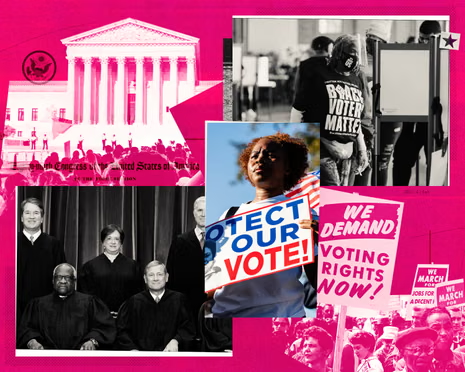
The recent ruling from the US Supreme Court has effectively dismantled the remaining pillars of the historic 1965 Voting Rights Act. This decision marks the final chapter in a long campaign led by Chief Justice John Roberts and Justice Samuel Alito. These two titans of the conservative wing have worked in tandem to roll back landmark civil rights legislation. The ruling in Louisiana v Callais is the fifth major decision authored by these justices to limit minority protections. This steady erosion of democratic rights has targeted the core of American voting equality over many years. Many experts view this as the end of an era for federal oversight in Southern states. The court’s rightwing majority has finally achieved a goal decades in the making through very strategic legal shifts.
The attack on Section 2 of the Voting Rights Act removes a tool used for forty long years. This provision previously prevented Republican-led states from diluting the political power of Black and minority voters during redistricting. Louisiana recently attempted to create a second electoral district to reflect its population which is one-third Black. The conservative majority however labeled this effort as a form of unconstitutional racial gerrymandering in their ruling. This 6-3 decision along ideological lines has completely overturned the original intent of the 1965 federal statute. Paradoxically the court used the equal protection clause to justify a move that limits minority representation in government. This clause was originally designed by the authors of the constitution to protect vulnerable and marginalized citizens.

Lisa Graves of True North Research notes that this hostility toward the act started very early in their careers. Both Roberts and Alito have been aligned on this specific destination for several decades of legal service. Justice Elena Kagan highlighted this persistent focus in a very powerful and pointed dissenting opinion this week. She noted that the Roberts court has had its sights set on the act for over ten years. The process began in 2013 with a ruling that ended federal oversight of electoral changes in the South. Since that time the conservative majority has further weakened a statute once considered a crown jewel of democracy. Kagan now mournfully refers to the Voting Rights Act in the past tense during her legal writings.
The shared history of Roberts and Alito stretches back to their time as young Reagan era revolutionaries. They both held senior positions within the Department of Justice during the transformative decade of the 1980s. Alito became focused on electoral maps while studying at Princeton and reading the works of conservative legal scholars. He developed a fierce opposition to ensuring equity in the distribution of political power across the states. This animosity hardened as he moved through the federal court system and eventually reached the highest bench. In 2018 he authored a ruling making it harder to prove instances of unlawful racial gerrymandering. Three years later he further weakened the act by making it difficult to challenge restrictive voting laws.
By 2024 Alito argued that state legislatures should be shown great deference in cases regarding minority representation. He claimed that shifting thousands of Black residents into new districts could be viewed as party political moves. This interpretation allowed states to claim partisan goals while effectively diluting the power of minority voting blocs. Alito recently argued that considering race as a remedy for past discrimination is itself a form of discrimination. This logic turns the 14th Amendment on its head by using civil war protections to shield white voters. He calls himself a practical originalist which critics say allows him to choose results that fit his ideology. This flexibility has allowed the court to ignore the historical context of racism in the American South.
Justice Kagan remains entirely unconvinced by the reassurances offered by the conservative majority in their latest written opinion. She warns that minority voters are now left virtually unprotected from the actions of many state lawmakers. Representation in government institutions is expected to decline sharply as more states follow the lead of Louisiana. While Alito authored the most recent ruling the fingerprints of Chief Justice Roberts are found everywhere. Roberts has harbored a deep animus toward voting rights legislation since his days in the Reagan administration. In 1981 he wrote twenty-five memos arguing that discriminatory outcomes were not enough to invalidate electoral maps. He insisted that lawyers must prove a specific discriminatory intent which is a very difficult legal standard.

Roberts has played a very long and patient game to see his early legal theories become law. Senator Ted Kennedy once warned during confirmation hearings that Roberts was trying to undo vital national progress. The Chief Justice famously argued in 2013 that the country had changed enough to end federal oversight. Ruth Bader Ginsburg countered that removing such safeguards was like throwing away an umbrella during a heavy rainstorm. Almost immediately after that ruling several Southern states began introducing changes that made it harder for minorities. The current ruling follows a brief moment in 2023 when Roberts appeared to support the voting act. However he planted a legal seed in that decision that allowed him to strike it down today.
This strategic muscle has allowed Roberts to end decades of settled law with a single final stroke. The two justices have now flipped key elements of the constitution to achieve their long-held political goals. They have moved against the clear will of Congress which reaffirmed the act almost unanimously many times. This hubris has led the court to set aside the work of thousands of elected federal legislators. Critics argue that the current direction of the court is fundamentally illegitimate and ignores basic democratic principles. The legacy of the civil rights movement now faces its greatest challenge since the era of Jim Crow. As electoral maps are redrawn the impact on the next generation of American voters remains deeply uncertain.
Related News:
 Two National Guard Soldiers Critically Injured Near White House
 US National Guard Member Killed in DC Shooting
 American Mother Extradited From UK to U.S. on Murder Charges
 US Cities Erupt in Protests Against Trump’s Venezuela Military Action
 Federal Immigration Shift: Officers Leave Louisiana for Minneapolis
 Trump Says US Must ‘Own’ Greenland to Block Russia, China
 Government Unveils Northern Powerhouse Rail Plans
 Trump press secretary attacks reporter over ICE question
 Kyrsten Sinema Faces High-Profile Lawsuit Over Marriage Interference
 ICE detainee death may be investigated as homicide in Texas camp
 ‘He Believed Help Was Coming’: Why Iran’s Protesters Feel Betrayed
 Trump Fed bid heads to Supreme Court
 Trump officials continue false claims after Alex Pretti shooting
 Partial US Government Shutdown Hits Homeland Security Funding
 Thousands Protest ICE Operations in Nationwide US Day of Action
 Epstein Files Reveal Trump Officials’ Emails with Financier
 Thousands Protest ICE in New York Against Trump Deportation Campaign
 Sinema payment row deepens after $9,000 transfer claim
 US-Cuba Negotiations Shift as Oil Blockade Looms
 Portland Mayor Demands ICE Leave After Protest Violence
 Nurses’ families fear breakup under UK immigration crackdown
 California Democrats Vow Trump Reckoning
 Trump’s Surgeon General Pick Evades Vaccine Questions
 Buffalo Refugee Tragedy: Border Patrol Neglect Leads to Death
 Minnesota Medicaid Funding Blocked Amid New ‘Fraud’ Crackdown
 New Poll Reveals Reform UK Stance on British Citizenship
 Adelaide University Faces Backlash Over Event Cancellation
 Ukraine war briefing: Zelenskyy offers help to Saudi Crown prince on combatting Iranian drones
 Utah Woman Found Guilty of Poisoning Husband for Inheritance
 Can King Charles Calm Trump on Key US Visit?
 US Airman Rescued in Daring Mission After F-15 Shot Down in Iran
 Melania Trump Epstein remarks spark survivor backlash
 Trump Signals Hope for New Iran Talks as Ceasefire Fades
 Trump’s Presidency: A House of Cards Collapsing?
 Brennan Investigation Faces Major Prosecutor Shift
 US Catholics Caught Between President and the Pope
 Louisiana Tragedy: Eight Children Die in Mass Shooting
 GOP Senator Criticizes Trump’s Feud With Pope Leo XIV
 Trump Starts $166bn Tariff Refund Process
 UK Stands Firm on Falklands Amid US Rift
 Investigation Into Anti-Trump Motives After Gala Shooting
 Trump Defiant After Washington Hotel Shooting
 Identity Revealed: Suspected Washington Gunman Named
 Judge halts deportation of Yemeni refugees in US
 White House Security Case Sparks Political Firestorm
 Trump approval plunges amid Iran war fears
 Ohio’s Battle for Trust: Democrats Vying to Flip the Buckeye State
 Trump warns Iran as Middle East tensions surge again
 US ‘Narco Boat’ Strikes Draw Global Outcry
 Ohio Primaries Set Stage for Crucial Midterms
 Afghan Families Left in Limbo Face Risk of Deportation
 Miami Upgrades Shake Up F1 Title Fight
 Florida Surgeon ‘Devastated’ Over Fatal Surgery Error
 Tensions Emerge in Netanyahu-Trump Alliance
 US Awaits Iran Reply on New Ceasefire Proposal
 Immigration Judges Fear Pressure in Trump Era
 Nancy Pelosi Endorses Connie Chan For Congress
 Trump Tightens Grip on GOP with Primary Victory
 Democrats release 2024 election report amid fierce backlash
 US green card applicants must apply from abroad, DHS says
 Tulsi Gabbard exits after turbulent intelligence tenure
 Hormuz Talks Near Critical Stage
 Former ICC prosecutor condemns US sanctions
 DeSantis’s ‘Alligator Alcatraz’ Faces Final Shutdown
 Prosecutor Proposes Law to Combat Election Deceit
 House Curbs Trump’s War Powers in Rare Rebellion
 UFC at the White House: Glory Marred by Bitter Smears
 Trump Urged to Condemn UFC Fighter Over Obama Slurs
 US Military Pacific Boat Strike Kills Three People
 US Loan Caps Threaten Future of Physician Assistants
 US Courts Back Trump on Park Signage Removals
 Trump’s Mount Rushmore Speech: A Divisive Anniversary
 Trump Intervenes in Fifa World Cup Balogun Ban
 NCAA Rules Unchanged After Supreme Court Transgender Ruling
 Conservative Groups Challenge ABC Broadcast Licenses
 US Airman Avoids British Court in Indecent Exposure Case
 Court Rejects Florida Campus Speech Restrictions
 Trump Refuses to Sign Housing Bill, But Law Takes Effect
 Florida Executes One of Its Oldest Death Row Prisoners
 Houthis Strike Saudi Arabia as Middle East Tensions Rise