Published: 12 May 2026. The English Chronicle Desk. The English Chronicle Online.
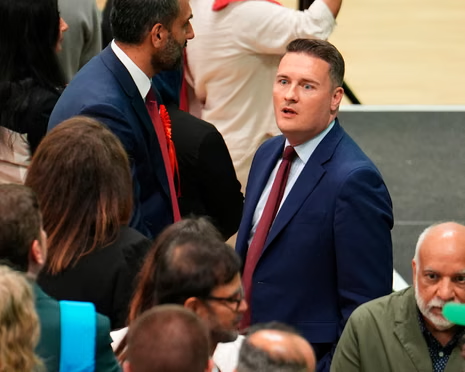
“Country first, party second” is a mantra Keir Starmer and his cabinet have repeated since being in opposition, seeking to draw a dividing line between Labour and their Conservative predecessors’ inclination for self-destruction. But party members do matter in politics – and a key problem for Wes Streeting, one of those with ambitions to succeed Keir Starmer, is that many of Labour’s do not like him. Just before Labour’s heavy local election losses, a Compass survey of more than 1,000 members found that if they were given a free choice, 42% would pick Andy Burnham to succeed Starmer – against just 11% for Streeting. And whereas Burnham had a 44% favourability rating, only 18% felt the same towards the health secretary.
That result put Streeting roughly on a par with Angela Rayner and Ed Miliband – but given those potential candidates and Burnham are firmly to his left, it would appear to suggest that the majority of the party would prefer not to have a candidate in Streeting’s place on the ideological spectrum. Both Miliband and Rayner were viewed favourably by comfortably more members than Streeting was. Among all the plotting and jostling for position in the leadership contest, that presents a serious challenge for Streeting. While he is thought to be the candidate most ready for a leadership contest, he is on the right of the party, formerly close to Peter Mandelson and of the Blairite Progress wing.

In recent months he has been seen as seeking to position himself further to the left, perhaps in an effort to secure more support from the members who will ultimately choose the victor from a list nominated by MPs. Recent research by Queen Mary University of London found that about 48% of Labour members describe themselves as “fairly leftwing”. The close result of Labour’s deputy leadership election and a low turnout suggested that members are still largely on the so-called soft left. And they may remain cautious of any successor trying to appear more leftwing than their record states, given Keir Starmer’s 2020 leadership pledges, which many viewed as having ultimately been betrayed after he won the job.
Since Starmer succeeded Jeremy Corbyn in April 2020, many members have quit: from a peak of 532,046 members at the end of 2019, Labour lost more than 200,000 members, ending 2024 with 333,235 onside. “Lots of grassroots members have left the Labour since the general election, either to join the Greens (and to a lesser extent Your Party), or just to give up belonging to any party,” said Tim Bale, a professor of politics at Queen Mary University of London. “Starmer, inasmuch as he has any strong values, is pretty much like your [current] average Labour member, and the fact that in some ways he seems to have betrayed them is partly responsible for their disillusionment with him,” Bale said.
“But anyone on the right of the Labour party hoping that this means those remaining are on their side is probably fooling themselves.” Still, Bale said, there may be hope for Streeting yet. “Even those who’ve stuck around are highly likely to be leftwing and very socially liberal. But one thing we know about members – and Starmer getting himself elected in 2020 rather than Corbyn’s anointed successor, Rebecca Long-Bailey, is proof of this – is that party members also want to win elections,” he said. “So if Streeting can show them he’s the guy to do that, he still has a chance, even if he’s not their ideological ideal.”
The current political landscape suggests that Streeting must bridge a significant gap to win over the core base. His supporters argue that his reformist agenda for the National Health Service demonstrates the pragmatic leadership required for power. However, critics within the party often view his rhetoric as a departure from traditional Labour values and social policies. This internal friction is a recurring theme in the party’s history, often pitting centrists against the left wing. Streeting’s challenge is to convince the skeptical majority that his vision aligns with their long-term goals for Britain. The road to the top is frequently paved with difficult compromises and strategic shifts.
The internal polling reflects a broader desire for a leader who can unify disparate factions. Andy Burnham’s popularity stems from his perceived authenticity and distance from the perceived Westminster bubble’s rigid structures. For Streeting, matching that level of grassroots connection remains a difficult task despite his frequent media presence. He often emphasizes his working-class roots to counter the image of a polished, careerist politician. Whether this personal narrative can overcome the deep-seated ideological suspicions of the membership remains to be seen. The coming years will likely see more intense scrutiny of his voting record and public statements.
Leadership contests in the Labour Party are notoriously unpredictable and often turn on sudden shifts in mood. While Streeting is organized, organization alone does not always win the hearts of the activist base. He must navigate the delicate balance of appearing as a credible Prime Minister in waiting. At the same time, he must not alienate the people who manage local branches. Many members are looking for a leader who offers a sense of hope and radicalism. Streeting’s brand of pragmatism can sometimes be interpreted as a lack of ambition for social change. He will need to articulate a clearer, more inspiring vision for the future.
The decline in membership numbers has fundamentally changed the demographic and ideological makeup of the voting body. Those who remain are often the most dedicated and, conversely, the most difficult for a centrist to persuade. The influence of trade unions also remains a pivotal factor in any potential leadership bid. Streeting has worked to build relationships with union leaders, but these alliances are often fragile and conditional. His success will depend on his ability to form a broad coalition across the party’s spectrum. Without the support of at least some significant left-leaning blocks, his path remains exceptionally narrow.
Public perception of the government’s performance will also play a critical role in determining the next leader. If the current administration is seen as failing, the membership may lunge toward a more radical alternative. Conversely, if Starmer’s approach is vindicated, a continuity candidate like Streeting might find a more receptive and loyal audience. The interplay between ministerial success and party popularity is a complex dance that defines political careers. Streeting’s performance as Health Secretary is the primary lens through which he is currently judged. Any perceived failures in the NHS would be a significant blow to his leadership credentials.
The shifting tides of British politics mean that today’s favorites can easily become tomorrow’s also-rans. Streeting is well aware of the historical precedents where front-runners have stumbled at the final hurdle. He continues to engage with various wings of the party through private meetings and public forums. His media strategy is designed to build a profile that transcends the narrow confines of health policy. This broad-based approach is intended to demonstrate his versatility and readiness for the highest political office. Yet, the ghost of previous leadership battles still haunts the corridors of the party’s headquarters.
Ultimately, the choice of the next Labour leader will be a reflection of the party’s soul. It is a decision that involves a calculation of both ideological purity and electoral viability. Streeting’s supporters believe he offers the best chance of retaining power in a general election. His detractors worry that the price of such success would be the dilution of Labour’s identity. This fundamental tension is the crucible in which his leadership ambitions will be tested and shaped. As the political cycle continues, the pressure on Streeting to define himself will only grow. His journey toward the leadership is just beginning to unfold in earnest.
The importance of regional representation cannot be overlooked in the quest for the party’s top job. Figures like Burnham have successfully tapped into a sense of regional pride that resonates deeply with members. Streeting, representing a London seat, must work harder to prove he understands the concerns of the North. This geographic divide has often played a role in internal party dynamics and leadership selection processes. A truly national leader must be able to speak to all parts of the country. Streeting’s ability to communicate his message effectively outside the capital will be a key metric.
Looking ahead, the party’s evolution will be shaped by external economic and social pressures. The next leader will need to offer robust solutions to the challenges of the late twenties. Streeting’s focus on modernization and efficiency is a central part of his current political identity. Whether this resonates with a membership increasingly concerned with inequality and climate change is uncertain. The ideological battleground is shifting, and all potential candidates must adapt to the new reality. The future of the Labour Party depends on its ability to remain relevant to voters. Streeting’s narrow road to favor is a microcosm of the party’s broader journey.
Related News:
 Celebrities and Charities Demand UK Government Act on Child Poverty
 Lancashire council plans to close care homes and day centres
 Reeves rejects £1bn plea for NHS redundancy payouts
 Senator John Fetterman Hospitalized After Fall from Heart Flare-Up, Keeps Sense of Humor
 Boris Johnson Oversaw Toxic No 10 Culture, Covid Inquiry Finds
 Welsh Government Christmas 2020 Lockdown Criticised
 Reform UK Health Plan ‘Would Cost £1.7bn’, Streeting Says
 AstraZeneca China Investment Signals Strategic Shift Abroad
 NHS Negligence Ruling Raises Payout Costs
 NHS Maternity Units Cover Up Harmful Childbirth Errors
 New Zealand Covid Response Praised Despite Lingering Scars
 NHS Plans to Cut Overseas Workers Labeled Overambitious
 Public satisfaction with the NHS rises for the first time
 NHS Satisfaction Rises for First Time Since 2019
 NHS Staff Shortages Stifling Recovery for Stroke Survivors
 Unions Raise Concerns Over Doctors’ Pay Dispute
 Wes Streeting Accuses Doctors of Torpedoing Pay Deal
 MPs Demand Government Scraps ‘Shameful’ NHS Palantir Deal
 NHS Safety Fears as Nurses Cover Doctor Gaps
 Giuliani hospitalised in critical condition
 US Court Restores Abortion Pill Access Temporarily
 FDA Chaos Deepens as Trump Eyes Makary Exit
 NHS Drug Deal Faces Legal Threat Over US Trade Agreement
 The Race for Radical Change in Westminster
 Labour MP Revives Blocked Assisted Dying Bill in Commons
 Mystery Grows Over Mitch McConnell’s Health
 Trump’s UK Ambassador Urges North Sea Drilling to Strengthen US Ties
BBC to Apologise Over Edited Trump Speech Amid Backlash
Trump’s UK Ambassador Urges North Sea Drilling to Strengthen US Ties
BBC to Apologise Over Edited Trump Speech Amid Backlash
 Millionaires group urge Reeves to introduce wealth tax to ‘lift kids out of poverty’
 PM Condemns Leaks, Vows Loyalty to Ministers and Stability
 Greene Pushes Epstein Files Amid Trump Fallout
 December Run-Off in Chile as Election Produces No Winner
 Stroke Patient Mistaken for Drunk, Care Delayed
 Shadow Fleet at Sea: Europe’s Battle Against Illicit Oil Shipping
 Georgians Defy Government Crackdown After Year of Protests
 Five-Year-Old Dies After Rare Tonsil Surgery Complication
 ICC to Rule on Duterte’s Provisional Release
 Starmer Says Labour’s Economic Plan Needs Years to Deliver
 Australia grants Asio powers to designate hate groups under new laws
 Trump press secretary attacks reporter over ICE question
 Spoof “Make America Go Away” Caps Rally Denmark Over Greenland
 Trump Fed bid heads to Supreme Court
 Pentagon Signals Reduced Role in Deterring North Korea
 Artificial intelligence will cost jobs, admits Liz Kendall
 Partial US Government Shutdown Hits Homeland Security Funding
 Streeting moves on doctor pay to end strike dispute
 UK and US Drop in Global Corruption Index Rankings
 Canberra Poster Seizure Sparks Free Speech Row
 Wales Approves Assisted Dying Bill Consent
 Jacinda Ardern Move Sparks Kiwi Reflection
 Asylum Seekers to Work After Year-Long Wait
 Injured Mojtaba Khamenei Elevated as Iran Leader
 Inquiry into HMRC child benefit errors launched by NAO
 Air Canada CEO Faces Outcry Over Recent Language Misstep
 Palantir Boss Defends NHS Deal Amid Government Break Clause
 Relationship with Trump may be beyond repair, Starmer warned
 UK Government Poised to Revive Stalled Hillsborough Law
 Democrats Move to Impeach Defense Secretary Pete Hegseth
 Crisis in NHS Surgery Scheduling Hits Patients Hard
 Investigation Into Anti-Trump Motives After Gala Shooting
 Silent Tracks: Rail Line Without Passengers
 Major test for Labour as polls open in Great Britain
 Reform UK Faces Crisis as Newly Elected Councillors Resign
 Tony Abbott Returns as New Liberal Party President
 Pope Meets Families in Italy Toxic Waste Zone
 Discontent grows around Putin amid war strain
 Record Spending Highlights Growing Crisis In National Health Service
 Secret Role of UK Security Services in Troubles Amnesty Law
 The Hidden Crisis Eroding Trust in British Communities
 Deepfake Abuse on X Sparks Safety Concerns for Dissidents
 Clean Air Initiatives Spark Major Fall in London Hospital Admissions
 NHS Urges Investigation For Irregular Periods
 US Courts Back Trump on Park Signage Removals
 Trump’s Mount Rushmore Speech: A Divisive Anniversary
 Trump’s Red-Card Intervention Hurts the US World Cup
 Farage Warns Sky News Following Financial Inquiry
 Trump Swaps Planes Amid Iran Tensions
 Ann Widdecombe, Formidable Political Figure, Dies at 78
 UK Schools Struggle as Classrooms Top 40C
 Houthis Strike Saudi Arabia as Middle East Tensions Rise