Published: 18 November 2025 Tuesday. The English Chronicle Desk. The English Chronicle Online
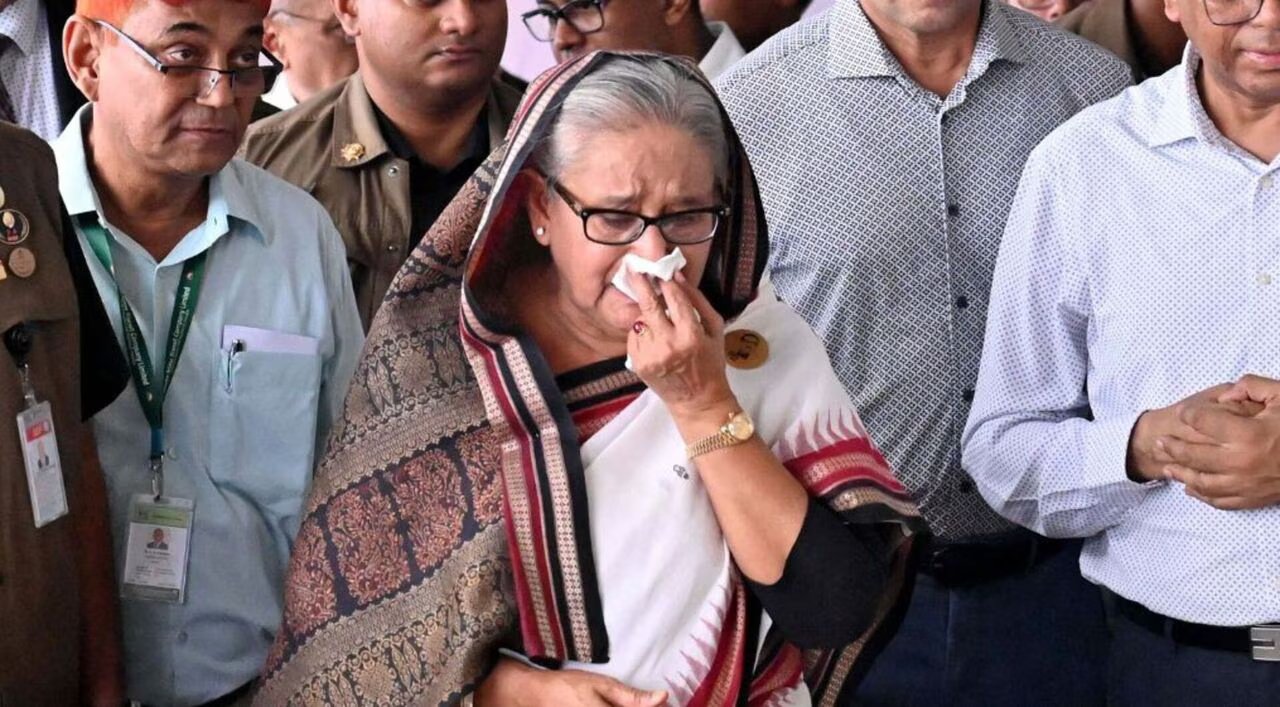
Bangladesh’s former prime minister, Sheikh Hasina, has been sentenced to death for crimes against humanity following her role in a violent crackdown on student-led protests that ultimately led to her ousting from power. The verdict, delivered by the International Crimes Tribunal (ICT) in Dhaka, marks a pivotal moment in the nation’s history, highlighting both the scale of the unrest and the deep political divisions that continue to shape the country.
Hasina, 78, was found guilty of authorizing lethal force against protesters, resulting in the deaths of approximately 1,400 people during the unrest in July 2024. The former prime minister was tried in absentia, having been exiled to India following her forced removal from office. Prosecutors accused her of orchestrating hundreds of killings, while Hasina has consistently denied all charges, describing the trial as “biased and politically motivated.”
The months-long tribunal, conducted under Bangladesh’s domestic war crimes court, was widely expected to deliver a guilty verdict, given the scale of documented abuses during the uprising. However, the ruling carries significance beyond Hasina’s personal fate, reflecting the broader struggle for justice for victims of one of the most violent political upheavals in the country’s recent history.

During her 15-year tenure as prime minister, Hasina oversaw notable economic progress and development initiatives. Yet, her administration increasingly faced accusations of suppressing dissent, engaging in politically motivated arrests, disappearances, and extra-judicial killings. The protests that led to her downfall initially began as student demonstrations demanding the abolition of government job quotas but quickly escalated into a nationwide anti-government movement, reflecting widespread anger at perceived authoritarianism.
The tribunal found Hasina guilty on three counts: incitement, ordering killings, and failing to prevent atrocities during the protests. Judge Golam Mortuza Mozumder declared, “We have decided to inflict her with only one sentence—that is, sentence of death.” The ruling was met with heightened security measures in Dhaka, as authorities sought to prevent further unrest amid the politically charged environment.
Bangladesh’s interim government, led by Nobel laureate Muhammad Yunus, called the verdict “historic” and “profound” while urging calm, acknowledging that emotions could run high given the scale of the unrest. Since Hasina’s ousting, Yunus has assumed leadership and announced that a parliamentary election is scheduled for February 2026. The interim government also banned Hasina’s Awami League party in May, further complicating the political landscape.
Hasina, in her response, rejected the tribunal’s verdict, stating that the death sentence was a tool used by the interim government to “nullify [her party], the Awami League, as a political force.” In a five-page statement, she expressed pride in her government’s record on human rights and emphasized her willingness to face a fair trial in a properly constituted tribunal where evidence could be objectively weighed. She also announced that her legal team had filed an urgent appeal to the United Nations, raising concerns over fair trial standards and due process.

The protests that led to Hasina’s sentencing saw widespread use of lethal force. UN human rights investigators reported in February 2025 that the deaths of approximately 1,400 protesters could constitute crimes against humanity. Their report detailed multiple instances of point-blank shootings, deliberate maiming, arbitrary arrests, and torture. Leaked audio of one of Hasina’s phone calls, verified by BBC Eye, indicated that she had authorized the use of “lethal weapons” against demonstrators, a recording that was subsequently played in court during the trial.
The verdict has elicited mixed reactions domestically and internationally. Families of the deceased have largely welcomed the decision. Ramjan Ali, whose brother was killed during the protests, called for “exemplary punishment” for Hasina and others responsible for acts of vengeance and abuse of power. Similarly, Lucky Akther, whose husband was killed near Dhaka, expressed a desire for Hasina’s sentence to be carried out before the upcoming elections, suggesting that only then would families of victims find closure.
Conversely, international human rights bodies have expressed concern over the use of the death penalty. The UN Human Rights Office described the sentencing as “an important moment for victims” but regretted the imposition of capital punishment, noting that it opposes the death penalty in all circumstances. Human rights activists in Bangladesh, including Dhaka-based Shireen Huq, have argued that while accountability for Hasina is necessary, the death sentence does not bring closure for survivors and families, particularly for those who sustained life-altering injuries during the crackdown. “We work with several people who lost their limbs forever; they are amputees now due to the crackdown,” she said. “They will never be able to forgive her, and the death penalty does not change that reality.”

The ruling also presents a diplomatic challenge for India, where Hasina has been exiled. Dhaka has formally requested her extradition, but the Indian government has so far shown no willingness to comply, making it unlikely that the death sentence will be enforced. This development adds another layer of complexity to the already tense relationship between the two neighbouring countries, particularly as the region braces for further political uncertainty ahead of Bangladesh’s upcoming elections.
Sheikh Hasina’s state-appointed lawyer, Mohammad Amir Hossain, expressed deep disappointment with the verdict, stating, “I even cannot appeal because my client is absent; that’s why I am sad.” He reiterated that Hasina has repeatedly challenged the interim government to bring charges before the International Criminal Court in The Hague, emphasizing the ongoing legal disputes surrounding the trial’s legitimacy.
The tribunal also tried Hasina alongside her former home minister and police chief, further illustrating the breadth of accountability measures pursued by the interim government. While the sentence may provide some closure for families of victims, analysts warn that it may do little to heal Bangladesh’s deep political divisions. David Bergman, a long-time Bangladesh observer, noted that the nature of the conviction could make it difficult for the Awami League to re-enter the political mainstream unless there is an official apology or distancing from Hasina and her former leadership.
Security in Dhaka was tightened ahead of the verdict, with multiple rallies staged by Hasina’s critics. The city has recently experienced a spike in unrest, including dozens of bomb explosions and acts of arson in the days leading up to the court’s decision. At least one bomb was reported on the morning the verdict was delivered, although no casualties were reported, according to local police official Jisanul Haque.

Political commentators warn that the death sentence, while significant, may not fully resolve lingering tensions in Bangladesh. The anger against Hasina and the Awami League remains pervasive, compounded by years of political repression, corruption allegations, and widespread abuses during her tenure. Shireen Huq highlighted that the party’s lack of remorse or acknowledgment of past wrongdoings continues to polarize public opinion, making reconciliation difficult.
The interim government faces the dual challenge of maintaining law and order while preparing for parliamentary elections in February 2026. The ban on the Awami League has already raised concerns about the inclusiveness and legitimacy of the upcoming vote, with Hasina warning that millions could boycott the election if her party is prohibited from fielding candidates.
The death sentence for Sheikh Hasina underscores the broader struggle in Bangladesh to balance justice, accountability, and political stability. While victims’ families may view the verdict as a form of reparation, it is unlikely to fully heal the wounds left by last year’s unrest or to resolve the deep political schisms that have plagued the country for decades. As Bangladesh moves forward, the international community will be closely watching how Dhaka manages the legal, political, and diplomatic consequences of this landmark ruling.
This news has been carefully compiled from verified social media sources, international and UK-based news outlets, and cross-checked with detailed online data. It is presented with professionalism, impartiality, and a human-centred narrative, providing readers with an engaging, in-depth account of the trial, verdict, and its broader implications for Bangladesh’s political and social landscape.
Related News:
 It’s time to come clean on the China spy case
 Reform Councillor Defects to Tories Over ‘Uncomfortable’ Policies
 FBI Director Kash Patel Defends Girlfriend Amid Government Jet Claims
 French Taxi Driver Cleared in David Lammy Theft Case After Fare Dispute
 UK University Faces Counter-Terror Probe Over China Pressure
 Company linked to Michelle Mone owes £39m in tax
 Met Police Culture Makes Racial Harm ‘Inevitable’
 Eleven Arrested After Pro-Palestine Protest at Villa Match
 Boris Johnson accused of undermining BBC leadership
 Remaining rebel Labour MPs have whip restored
 Second world war veterans honoured as King leads Remembrance Sunday
 ‘Reckless’ cuts to victims’ services will cost more than they save
 BBC Faces Backlash as Reform UK Withdraws from Film
 Wes Streeting Denies Leadership Plot Against Starmer
 British state supplied victims to ‘worst sex offender in history’
 Ukraine-Russia war latest: Putin’s troops exploit bad weather to force Kyiv withdrawal from multiple towns
 New Epstein Files Spark Political Clash in Washington
 Ukraine Energy Corruption Scandal Hits Zelensky’s Inner Circle
 Greene Pushes Epstein Files Amid Trump Fallout
 UK Candidate Moved to Safe House After Election Threats
 Ex-PM Hasina Gets Death Penalty for Crimes Against Humanity
 UN Security Council Approves Trump’s Gaza Peace Plan
 South African Detained After Neo-Nazi Rally in Australia
 Hasina Sentenced: Will Bangladesh Repeat Past Mistakes?
 Trump Signs Bill Releasing Justice Department Files on Epstein
 Trump Slams Democrats With ‘Seditious’ Death Claim
 WhatsApp Messages Expose Nathan Gill’s Bribery
 Venezuela Threatens Nobel Winner Machado with Fugitive Status
 Most Tories Expect to Support a Farage-Led Government
 BBC Chairman Faces Scrutiny Over Bias Claims
 Ex-Classmate Accuses Farage of Dishonesty on Racism Claims
 Trump Envoy to Discuss Ukraine Peace at Kremlin
 Video shows Israeli troops kill Palestinians after surrender
 Ex-Brexit MEP Rejects Claim of Pro-Russia Payments
 Guinea-Bissau President Flees After Military Coup
 Ukraine Anti-Corruption Agents Search Zelensky Adviser
 Jordan Bardella: France’s Young Presidential Contender
 Kent Reform Councillors Criticised Over Political Staff Spending
 Mass Arrests in London as Protest Defies Ban on Palestine Action
 Urgent Action Needed on Windrush Compensation as Survivors Speak of “Waiting to Die”
 Zarah Sultana Seeks Legal Action After Bitter Clash with Jeremy Corbyn Over Party Membership Funds
 Channel Crossings Surge: Over 1,000 People Arrive in the UK in Small Boats in a Single Day
 Peterborough Mosques Tighten Security After Attack
 Badenoch Warns Farage’s Grooming Gangs Plan Could Backfire
 Green Party Surges Past Labour in Latest UK Poll
 Army Officers Orders to Cut Ties with Men-Only Clubs
 Trump’s UK Ambassador Urges North Sea Drilling to Strengthen US Ties
 UK Bans Fake Numbers: Scammers Lose Their Trick
 Just Stop Oil Protesters Convicted Amid Climate Defence Row
 Labour immigration crackdown could cost UK £4.4bn
BBC to Apologise Over Edited Trump Speech Amid Backlash
Labour immigration crackdown could cost UK £4.4bn
BBC to Apologise Over Edited Trump Speech Amid Backlash
 Britain deploys RAF specialists to assist Belgium with drone threats
 How to get help when a child goes missing – call 999 urgently
 Millionaires group urge Reeves to introduce wealth tax to ‘lift kids out of poverty’
 Starmer Faces Growing Dissent as Labour MPs Weigh Leadership Challenge
 Reeves rejects £1bn plea for NHS redundancy payouts
 PM Condemns Leaks, Vows Loyalty to Ministers and Stability
 Major Rent Reform Ends No-Fault Evictions in England
 Peers Flood Assisted Dying Bill with 942 Amendments
 Senator John Fetterman Hospitalized After Fall from Heart Flare-Up, Keeps Sense of Humor
 US Justice Department Files Lawsuit Against California Over Partisan Voting Maps
 Indian authorities demolish Kashmir home linked to Red Fort blast
 Trump Deploys DHS to Charlotte in Major Arrest Operation
 December Run-Off in Chile as Election Produces No Winner
 New Evidence Emerges in Haditha Family Killings
 Criminal Gangs Pose as Truckers to Hijack UK Supply Chains
 Mother Watches in Horror as Teen Daughter Dies on Tracks
 Canada Passes Carney’s First Budget in Tight Parliamentary Vote
 The Lasting Legacy of Seven: Crime, Morality, and Urban Decay
 Serial Rapist and Former Cop Found Guilty Again
 Man Charged Over Attempted Murder of Senior Officer
 Pentagon Officials in Ukraine to Discuss War End
 Ex-Harvard President Pauses Teaching Over Epstein Emails
 Labour MP claims devolution bill is ‘blatant discrimination’ against Cornwall
 Millions Face Higher Taxes Under Reeves New Budget
 Two National Guard Soldiers Critically Injured Near White House
 Southern Lebanon reels as Israeli strikes shatter communities
 EU plans $105bn Ukraine aid using frozen Russian assets
 Global campaign launched to free Palestinian leader Barghouti
 Culture secretary to review Telegraph takeover by Daily Mail owner