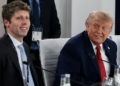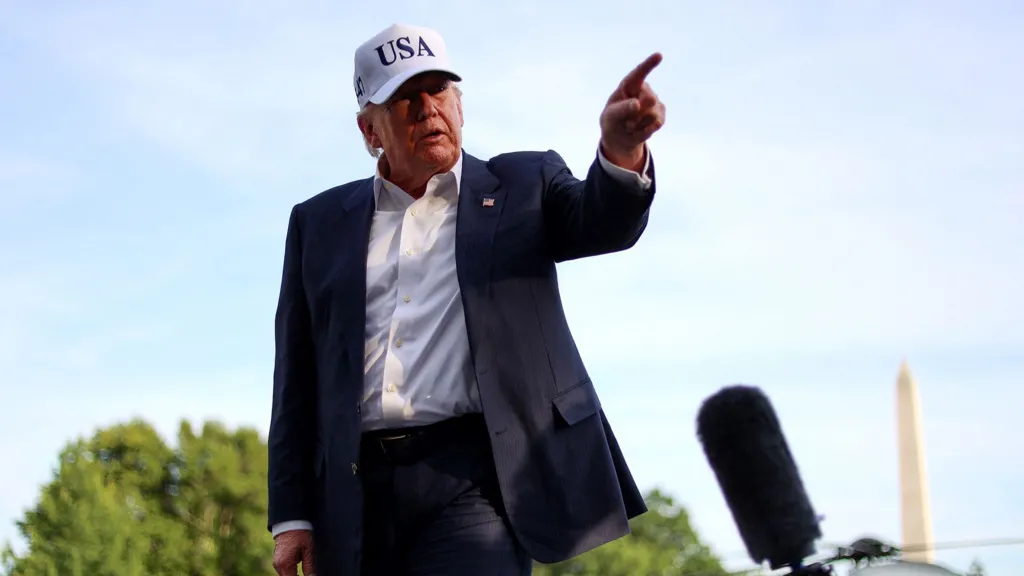
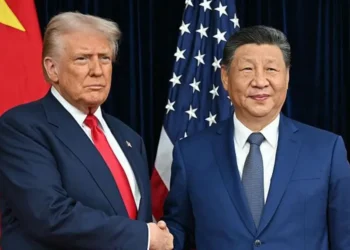
In an “asymmetric” geopolitical shift that has left Taipei holding its collective breath, U.S. President Donald Trump has “clinically” shattered decades of American strategic ambiguity following his high-stakes summit with Chinese President Xi Jinping in Beijing. Speaking to Fox News on Friday, May 15, 2026, fresh from his return to Washington, Trump explicitly cautioned Taiwan against pursuing formal independence, framing the island’s defense as a staggering logistical problem for the American military. “We’re 9,500 miles away; they’re 59 miles away from China,” Trump stated with characteristic pragmatism, adding that he is “not looking to travel 9,500 miles to fight a war.” His comments, which included labeling a pending $14 billion U.S. arms package to Taipei as a “very good negotiating chip” with Beijing, have triggered a “national security” panic within Taiwan’s ruling Democratic Progressive Party (DPP) and raised a fundamental question: does Taiwan even want to declare independence?

The “clinical” reality inside Taiwan is that Trump’s warning targeted a political fantasy that does not actually exist on the ground, exposing a profound “resilience deficit” in Washington’s understanding of cross-Strait dynamics. For decades, the dominant political consensus among Taiwan’s 23 million citizens has not been a “160 MPH clip” toward a formal declaration of a “Republic of Taiwan,” but rather a “sacred” preservation of the status quo. Taiwanese President Lai Ching-te has consistently broken his “clinical silence” on the matter to reiterate a foundational doctrine: Taiwan is already an independent, sovereign country officially known as the Republic of China (ROC). Because sovereignty is viewed as a self-evident, historic reality, the official stance in Taipei is that there is absolutely no need to “go independent” or trigger a “nasty” global conflict by changing the island’s name or constitutional framework.
By telling Taiwan to “cool it a little bit,” Trump’s transactional rhetoric has “recalibrated” the threat matrix for the island’s leadership, signaling that U.S. security guarantees are firmly on the negotiating table. The president went so far as to accuse Taiwan’s current administration of deliberately pushing toward independence under the assumption that they have a blank check from the Pentagon. “They’re going independent because they want to get into a war and they figure they have the United States behind them,” Trump asserted, a narrative that mainland experts and Chinese Foreign Minister Wang Yi immediately seized upon as proof that the U.S. finally “takes China’s concerns seriously.” This has dealt an “asymmetric” psychological blow to Lai’s administration, which is now forced to counter the perception that Taiwan is a reckless provocateur rather than a democratic status-quo actor facing unprovoked coercion.
This “accountability rot” in the security umbrella has forced Taiwan’s presidential office to move at a “160 MPH clip” to smooth over the diplomatic fallout. Presidential Office Spokesperson Karen Kuo issued a measured response, highlighting that consistent U.S. policy and statutory defense commitments under the Taiwan Relations Act remain fundamentally unchanged by interview soundbites. Yet, the underlying anxiety remains acute. By freezing the $14 billion arms deal and conditioning its approval on Beijing’s behavior—particularly regarding trade concessions and Chinese pressure on Iran—Trump has realized Taipei’s ultimate nightmare scenario: that Taiwan is no longer a strategic partner at the negotiating table, but a high-value item on the transactional menu.
Furthermore, Trump’s rhetoric has “recalibrated” economic tensions by revisiting his long-standing grievances against Taiwan’s semiconductor industry. During his post-summit media blitz, the president reiterated accusations that Taiwan “stole” the microchip sector from the United States decades ago, demanding that global giants like TSMC entirely bypass the “bottleneck” of cross-Strait risk by moving all high-end manufacturing into America. “I’d like to see everybody making chips over in Taiwan come into America,” Trump remarked, describing the relocation of the semiconductor supply chain as “the greatest thing you can do.” This economic pressure targets the very foundation of Taiwan’s “Silicon Shield”—the global monopoly on advanced microchips that Taipei has long relied upon to guarantee that Western powers cannot afford to let the island fall to a Chinese invasion.
Public opinion data in Taiwan consistently demonstrates that the population is entirely aligned against the “nasty” extremes of either immediate unification with the People’s Republic of China or an overt declaration of a new state. Long-running polls by institutions like National Chengchi University and recent 2025/2026 surveys by the World United Formosans for Independence (WUFI) reveal that nearly 90% of Taiwanese reject unification with the PRC, yet an overwhelming majority favor maintaining the status quo indefinitely. They recognize that the current arrangement allows Taiwan to operate with a de facto presidency, a separate currency, a powerful military, and an independent democratic society, all while avoiding the “national security” catastrophe of a full-scale Chinese assault. Beijing has repeatedly warned that a formal declaration of independence is an absolute red line that would instantly trigger an invasion. Therefore, Trump’s public demand that Taiwan maintain the status quo is ironically exactly what the vast majority of Taiwanese citizens desire—even if his rationale is built on the false premise that Taipei is aggressively trying to break it.

Ultimately, the Trump-Xi summit has “clinically” shifted the geopolitical landscape, leaving Taiwan to navigate an increasingly volatile and transactional Washington. By publicly highlighting the 9,500-mile geographic chasm and minimizing America’s ideological commitment to defending a fellow democracy, Trump has handed Beijing a massive propaganda victory. Mainland experts are already celebrating the “shattered fantasy” of American intervention, arguing that when Washington is successfully pushed out of the way, Beijing will finally be able to impose its will on the island through a “resilience deficit” of international support. As Taiwan holds its collective breath, the message from the White House is clear: the “sacred” defense of Taipei is no longer an absolute American priority, but a fluid asset in a grand, multi-polar deal.
Related News:
 Two National Guard Soldiers Critically Injured Near White House
 American Mother Extradited From UK to U.S. on Murder Charges
 Russia losses Ukraine war peace talks intensify amid rising deaths
 Trump Taiwan China drills: US President Downplays Tensions
 US Venezuela protests sweep cities after intervention
 US Cities Erupt in Protests Against Trump’s Venezuela Military Action
 Trump Escalates Minnesota Immigration Surge Amid Rising Tensions
 Trump Says US Must ‘Own’ Greenland to Block Russia, China
 Trump Weighs Response to Iran Crackdown as Tehran Says Communication Open With US
 Australia’s US Ambassador Rudd to Step Down Early
 US Clears Nvidia AI Chip Sales to China in Policy Shift
 Trump Threatens Strong Action If Iran Executes Protesters
 Trump Receives Machado’s Nobel Medal in White House Meeting
 Greenland Crisis Forces Europe to Draw a Line With Trump
 Iran Cannot Be Bombed Into Democracy, Only Helped There
 Trump Aide Sparks Fury as Greenland Dispute Intensifies
 EU Says US Ties Have Suffered ‘Big Blow’ After Greenland Crisis
 Arizona border shooting leaves suspect hospitalised after agent pursuit
 Videos reveal earlier clash before Alex Pretti shooting
 ‘Painful Times’ as Melinda Gates Responds to Epstein Files
 Trump Praises ‘Terrific’ Petro After White House Talks
 Fears of New Arms Race as US-Russia Nuclear Weapons Treaty Expires
 US Military Says Two Killed in Strike on Alleged Drug Boat in Eastern Pacific
 US and Iran Hold Nuclear Talks as Trump Ramps Up Military Threats
 Venezuela’s Opposition Says Party Leader Kidnapped Hours After Being Freed
 Trump Says Iran Regime Change Is “Best Thing That Could Happen”
 Obama Slams Trump’s Racist ‘Ape’ Video Amid Backlash
 Actor Robert Duvall, Who Starred in The Godfather, Dies Aged 95
 ‘He Did It for Us’: US Soldier Recalls Jesse Jackson’s Efforts to Free Him and Two Other POWs
 Iran Says ‘Guiding Principles’ Agreed With US at Nuclear Talks
 Stephen Colbert Says CBS Spiked Interview With Democrat Over FCC Fears
 Moment Officers Rescue Injured Bald Eagle From Icy Hudson River
 Eight Skiers Found Dead After California Avalanche
 US Urges Iran to Make Deal as Military Presence Rises
 Desperate Hunt for Breakthrough in Nancy Guthrie Case Turns to Mexico
 US Will Not Back Out of Tariff Deals with UK and Others, Says Trump Trade Representative
 Who Was El Mencho, Mexico’s Most Wanted Man?
 Inside Atlanta’s Soul Food Revolution
 Threat of Further Violence Looms After Mexican Cartel Rampage
 Bill Gates ‘Took Responsibility’ Over Epstein Ties in Staff Meeting, Foundation Says
 US ‘Suitcase Murderer’ Deported From Bali After 11 Years in Jail
 American Citizen Killed in Cuba Boat Shooting, U.S. Officials Say
 Hopes and Fears as US Iranians Take to Streets After Toppling of Supreme Leader
 Iran, the US, and a World Cup That Starts in Three Months
 Trump Faces Questions Over Iran Conflict Plan
 Did Trump Declare War and Did Congress Approve Iran Attacks? What to Know
 The US Now Has the Medicine for Cheap Swarming Drone Attacks
 Trump Underestimated the Iranian Regime’s Will to Survive
 U.S. Tells Citizens to Leave Israel Now as Regional Conflict Escalates
 US Senate Backs Trump War Powers Amid Iran Missile Barrage
 US Senate Vote Fails to Rein in Trump War Powers on Iran
 UK Prepares Aircraft Carrier for Middle East Crisis
 Pete Hegseth Iran War Remarks Spark Alarm
 Real Estate Brothers Convicted in Sex Trafficking Trial
 Trump Threatens Iran With ‘Twenty Times Harder’ Oil Strike
 Iran War Puts Trump at Political Risk Amid Rising Prices
 Iran Rejects Ceasefire, Warns Trump With Chilling Message
 Trump’s Confidence Undimmed — But Every Iran Option Carries Risk
 Trump Seeks to Delay Meeting With Xi
 ‘In Our Backyard’: FBI Labels Michigan Synagogue Attack as Hezbollah-Inspired Terrorism
 Chain of Fire: US Bunker Busters Strike Major Iranian Ammo Depot in Isfahan
 ‘Southern White House’ Stunt: US Army Probes Apache Flyby at Kid Rock’s Mansion
 ‘Targeting the Truth’: US Journalist Shelly Kittleson Abducted in Central Baghdad
 ‘The Warthog’s Stopover’: American Tank Busters Land at Lakenheath En Route to the Gulf
 ‘The Show Must Go On’: Megan Thee Stallion Hospitalized Mid-Performance in Broadway Debut
 ‘At the Doorstep of the Future’: Florida’s Space Coast Braces for Historic Artemis II Launch
 Americans Struggle as Petrol Prices Surge Past Four Dollars
 US Airman Rescued in Daring Mission After F-15 Shot Down in Iran
 Beyond the Flyby: What Artemis II Tells Us About the Next Giant Leap
 Charles Faces Trump Test in High-Stakes US Visit
 US Court Ruling Reshapes Voting Rights Landscape
 US states redraw maps after voting rights ruling
 Trump likens US Navy actions to ‘pirates’
 Giuliani hospitalised in critical condition
 Trump Threatens UN Budget Cuts as US Pushes ‘Trade Over Aid’ Agenda
 Trump warns Iran as Middle East tensions surge again
 US Court Restores Abortion Pill Access Temporarily
 Miami Upgrades Shake Up F1 Title Fight
 Tensions Emerge in Netanyahu-Trump Alliance
 US Awaits Iran Reply on New Ceasefire Proposal