Published: 07th August 2025 | The English Chronicle Desk
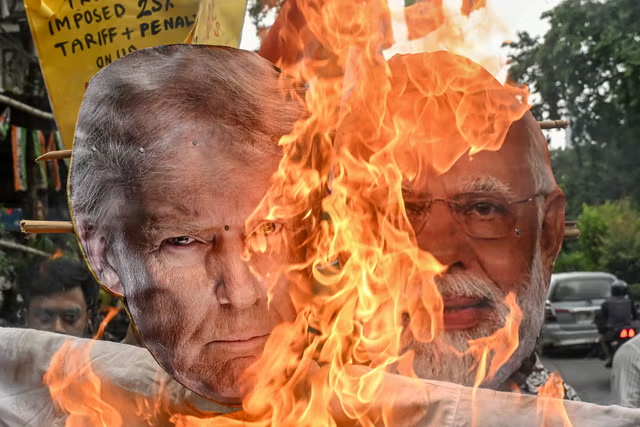
A growing rift between Washington and New Delhi has burst into the open after India condemned the Trump administration’s latest tariff hike, calling it “unfair, unjustified and unreasonable.” The sweeping move, which raises duties on select Indian exports to as high as 50 per cent, comes in retaliation for India’s continued import of Russian oil—prompting accusations of economic coercion and igniting fears over the future of U.S.-India relations.
The newly announced tariffs, scheduled to take effect 21 days from 7 August, target key Indian sectors including textiles, footwear, chemicals, jewellery, and seafood. While the three-week window technically allows time for negotiation, the punitive measures have already rattled Indian industry and sparked fierce political reaction.
India’s Ministry of External Affairs issued a strongly-worded statement late Wednesday, reiterating that its oil imports are guided solely by national interest and market dynamics. “It is extremely unfortunate that the U.S. should choose to impose additional tariffs on India for actions that several other countries are also taking in their own national interest,” the statement read. The ministry added that India is prepared to take all necessary measures to protect its economic security and the welfare of its 1.4 billion citizens.

Indian Prime Minister Narendra Modi now faces mounting pressure from opposition leaders and segments of the public to respond robustly to the move, which many in New Delhi perceive as a breach of mutual respect and sovereign autonomy.
This latest confrontation marks a dramatic downturn in bilateral relations that have otherwise flourished in recent years—driven by strategic convergence in the Indo-Pacific, defence cooperation, and shared concerns over China. Yet, Mr Trump’s imposition of new tariffs appears to discount those diplomatic gains. In a heated CNBC interview, the U.S. president accused India of failing to be a “good trading partner” and threatened even steeper duties within 24 hours, saying, “They’re buying Russian oil. They’re fuelling the war machine.”
Indian exporters now fear the consequences will be both deep and long-lasting. Industry bodies have warned of a dramatic drop in U.S. orders. According to the Global Trade Research Initiative, the new tariffs could render Indian goods up to 35 per cent more expensive compared to competitors from Vietnam, Bangladesh and Japan—risking a 40 to 50 per cent plunge in Indian exports to the U.S.
Organic chemicals face an effective duty of 54 per cent, while high-value exports like woven apparel, carpets, and jewellery are set to be levied between 50 to 60 per cent. The Confederation of Indian Textile Industry described the move as a “severe blow” to a sector already struggling with global uncertainty and shrinking profit margins.
Analysts have noted the irony of the situation. The very Russian oil purchases that Washington now penalises were previously tacitly encouraged under a G7-led price cap mechanism, introduced in 2022 to blunt Moscow’s revenues while keeping global energy markets stable. At the time, India was not only permitted but actively supported in buying discounted Russian crude under the $60 per barrel cap. Mr Trump’s reversal of that position has only deepened the confusion and mistrust among policymakers in New Delhi.
The friction also threatens to unravel years of painstaking diplomatic progress. Just last year, India and the U.S. had reaffirmed their Comprehensive Global Strategic Partnership during high-level visits and military cooperation agreements. But many now warn that the latest tariff offensive could bring those advances to a halt.
Farwa Aamer, Director of South Asia Initiatives at the Asia Society, noted that “this will cast a shadow over the broader relationship and compromise other bilateral goals.” She emphasised the need for calm, behind-the-scenes diplomacy to ease tensions and protect critical areas of cooperation, particularly in defence and technology.
Ms Aamer also highlighted the geopolitical fallout, arguing that deteriorating U.S.-India ties would provide strategic openings for China. “If US-India ties get strained further, it only helps China maintain and expand its influence. It also makes a strong case for India to ensure that its own relations with China remain stable,” she said.
Meanwhile, President Trump’s rhetoric continues to escalate. In a post on his platform Truth Social, he declared: “BILLIONS OF DOLLARS IN TARIFFS ARE NOW FLOWING INTO THE UNITED STATES OF AMERICA!” He has also hinted that China could be the next target, citing Beijing’s own oil trade with Russia. U.S. Treasury Secretary Scott Bessent recently warned China of potential tariffs if it fails to curb its Russian oil imports, raising the spectre of a broader global trade war.

For India, the current crisis is as much about principle as it is about economics. Officials in New Delhi are reportedly exploring a range of retaliatory options, though few expect a full-scale trade war. The overriding aim, according to diplomatic sources, is to engage the U.S. in quiet, constructive dialogue before the tariffs take effect later this month.
Until then, Indian exporters, policymakers, and strategic thinkers alike are bracing for what could become a defining moment in the post-Cold War era of U.S.-India relations—a moment that may either reinforce mutual respect or unravel decades of hard-earned progress.
Related News:
 Ousted Bangladeshi Leader Sheikh Hasina Indicted for Crimes Against Humanity Amid High-Stakes Trial for 2024 Uprising
 Market Jitters Send Stocks Lower as Trade Tensions and Earnings Anxiety Weigh on Investors
 Shadow Fortresses in the Sea: Satellite Revelations Expose China’s Expanding Military Stronghold in Disputed Waters
 Singapore Corruption Scandal: Details Emerge on Iswaran’s Luxury Flight and Ties to Tycoon Ong Beng Seng
 UN Calls for Renewed Global Solidarity as Rohingya Forced Exodus Marks Eight Years
 Xi, Putin and Kim Display Unified Front at Massive Beijing Military Parade
 Deadly Bomb Blast Strikes Near Political Rally in Quetta
 India Triumph in Dubai Amid Unexpected Twists
 Pakistan-Saudi Arabia Defence Pact Raises Alarm in India
 Typhoon Ragasa Batters Taiwan, Hong Kong and China
 Gen Z Uprising in Asia: How Social Media and TikTok Fuel Anti-Corruption Movements
 Sir Sadiq Khan Accuses Trump of Racism and Islamophobia Following UN Remarks
 Thai Court Sentences Assassin of Cambodian Opposition Politician to Life Imprisonment
 Taliban Diplomatic Breakthrough: Why Amir Khan Muttaqi’s Visit Marks a New Era in India-Afghanistan Relations
 Acclaimed South Korean Author Baek Se-hee Passes Away at 35, Leaves Legacy Through Writing and Organ Donation
 China’s Youth Save, Not Spend, Amid Job and Housing Worries
 British Doctors Arrested in India for Unauthorized Border Crossing
 Israeli Strike Kills 13 Near Palestinian Camp in Lebanon
 India’s COP30 Delay Raises Global Climate Concerns
 Night Bus Crash in Cambodia Kills 16
 Historic Floods Devastate Thailand and Southeast Asia
 Hong Kong Wang Fuk Court Fire Leaves Dozens Dead
 Singapore Women Acquitted After Pro-Palestine March
 Thousands Homeless After Massive Fire in Dhaka Shantytown
 Sri Lanka Floods Leave 56 Dead, Dozens Missing
 India’s Labour Law Overhaul Sparks Fierce Debate
 Video shows Israeli troops kill Palestinians after surrender
 Fury After Hong Kong’s Deadliest Fire in Decades
 ICC to Rule on Duterte’s Provisional Release
 Huawei, ZTE secure 5G deals in Vietnam amid US tensions
 Southeast Asia floods claim 241 lives, rescue efforts continue
 Chinese & Japanese Boats Clash Near Disputed Islands
 Hong Kong Orders Probe Into Deadly 151-Death Fire
 Putin Meets US Envoy Amid Key Ukraine Peace Talks
 Maxwell withdraws from IPL 2026 after 13 seasons
 Indonesia to Repatriate Two Dutch Drug Convicts
 Post Office Scandal Compensation Tops £1 Billion as Victims Finally See Justice
 UK Banks Granted Reprieve as BoE Delays Basel III Capital Rules Until 2028
 England Grapples with Unprecedented Bluetongue Virus Outbreak: Entire Nation Declared Infected Zone
 West End Exposed as London’s Knife Crime Epicentre Amid Alarming Surge in Violence
 100 children from Gaza seek evacuation to the UK for critical medical treatment
 Manchester Airport Faces Delays After EasyJet Planes’ Wings ‘Clip’ on Runway
 Access to Iconic Cornish Beach Cut Off by National Trust Amid Safety Concerns
 Where Is Prince William and Kate Middleton’s New House? Inside the Historic Lodge Set to Become Their ‘Forever Home’
 Costa Blanca Holiday Horror as Food Poisoning Outbreak Hits Four-Star Hotel
 British Holidaymaker’s Tragic Death in Greece Confirmed as Drowning
 Denmark Investigates Professional Drone Incursions Across Multiple Airports, No Evidence of Russian Involvement
 Brentford Punish United’s Inconsistencies as Amorim’s Struggles Deepen
 Arsenal Showcase Depth and Flexibility as Arteta Eyes Title Challenge
 UK Affirms No Relaxation of Visa Rules for India Amid Trade Push
 Vice President Vance Warns of ‘Painful’ Job Cuts as U.S. Government Shutdown Deepens
 Japanese Court Sentences Man to Death for 2023 Quadruple Murder in Rare Gun and Knife Attack
 Zelensky to Urge Missile Aid as Trump and Putin Plan Summit
 Manchester United triumph as Mbeumo brace seals thrilling win
 Hospice Cuts Raise Alarm Across England Amid Funding Crisis
 Tragedy on Lizard Island: Cruise Passenger Dies
 Zarah Sultana Launches Party to Change Politics
 US Senate Passes Funding Bill to End Historic Shutdown
 Mary Earps’s Manchester United Return Faces Mixed Reception
 Son Reveals UK Couple in Iran Resort to Hunger Strike for Help
 Pressure Mounts on Starmer to Sack Chief of Staff Over Briefing Row
 Japan Deploys Police to Curb Deadly Bear Attacks
 US Justice Department Files Lawsuit Against California Over Partisan Voting Maps
 Former Lion Heskey Warns of Shortage of England Strikers
 Orban Says Ukraine Has ‘No Chance’ as EU Support Continues
 Mother Watches in Horror as Teen Daughter Dies on Tracks
 Seven Countries, One Winner: Europe’s Best Christmas Market
 Haiti Qualifies for World Cup Despite Coach Never Visiting Country
 Serial Rapist and Former Cop Found Guilty Again
 Pentagon Officials in Ukraine to Discuss War End
 Vietnam Battles Deadly Floods as Rains Continue
 Scottish Families Take Legal Action Over School CO Leak
 Venezuela Threatens Nobel Winner Machado with Fugitive Status
 Vicki Fears Losing Motability Car
 Millions Face Higher Taxes Under Reeves New Budget
 Two National Guard Soldiers Critically Injured Near White House
 Southern Lebanon reels as Israeli strikes shatter communities
 Jordan Bardella: France’s Young Presidential Contender
 Search underway for British man overboard off Tenerife
 Pavarotti statue frozen in Italian ice rink sparks backlash