Published: 04 May 2026. The English Chronicle Desk. The English Chronicle Online.
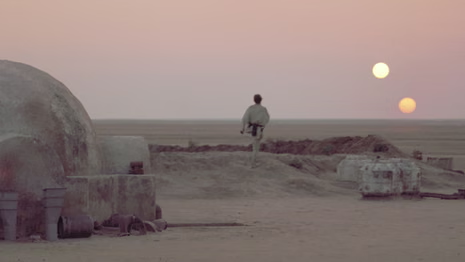
The vast mysteries of the cosmos have always sparked our deepest human wonder. On this special day for space fans, science has brought fiction closer to reality. Researchers have just announced the discovery of twenty-seven potential new planets in deep space. These distant worlds are unique because they orbit two stars instead of only one. This rare celestial arrangement creates a stunning visual similar to the famous Tatooine scenes. For decades, we thought such worlds were only the products of cinematic imagination. Now, we know these double-sun systems are actually quite common across the galaxy. This discovery has significantly expanded our understanding of how various solar systems can form. Our own sun is a lonely star, but many others travel in pairs. This new report highlights how diverse and strange the universe can truly be.
The timing of this announcement feels perfect for fans of the stars everywhere. Scientists chose to share these findings during a global celebration of space fantasy. We have long known about thousands of planets orbiting single, solitary sun-like stars. Only a handful of these circumbinary planets had been confirmed until very recently. The total number of these special worlds used to be incredibly small and rare. Now, the tally of potential candidates has nearly doubled in one single study. These new worlds are located many thousands of light years away from our home. Such distances are difficult for the human mind to grasp or fully visualize. Yet, the data tells a clear story of distant suns and orbiting spheres. Each of these planets represents a new frontier for our modern astronomical tools. We are finally peering into corners of the galaxy once hidden from view.

Associate Professor Ben Montet led this ambitious study at a famous Australian university. He explains that many concepts in astronomy feel very abstract to the public. However, the image of a double sunset is something everyone can easily imagine. This cultural connection makes the scientific data feel much more personal and real. People can picture themselves standing on a surface watching two different suns set. This shared vision helps bridge the gap between complex math and human experience. The team at the University of New South Wales worked tirelessly for years. They wanted to find worlds that traditional methods might have missed quite easily. Their dedication has now paid off with a long list of new candidates. This research proves that our galaxy is far more crowded than once thought. Every new planet discovered changes the way we view our place in space.
In our universe, more than half of all stars exist in pairs. These binary systems are actually the standard way that many stars are born. Despite this fact, finding planets around them has always been a major challenge. Traditionally, astronomers look for a dip in light as a planet passes by. This event is called a transit and acts like a tiny solar eclipse. If the planet does not cross directly in front, we cannot see it. This means we have likely missed millions of planets using only that method. It is like trying to spot a tiny candle next to a lighthouse. The glare of the twin stars often hides everything else in the system. To overcome this, the researchers had to think of a brand new way. They needed a method that did not rely on perfect visual alignment alone. Their creative thinking has opened a new door for future planet hunters everywhere.
The team focused on a phenomenon known technically as the apsidal precession effect. They carefully watched for a specific wobble in the orbits of the stars. When a hidden planet is present, its gravity pulls on the two suns. This causes the timing of their eclipses to change in a predictable way. By monitoring these tiny shifts, the scientists can detect a hidden third body. Margo Thornton, the lead author, spent many months analyzing these complex orbital timings. She looked at over fifteen hundred different star systems to find these patterns. After filtering out other gravitational factors, thirty-six systems showed very unusual physical behavior. Out of those, twenty-seven appear to be the correct mass for a planet. These objects are likely giant gas worlds similar to Neptune or even Jupiter. They are much larger than Earth but represent a massive leap in knowledge.
Confirming the exact nature of these objects is the next vital scientific step. Researchers need to study the light spectra to determine their true physical mass. Some might be small stars or brown dwarfs instead of actual rocky planets. However, the probability of them being planets is currently very high and exciting. The data for this massive project came from a powerful NASA space telescope. This satellite was launched years ago specifically to hunt for new alien worlds. It has provided a treasure trove of information for astronomers across the globe. By using this data in a new way, the team found gold. This shows that old information can still yield brand new and surprising results. Science is often about looking at the same data with fresh eyes. This study is a perfect example of that persistent and creative spirit.

Dr. Sara Webb is an astrophysicist who has praised this very clever technique. She believes these methods will help us find even more planets very soon. These circumbinary environments are likely very extreme and harsh compared to our Earth. The gravitational dance of two suns creates wild seasons and unpredictable weather patterns. Yet, there is still a chance for a “sweet spot” to exist there. This is a zone where temperatures are just right for liquid water. When the first space movies were made, we knew of no exoplanets. Our knowledge was limited to the small family of planets in our system. Today, we realize that nature is far more creative than our old maps. The gap between science and art continues to shrink with every new year. What was once a dream is now a data point on a chart.
The findings have been published in a prestigious royal society journal this week. This peer-reviewed work ensures that the data is accurate and scientifically very sound. It marks a major milestone for the university and the global science community. As we look up at the night sky, we can imagine more. We now know that double sunsets are not just for the big screen. They are happening right now across thousands of different and distant solar systems. Our galaxy is a vast collection of worlds waiting to be fully seen. Every discovery like this reminds us of how much left there is. We are living in a golden age of discovery and celestial exploration. The English Chronicle will continue to follow these stories as they develop. For now, we can simply marvel at the beauty of the cosmos. Space truly is the final frontier for our curious and wandering human minds.
Related News:
 How Bringing Forests Into Preschools Boosts Children’s Health
 Critically Endangered Spider Rediscovered in UK After 40 Years
 UK Bans Fake Numbers: Scammers Lose Their Trick
 England Curriculum Review Recommends Major Changes
 Mortgages and AI Set to Feature in English Schools
 Experts Urge Legal Right to Timely Cancer Care
 Patients to Test Health at Home to Ease NHS Winter Pressure
 One of world’s last dinosaurs on sale for £3m
 North Sea oil workers must lose weight or face job loss
 No link found between paracetamol in pregnancy and autism
 Government urges schools to ban phones to curb classroom disruption
 Northern Lights May Illuminate UK Skies Amid Strong Solar Storm
 Northern Lights may illuminate UK skies this week
 UK Greenlights First Small Nuclear Plant in North Wales
 Higgs Donates Nobel Medal to His Beloved University
 Coffins Now Too Large to Cremate Amid Rising Obesity Crisis
 UK Taskforce Unveils Plan to Streamline Nuclear Reactor Rules
 Thinktank Urges Smaller Hospitals to End NHS ‘Permacrisis’
 NHS paediatric leave parents waiting months for answers
 Ofcom urges platforms to limit abuse and curb online ‘pile-ons’
 Starmer’s communications chief to outline media strategy overhaul
 UK Car Sales Pass 2 Million as Chinese Brands Surge
 AI Grok Sparks Child Safety Alarm in the UK
 Lammy and Vance unite against AI abuse images on X
 UK Threatens Action Against X Over Sexualised AI Images
 Amazon Milton Keynes closure sparks concern for UK warehouse workforce
 AI will transform human jobs, enhancing skills, says minister
 TikTok to Strengthen Age Verification Across the EU
 MPs warn AI financial risks threaten UK stability
 MPs warn AI financial risks threaten UK stability
 AI job losses UK: Britain faces sharper employment shock
 Pornhub blocks new UK users over age checks dispute
 UK New Car Discounts Near £6,000 as Prices Are Slashed
 Barnsley tech town leads UK AI transformation
 Childnet Censorship Row Over Teen Safety Speeches
 Revenge Porn Crackdown: 48-Hour Rule Warning
 UK Anti-Slavery Watchdog Urges Adult Sites Overhaul
 Facial Recognition Error Leads to Wrongful Arrest in Milton Keynes
 UK Social Media Ban for Under-16s Gains Momentum
 Met police to trial handheld facial recognition checks in London
 UK Teen Social Media Ban Trials Begin
 Cancer Death Rate in Britain Falls by Nearly a Third
 Ministers Urged to Act Faster on Deepfakes Threat
 MPs Reject Ban on Social Media for Under-16s
 Scientists Unveil Heavier Proton at CERN LHC
 Charity Watchdog Warns Alan Turing Institute Over Conduct
 Traffic: The Science Behind Why Slower Cars Always Catch Up
 The Night an AI Bot Threw a Party in Manchester
 OpenAI Halts Stargate UK Project Amid Energy Crisis
 Heavier SUVs Accelerate Britain’s Pothole Crisis
 Europe EV Demand Surges as Fuel Prices Rise
 Liz Kendall: UK Must Seize AI Growth Despite Risks
 Reform UK funding: mystery billionaire revealed
 Virtual Racing Faces New Era of Anti-Doping Measures
 Cambridge South Signals New Era for British Rail Travel
 Alarm as Sextortion and AI Abuse Threaten UK Children
 UK rejects EV charging VAT cut amid Treasury clash
 UK firms accused of ‘AI washing’ boom
 British Paralympian Set to Make History in Earth Orbit
 UK to Expand Prostate Cancer Trials for Black Men
 NHS Approves Landmark Ovarian Cancer Drug
 Tech Trends and the Battle Against Exam Hall Cheating
 Aviva Exposes Record £230m in Fraudulent AI Claims
 Stolen Mobiles Could Soon Become Useless Bricks
 UK Ministers Lobby Trump Over Under-16s Social Media Ban
 AI Lawyer Triumphs in Landmark English Court Victory
 How the ‘Happy Vowel’ Defines Class in Manchester
 UK Mobile Connectivity Trails Global Peers
 Reeves Launches City AI Skills Compact
 London’s 2026 ‘Great Stink’ Raises Sewer Concerns
 Sundar Pichai Cautions on AI Hype and Market Risks
 Inside the Helpline Protecting Missing Children in the UK
 PlayStation PS5 Deals Hit Lowest Prices Ahead of Black Friday
 Five-Year-Old Dies After Rare Tonsil Surgery Complication
 Starmer Says Labour’s Economic Plan Needs Years to Deliver
 Reform UK Faces Crisis as Newly Elected Councillors Resign
 Starmer Strikes Back as 100 MPs Sign Support Pledge
 UK Firms Freeze Spending as Iran Conflict Bites
 Reeves to Fast-Track Clean Energy Amid Iran Crisis
 The Battle for Wembley Sparking Unprecedented Legal Warfare