Published: 5 May 2026. The English Chronicle Desk. The English Chronicle Online
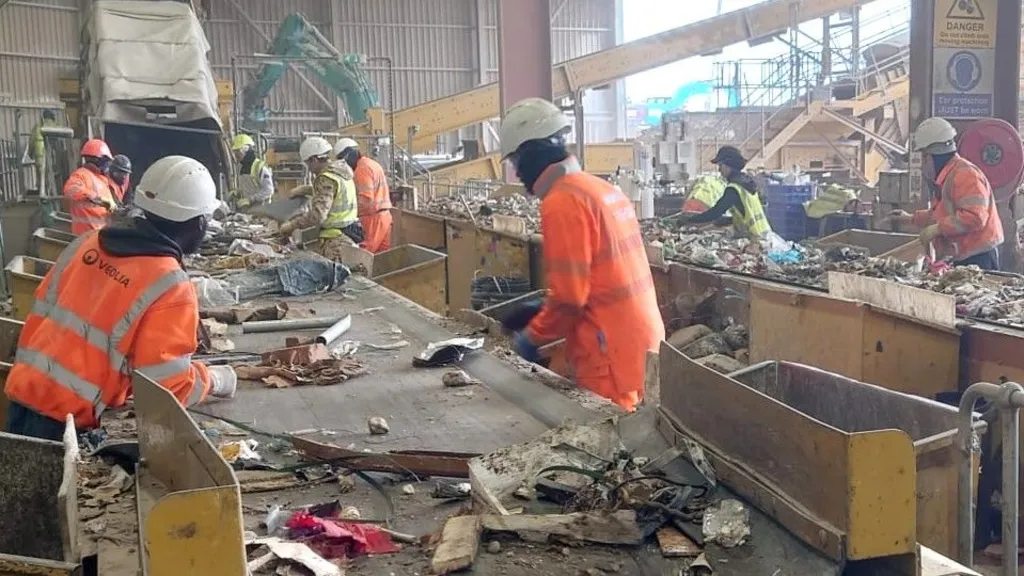
In the “unforgiving” environment of the world’s material recovery facilities (MRFs), a quiet revolution is replacing human hands with high-speed silicon. Faced with a chronic “resilience deficit” in their workforce—where annual staff turnover now routinely hits 40%—waste management firms are pivoting toward advanced robotics to keep the conveyor belts moving.

The industry, once reliant on agency workers to sift through debris in a “dopamine desert” of repetitive labor, is witnessing a historic “milestone” in 2026. From autonomous collection vehicles to humanoid “Automated Litter Processing Assistants” (ALPHAs), the “clinical silence” of the machine is fast becoming the new sound of global recycling.
Large-scale operators are moving past pilot programs and into full-scale robotic modernization.
The Humanoid Bet: In the UK, the Sharp Group has begun training “Alpha,” a humanoid robot built by China’s RealMan Robotics. Unlike traditional fixed machinery, these robots are designed to slot into existing human picking lines, using VR-trained AI to identify everything from old trainers to concrete slabs.
Superhuman Accuracy: While human sorters typically average 70-80% accuracy, AI-powered vision robots like those from AMP Robotics and Tomra are achieving 95% precision. This higher purity allows firms to command better prices for recyclables, offsetting the $1.2 million typically spent on manual labor with a robotic cost closer to $660,000.
Safety First: Robotics are increasingly deployed in “hazardous environments,” handling chemical and electronic waste that poses significant health risks to human workers, thereby reducing the “national security emergency” of industrial accidents.
The move to automation is a functional necessity born from a “recruitment rot” that has plagued the sector since 2024.
The “Unattractive” Job Gap: With over-50s increasingly “frozen out” of the labor market and younger workers seeking “digital-first” careers, firms have found it nearly impossible to fill the “early-morning bin collection” and “dirty conveyor” roles.
The “Hormuz” of Materials: Much like the Strait of Hormuz blockade has forced a rethink of global supply chains, the global waste volume—projected to hit 2.2 billion tons by 2030—has created a bottleneck that manual labor simply cannot clear.
Upskilling the Survivors: Rather than total replacement, the 2026 strategy focuses on “reskilling.” Former sorters are being trained to maintain and oversee the robots, moving them away from the noise, heavy lifting, and unpleasant fumes of the front line.
The 2026 waste landscape is no longer just about sorting; it’s about a “human-machine coordination” across the entire urban grid.
Autonomous Fleets: Self-driving collection trucks are now navigating city streets using LiDAR and GPS, optimizing routes based on real-time data from “smart bin sensors.”
Predictive Maintenance: Using AI-driven CMMS (Computerized Maintenance Management Systems), firms can predict when a robot or truck is likely to fail, ensuring 99% fleet uptime and avoiding the “clinical silence” of a broken-down service.
The Global Market: The trash robot market has soared to a $1.2 billion valuation this year, with Asia-Pacific regions leading the way by piloting autonomous systems in 25% of their urban areas.

As the RHS Wisley wisteria blooms and the Southbank Centre celebrates 75 years of progress, the waste industry’s robotic pivot serves as a “golden tone” of industrial evolution.
“Justice has no expiry date for the environment,” noted one industry analyst. “If we can’t find the people to sort our waste, we must find the technology.” With the King’s Speech on May 13 expected to address “Social Cohesion and the Technological Future,” the transformation of the “bin man” into a “robotics supervisor” marks a definitive end to the labor-intensive models of the 20th century.
Related News:
 Quantum Computing: Is This the Tech Race Europe Could Finally Win?
 UK’s Largest Proposed Datacentre Faces Water Use Concerns
 BP’s Influence Sparks Controversy in UK STEM Education
 Robo-Vaccination Could Transform Fight Against Bovine TB
 Fungi Mining and Giant Waste Piles: How to Get Rare Earths Without Mining Rock
 How China Became Fixated on Cloud Seeding
 AI Climate Claims Face Greenwashing Backlash
 Brace for Trump’s Brave New World of 1.7°C Global Warming
 Urgent AI Threat Research Needed, Says Google Boss
 Met Police Using AI Tools Supplied by Palantir to Flag Officer Misconduct
 Ocean Warming Drives Massive Marine Life Loss, Study Warns
 Anthropic Boss Rejects Pentagon Demand to Drop AI Safeguards
 Jack Dorsey’s Block Cuts Thousands of Jobs as It Embraces AI
 How AI Can Read Our Scrambled Inner Thoughts
 The Sad, Strange Story of the World’s Most Radioactive Paradise
 Water Cremation Introduced in UK First
 Boy George Says He’s Using ChatGPT to Help Write New Songs
 Fuel and Remittances: How Iran Conflict Hits India At Home
 Tiny Possum and Glider Thought Extinct for 6,000 Years Found in Remote West Papua
 US Eases Sanctions on Russian Oil Sales to India During Iran Conflict
 Ukraine’s Anti-Drone Bullet Could Shield Gulf Skies
 Net Zero by 2050 ‘Cheaper Than One Fossil Fuel Crisis’
 Musk’s xAI Permit Sparks Fury Over Power Plant Expansion
 ‘Greedy’ Beaver Caught Twice in Wildlife Monitoring Trap
 ‘Drinking from a Fetid Pond’: Superbug Genes in Lough Neagh
 India’s $300bn Outsourcing Industry Faces AI Test
 NHS Enlists AI in Major Push to Slash Hospital Waiting Lists
 Councils Pressed to Use Universal Parking App to Cut ‘Unfair’ Fines
 China’s Tech Giants Race to Hong Kong as Global “Staging Post”
 One Ant for $220: The New Frontier of Wildlife Trafficking
 China’s AI ‘Lobster’ Craze Signals Bigger Ambitions
 China and the US: The Divergent Fronts of the Global AI Superpower Race
 Beyond the Far Side: Artemis II Restores Contact After 40-Minute Silence
 Beyond the Flyby: What Artemis II Tells Us About the Next Giant Leap
 The Silicon Emerald: How Irish Engineers are Cashing In on the AI Boom
 The Great Escape: ‘Challenging’ Search for Missing Capybara Enters New Phase
 Southern Skies: High Turnout and Surprise Visitors in Birdwatch 2026
 The Lithium Inferno: Lorry Loaded with Batteries Engulfs Major Motorway
 Artemis II Returns After Historic Moon Flyby
 Big Tech Lobbies EU to Hide Massive Datacentre Emissions
 Robots Outpace Humans in Beijing Half-Marathon
 Gene Therapy Wins Major Prize for Restoring Vision
 Tsunami Alerts Eased After Magnitude 7.7 Earthquake Rattles Northern Japan
 ‘A Week of Fear’: Japan Braced for Magnitude 8.0 Megaquake After Sanriku Jolt
 ‘A Ticking Time Bomb’: Communities Sound Alarm Over ‘Catastrophic’ Battery Storage Risks
 The Next Chapter: Apple’s Future Under the Stewardship of John Ternus
 Reform UK funding: mystery billionaire revealed
 Disneyland Adds Facial Recognition at Entrances
 Meta Faces EU Action Over Child Safety Breach
 Inside the World of AI Jailbreakers
 The Ethylene Enigma: Is Foil-Wrapping the Stems Truly the Secret to “Evergreen” Bananas?
 Record May Heat to Cold Front in Eastern Australia
 “Taking the Fight to Amazon”: GameStop Launches Unsolicited $55.5bn Bid for eBay
 Canadian Fiddler Sues Google Over AI Defamation Claim
 UK Bans Fake Numbers: Scammers Lose Their Trick
 Vibe coding’ named Collins dictionary’s word of the year
 Sundar Pichai Cautions on AI Hype and Market Risks
 ‘Extinct’ Antelope Returns to Sahara, Bringing Hope
 Conservatives Pledge to Scrap 2030 Petrol and Diesel Car Ban
 UK Weather: End of Cold Spell in Sight as Temperatures Rise
 US Clears Nvidia AI Chip Sales to China in Policy Shift
 No Gas Boiler Ban as UK Warm Homes Plan Backs Heat Pumps
 Devon hosts first high-density hydro power system
 AI breast screening cuts later cancer diagnoses by 12%, study finds
 Most Statin Side-Effects Are Not Caused by Drugs, Study Confirms
 How Do You Modernise Mango Farming? India’s Growers Urged to Innovate as Climate Change Hits
 AI Coding Firm’s ‘Pride’ at Business Award Win
 Stewart Brand on Musk, Bezos and a Life of Long Thinking
 Iran War Puts Trump at Political Risk Amid Rising Prices
 Social Media Giant Trial Reaches Final Jury Decision
 UK Forces Ready to Seize Russian Shadow Fleet Vessels
 Trump Considers Military Operation to Seize Iran’s Uranium
 ‘Zoom Dysmorphia’ Explosion: BDD Patients Quadruple in Post-Pandemic UK
 ‘The Insulation Trap’: Knifeman Discovered Hiding Under Loft Padding After Six-Hour Standoff
 The Banbridge Rescue: 300 Sheep Saved from Massive Hay Shed Inferno
 Electric Shock: Australians Buy Record Number of New EVs as Fuel Crisis Bites
 The Great Chokehold: Why the Strait of Hormuz is the Epicenter of the 2026 Crisis
 Moldova River Crisis Exposes War’s Hidden Cost
 Governments Fail Murray-Darling River Projects
 The “Dry” Life: Teens Trialing Social Media Bans Call Initial Disconnection “Boring” and “Dry”