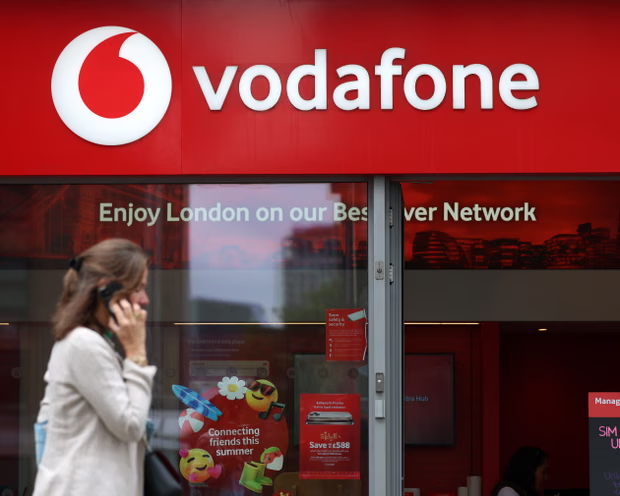
Published: 22 September ‘2025. The English Chronicle Desk. The English Chronicle Online
Vodafone, one of the UK’s most recognisable telecoms brands, is facing growing scrutiny over its treatment of franchisees, after it emerged that warnings about the devastating mental health impact of commission cuts had been raised as far back as 2020—four years before a £120m High Court claim was launched. The revelations shed light on deep-rooted dissatisfaction among small business owners who operated Vodafone’s retail stores, and whose testimonies describe lives upended by stress, financial instability and a sense of betrayal.
The controversy centres on a decision made during the Covid-19 pandemic, when Vodafone reduced the fees paid to franchisees for selling its products and services. For many small operators, these commissions represented the backbone of their businesses. With the pandemic already weakening consumer activity and heightening uncertainty, the cuts came as a crushing blow. What had once been marketed as a partnership with a global brand began to feel, for many, like a one-sided relationship in which small retailers bore the risks while Vodafone reaped the rewards.

A survey carried out in September 2020 by a steering committee of franchisees—modelled on questionnaires from the British Franchise Association—provides a snapshot of the despair that rippled through the community. Out of 167 historic Vodafone franchisees, 119 responded. Their feedback was unflinchingly bleak. Asked to rate their trust in Vodafone’s word, franchisees gave a score of just 1.75 out of five. On whether they felt truly valued by the company, the score fell further to 1.67.
Yet it was in their written comments that the most harrowing details emerged. Franchisees spoke of sleepless nights, panic attacks, and deteriorating family lives. One admitted: “My mental health has become very poor as I am suffering from anxiety and spells of depression.” Another confessed: “The stress and worry of not hitting overheads is giving me anxiety. I feel the constant threat of losing my savings, home and livelihood.” Others described panic attacks, illness brought on by stress, and a corrosive effect on their home life.
These testimonies foreshadow the grievances now at the centre of the legal case launched in December 2024 by 62 franchisees—representing nearly 40% of Vodafone’s entire franchise base. Their claim alleges that Vodafone “unjustly enriched” itself by slashing commissions and in the process inflicted devastating financial and psychological harm on the small business owners who had invested heavily in running its branded stores. For many, the financial losses ran to six figures, with personal debts surpassing £100,000. Some claimants have even said the pressures drove them to suicidal thoughts.
The comparison with the Post Office Horizon IT scandal has not gone unnoticed. Several MPs have drawn parallels, noting how systemic corporate decisions can have ruinous consequences for individual operators, many of whom are left isolated and voiceless against powerful institutions. Like the Post Office case, the Vodafone dispute raises broader questions about corporate accountability, oversight, and the fairness of franchise models that often leave smaller players dangerously exposed.
Vodafone has sought to defend itself against the mounting criticism. A company spokesperson expressed regret for any negative experiences, emphasising that Vodafone UK encourages franchisees to raise concerns “in the knowledge they will be taken seriously.” The spokesperson also highlighted that many franchisees had successfully expanded their operations by taking on additional stores, pointing to what the company described as a “successful franchise operation.” Vodafone further confirmed it has launched a fourth investigation into historic practices within its franchising division, but continues to “strongly refute” the allegations, framing the court battle as a “commercial dispute” rather than evidence of systemic wrongdoing.
Nevertheless, the legal action and the historical survey together paint a troubling picture of discontent that was both widespread and long-standing. That so many franchisees reported mental health struggles linked directly to corporate decisions raises pressing questions about duty of care in franchising arrangements. Small operators, often financially and emotionally invested far beyond what a corporate balance sheet might reveal, found themselves squeezed by a global brand with far greater resilience to weather storms like the Covid-19 pandemic.

The High Court case will be closely watched not only for its potential financial consequences for Vodafone but also for the precedent it may set in terms of corporate responsibility towards franchisees. If the claimants succeed, it could embolden others in similar situations across different industries to challenge practices they consider exploitative or unfair. Even if Vodafone prevails, the damage to its reputation as a trusted partner for entrepreneurs may prove lasting.
At the heart of the dispute lies a fundamental imbalance of power. For the franchisees, operating under Vodafone’s branding was a promise of security and shared prosperity. Yet the reality, according to their testimonies, has been one of vulnerability, stress, and financial peril. Their stories reflect not just a clash between small businesses and a telecoms giant, but a wider reckoning with the ethics of franchising in modern Britain.
As the case progresses, the words of the franchisees from that 2020 survey stand as a stark reminder of what is truly at stake. Behind the balance sheets and legal arguments are people who saw their mental health deteriorate, their family lives unravel, and their futures placed in jeopardy. Whether justice will be served in the courtroom remains to be seen, but the voices of those who spoke up years ago are now impossible to ignore.
Related News:
 UK Jobs Market Faces Strain as Employers Cut Bonuses and Hiring Amid Economic Slowdown
 Shein UK Faces Allegations of Shifting Majority of Profits to Singapore to Reduce UK Tax
 Rachel Reeves Hosts Top UK and US Financial Executives as Trump’s State Visit Begins
 UK Inflation Holds Steady at 3.8% as Rising Fuel Costs Offset Falling Air Fares
 UK Borrowing Surges to £18bn in August, Exceeding Forecasts
 AstraZeneca to List on New York Stock Exchange While Retaining London Ties
 Richard Desmond Begins High Court Battle Over National Lottery Licence
 UK inflation update: New rate expected as Budget approaches
 Co-op Urged Staff to Promote Vapes After Cyber-Attack Hit Sales
 Rachel Reeves to lead UK trade push in Saudi Arabia amid rights debate
 UK Small Business Owner to Challenge L’Oréal in Tribunal
 Troubled drinks giant Diageo names former Tesco boss to lead turnaround push
 Mossmorran Plant Closure Hits Cowdenbeath Hard
 Rising Water Bills Lift Troubled Thames Back to Profit
 Gusto Faces Collapse as UK Dining Sector Crisis Deepens
 Bank of England Poised to Cut Interest Rates Amid Rising Unemployment and Global Trade Pressures
 Non-Dom Tax Crackdown Risks Backfiring as Exodus Threatens UK Revenue and Investment
Inflation Latest: Cost of Living Expected to Rise Again in Key Figures Released Today
Non-Dom Tax Crackdown Risks Backfiring as Exodus Threatens UK Revenue and Investment
Inflation Latest: Cost of Living Expected to Rise Again in Key Figures Released Today
 WH Smith Market Value Plummets by £600m Following North American Accounting Error
 Energy Users Could Save £5bn Annually if Gas Power Plants Are Removed from Market
Retail Sales See Uptick Amid Errors and Delays as ONS Faces Scrutiny
Energy Users Could Save £5bn Annually if Gas Power Plants Are Removed from Market
Retail Sales See Uptick Amid Errors and Delays as ONS Faces Scrutiny
 UK House Prices Hit Record £299,331 as Market Shows Steady Growth
 Londoners Buying Lowest Share of Property Outside Capital Since 2013
 UK Retail Sales Rise in August, but Tax Concerns Loom Over Festive Period
 Vodafone Faces Fourth Probe into Franchising Division Amid £120m Legal Battle
 Merck Abandons £1bn London Research Hub and Cuts 125 Jobs in Blow to UK Life Sciences
 John Lewis Partnership Posts £88m Loss as Costs and Restructuring Bite
 UK Economy Flatlines in July, Raising Pressure on Rachel Reeves Ahead of Autumn Budget
Business Rates Hike Could Threaten Hundreds of UK Retailers, Putting 100,000 Jobs at Risk
UK Economy Flatlines in July, Raising Pressure on Rachel Reeves Ahead of Autumn Budget
Business Rates Hike Could Threaten Hundreds of UK Retailers, Putting 100,000 Jobs at Risk
 UK Labour Market Shows Signs of Cooling as Wage Growth Slows and Redundancies Rise
 UK Wage Growth Remains High, But Cost of Living Pressures Bite
 Ben & Jerry’s Co-Founder Resigns, Accusing Unilever of Silencing Brand’s Social Mission
 Next Shares Slide Amid Warning on Weak UK Growth and Jobs
 Farage’s Reform UK Receives £100,000 from Design Firm with Past Tax Issues
 Dagenham Left in Limbo After Smithfield and Billingsgate Market Relocation Cancelled
 King Charles Earns Over £1 Million from Duchy Land Linked to Scrapped HS2 Project
 Public Skepticism Over AI Poses Challenge to UK’s Superpower Ambitions, Says Tony Blair Institute
 Gatwick Secures Approval for £2.2bn Second Runway Expansion
Resolution Foundation Urges Reeves to Rebalance Tax System with 2p NI Switch in Autumn Budget
Nearly 1.5 Million Homes Could Be Built on Brownfield Sites in England, Report Reveals
UK White-Collar Workers Face Increasing Office Attendance as Hybrid Balance Shifts
Gatwick Secures Approval for £2.2bn Second Runway Expansion
Resolution Foundation Urges Reeves to Rebalance Tax System with 2p NI Switch in Autumn Budget
Nearly 1.5 Million Homes Could Be Built on Brownfield Sites in England, Report Reveals
UK White-Collar Workers Face Increasing Office Attendance as Hybrid Balance Shifts
 UK Government Backs Return of International Rail Travel to Kent Stations
 Labour to Unveil Ambitious Plan for 12 New Towns to Tackle England’s Housing Crisis
 GSK Chief Executive Emma Walmsley to Step Down After Eight Years at the Helm
 Retailers Warn Tax Rises Could Prolong Inflation as Shop Prices Climb
 Marks & Spencer Staff to Work on Boxing Day for First Time in Five Years Amid Cost-Cutting Measures
UK Housing Market Returns to Growth Amid Signs of Stability and Regional Variation
Marks & Spencer Staff to Work on Boxing Day for First Time in Five Years Amid Cost-Cutting Measures
UK Housing Market Returns to Growth Amid Signs of Stability and Regional Variation
 UK Government Secures £122m Win Against Michelle Mone-Linked Firm Over Defective PPE
 Delivery Apps Could Double the Cost of Your Groceries, Warns Consumer Watchdog
 Jaguar Land Rover to Resume Production After Cyber-Attack, Launches Supplier Support Scheme
 Gold Hits Historic $4,000 Amid Global Uncertainty
 Millions Face Higher Water Bills After Regulator Approves Hikes
 Massive Vodafone Outage Disrupts Internet and Mobile Services Across the UK
 UK GDP edges up 0.1% in August as Reeves faces budget pressure
 Rachel Reeves urged to consider welfare cuts to boost fiscal credibility
 Pizza Hut to shut 68 sites after collapsing into administration
 Lotto result jackpot draw halted due to technical glitch
 Aston Martin cuts £300m investment as Trump tariffs and weak China demand hit profits.
 Court Hears Challenge Over Water Bills Funding Sewage Fixes
 Rachel Reeves Set to Break Labour Pledge and Raise Income Tax
 UPS Cargo Plane Crash in Kentucky Kills Seven
 Thinktanks Urge Rachel Reeves to Reform UK Tax System
 Gopichand Hinduja, UK’s Wealthiest Business Leader, Dies
 Tony Blair think tank warns Rachel Reeves must cut taxes if manifesto broken
MPs Press Rachel Reeves to Hike Gambling Taxes
Cuts to home insulation funding threaten UK climate goals
Tony Blair think tank warns Rachel Reeves must cut taxes if manifesto broken
MPs Press Rachel Reeves to Hike Gambling Taxes
Cuts to home insulation funding threaten UK climate goals
 Warning as Britons prepare to spend £4 billion this Black Friday
 Taylor Wimpey Sales Drop Amid Budget Uncertainty
 Reeves’s Tax U-Turn Triggers Fresh Jitters in UK Markets
 Global markets drop amid tech sell-off and China slowdown
 PM Highlights UK Business at G20 in South Africa
 Eurotunnel Investment Halted as UK Rates Soar
 UK Energy Bills to Rise Slightly in January
 UK Government Borrowing Higher Than Expected
 Netherlands Suspends Nexperia Takeover Amid China Talks
 Minister Denies Budget Leaks Have Harmed UK Economy
Budget 2025: Reeves Drops Economic Growth Reference
Minister Denies Budget Leaks Have Harmed UK Economy
Budget 2025: Reeves Drops Economic Growth Reference
 Huawei, ZTE secure 5G deals in Vietnam amid US tensions
 Black Friday Footfall Falls as UK Shoppers Hold Back Amid Economic Concerns
 Prada buys Versace for $1.38bn, expanding luxury fashion empire