Published: 18 November 2025 Tuesday. The English Chronicle Desk. The English Chronicle Online
David Fincher’s gritty thriller Seven did more than shock audiences with its gruesome imagery; it captured the anxieties, urban decay, and moral contradictions of the United States in the 1980s. Thirty years after its release, the film remains a benchmark of neo-noir crime storytelling, with box office earnings of $327 million on a modest $34 million budget, critical acclaim, and an enduring cultural footprint. Yet beneath the blood and the iconic twist ending lies a subtle but compelling critique of the social landscape from which it emerged—a world of urban blight, rising crime, and the uneasy intersection of religious conservatism and political power.
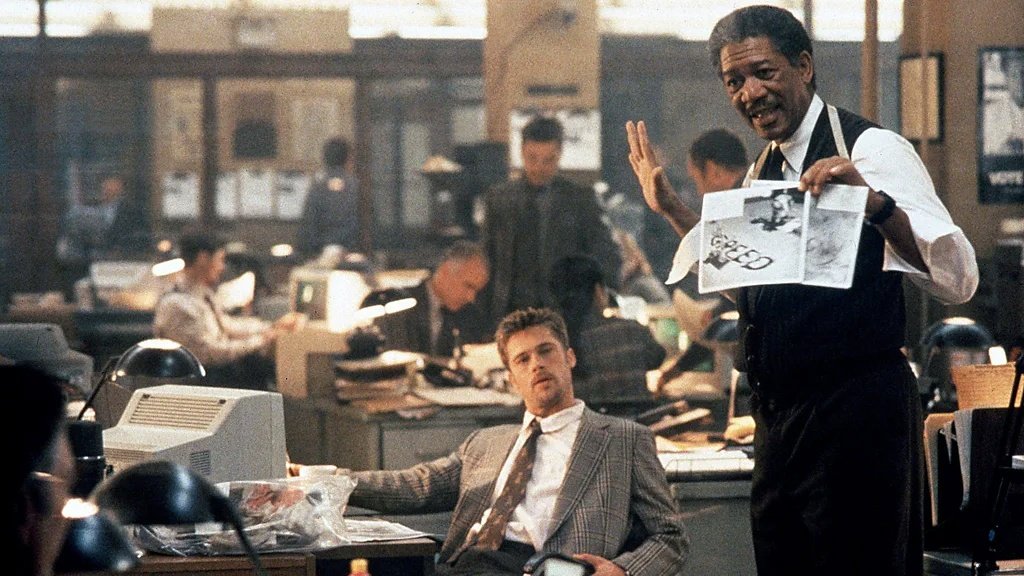
When the film premiered in 1995, it drew praise for its cinematic style and performances. Morgan Freeman’s weary Detective William Somerset and Brad Pitt’s impetuous rookie David Mills offered a compelling contrast of experience and naïveté. Kevin Spacey, virtually uncredited at the film’s opening, delivered a chilling portrayal of John Doe, a methodical serial killer who frames his murders around the seven deadly sins. Critics at the time, however, often dismissed the film as a sensationalized exercise in gore. The Washington Post lamented the “formulaic writing” masked by the “bloodletting,” while the New York Times called it “dull” despite its piles of body parts.
Yet decades later, scholars, critics, and audiences alike recognize that Seven resonates far beyond its shock value. It is, in essence, a dark mirror reflecting the social crises of the 1980s: the economic recession, the crack cocaine epidemic, soaring urban crime, and the public health emergency of AIDS. President Ronald Reagan’s administration, rising amid these crises, responded with rhetoric emphasizing law and order and the promotion of “traditional family values,” often under the moral guidance of prominent Christian conservative leaders.

In this environment, the figure of John Doe emerges not merely as a psychopath but as a symbol of society’s obsession with moral order. The murders, each corresponding to a deadly sin, are presented as moral judgments against the perceived failings of contemporary society. Gluttony, greed, sloth, envy, wrath, pride, and lust are not abstract notions; they are embodied in the victims, forcing viewers to confront the sometimes hypocritical moral discourse of the era.
The film’s premise is deceptively simple. Somerset and Mills pursue Doe across a rain-soaked, perpetually twilight-ridden cityscape. The opening murder—a morbidly obese man forced to overeat—establishes the pattern of symbolic violence. Each subsequent crime escalates the psychological tension, culminating in the now-iconic twist: Mills’ wife, Tracy (Gwyneth Paltrow), becomes the final victim, leading Mills to succumb to the very sin Doe was enacting—wrath. The ending remains one of cinema’s most unforgettable finales, not just for the shock but for its meditation on human fragility and the limits of moral judgment.
The origins of Seven lie in the lived experience of screenwriter Andrew Kevin Walker. Walker moved to New York City in 1986, landing a job at Tower Records in Astoria, Queens. Coming from central Pennsylvania, he found the urban reality of New York—abandoned buildings, pervasive drug use, and the daily presence of violence—both overwhelming and alien. “Every time you’d walk up a stairwell, the crack vials would crunch underfoot,” Walker recalls. “Trash accumulated on the sidewalks, and after a while, I’d become inured to the sounds of gunshots. Across a week, you’d see a car abandoned, then its windows smashed and tires stripped, and by Saturday, it’d be a burnt skeleton. It felt like an external blight that eventually seeped into your soul and hollowed you out.”
This sense of urban decay is palpable in Seven’s cinematography. Fincher, working with cinematographer Darius Khondji, created a city that is at once timeless and specific: streets perpetually wet, skies darkened by clouds, interiors dimly lit. The visual language mirrors the thematic preoccupations of the story—the pervasive moral and social corruption that Walker witnessed in the 1980s. The setting becomes a character in its own right, one that shapes behavior and reflects despair.

Religious conservatism, another hallmark of the period, also permeates the narrative. The 1980s saw a surge in the influence of the Christian right in American politics, framing public discourse around sin, redemption, and moral responsibility. In Seven, John Doe acts as an extreme embodiment of this moralistic worldview, judging his victims according to a rigid code. Yet Fincher and Walker are careful not to present Doe’s philosophy as righteous. Instead, it is chilling precisely because it externalizes societal anxieties in the form of meticulous violence, highlighting the dangers of moral absolutism and the human cost of abstract ideology.
The film’s reception also foreshadowed today’s fascination with true crime. Seven’s methodical, procedural storytelling, coupled with its psychological depth, prefigured the way audiences would later consume real-world cases. Crime series, podcasts, and documentaries often examine not just the act itself but the sociocultural forces behind it. Seven does the same, albeit in a fictional and heightened way. Its lingering impact is evident in the way true crime is discussed today, with an emphasis on psychology, environment, and systemic failure, rather than merely sensational acts of violence.
Cultural and generational context matters as well. By the time Seven arrived in the mid-1990s, the anxieties of the 1980s had not fully dissipated. The economic boom of the late 1980s and early 1990s coexisted with persisting urban inequalities, and the legacy of Reagan-era policies was still tangible. The audience, particularly in the United States, could recognize in the decaying cityscape and the relentless moralist killings echoes of the society around them—whether in headlines about crack-related crime or debates over “family values.”
What sets Seven apart from other thrillers of the time is its ability to merge spectacle with social critique. The film’s violence, while shocking, is never gratuitous for the sake of entertainment alone. Each act serves narrative and thematic purposes, reinforcing the broader social commentary embedded within the noir aesthetic. In doing so, the film asks difficult questions: What does moral judgment mean in a society riddled with inequality? How do social structures fail their citizens? And how do ordinary individuals navigate moral ambiguity in a world seemingly devoid of hope?

The legacy of Seven is also technological and stylistic. Fincher’s meticulous attention to production design, lighting, and narrative pacing created a template for neo-noir thrillers in the decades that followed. Its influence can be traced in the dark atmospheres of films like Zodiac and Gone Girl, both Fincher projects, as well as in the tone of many contemporary crime series that emphasize psychological depth and moral complexity.
In retrospect, the film is as much a historical artifact as it is entertainment. It captures the urban malaise, political tensions, and cultural anxieties of 1980s America in a form that is visceral, haunting, and enduring. It reflects the fears of a nation confronting rapid social change, rising crime, and ideological polarization, all filtered through the lens of a thriller that is equal parts suspense and allegory.
As Walker notes, the experience of living in New York at that time fundamentally shaped the script. “It was a city alive with danger and decay,” he says. “The blight wasn’t just physical—it seeped into people’s lives, their behavior, their expectations. That feeling is at the heart of Seven, and I think it’s why it continues to resonate. It’s not just a story about a killer—it’s a story about the world we were living in, the anxieties we carried, and the ways we coped with them.”
Three decades on, Seven is more than just a thriller. It is a cinematic meditation on morality, a time capsule of a troubled era, and a prescient reflection on the American obsession with crime and punishment. Its enduring power lies not only in the shock of its images but in the unsettling truths it conveys about human nature and societal failure. In its rain-drenched streets and meticulously staged killings, the film reminds us that the blight of a city, the strictures of ideology, and the fragility of human morality are forces that, even in fiction, seep into our souls.
Related News:
 Meghan ‘to return to acting’ after eight-year hiatus
 Pauline Collins, Beloved ‘Shirley Valentine’ Star, Dies at 85
 Boos, backlash and body horror: The story of Alpha
 Pat Butcher Returns to EastEnders in Touching Dementia Storyline

 SS Rajamouli Announces ‘Varanasi,’ a Mythic Time-Travel Epic
 Tom Cruise Receives Honorary Oscar, Celebrates Cinema
 Director Michael Caton-Jones Reflects on Career and Beginnings
 Chappell Roan Delivers Fairytale Spectacle at Reading Festival, Cementing Pop Stardom
 Robert Redford: The Indispensable Patron of American Independent Cinema
 Academy Award-Winning Actress Diane Keaton Dies at 79
 Netflix’s A House of Dynamite Hits Reality Walls
 Prunella Scales: From Fawlty Towers Icon to Beloved Canal Explorer
 Charlie Kaufman: They told me Being John Malkovich would never get made
 Kate Winslet to Narrate Film Highlighting King’s Environmental Mission
 The upcoming book-to-screen adaptations I’m most excited about
 Hollywood Is an Industry of Looney Tunes Pretending to Be Normal
 I’m a Celebrity 2025 line-up revealed: Osbourne joins
 Lola Petticrew: ‘Calling it the Troubles minimises what it really was’
 Amber Davies Shines on Strictly – Time to Drop the West End Debate
 EastEnders icon Pat Butcher returns to Walford this Christmas
 Wuthering Heights: bold new trailer for Emerald Fennell’s epic adaptation
 Yungblud Pauses Tour Over Health Concerns, Apologises to Fans
 Two Judges Quit Miss Universe Amid Allegations of Rigged Competition
 New Miss Universe Crowned Amid Controversy in Thailand
 Robert Irwin Claims Dancing with the Stars Crown
 Rosalía Inspires Young Listeners to Discover Classical Music
 Belfast’s Elle Vosque finishes runner-up on Drag Race UK
 Sean Hayes Reimagined: From Sitcom Stardom to Serious Stage Acclaim
 September’s Must-See Films: From Spinal Tap II to Leonardo DiCaprio’s Latest Thriller
 Watchdog, Cornflakes and Courage: Remembering John Stapleton, a Broadcaster Who Did It All
 Beloved Actress Dame Patricia Routledge Dies Aged 96
 Karen Carney Shines on Strictly Come Dancing Week Two Despite Tango Wobbles
 Celebrity Traitors First Look: A Star-Studded Highland Adventure That Hooks from the Start
 Paedophile Singer Ian Watkins Dies After Prison Attack
 Strictly Celebs Starstruck as Cynthia Erivo Shines
 Dave Ball: The Unsung Genius Behind Soft Cell’s Bold Sound
 Peterborough Mosques Tighten Security After Attack
 Badenoch Warns Farage’s Grooming Gangs Plan Could Backfire
 FBI Director Kash Patel Defends Girlfriend Amid Government Jet Claims
 Police Probe Four Knife Incidents Linked to Cambridgeshire Train Attack
 French Taxi Driver Cleared in David Lammy Theft Case After Fare Dispute
 UK Bans Fake Numbers: Scammers Lose Their Trick
 Top Christmas Books Reads: Classics to Cozy Romcoms
 Just Stop Oil Protesters Convicted Amid Climate Defence Row
 Jailed UK climate protesters face extremist-style restrictions
 How to get help when a child goes missing – call 999 urgently
 ‘Reckless’ cuts to victims’ services will cost more than they save
 VAR Must Rein Its Neck In to Save Football’s Spirit
 From Lego to Pokémon: How Adults Are Driving UK Toy Market Growth
 Pop Stars Call on UK Government to Cap Resale Prices for Fans
 TalkTV Fires Mike Graham Over Racist Facebook Post
 Oklahoma Governor Grants Last-Minute Clemency to Death Row Inmate
 Rio Raid’s Death Toll Raises Questions About Gang Impact
 Israel Confirms Returned Hostage as Meny Godard
 Greene Pushes Epstein Files Amid Trump Fallout
 New Evidence Emerges in Haditha Family Killings
 Criminal Gangs Pose as Truckers to Hijack UK Supply Chains
 Mum Calls for New Licence Rules After Teen Road Death
 Mother Watches in Horror as Teen Daughter Dies on Tracks
 Agency Workers Vote to Join Picket Lines Amid Dispute
 Charlotte Raids: 130 Arrested in Major Immigration Sweep
 Eminem Takes Legal Aim at Australian ‘Swim Shady’ Brand
 Serial Rapist and Former Cop Found Guilty Again
 Man Charged Over Attempted Murder of Senior Officer
 Two Officers Injured After Van Deliberately Rams Patrol Car
 Ex-Harvard President Pauses Teaching Over Epstein Emails
 Ex-Olympian Snowboarder Now Drug Kingpin Charged with Murder
 Venezuela Threatens Nobel Winner Machado with Fugitive Status
 Most Tories Expect to Support a Farage-Led Government
 Bill Murray Terrified Wes Anderson but Became His Closest Collaborator
 Reggae Legend Jimmy Cliff Dies at 81
 Karen Carney Stuns on Blackpool Week, Deserves Strictly Final
 Prisoner 951 Review: arrowing Retelling of Nazanin Zagharz-Ratcliffe
 Trump Envoy to Discuss Ukraine Peace at Kremlin
 Two National Guard Soldiers Critically Injured Near White House
 Southern Lebanon reels as Israeli strikes shatter communities
 Video shows Israeli troops kill Palestinians after surrender
 Jordan Bardella: France’s Young Presidential Contender
 Pavarotti statue frozen in Italian ice rink sparks backlash