Published: 19 November 2025 Wednesday . The English Chronicle Desk. The English Chronicle Online
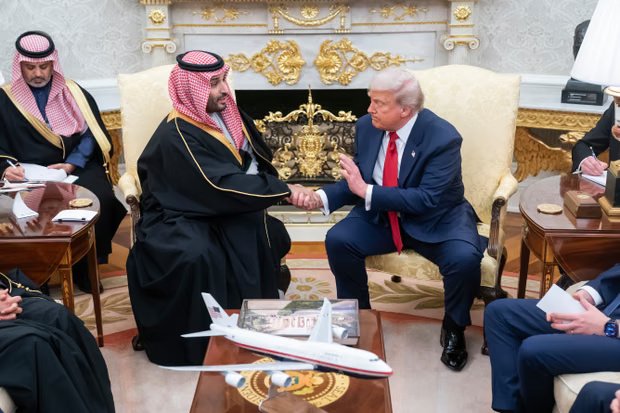
US President Donald Trump has publicly defended Saudi Arabia’s Crown Prince Mohammed bin Salman regarding the 2018 killing of journalist Jamal Khashoggi, insisting that the kingdom’s de facto ruler “knew nothing” about the operation that led to the Washington Post columnist’s death. The comments came as Trump welcomed the crown prince to the White House, marking his first visit to the United States since the assassination that sent shockwaves through US-Saudi relations.
Speaking in the Oval Office, Trump appeared to downplay the controversial nature of the 2018 murder. Addressing reporters, he said: “You’re mentioning someone that was extremely controversial. A lot of people didn’t like that gentleman that you’re talking about. Whether you like him or didn’t like him, things happen. But he [the crown prince] knew nothing about it. You don’t have to embarrass our guests.”
Trump’s remarks directly contradicted a US intelligence assessment published in 2021 under the Biden administration, which concluded that Crown Prince Mohammed bin Salman had approved the operation that resulted in Khashoggi’s death at the Saudi consulate in Istanbul. Despite this assessment, Trump has consistently portrayed the crown prince as having no direct involvement, reflecting his longstanding approach of maintaining close ties with Saudi leadership.
The crown prince himself addressed the murder during his visit, describing it as “painful” and acknowledging it as a “huge mistake.” He maintained that Saudi Arabia had taken appropriate steps to investigate Khashoggi’s death, insisting that the kingdom had acted correctly in its internal inquiry. His statements, however, stopped short of acknowledging personal culpability, creating a stark contrast with the US intelligence report.

For Khashoggi’s widow, Hanan, Trump’s defense of the crown prince was deeply troubling. Speaking to BBC Newsnight, she said that the president’s comments did not align with the crown prince’s own previous acknowledgment of responsibility. “The crown prince himself, in a 2019 60 Minutes interview, did take accountability and hold responsibility for this horrible crime,” she said. In a subsequent post on X, she also called for a meeting with bin Salman, along with a formal apology and compensation for her husband’s murder. Hanan Khashoggi, who was granted political asylum in the US, resides in the Washington DC area.
The White House visit, which includes a gala dinner and an investment summit, is the first major engagement between Trump and the crown prince since 2018. Beyond addressing the lingering tensions over Khashoggi’s killing, the discussions are expected to focus on a wide range of strategic and economic issues. Among the priorities are civilian nuclear power cooperation, artificial intelligence investments, and increased Saudi financial commitment to the US economy. According to bin Salman, the crown prince’s investment pledge to the United States has been increased to $1 trillion (£761bn), up from the $600 billion previously announced earlier this year.
Defense and security matters were also prominent on the agenda. Trump and bin Salman discussed a potential sale of advanced F-35 fighter aircraft to Saudi Arabia. While export licenses are still being processed, Trump indicated that a deal could soon be finalized between Saudi Arabia and Lockheed Martin, the US defense giant that manufactures the jets. The prospect of selling the F-35 to the Saudis has raised concerns among Israeli officials, who worry that it could affect Israel’s so-called “qualitative military edge” in the region. Trump, however, assured that the model supplied to Saudi Arabia would be broadly comparable to the one operated by Israel. “This [Saudi Arabia] is a great ally, and Israel is a great ally. I know they’d like you to get planes of reduced calibre. But as far as I’m concerned, I think they are both at a level where they should get top of the line,” he said.
The White House engagement also reflected the Trump administration’s broader approach to strengthening US-Saudi relations. Trump praised the kingdom’s strategic significance, highlighting its role in regional stability and global energy markets. The president repeatedly emphasised the economic and political benefits of closer ties, portraying the visit as a demonstration of the United States’ commitment to its long-term partnership with the kingdom.

The visit took place against the backdrop of ongoing debate in the US over accountability and human rights in Saudi Arabia. Critics of Trump’s stance argue that his unwavering support for the crown prince risks undermining the credibility of American foreign policy regarding press freedom and human rights advocacy. The Khashoggi case, which drew international condemnation, continues to be a potent symbol of these concerns. By publicly defending bin Salman, Trump has reignited discussions about the balance between strategic interests and ethical responsibilities in US-Saudi relations.
The crown prince’s White House agenda also included discussions on regional security, counterterrorism, and bilateral trade agreements. Both leaders stressed the importance of maintaining stability in the Middle East, with Trump framing Saudi Arabia as a key partner in the fight against extremism. Analysts suggest that the visit reinforces the long-term trajectory of US-Saudi collaboration, particularly in areas of defense, energy, and technology.
A notable highlight of the evening was the presence of Portuguese football superstar Cristiano Ronaldo, who has become a prominent figure in Saudi Arabia’s professional football league. Ronaldo’s attendance at the gala dinner underscored the crown prince’s efforts to use sports and entertainment as part of the country’s broader diversification strategy, aimed at reducing reliance on oil revenues. Alongside Ronaldo, high-profile business leaders including Elon Musk and Apple CEO Tim Cook were also present, reflecting the economic dimension of the visit and the crown prince’s ambitions to increase foreign investment in the kingdom.
Trump’s remarks and the visit as a whole mark a sharp departure from the approach taken by the Biden administration, which publicly condemned Saudi Arabia over Khashoggi’s murder and initially pledged to make the kingdom a “pariah” over its human rights record. Despite this, the US-Saudi partnership has historically remained resilient, given the strategic importance of the kingdom in regional security, energy markets, and counterterrorism initiatives.
The debate over accountability in the Khashoggi case remains a flashpoint in US politics. While Trump emphasized pragmatism and strategic alignment, human rights advocates continue to call for greater transparency and justice for the slain journalist. Hanan Khashoggi’s ongoing appeals for a formal apology and compensation highlight the enduring personal and political consequences of the assassination.

In the Oval Office, the tone of the visit conveyed both reconciliation and realpolitik. Trump’s assertion that “things happen” regarding Khashoggi’s death, paired with his assertion that the crown prince had no knowledge of the operation, reflects his prioritization of strategic partnership and economic engagement over confronting past transgressions. The crown prince’s acknowledgment of the incident as a “huge mistake” offered a partial nod to accountability but avoided direct personal responsibility, further illustrating the complex dynamics of the visit.
As the gala dinner and investment summit concluded, observers noted the clear signal Trump sought to send regarding US-Saudi relations. The meeting underscored the centrality of Saudi Arabia in US foreign policy calculations, particularly in terms of economic diversification, regional security, and defense collaboration. The inclusion of prominent figures from sports and business also reflected the multi-faceted nature of the crown prince’s agenda, emphasizing soft power alongside strategic diplomacy.
While Trump’s defense of Mohammed bin Salman has sparked controversy, particularly in light of the 2021 US intelligence findings, it remains consistent with his longstanding approach of prioritizing strategic alliances and economic engagement over human rights considerations. The visit also demonstrates the crown prince’s ongoing efforts to rebrand Saudi Arabia on the global stage, leveraging economic, technological, and cultural initiatives to strengthen international partnerships and investment opportunities.
As both leaders concluded the White House engagement, the overarching message was one of partnership, investment, and strategic alignment. The enduring debate over Khashoggi’s assassination, however, ensures that the visit will remain a focal point for discussion regarding accountability, justice, and the role of ethics in international diplomacy. The visit, combining political, economic, and cultural dimensions, encapsulates the complexities and contradictions inherent in modern US-Saudi relations.
Related News:
 Early Trends Suggest Modi’s Alliance Leading in Key Bihar Election
 India’s Labour Law Overhaul Sparks Fierce Debate
 Video shows Israeli troops kill Palestinians after surrender
 Chinese & Japanese Boats Clash Near Disputed Islands
 Putin Meets US Envoy Amid Key Ukraine Peace Talks
 Putin visits India as Ukraine peace, trade push intensifies
 The Explosive Fallout of a Broken Alliance Between Thailand and Cambodia
 Philippine Supreme Court Halts Impeachment of Sara Duterte, Fuelling 2028 Election Speculation
 Thailand and Cambodia Agree to Immediate Ceasefire Following Regional Diplomacy
 Tensions Flare as Thailand Accuses Cambodia of Breaching Hours-Old Ceasefire Amid Border Clashes
 British Woman in Iran ‘Losing Hope’ Amid Ongoing Detention
 BBC Journalist Held and Interrogated in Vietnam
 UK University Suspends Human Rights Research Following Pressure from China
 UK University Faces Counter-Terror Probe Over China Pressure
 Zohran Mamdani becomes New York City’s first Muslim mayor
 Abigail Spanberger Elected Virginia’s First Female Governor
 Mikie Sherrill Elected New Jersey’s Governor in Key Win
Zohran Mamdani names all-female transition team for NYC mayoralty
China-critical UK academics face ‘extremely heavy’ pressure from Beijing
Mikie Sherrill Elected New Jersey’s Governor in Key Win
Zohran Mamdani names all-female transition team for NYC mayoralty
China-critical UK academics face ‘extremely heavy’ pressure from Beijing
 British military receives first Ajax armoured vehicles – eight years late
 BBC to Apologise Over Edited Trump Speech Amid Backlash
 Second world war veterans honoured as King leads Remembrance Sunday
 Britain deploys RAF specialists to assist Belgium with drone threats
 BBC director-general and news chief resign amid bias row
 Suicide Bombing at Islamabad Court Kills 12, Injures Dozens
 Shook the ground under my feet: Panic as car blast hits near Delhi’s Red Fort
 Night after night, Belgium is on high alert.
 Ukraine-Russia war latest: Putin’s troops exploit bad weather to force Kyiv withdrawal from multiple towns
 Trump Claims Victory as Longest Shutdown Ends
 New Epstein Files Spark Political Clash in Washington
 Trump Ends Record Shutdown by Signing Temporary Funding Bill
 Hamas Fighters in Gaza Tunnels Stall Ceasefire Progress
 Thai King Embarks on Historic China Visit After 50 Years
 Delhi Car Blast Kills Eight, Declared Terror Incident
 Ukraine Energy Corruption Scandal Hits Zelensky’s Inner Circle
 Hasina Rejects Allegations Ahead of Bangladesh Tribunal Verdict
 US Justice Department Files Lawsuit Against California Over Partisan Voting Maps
 Berlin Reintroduces Military Service Amid Rising Security Concerns
 Greene Pushes Epstein Files Amid Trump Fallout
 Trump Deploys DHS to Charlotte in Major Arrest Operation
 South Korea Gains US Support for Nuclear Submarine Programme
 Former President Backs Public Release of Epstein Records
 December Run-Off in Chile as Election Produces No Winner
 Tragedy Strikes Indian Pilgrims in Saudi Bus Accident
 Ex-PM Hasina Gets Death Penalty for Crimes Against Humanity
 UN Security Council Approves Trump’s Gaza Peace Plan
 Ukraine to Get 100 French Rafale Jets in Historic Deal
 Canada Passes Carney’s First Budget in Tight Parliamentary Vote
 Why India is Unlikely to Return Sheikh Hasina to Face Execution
 Why Russian Liberals Push Strongly Pro-Israel Narratives
 Israeli Strike Kills 13 Near Palestinian Camp in Lebanon
 Congress Approves Release of Epstein Files, Trump Expected to Sign
 Shadow Fleet at Sea: Europe’s Battle Against Illicit Oil Shipping
 Rama Rebukes Mahmood for Targeting Albanian Families
 Russian Vessel Used Lasers on RAF Pilots, UK Claims
 Pentagon Officials in Ukraine to Discuss War End
 Turkey to Host COP31 After Breakthrough Deal with Australia
 US Military Team Visits Kyiv Amid War Talks
 WhatsApp Messages Expose Nathan Gill’s Bribery
 India’s COP30 Delay Raises Global Climate Concerns
 Venezuela Threatens Nobel Winner Machado with Fugitive Status
 Texas Governor Faces Lawsuit From CAIR
 Mamdani’s Vision: Affordable, Democratic Socialism
 Trump Envoy to Discuss Ukraine Peace at Kremlin
 Pope Leo XIV Begins Historic Trip to Turkey and Lebanon
 Georgians Defy Government Crackdown After Year of Protests
 Southern Lebanon reels as Israeli strikes shatter communities
 Putin Intensifies Territorial Demands Before US Talks
 Sri Lanka Floods Leave 56 Dead, Dozens Missing
 Families wait in agony for missing after Hong Kong tower blaze
 Trump to Recheck Green Cards from 19 Nations After DC Attack
 Carney’s Alberta Pipeline Deal Sparks Immediate Pushback
 ICC to Rule on Duterte’s Provisional Release
 Tokyo court rules Japan’s same-sex marriage ban constitutional
 Ireland Boosts Ukraine Aid as Zelensky Visits Dublin
 Kremlin Talks With US Yield No Ukraine Peace Breakthrough
 Indonesia to Repatriate Two Dutch Drug Convicts
 Russia-Ukraine war update: Key events, day 1,379
 Global campaign launched to free Palestinian leader Barghouti
 UK Must Act with Courage and Clarity on Israel-Palestine Conflict, Says Foreign Affairs Committee Report