Published: 14 January 2026. The English Chronicle Desk. The English Chronicle Online
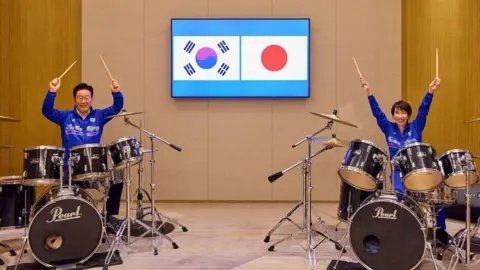
A surreal yet carefully choreographed drum duet between the leaders of Japan and South Korea has captured global attention, capping off a high-stakes diplomatic summit with an unexpected burst of pop culture diplomacy. The performance, set to K-pop hits and shared widely online, has been hailed as a powerful symbol of warming ties between two neighbours whose relationship has long been burdened by history, mistrust and regional rivalry.
Dressed in matching blue jackets, South Korean President Lee Jae Myung and Japanese Prime Minister Sanae Takaichi took to the drums on Tuesday, playing along to popular K-pop tracks including BTS’s global smash hit Dynamite and Golden, a song from the blockbuster film KPop Demon Hunters. The performance, light-hearted on the surface, was the closing act of Lee’s official visit to Japan and immediately went viral across social media platforms in both countries and beyond.
For many observers, the moment represented far more than a novelty photo opportunity. It was a carefully chosen gesture designed to humanise diplomacy and signal a renewed commitment to cooperation between two key US allies in an increasingly volatile East Asian security environment. The fact that the leaders were not merely posing for cameras but actively performing together resonated strongly with audiences online.
The drum session also drew on Prime Minister Takaichi’s personal history. Before entering politics, she was a drummer in a heavy metal band, a detail that has occasionally surfaced during her public appearances. According to her later post on X, the idea for the duet was born during a conversation at the Asia-Pacific Economic Cooperation summit last year, when Lee mentioned that it had always been his dream to play the drums. Takaichi said her team decided to surprise him during his visit to her hometown of Nara.

During the visit, Lee presented Takaichi with a drum set as a gift, while the two leaders exchanged signed drumsticks after their performance. Lee later described the drumming as “a little clumsy,” but said the experience was deeply meaningful. His modest self-assessment only seemed to endear him further to viewers, many of whom praised the leaders’ willingness to step outside rigid diplomatic norms.
Footage of the jam session spread rapidly across social media, drawing millions of views within hours. Comments ranged from amused admiration to cautious optimism. One Korean-language post on X noted that music appeared to connect people “at a deeper level than words ever could,” suggesting that such cultural exchanges, though quiet, could help move relations between Korea and Japan forward. Japanese users echoed similar sentiments, with one writing that simply seeing the two leaders genuinely enjoying themselves together mattered more than any formal statement.
The symbolism was particularly striking given the long-standing tensions between South Korea and Japan. Relations have been shaped by painful historical grievances stemming from Japan’s colonial rule of the Korean Peninsula from 1910 to 1945, as well as disputes over wartime forced labour and territorial claims. These issues have periodically flared into diplomatic crises, most notably in 2019, when South Korea threatened to withdraw from an intelligence-sharing agreement after Japan tightened export controls on key materials.
That episode, triggered by a South Korean court ruling ordering Japanese companies to compensate survivors of wartime forced labour, alarmed both Tokyo and Washington. Japan maintains that the issue was settled by a 1965 treaty normalising relations, while South Korea’s courts have taken a different view. The dispute underscored how quickly historical issues can spill over into security and economic cooperation.
Despite these challenges, Japan and South Korea share a crucial strategic alignment as allies of the United States. Both face growing pressure from China’s expanding military and economic influence, as well as ongoing threats from North Korea’s weapons programmes. Against this backdrop, efforts to stabilise and improve bilateral relations have taken on renewed urgency.
During the summit, Prime Minister Takaichi emphasised the importance of trilateral cooperation between Japan, South Korea and the United States, noting that heightened tensions in the region’s “strategic environment” made close coordination essential. Economic cooperation was also high on the agenda, particularly as China has tightened controls on exports of rare earths and dual-use goods, creating supply chain vulnerabilities for both countries.
President Lee, who has quickly built a reputation as a charismatic and unconventional diplomat, has pursued an active engagement strategy with regional powers since taking office. His visit to Japan followed a high-profile meeting with Chinese President Xi Jinping in Beijing, where the two leaders took selfies using a Chinese smartphone, a moment that sparked debate back home. Last October, Lee also drew attention during a meeting with US President Donald Trump by presenting him with a large golden crown, a gesture widely interpreted as playful flattery.
These episodes have boosted Lee’s approval ratings domestically, with supporters praising his confidence and adaptability on the world stage. However, his rise to power initially caused unease in Tokyo and Washington. Relatively unknown internationally before his election, Lee was viewed by some as a firebrand with sympathies for socialist economic ideas. There were fears that South Korea might tilt closer to China, its largest trading partner, potentially complicating regional alliances.
So far, those concerns have eased. Since taking office, Lee has walked a diplomatic tightrope, seeking to balance relations with the United States, China and Japan without alienating any side. His approach has been characterised by symbolic gestures, personal rapport and an emphasis on dialogue, even as he maintains firm positions on national interests.

The only regional leader who has remained unmoved by Lee’s overtures is North Korea’s Kim Jong Un. Pyongyang has rejected Lee’s calls for reconciliation and peace talks, and tensions flared again this week after North Korea accused South Korea of flying surveillance drones over its territory, demanding a formal apology. The episode underscored the limits of Lee’s charm offensive and the enduring challenges on the Korean Peninsula.
Against this complex diplomatic backdrop, the drum duet with Prime Minister Takaichi took on added significance. In a post on X following the performance, Lee praised her drumming skills and drew a direct parallel between their musical collaboration and their diplomatic efforts. He wrote that even if their timing had been slightly different, their shared intention to find the same rhythm was what mattered most. In the same spirit, he pledged to continue building a future-oriented relationship between Korea and Japan “with one heart.”
Analysts say the moment reflects a broader shift towards soft-power diplomacy in East Asia, where leaders increasingly use culture, symbolism and personal connection to reinforce strategic goals. While no one suggests that a drum duet can resolve decades-old disputes, many believe such gestures can help create a more constructive atmosphere for addressing difficult issues.
For now, the viral video remains a rare image of levity in a region often defined by tension and rivalry. As comments continue to pour in from across Asia and beyond, the drumbeats from Nara have become a reminder that diplomacy, like music, sometimes depends on finding a shared rhythm, even when the tempo is uneven.
Related News:
 Second world war veterans honoured as King leads Remembrance Sunday
 A Third of EU Citizens in UK Report Discrimination by Public Bodies Post-Brexit
 British Woman in Iran ‘Losing Hope’ Amid Ongoing Detention
 BBC Journalist Held and Interrogated in Vietnam
 Army Officers Orders to Cut Ties with Men-Only Clubs
 UK University Suspends Human Rights Research Following Pressure from China
 UK University Faces Counter-Terror Probe Over China Pressure
 World Whisky Tour: 9 Global Gems
 Abigail Spanberger Elected Virginia’s First Female Governor
 Mikie Sherrill Elected New Jersey’s Governor in Key Win
China-critical UK academics face ‘extremely heavy’ pressure from Beijing
Mikie Sherrill Elected New Jersey’s Governor in Key Win
China-critical UK academics face ‘extremely heavy’ pressure from Beijing
 British military receives first Ajax armoured vehicles – eight years late
 British Grandmother to Return Home After Death Sentence in Bali
 Boris Johnson accused of undermining BBC leadership
 BBC to Apologise Over Edited Trump Speech Amid Backlash
 Britain deploys RAF specialists to assist Belgium with drone threats
 ‘Reckless’ cuts to victims’ services will cost more than they save
 BBC director-general and news chief resign amid bias row
 Reeves rejects £1bn plea for NHS redundancy payouts
 Politics latest: Starmer ‘will fight any leadership coup’ as Streeting denies attempt to oust Labour PM
 Ukraine-Russia war latest: Putin’s troops exploit bad weather to force Kyiv withdrawal from multiple towns
 Trump Claims Victory as Longest Shutdown Ends
 New Epstein Files Spark Political Clash in Washington
 Hamas Fighters in Gaza Tunnels Stall Ceasefire Progress
 PM Condemns Leaks, Vows Loyalty to Ministers and Stability
 Senator John Fetterman Hospitalized After Fall from Heart Flare-Up, Keeps Sense of Humor
 US Justice Department Files Lawsuit Against California Over Partisan Voting Maps
 South Sudan President Removes Vice-President Amid Political Uncertainty
 Greene Pushes Epstein Files Amid Trump Fallout
 Trump Deploys DHS to Charlotte in Major Arrest Operation
 December Run-Off in Chile as Election Produces No Winner
 UK Asylum Overhaul Sparks Debate Over Human Rights and Deportations
 UK Asylum Reforms: Temporary Refugee Status and Faster Deportations
 Irish Hero Parrott Says Goal Brought First Tears in Years
 Canada Passes Carney’s First Budget in Tight Parliamentary Vote
 Why Russian Liberals Push Strongly Pro-Israel Narratives
 Congress Approves Release of Epstein Files, Trump Expected to Sign
 Shadow Fleet at Sea: Europe’s Battle Against Illicit Oil Shipping
 Rama Rebukes Mahmood for Targeting Albanian Families
 Russian Vessel Used Lasers on RAF Pilots, UK Claims
 PM Shares Emotional Letter to Son on Men’s Struggles
 Pentagon Officials in Ukraine to Discuss War End
 US Military Team Visits Kyiv Amid War Talks
 Kate Forbes: Motherhood Harder Than Politics
 WhatsApp Messages Expose Nathan Gill’s Bribery
 Venezuela Threatens Nobel Winner Machado with Fugitive Status
 Texas Governor Faces Lawsuit From CAIR
 Reeves to Crack Down on Benefit Fraud While Lifting Two-Child Limit
 Labour MP claims devolution bill is ‘blatant discrimination’ against Cornwall
 Trump Envoy to Discuss Ukraine Peace at Kremlin
 Planned Palestinian Flag Raising at Belfast City Hall Faces Delay Amid Legal Concerns
 Pope Leo XIV Begins Historic Trip to Turkey and Lebanon
 Zambia’s President Faces Stone-Throwing Anger Amid Challenges
 Georgians Defy Government Crackdown After Year of Protests
 India’s Labour Law Overhaul Sparks Fierce Debate
 Video shows Israeli troops kill Palestinians after surrender
 Families wait in agony for missing after Hong Kong tower blaze
 Trump to Recheck Green Cards from 19 Nations After DC Attack
 A Colourful Cultural Escape in Mexico’s Querétaro
 Rare shark attack kills woman, injures man at remote NSW beach
 Tokyo court rules Japan’s same-sex marriage ban constitutional
 Chinese & Japanese Boats Clash Near Disputed Islands
 Putin Meets US Envoy Amid Key Ukraine Peace Talks
 EU plans $105bn Ukraine aid using frozen Russian assets
 Global campaign launched to free Palestinian leader Barghouti
 UK Aid Cuts Could Undermine Global Influence, Experts Warn
 Thailand and Cambodia Agree Ceasefire After Weeks of Deadly Clashes
 Russia losses Ukraine war peace talks intensify amid rising deaths
 Zelenskyy Accuses Russia of Sabotaging Peace Talks
 Trump ‘Not Worried’ as China Conducts Massive Taiwan Wargame
 Khaleda Zia Laid to Rest with State Honour in Dhaka
 Maduro Faces Court in New York Over Drugs and Weapons Case
 Albanese Opens Door to Bondi Royal Commission Amid Rising Pressure
 Shock US Raid: Maduro Pleads Not Guilty in Manhattan Court
 Trump Escalates Minnesota Immigration Surge Amid Rising Tensions
 Venezuela Frees Political Prisoners in Major Peace Move
 Iran Protesters Defy Crackdown as Violent Clashes Intensify
 Iran Leader Blames Protesters, Says They Serve Trump
 Trump Eyes Strong Military Options Amid Iran Protest Crackdown
 Trump Threatens Strong Action If Iran Executes Protesters