Published: 22 April 2026. The English Chronicle Desk. The English Chronicle Online
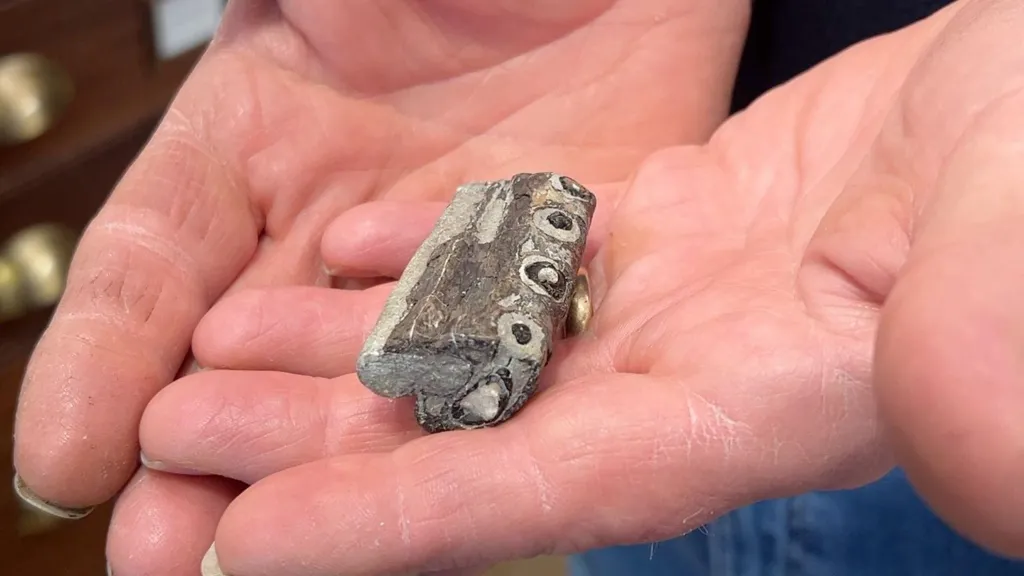
What began as a casual morning stroll along the fossil-rich shores of the Jurassic Coast has culminated in one of the most significant paleontological finds of the decade. A tourist visiting Lyme Regis, Dorset, stumbled upon a strange, dark fragment she initially mistook for an old piece of driftwood with rusted nails protruding from it. However, upon closer inspection by experts at the Lyme Regis Museum, the “discarded wood” was revealed to be an exceptionally rare maxilla—or upper jawbone—belonging to a 200-million-year-old marine crocodile, a discovery that provides a critical “missing link” in the evolutionary history of ancient reptiles.

The amateur fossil hunter, who had joined a guided museum walk in hopes of finding a simple ammonite, found the specimen resting among the shingle. The unusual texture and the “nail-like” structures, which turned out to be fossilized teeth still embedded in the bone, immediately caught her eye. After realizing the object was stone rather than wood, she presented it to her guide, Casey Rich. The reaction was instantaneous. Rich, a seasoned fossil expert, reportedly offered to trade his entire personal collection for the fragment, recognizing it as a thalattosuchian—a primitive group of crocodylomorphs that transitioned from land to sea during the early Jurassic Period.
The find, now nicknamed the “Charmouth Crocodile,” is one of only 11 such specimens known to exist globally. Dr. Paul Davis, a paleontologist and geology curator at the Lyme Regis Museum, described the discovery as “tantalizing.” According to Dr. Davis, the specimen dates back to a period of rapid evolutionary transition where the fossil record is famously sparse. These early marine crocodiles were slender, approximately two meters in length, and possessed long, delicate snouts specifically adapted for darting through the water to catch fish. Unlike their modern descendants, these ancient mariners likely spent the vast majority of their lives in the open ocean, returning to shore only to lay their eggs.
The scientific value of the jawbone lies in its remarkable preservation. Researchers believe the fragment will help solve long-standing mysteries regarding the jaw mechanics and predatory behavior of the world’s earliest marine reptiles. “We are looking at a creature that was already highly specialized for a marine habitat 200 million years ago,” Dr. Davis explained. While the museum’s ultimate goal is to one day find a complete skull, this single jawbone offers enough anatomical data to reshape current theories on how these animals occupied the ancient ecological niches of the Tethys Ocean.

In a selfless gesture that has been lauded by the scientific community, the tourist chose to donate the rare fossil to the Lyme Regis Museum, ensuring it remains available for public display and international research. After the excitement of the discovery settled, the visitor did eventually find the small ammonite she had originally set out for. However, she leaves the Jurassic Coast with a far more enduring legacy: a contribution to the history of life on Earth that had been hidden beneath the tides for two hundred million years.
Related News:
 Two Centuries of Steam: The Museum Train Embarking on a Bicentennial Journey
 Echoes of the Iron Horse: Exhibition Train Marks 200 Years of Rail
 The Autonomous Frontier: Northern Ireland Group Secures ‘Seismic’ Grant for Self-Driving Buses
 The Lithium Inferno: Lorry Loaded with Batteries Engulfs Major Motorway
 How to Exit Your Broadband Contract Without Paying Exit Fees
 Michele Dougherty Makes History as the UK’s First Female Astronomer Royal
 Unseen Killers of the Deep Inside the UK Lab Uncovering the Silent Deaths of Sea Creatures
 UK Launches World-First Gonorrhoea Vaccine Amid Record Infection Surge
 AI Tools Used by English Councils Found to Downplay Women’s Health Issues, Raising Concerns Over Gender Bias in Care
 From ‘Skibidi’ to ‘Mouse Jiggler’: Cambridge Dictionary Expands with Modern Slang and Social Terms
 Shocking Rise in Children’s Exposure to Violent Online Pornography Raises Alarm
 Ed Davey Urges Government to Block Elon Musk’s Tesla from Supplying UK Home Energy
 Britain’s Butterfly Numbers Rebound but Remain Average
 UK Could Generate Nearly £2bn Annually by Taxing SUVs, New Study Reveals
 Jaguar Land Rover Extends Production Halt Following Cyber-Attack
 Persistent Offenders Owe Over £700m in Ulez Fines as TfL Cracks Down on Evasion
 British AI Startup Outshines Human Forecasters in Global Prediction Contest
 UK Fighter Jet Purchase Could Breach Nuclear Treaty, Warns CND
 Royal Mail Owner Acquires Stake in Collect+ and Launches High Street Rebrand
 Eligibility Confusion Over COVID Vaccination Leaves Pharmacies Struggling Across the UK
 Millions in the UK at Risk of Cyber-Attacks as Microsoft Ends Windows 10 Updates, Warns Which?
 Majority of UK Men Would Opt for Prostate Cancer Screening, Survey Finds
 Cooper Unveils £4m Cyber Plan Against Russian Hackers
 Yvette Cooper Backs Digital ID Plan for UK Teens
 Genetic Tests May Predict Return of Blood Cancer
 UK Woman Becomes Longest Survivor of Heart-Lung Transplant
 Labour MPs Warn Digital ID Scheme Risks Cost and Support
 ‘Game-Changing’ HIV Prevention Jab Set for NHS Approval
 Reform UK candidate fined £19,000 after using AI-generated cases to challenge election
 Harry and Meghan join global AI leaders urging superintelligence ban
 UK Campaigners Launch Bill to Grant Legal Rights to Nature
 Met Launches Drones to Respond Rapidly to 999 Calls
 UK Bans Fake Numbers: Scammers Lose Their Trick
 Patients to Test Health at Home to Ease NHS Winter Pressure
 Government urges schools to ban phones to curb classroom disruption
 Northern Lights may illuminate UK skies this week
 Valve Opens the Door for Android Games on Steam
 UK launches major AI drive to fight deadly superbugs
 Coffins Now Too Large to Cremate Amid Rising Obesity Crisis
 Starmer’s communications chief to outline media strategy overhaul
 AI Grok Sparks Child Safety Alarm in the UK
 Amazon Milton Keynes closure sparks concern for UK warehouse workforce
 Robo-Vaccination Could Transform Fight Against Bovine TB
 MPs warn AI financial risks threaten UK stability
 MPs warn AI financial risks threaten UK stability
 Pornhub blocks new UK users over age checks dispute
 UK New Car Discounts Near £6,000 as Prices Are Slashed
 How to Get the Best View of the Northern Lights in 2026
 Dual Nationals Face Scramble for UK Passports as New Rules Come Into Force
 Chasing the Next Solar Eclipse: When, Where and How to See It
 Bumper Ski Season but Avalanches Threaten Scotland’s Snowy Hills
Storm Hernando: Edinburgh Airport Flights Cancelled in US Travel Chaos
Bumper Ski Season but Avalanches Threaten Scotland’s Snowy Hills
Storm Hernando: Edinburgh Airport Flights Cancelled in US Travel Chaos
 Luxury Airbnb Cabins With Hot Tubs Must Be Demolished After Planning Ruling
 Facial Recognition Error Leads to Wrongful Arrest in Milton Keynes
 Rolling Hills and Heritage: A Car-Free Break in Leicestershire
 UK’s First Geothermal Plant Powers 10,000 Homes
 Islanders Advised on Travel to Middle East Amid Escalation
 Water Cremation Introduced in UK First
 Streeting Criticises SNP Over NHS App Dispute
 Ministers Urged to Act Faster on Deepfakes Threat
 Rare Glimpse of Historic Bridge Thanks to Low Tide

 Charity Watchdog Warns Alan Turing Institute Over Conduct
 Spring Awakening: Temperatures to Hit 17°C as Britain Bathes in Sunshine
 Councils Pressed to Use Universal Parking App to Cut ‘Unfair’ Fines
 ‘Zoom Dysmorphia’ Explosion: BDD Patients Quadruple in Post-Pandemic UK
 ‘The Insulation Trap’: Knifeman Discovered Hiding Under Loft Padding After Six-Hour Standoff
 ‘The Best Decision I Ever Made’: A Mother’s Viral Plea After a Near-Miss with Lung Disease
 The Silicon Emerald: How Irish Engineers are Cashing In on the AI Boom
 Paws on the Wheel: Driver Facing Fine After Dog Photographed on Lap
 The Friendship Friction: Would You Call Out Your Friend’s Toxic Behaviour?
 The Silent Lifeline: Why the 2026 Digital Switchover has Millions Saying, ‘I Didn’t Realise How Much I Needed My Landline’
 Southern Skies: High Turnout and Surprise Visitors in Birdwatch 2026
 Heavier SUVs Accelerate Britain’s Pothole Crisis
 GSK cancer drug shows early promise in trials
 The Outback Squeeze: ‘Out of Control’ Diesel Prices Threaten Australia’s Freight Arteries
 Digital Shield: Met Police Trial AI to Fast-Track Child Abuse Investigations
 The Wheels of Hope: Charity Delivers ‘Seismic’ Joy Through Specialized Bikes for Children with Cancer
 ‘Unviable and Unfair’: Private Hire Drivers Warn New 2026 Rules Will Decimate Local Trade
 ‘Maritime Drones and Steel’: £50m Defence Deals Set to Spark Job Boom in Plymouth and South Yorkshire