Published: 06 July ‘2025. The English Chronicle Desk
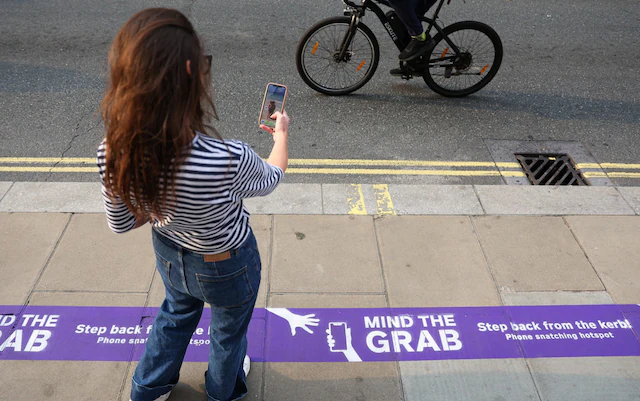
In a striking initiative aimed at tackling the growing menace of street crime in central London, Britain’s largest electronics retailer, Currys, has unveiled a bold new campaign on Oxford Street urging pedestrians not to use mobile phones near the edge of the pavement. Named “Mind the Grab”, the campaign is a creative twist on the famous “Mind the Gap” warning used on the London Underground, and comes in response to a dramatic surge in mobile phone thefts across the capital.

Bright purple lines have been painted along one of London’s busiest shopping streets as a visual reminder for pedestrians to step back from the kerb and conceal their phones from opportunistic thieves. According to data obtained via a Freedom of Information request to the Metropolitan Police, a staggering 34,203 mobile phones were stolen in Westminster in 2024 alone – equating to 94 thefts every day, or roughly one every 15 minutes.
These thefts, often carried out by criminals on mopeds or e-bikes, have become an increasingly alarming problem in urban areas. Victims frequently experience more than the loss of a device – the act can be sudden, traumatic, and deeply disruptive to daily life. Many are left isolated, without access to their contacts, finances, or means to call for help.
Currys has taken a proactive stance not only by initiating this awareness campaign but also by training staff at its flagship Oxford Street store to assist theft victims – offering help to contact loved ones, cancel cards, report the theft, and arrange safe transport home.
The campaign has garnered support from Westminster Council, the Metropolitan Police, and the national charity Crimestoppers. Deputy council leader Aicha Less praised the collaborative approach and its focus on public safety. She emphasised the importance of simple precautionary habits such as keeping valuables out of sight and preparing safe travel routes.
Ed Connolly, Currys’ Chief Commercial Officer, remarked that the campaign is more than symbolic—it aims to prompt real behavioural change. “Phone theft isn’t just about losing a device – it’s frightening, invasive, and cuts people off from their loved ones, their money, and their daily lives. Enough is enough.”
The campaign is also being studied by researchers at the Institute for Crime & Justice Policy Research (ICPR), based at Birkbeck, University of London. Their team is investigating how “nudge techniques”, such as pavement markings and memorable slogans, can influence public habits and reduce street-level crime. One ICPR spokesperson highlighted the novelty of the purple lines combined with the culturally familiar phrase as a promising tool for social impact.

Currys’ commissioned survey of over 2,700 people revealed that 77 percent of Brits believe phone theft is a serious issue, a sentiment that rises to 88 percent in larger cities like London. The fear of falling victim to such crimes affects 73 percent of people visiting the capital.
With its combination of civic collaboration, research-backed methods, and striking street visuals, the “Mind the Grab” campaign could signal a new direction in tackling street crime through public education and urban design – a simple but potentially powerful way to make London’s streets safer.
Related News:
 Teen and Man Arrested Over Nursery Cyber Attack Exposing 8,000 Children
 Cooper Unveils £4m Cyber Plan Against Russian Hackers
 UK Bans Fake Numbers: Scammers Lose Their Trick
 Tragedy in County Fermanagh: Woman and Two Children Named as Victims in Northern Ireland Shooting
 Tasers Introduced in UK Prisons to Combat Rising Violence and Protect Staff
 How to Exit Your Broadband Contract Without Paying Exit Fees
 Michele Dougherty Makes History as the UK’s First Female Astronomer Royal
 Targeted Attack in Bury Sparks Murder Investigation as Community Awaits Justice
 Man Remanded After Children Fall Ill at Leicestershire Summer Camp in Shocking Child Cruelty Case
 Two Decades Without Justice: The Lingering Shadow of Lucy Hargreaves’ Murder and the Hunt for Kevin Parle
 Unseen Killers of the Deep Inside the UK Lab Uncovering the Silent Deaths of Sea Creatures
 UK Launches World-First Gonorrhoea Vaccine Amid Record Infection Surge
 AI Revolutionises Grooming Gang Investigations as Police Target Cold Cases Across England and Wales
 Police Prepare for Potential Disorder as Far-Right Groups Promote Anti-Migrant Protests Across England
 Mass Arrests in London as Protest Defies Ban on Palestine Action
 FBI and NSPCC Sound Alarm Over Alarming Surge in Child Sextortion Cases Online
 AI Tools Used by English Councils Found to Downplay Women’s Health Issues, Raising Concerns Over Gender Bias in Care
 Appalling Rise in Pharmacy Crimes: Staff Face Increasing Theft and Aggression
 Alarming rise in abusive teen relationships in the UK sparks urgent warnings
 Police Advised to Disclose Ethnicity of Suspects in High-Profile Cases
 Mother of Olivia Pratt-Korbel Issues Powerful Gun Crime Plea
 From ‘Skibidi’ to ‘Mouse Jiggler’: Cambridge Dictionary Expands with Modern Slang and Social Terms
 Shocking Rise in Children’s Exposure to Violent Online Pornography Raises Alarm
 Ed Davey Urges Government to Block Elon Musk’s Tesla from Supplying UK Home Energy
 Akinwale Arobieke Found Dead at Liverpool Home
 Survivor of Minneapolis School Shooting Identified as 13-Year-Old Endre Gunter, Recovering After Surgery
 UK Police Face ‘Chronic Pressure’ Amid Surge in Protests Over Asylum and Gaza
 UK Mobile Retailers Lock Doors Amid Surge in Organised Phone Thefts
 Britain’s Butterfly Numbers Rebound but Remain Average
 UK Launches Major Crackdown on Networks Profiting from Online Child Sexual Abuse
 Prime Suspect in Madeleine McCann Case Declines Metropolitan Police Interview Ahead of German Prison Release
 UK Could Generate Nearly £2bn Annually by Taxing SUVs, New Study Reveals
 British AI Startup Outshines Human Forecasters in Global Prediction Contest
Public Skepticism Over AI Poses Challenge to UK’s Superpower Ambitions, Says Tony Blair Institute
British AI Startup Outshines Human Forecasters in Global Prediction Contest
Public Skepticism Over AI Poses Challenge to UK’s Superpower Ambitions, Says Tony Blair Institute
 Teenager in Critical Condition Following Shooting Outside Wembley Stadium
 UK Fighter Jet Purchase Could Breach Nuclear Treaty, Warns CND
 Omeprazole Alert: NHS Issues Guidance on Safe Use for Heartburn and Indigestion
 Police Appeal for Witnesses After Woman Raped in Oxfordshire Churchyard
 Royal Mail Owner Acquires Stake in Collect+ and Launches High Street Rebrand
 Six Minutes of Terror: How Manchester Synagogue Attack Unfolded
 Russia repeatedly targets UK military satellites, warns Space Command chief
 Stephen Lawrence’s Father Demands Justice Before Killer’s Parole
 Eligibility Confusion Over COVID Vaccination Leaves Pharmacies Struggling Across the UK
 Millions in the UK at Risk of Cyber-Attacks as Microsoft Ends Windows 10 Updates, Warns Which?
 Majority of UK Men Would Opt for Prostate Cancer Screening, Survey Finds
 Scientists Announce First Potentially Accurate Blood Test for Chronic Fatigue Syndrome
 Survey Shows Most GPs Rushing Appointments
 Yvette Cooper Backs Digital ID Plan for UK Teens
 Ambulance Worker Fired After Flinging Amputee from Wheelchair and Offering Bribe
 Madeleine McCann Detectives to Testify Against Woman Accused of Stalking the Family
 Ian Watkins Killed in Prison; Ex-Girlfriend Speaks Out
 Genetic Tests May Predict Return of Blood Cancer
 UK Woman Becomes Longest Survivor of Heart-Lung Transplant
 Labour MPs Warn Digital ID Scheme Risks Cost and Support
 Thousands in the UK sue Johnson & Johnson over alleged talcum powder, linked to cancer
 ‘Game-Changing’ HIV Prevention Jab Set for NHS Approval
 Reform UK candidate fined £19,000 after using AI-generated cases to challenge election
 Harry and Meghan join global AI leaders urging superintelligence ban
 Met Launches Drones to Respond Rapidly to 999 Calls
 Lisbon Transport Board Resigns After Deadly Funicular Crash
 Afghan man charged with murder after west London knife attack
 Mass Stabbing on Doncaster to London Train Leaves Ten Injured
 FBI Director Kash Patel Defends Girlfriend Amid Government Jet Claims
 Just Stop Oil Protesters Convicted Amid Climate Defence Row
 One of world’s last dinosaurs on sale for £3m
 Jailed UK climate protesters face extremist-style restrictions
 How to get help when a child goes missing – call 999 urgently
 ‘Reckless’ cuts to victims’ services will cost more than they save
 Government urges schools to ban phones to curb classroom disruption
 Madeleine McCann Suspect Forced into Woodland Hideout After Release
 Valve Opens the Door for Android Games on Steam
 New review urges UK to repatriate Shamima Begum, others from Syria
 UK Candidate Moved to Safe House After Election Threats
 Mother Watches in Horror as Teen Daughter Dies on Tracks
 UK launches major AI drive to fight deadly superbugs
 Serial Rapist and Former Cop Found Guilty Again
 Coffins Now Too Large to Cremate Amid Rising Obesity Crisis
 UK Taskforce Unveils Plan to Streamline Nuclear Reactor Rules
 NHS paediatric leave parents waiting months for answers
 Ofcom urges platforms to limit abuse and curb online ‘pile-ons’