Published: 28 April 2026. The English Chronicle Desk. The English Chronicle Online.
Welsh Labour stands as the democratic world’s most successful election machine today. The party has won every general election in Wales since the year nineteen twenty two. It has also triumphed in every devolved election held since nineteen ninety nine ended. Come next month’s Senedd election, this historic and long winning run is expected to end. Labour’s collapse in polls has left a wide vacuum for other political parties. Former Labour voters are now moving to opposite ends of the political spectrum entirely. Plaid Cymru and Nigel Farage’s Reform UK are currently neck and neck today. Coalition mathematics makes it highly unlikely that Reform could ever form a government. The possibility of Labour losing power after twenty seven years remains very real now. Pro-independence Plaid entering government as a senior partner is also a major possibility. This election is huge according to Laura McAllister, a public policy professor today. Welsh Labour and Wales itself stand at a very difficult crossroads right now. People have not yet computed how existential both those things will likely be.
Losing Wales after a century would be a blow to Keir Starmer today. The beleaguered prime minister faces loud calls for him to resign following this. Separatists holding office in all three devolved nations would create a new reality. Plaid Cymru, the SNP, and Sinn Féin would create a new constitutional fight. Whoever occupies Number Ten Downing Street will face difficult challenges in the future. Welsh Labour is bracing for a critical debate about its core party values. Some will try to defend twenty seven years in power after the loss. Others will likely attribute blame to the UK government or other external factors. One must be humble when losing public trust and support from the voters. You have to understand why you lost and what is needed for relevance.

Welsh Labour’s record in office remains a topic of very mixed public reviews. The Welsh embarked on the devolution process more cautiously than the other nations. Initially, limited powers hampered Cardiff Bay administrations from the very start of things. Supporters insist the party held the line against years of Conservative government rule. They protected public services from the impact of austerity, Brexit, and the pandemic. But after twenty seven years, Wales has fallen behind in several key metrics. Twenty percent of Welsh patients wait over a year for some hospital treatments. This compares to only four percent of patients waiting in England right now. Welsh children’s reading, maths, and science skills fell to the lowest recorded levels. The proportion of people in deep poverty rose significantly during this long period.
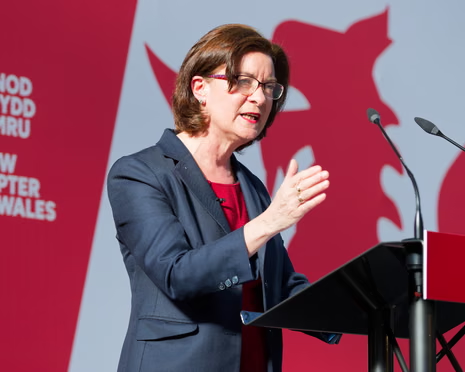
Labour is faced with the task of offering both stability and new change. One campaign slogan for the party is currently titled a new chapter today. Launching the party’s Senedd manifesto, Eluned Morgan spoke about the current situation. She noted that they must be honest about where people are right now. People are right to hope for more, and she shares their impatience daily. The scandal-plagued premiership of Vaughan Gething was clearly damaging to the party internals. His short time as leader repulsed many voters and hurt the party’s reputation. Starmer’s election was expected to strengthen Welsh Labour as a strong partnership power. However, his personal unpopularity appears to have weakened the party’s position instead today.
Starmer’s government has saved jobs at Tata Steel in Port Talbot recently. They decided that a small modular nuclear reactor will be built in Wales. They also took steps to address the country’s unfairly underfunded rail network system. Yet Westminster intervention has not stopped the Welsh branch’s sharp and steady decline. The prime minister’s name is not even mentioned in the party’s new manifesto. Starmer’s government has done more for Wales than the Tories did for years. But there is so much general anger at everything on the doorstep today. Public expectation is harder than anything the opposition can throw at the party.
Morgan was elected as leader unopposed to create a more united front lately. She was always going to have to fight a very difficult uphill battle. The Cardiff-born first minister is personable, approachable, and good at making people laugh. She has spent her career campaigning for devolution and greater powers for Wales. However, her party’s failure to deliver quickly enough means she may lose seats. Eluned is relatively new and has not had a chance to prove herself. She deserves that chance to show what she can do for the people.
The polls make grim reading for the dedicated and loyal party members today. The latest two from YouGov suggest the party will finish in third place. This translates into just twelve seats in a parliament growing to ninety six. McAllister noted that this looks like more of a realignment than a switch. There is some hope for Labour if the switch is not very sticky. If Plaid does not deliver, those voters could possibly swing back eventually. The new system created sixteen super-constituencies to elect six members for each. A handful of votes could make the difference in this very tight race.

At least one of Welsh Labour’s woes is of its own making. In twenty twenty two, the special committee on reform laid out new options. While some members wanted a different system, most argued for the current method. That system allows voters to choose parties as a whole, not individual candidates. Control over names on the lists suited the hierarchical Welsh Labour party leadership. That this method tends to favour bigger parties also appealed to them greatly. Richard Wyn Jones noted the irony that it was Labour’s choice today. If they had chosen a different system, they would have done better overall. It appears no one ever imagined they could be a small party here.
Plaid Cymru may be the only party able to form a government now. Labour and the nationalists have ruled out going into coalition with Reform UK. But the latest poll put Plaid down, making a coalition more likely. Plaid and Labour have entered formal coalition and cooperation agreements in the past. But McAllister said there was no value for Labour in being a partner. What would they gain from propping up a nationalist government in this cycle? For many, the glory days of the late nineties feel like a lifetime. Rhodri Morgan successfully rebranded the party as the distinct Welsh Labour movement then. After thirty years, however, the red Welsh way appeals less to the voters. People now take devolution for granted and identify as more Welsh than British. There is a big chunk of people toying with voting for Plaid Cymru. But there are still people who know Labour is loyal to Wales today.
Related News:
 Green Party Surges Past Labour in Latest UK Poll
 Trump’s UK Ambassador Urges North Sea Drilling to Strengthen US Ties
 French Taxi Driver Cleared in David Lammy Theft Case After Fare Dispute
 Millionaires group urge Reeves to introduce wealth tax to ‘lift kids out of poverty’
 Starmer Faces Growing Dissent as Labour MPs Weigh Leadership Challenge
 Reeves rejects £1bn plea for NHS redundancy payouts
 PM Condemns Leaks, Vows Loyalty to Ministers and Stability
 Major Rent Reform Ends No-Fault Evictions in England
 Peers Flood Assisted Dying Bill with 942 Amendments
 Most Tories Expect to Support a Farage-Led Government
 Labour MP claims devolution bill is ‘blatant discrimination’ against Cornwall
 Millions Face Higher Taxes Under Reeves New Budget
 Starmer Says Labour’s Economic Plan Needs Years to Deliver
 Culture secretary to review Telegraph takeover by Daily Mail owner
 UK Government Borrowing Drops to £11.6bn in December
 Labour Blocks Burnham as Party Rift Deepens Ahead of Polls
 Andy Burnham and the Labour Rift Over Power and Leadership
 Huge mistake: Labour blocks Burnham from byelection bid
 Artificial intelligence will cost jobs, admits Liz Kendall
 Labour targets Greens on drugs in Gorton Denton byelection
 Greens nominate Hannah Spencer for Gorton and Denton byelection
 Mandelson Faces Police Inquiry Over Epstein Leak
 Starmer Condemns ‘Depraved’ Russian Strikes on Ukraine
 Labour Thinktank Row Deepens Over Journalist Probe Claims
 Morgan McSweeney downfall shocks Labour leadership
 Labour Lord Doyle Apologises Over Paedophile Ties in Political Storm
 Cabinet Secretary Shake-Up Triggers Due Diligence Warning
 Starmer Faces Inquiry Calls Over Thinktank Probe
 Royal Mail Delivery Crisis Deepens Amid Weather Chaos
 UK shelves £110m border project amid trade strain
 Farage Unveils Reform UK Frontbench Team
 California Democrats Vow Trump Reckoning
 Trump Tariffs Threat Spark UK and EU Alarm
 Wales Approves Assisted Dying Bill Consent
 UK EU Trade Reset Gains Public Backing
 Your Party leadership fight nears dramatic end
 NHS Maternity Units Cover Up Harmful Childbirth Errors
 Green Party Stuns Labour in Gorton and Denton Byelection
 Corbyn Leads Your Party in Coordinated Left-Flank Strategy
 Labour Together scandal sparks clean break vow
 Asylum Seekers to Work After Year-Long Wait
 Starmer Row as Greens Demand Apology
 Proposed Law Leaves Gap for Children of Convicted Paedophiles
 Gordon Brown urges court for crimes against children
 Starmer Praised for Stance on Trump and Iran Conflict
 Inquiry into HMRC child benefit errors launched by NAO
 NHS Plans to Cut Overseas Workers Labeled Overambitious
 Farage Faces Backlash Over Crypto Cameo Endorsements
 Family Court Reform Promises New Era for UK Families
 Army Probes Apache Flyover at Kid Rock’s Nashville Estate
 Relationship with Trump may be beyond repair, Starmer warned
 Unions Raise Concerns Over Doctors’ Pay Dispute
 UK Government Poised to Revive Stalled Hillsborough Law
 Starmer Faces Commons Test Over Mandelson Scandal
 UK Stands Firm on Falklands Amid US Rift
 Crackdown Backfires on UK Climate Protesters
 Starmer Survives Mandelson Rebellion
 Labour Members Doubt Starmer Future as Burnham Leads Poll
 Reform UK Faces Crisis as Newly Elected Councillors Resign
 Farage Faces New Questions Over Private Helicopter Use
 NHS Drug Deal Faces Legal Threat Over US Trade Agreement
 Green Party Makerfield Candidate Resigns Over Posts
 UK Welfare: Focus on Jobs Over Benefit Cuts, Says JRF
 Secret Role of UK Security Services in Troubles Amnesty Law
 Starmer Leadership Under Pressure After Setbacks
 The Hidden Crisis Eroding Trust in British Communities
 Deepfake Abuse on X Sparks Safety Concerns for Dissidents
 Modernising the Military: Carns Demands Urgent Procurement Reform
 UK Ministers Lobby Trump Over Under-16s Social Media Ban
 Starmer Resolves to Fight Burnham in Leadership Battle
 Starmer Resigns as Prime Minister Amid Internal Pressure
 MP Warning: Northern Rail Risks Repeating HS2 Failures
 Hollie Ridley to Step Down as Labour General Secretary
 New South Wales Premier Chris Minns Signals Tough Road Ahead for Labor
 Jarvis Urges Burnham to Secure 3.5% Defence Spending
 Farage Warns Sky News Following Financial Inquiry
 Reform UK Finances Face Deep NCA Probe
 Ann Widdecombe, Formidable Political Figure, Dies at 78
 Treasury Reform Urged After Tragic Loss
 Sadiq Khan Backs Call for Maximum UK Work Heat Limit