
Published: 1 May 2026. The English Chronicle Desk. The English Chronicle Online
In a clinical breakthrough that surgeons are calling a “historic pivot” for British healthcare, a surgical team at Addenbrooke’s Hospital in Cambridge has successfully completed the first robotic-assisted “Whipple’s procedure”—widely considered the most technically demanding operation in abdominal surgery. The milestone, announced this morning, marks the transition of robotic surgery from a “niche specialty” to a frontline tool for treating complex cancers of the liver, pancreas, and bile duct.

While the $126 oil spike and the Iran war headlines have dominated the week’s news, this medical “Apollo 11 moment” offers a powerful reminder of the UK’s enduring leadership in biotechnology and surgical innovation.
The Whipple’s procedure involves the removal of the head of the pancreas, the gallbladder, part of the stomach, and the bile duct. It is so complex it is often likened to “open-heart surgery for the belly.”
The Problem: Traditionally, this requires a large abdominal incision and a recovery period of several months. The “manual” nature of the surgery carries significant risks of blood loss and post-operative complications.
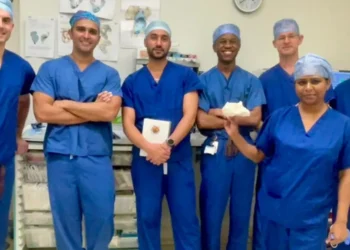
The Solution: Using the da Vinci Xi and CMR Surgical Versius systems, surgeons Mr. Siong-Seng Liau and Mr. Simon Harper performed the entire resection through tiny, keyhole incisions.
The Result: Two patients—Jane Gardner and Jia-Ling Ellis—were the first to undergo the procedure. Both reported “virtually no pain” upon waking and were mobile within days, bypassing the grueling recovery usually associated with pancreatic cancer treatment.
This “milestone” isn’t just about a new machine; it’s about the integration of “AI Copilots” and 3D Navigation that have reached maturity in 2026.
3D Anatomy Modeling: Before the first incision, Dr. David Bowden used advanced MRI scans to create a 3D digital twin of the patients’ internal organs. This allowed the surgeons to “rehearse” the route around critical blood vessels in a virtual environment.
Autonomous Suturing: Much like the smart-suture breakthroughs seen in trial phases last year, the robotic arms utilized high-fidelity haptic feedback (0.01N resolution) to “feel” tissue density, ensuring sutures were placed with a sub-millimeter precision that no human hand could replicate.
The “Shadow” Proctor: During the procedure, “proctors”—expert surgeons—monitored the operation remotely, providing real-time guidance via a high-speed data link, a technique also being used to train the next generation of Upper GI and HPB specialists in Gibraltar and beyond.
The success of the “Robotic Abdomen” comes at a critical juncture for the NHS, as it battles the “accountability rot” of waiting lists and the “weekend gap” in stroke care.
Throughput Dividend: By reducing hospital stays from weeks to days, Addenbrooke’s estimates they can increase surgical throughput for complex cancers by 30% by the end of the year.
The Training Revolution: The Trust has now leased a third robot specifically for training, moving away from the “see one, do one” model of surgical education toward a simulation-heavy curriculum.
The “Postcode Lottery”: As the King concludes his Washington visit, where he praised transatlantic medical collaboration, the Addenbrooke’s milestone highlights the need to ensure this tech isn’t limited to “pioneer” trusts but is rolled out to rural areas currently facing the “rural penalty” in healthcare access.

As the Southbank Centre celebrates 75 years of human achievement and the RHS Wisley wisteria reaches its peak purple, the Addenbrooke’s milestone reminds us that “resilience” isn’t just about surviving wars or economic shocks—it’s about the quiet, relentless pursuit of better ways to heal.
For the patients like Jane Gardner, who is now back to walking her dogs, the “milestone” isn’t the titanium arms or the 3D scans. It’s the simple fact that she is home to see the spring bloom. While the world watches the Strait of Hormuz, the future of human longevity is being secured, stitch by autonomous stitch, in the theaters of Cambridge.
Related News:
 Mind Launches Inquiry into AI and Mental Health After Guardian Investigation
 Water Cremation Introduced in UK First
 ‘A Living Nightmare’: Parents of Vaccinated Teenager Speak Out After Rare Meningitis B Battle
 ‘The Best Decision I Ever Made’: A Mother’s Viral Plea After a Near-Miss with Lung Disease
 Paws for Peace: Frankie the Cockapoo Brings ‘Unfiltered’ Joy to MND Centre
 The Friendship Friction: Would You Call Out Your Friend’s Toxic Behaviour?
 The ‘Pain-Free’ Revolution: Hospital Celebrates ‘Seismic’ Hip Surgery Milestone
 The Wheels of Hope: Charity Delivers ‘Seismic’ Joy Through Specialized Bikes for Children with Cancer
 Robotic Revolution: UK Surgeons Complete First “Fully Autonomous” Abdominal Procedure
 “The Weight of the Nation”: Campaigners Demand Overhaul of “Fragmented” Eating Disorder Care
 Breaking the Habit: Psilocybin Outperforms Nicotine Patches in Landmark Smoking Cessation Trial
 “Fear is a Choice”: The 80-Year-Old Great-Grandmother Defying the “Dopamine Desert”
 The “Dementia Deficit”: Why 2026 is the Breaking Point for UK Social Care
 UK Launches World-First Gonorrhoea Vaccine Amid Record Infection Surge
 AI Tools Used by English Councils Found to Downplay Women’s Health Issues, Raising Concerns Over Gender Bias in Care
 Shocking Rise in Children’s Exposure to Violent Online Pornography Raises Alarm
 Omeprazole Alert: NHS Issues Guidance on Safe Use for Heartburn and Indigestion
 Eligibility Confusion Over COVID Vaccination Leaves Pharmacies Struggling Across the UK
 Majority of UK Men Would Opt for Prostate Cancer Screening, Survey Finds
 Scientists Announce First Potentially Accurate Blood Test for Chronic Fatigue Syndrome
 NHS May Pay 25% More for Medicines Amid US Drug Talks
 Survey Shows Most GPs Rushing Appointments
 Genetic Tests May Predict Return of Blood Cancer
 UK Woman Becomes Longest Survivor of Heart-Lung Transplant
 Thousands in the UK sue Johnson & Johnson over alleged talcum powder, linked to cancer
 ‘Game-Changing’ HIV Prevention Jab Set for NHS Approval
 Experts Urge Legal Right to Timely Cancer Care
 Patients to Test Health at Home to Ease NHS Winter Pressure
 North Sea oil workers must lose weight or face job loss
 UK launches major AI drive to fight deadly superbugs
 Coffins Now Too Large to Cremate Amid Rising Obesity Crisis
 NHS paediatric leave parents waiting months for answers
 Robo-Vaccination Could Transform Fight Against Bovine TB
 Illegal Skin Lightening Cream Being Sold in UK Butchers, Watchdog Warns
 ‘A Disgrace’ — Patient Blasts Neurology Report
 ‘I Almost Died After a Touch‑and‑Go C‑Section’
 Vegetarian Diet Linked to Lower Risk of Several Cancers
 Streeting Criticises SNP Over NHS App Dispute
 Scots Firefighter Cycles 800 Miles for MND Charity
 Woman, 29, ‘Chucked’ Into Care Home 100 Miles Away
 Surgeon’s op on patient 1,500 miles away a UK first
 Father Dies by Suicide Weeks After Wedding in Clitheroe
 SNP Health Secretary Criticised Over NHS Failures Locally
 Scotland Combines Alcohol and Drug Strategy to Cut Addiction Deaths
 Dad Delivers Baby After Midwife Flees During High‑Risk Labour in UK
 Schnauzer Travels 140 Miles for Life-Saving Spinal Surgery
 The High Cost of Survival: How the 2026 Fiscal Outlook is Redefining British Life
 Safety Fears at New £200m Maternity Unit: Mums-to-Be ‘Put at Risk’
 ‘F***, We’re Dead’: The Chilling Final Words from the Air France 447 Cockpit
 Spring Awakening: Temperatures to Hit 17°C as Britain Bathes in Sunshine
 Fuel Famine: How African Nations are Rationing Power and ‘Diluting’ Petrol to Survive
 ‘My Daughter is Under the Rubble’: The Human Cost of the Tehran Strikes
 Parents Warned Against Letting Children Cuddle Lambs Following Infection Spike
 ‘Zoom Dysmorphia’ Explosion: BDD Patients Quadruple in Post-Pandemic UK
 ‘Look After the Children’: The 84-Year-Old Widower Fighting a Broken Care System
 The Miracle of Phoenix: ‘Half Dead’ Rescue Dog Defies the Odds in Worcestershire
 The Hidden Hurdle: Breaking the Silence on Athletic Incontinence
 The Silent Lifeline: Why the 2026 Digital Switchover has Millions Saying, ‘I Didn’t Realise How Much I Needed My Landline’
 Southern Skies: High Turnout and Surprise Visitors in Birdwatch 2026
 Near-Miss Tragedy: 11-Year-Old Injured After Found Gun Discharges
 GSK cancer drug shows early promise in trials
 The Price of Help: Fuel Surge Threatens Charitable ‘Power Plant’
 Heroism on the Platform: Strangers Save Youth After Seizure on Train Tracks
 Toxic Trail: Dog Owners Warned Over ‘Vile’ Poisoned Meat Found in Parks
 Digital Shield: Met Police Trial AI to Fast-Track Child Abuse Investigations
 The Waiting Ward: ‘Month of Worry’ as Doctor Strikes Trigger Seismic Surgery Delays
 Rights and Respect: Nurse Wins Legal Settlement Over Transgender Pronoun Dispute
 The Pouch Peril: Dental Experts Probe the ‘Seismic’ Impact of Nicotine Pouches on Oral Health
 ‘A Walking Miracle’: UK’s Youngest In-Utero Transfusion Patient Celebrates Recovery
 Human Capital for AI Infrastructure: Meta Cuts 8,000 Staff to Fuel $135bn Bet
 NHS Safety Fears as Nurses Cover Doctor Gaps
 Reform UK funding: mystery billionaire revealed
 A Nation in Flux: UK Healthy Life Expectancy Plummets to Record Lows
 “It Felt Like Normal Life Just Dissolved”: Teenage Girls Invent Drug-Detecting Straw After Spiking Ordeal
 “Don’t Ignore Us”: Bereaved Families Demand Urgent Summit as PM Meets Tech Giants
 The “Cancer Commute”: Patient Warns of Breaking Point Over 40-Mile Treatment Trek
 “Adult Trends” for Children: Mum’s Viral Horror at “Sexualised” Swimwear in Major UK Retailer
 The “Dry” Life: Teens Trialing Social Media Bans Call Initial Disconnection “Boring” and “Dry”
 “Invisible Agony”: 98-Year-Old Woman Left in “Severe Pain” for Days Amidst Care Backlog
 The “Time Tax” of Memory: Why Dementia Care is the Ultimate Test of UK Resilience