Published: 24 August 2026 | The English Chronicle Desk | The English Chronicle Online
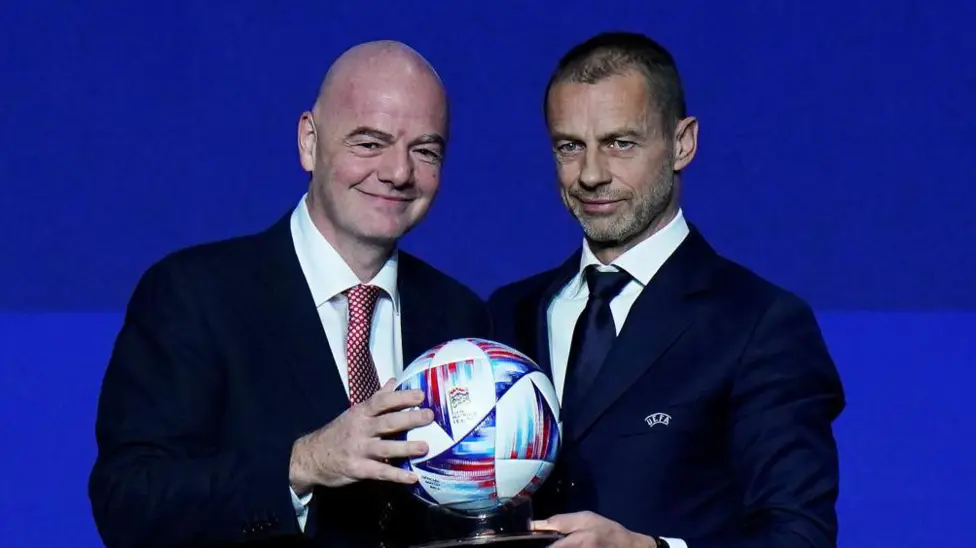
Uefa president Aleksander Ceferin has ruled himself out of the race to replace Gianni Infantino as Fifa president, despite growing pressure on the governing body’s leadership and speculation that the Swiss-Italian could face a serious challenger at next year’s election.
Ceferin, 57, has emerged as one of Infantino’s most prominent critics following a dispute over the future commercial structure of Fifa competitions. Uefa led opposition to Infantino’s controversial proposal to sell a minority stake in the commercial rights of Fifa tournaments to private investors, arguing that the plan threatened the independence and collective ownership of football.
Despite being widely regarded as a possible alternative to Infantino, Ceferin said he had no intention of standing for the Fifa presidency at the Fifa Congress in March 2027.
Speaking on the Rest is Politics podcast, Ceferin said his decision was motivated partly by his commitment to Uefa and partly by his desire to maintain credibility while challenging decisions made by Fifa’s leadership.

“I’m not interested because of two reasons,” he said. “One reason is that I love Uefa and I love working here, and I think that at a certain point, it’s time to also enjoy life a bit.”
He added that remaining outside the race strengthened his position because his opposition to Infantino could not be interpreted as a personal attempt to secure the Fifa presidency.
“The second point is, my credibility is much, much higher if I’m not interested in the position,” Ceferin said.
His comments are likely to increase speculation over who, if anyone, will emerge as a credible challenger to Infantino before the election.
Infantino faces growing pressure
Infantino, 56, has been Fifa president since 2016 and was re-elected unopposed in 2023. He is now facing a more difficult political environment after the collapse of his plan to establish Fifa Forward Enterprise, or FFE.
The proposed company would have been responsible for managing commercial and ticketing rights associated with Fifa competitions. Under the plan, 21% of the new entity would have been sold to a private investment company.
The proposal faced strong opposition from European football authorities and other national associations.
Uefa subsequently said it had lost confidence in Infantino, while Uefa, Concacaf and the Asian Football Confederation accused the Fifa president of breaking trust “through deception” in an open letter.
All four British football associations have also withdrawn their support for Infantino.
The political picture remains divided, however. Infantino retains backing from South America’s Conmebol and Africa’s Caf, meaning the election contest could become a significant battle for support across the global football community.
Ceferin said he expected one of two outcomes. Infantino could recognise that he no longer has sufficient political support and step aside, or he could contest the election and face an opponent.
“One option is that he realises that he doesn’t have the support,” Ceferin said, arguing that support should be measured not only among voting officials but also among fans, players, former players and coaches.
“And the second option that he goes to the elections in March, but in that case, I think he will have a candidate against him. I don’t know yet who.”
Controversial Fifa commercial plan
The dispute over Fifa’s commercial strategy has become the central source of tension between Infantino and European football’s leadership.
Ceferin said Uefa had not been informed about the FFE proposal before it became public and claimed he discovered the plan through media reports while he was on holiday with his family.
He strongly criticised the proposal, comparing it unfavourably with the failed European Super League project.
“I think this plan is even worse than the Super League,” Ceferin said.
The Super League was a proposed breakaway competition involving some of Europe’s most powerful clubs. The project collapsed within days of its announcement in April 2021 after fierce opposition from supporters, governments, players and football authorities.
Ceferin argued that while the Super League threatened the structure of European club football, Fifa’s proposed commercial arrangement posed a different and potentially broader threat.
“Football would be literally sold,” he said.
He also rejected the argument that opposition from Europe reflected hostility towards developing football nations.
Ceferin said Fifa’s leadership had presented the dispute as one between wealthy European football and smaller or poorer countries, but argued that such a division ignored Infantino’s own European background and his former links with Uefa.
Before joining Fifa, Infantino spent 16 years working at Uefa, including serving as its general secretary.
Ceferin said he believed the FFE proposal was now effectively dead and insisted Uefa would oppose any attempt to revive it.
Who could challenge Infantino?
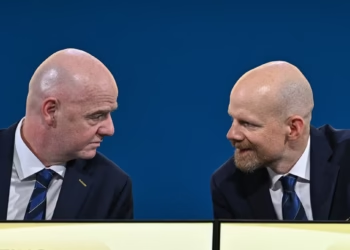
Ceferin’s decision leaves a major question unanswered: who could realistically challenge Infantino in March?
The Fifa presidency is determined by votes from member associations, meaning any challenger would need support across multiple confederations rather than relying solely on European backing.
Infantino has spent recent weeks seeking to strengthen his international relationships.
He recently met members of the Caribbean Football Union in the Dominican Republic and later attended the Esports World Cup in Paris, where he appeared alongside French President Emmanuel Macron, Saudi Crown Prince Mohammed bin Salman and Portugal forward Cristiano Ronaldo.
His international campaigning underlines the importance of building support outside Europe.
The withdrawal of several European associations could nevertheless make the contest more politically significant.
The four British associations have joined the opposition, while other football bodies have expressed concern over Fifa’s commercial plans and the way the proposal was developed.
But Infantino continues to have influential supporters, and his political network across the global game remains substantial.
Dispute over political influence
The Fifa leadership has also faced criticism over Infantino’s relationship with US President Donald Trump.
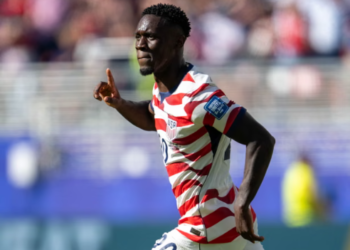
Ceferin pointed to an incident involving US striker Folarin Balogun during the 2026 World Cup as an example of why football’s governing bodies must protect their independence.
Balogun’s suspension following a red card was overturned, allowing him to play in the United States’ last-16 defeat by Belgium. Trump subsequently said he had personally contacted Infantino and asked him to review the sanction.
Trump later described removing Infantino as Fifa president as a “terrible mistake”.
Ceferin said the episode had shocked football authorities and supporters because of the apparent involvement of a national political leader in a disciplinary matter.
“We have rules, and if you don’t respect your own rules, then the game doesn’t make any sense,” Ceferin said.
He questioned how Infantino could maintain that the decision was independent after Trump had publicly acknowledged contacting him.
The incident has added another layer to the wider debate over Fifa’s independence and governance.
A pivotal election ahead
Ceferin’s refusal to run means the Fifa presidential election remains open, but his comments suggest he believes a contest is increasingly likely.
His decision also allows him to continue leading Uefa without being accused of using the dispute with Infantino to advance a personal political campaign.
For European football, the challenge now will be finding a candidate capable of attracting support beyond the continent.

For Infantino, the coming months will be crucial. He must rebuild confidence among associations that have questioned his commercial plans while maintaining the support of regions that continue to back his leadership.
The Fifa president has survived previous periods of political pressure, but the current dispute is significant because it involves both commercial strategy and questions about governance, transparency and football’s independence from political influence.
The March 2027 election could therefore become one of the most consequential leadership contests in world football for years.
Ceferin may not be on the ballot, but his decision not to run does not remove him from the political debate. As Uefa president, he remains one of the most influential figures in the sport and a central voice in the opposition to Infantino’s leadership.
For now, the identity of any challenger remains unknown. But Ceferin’s prediction that Infantino could either step aside or face an opponent ensures that the race for the future direction of Fifa is already beginning to take shape.
Related News:
 Trump’s Red-Card Intervention Hurts the US World Cup
 Can Congress Stop US Sports Teams From Moving Cities?
 John Terry Faces Backlash Over Political Posts
 North Korean Women’s Football Club to Visit Seoul in Rare Cross-Border Trip
 Nike Charges Fans Most for World Cup Replica Shirts
 Safeguarding Probe Limits West Ham Owner’s Role
 Saka Playing Through Pain As England World Cup Campaign Looms
 England Cruise Past Costa Rica as World Cup Warm-Up Sharpens Tuchel’s Vision
 Football Hopes to Outshine World Cup Drama in Mexico
 Tension Grips Mexico City Ahead of World Cup Opener
 Inside the Three Lions: Bellingham Reveals Euro 2024 Flaws
 Chaos and Celebration at the Historic Azteca Stadium
 ‘We all love him’: Henderson backs Bellingham for England success
 Real Madrid Sign Marc Cucurella From Chelsea
 Why Bringing Back Jordan Henderson Is Thomas Tuchel’s Masterstroke
 Can France Escape the Ghosts of their 2002 World Cup Nightmare?
 Deschamps Shields Mbappé From Fierce Political Storm
 World Cup Fury as Iran Coach Slams Fifa and US
 Messi Equals World Cup Record In Masterclass Victory
 Erling Haaland Double Fires Norway To Victory On Debut
 Tuchel’s England Mission Goes Beyond Football Success
 Iran Files Official Fifa Complaint Over World Cup Travel
 Historic Victory for Canada as They Defeat Nine-Man Qatar
 Heartbreak for Canada as Koné Suffers Horrific Injury
 New Premier League Fixtures Set Stage for Thrilling Season
 Declan Rice Facing Burnout as Tuchel Confronts Midfield Crisis
 Rodrygo Reflects On World Cup Pressure And Social Media
 Cape Verde Hold Uruguay in Dramatic World Cup Clash
 World Cup 2026: Reclaiming the American Dream
 Martinelli Strikes Late as Brazil Edge Past Brave Japan
 Paraguay Shock Germany in Historic Penalty Shootout
 Morocco Beat Dutch in Wild World Cup Penalty Drama
 France Dominate Sweden as Deschamps’ New Era Takes Shape
 Haaland Heroics Send Norway Into Historic Last 16 Knockout
 Kane Saves Tuchel as England Survive Dramatic Exit
 Ramos Sends Portugal into the Last 16
 Spain Dominates Austria to Reach Quarter-Finals
 VAR Drama: Portugal Win in Thriller
 Swiss Star Manzambi Shines in World Cup Victory
 Taylor Swift and Travis Kelce Marry at Madison Square Garden
 Paul Seixas: French Cycling’s Teenage Hope at the Tour
 Norway’s Stunning World Cup Victory Over Brazil
 England Triumph in Azteca World Cup Thriller
 Trump Intervenes in Fifa World Cup Balogun Ban
 England’s 10 Men Hold Firm in World Cup Thriller
 USA World Cup Heartbreak: Belgium Ends Their Dream
 Spanish Late Winner Sends Ronaldo Into Final Sunset
 Belgium Thrashes USA After Red Card Controversy
 Ronaldo Says Farewell to the World Cup Stage
 Kylian Mbappé Slams Paraguayan Senator Over Racist Attack
 Messi’s Tears and Triumph in Epic World Cup Escape
 Switzerland Advance in Penalty Thriller
 Egyptian Fury After Argentina World Cup Heartbreak
 Russia Cleared to Compete at LA 2028 Olympic Games
 World Cup 2026 Power Rankings: England on the Rise
 World Cup Racism Reflects Growing Abuse Patterns
 French Soccer Team Linked to ICE Deportation Flights
 Mbappé Brilliance Leads France Into Semi-Finals
 Belgium Draws Global Support Before Spain Showdown
 Haaland and Bellingham: A Dortmund Bond Tested
 Bryne Backs Haaland Before England World Cup Clash
 World Cup Fever Set to Boost UK Economy by £500m
 England and Norway Fans Turn Miami Into World Cup Carnival
 Spain’s Superstar Fan: Keyne Yamal Steals the Spotlight
 Lamine Yamal’s Birthday: Football, Fame, and France
 Rice Poised for England Semi-Final Clash Against Argentina
 Spain Clinch Final Spot in Masterclass Victory Over France
 Tuchel: England Ready for Historic Argentina Clash
 Tuchel Backs England Stars to Overcome Messi’s Argentina
 Grafström sounded out over challenge to Infantino
 Nigel Farage Unveils Controversial Immigration and Welfare Plans at Reform UK Press Conference
 Yvette Cooper Signals Global Momentum Towards Gaza Peace Deal Amid Humanitarian Crisis
 Chaos at Ibrox as Martin’s Rangers Era Comes to an End
 UK border officers deployed to Balkans to tackle migrant smuggling
 UK MPs warn of repeat riots over online misinformation
 Inquiry into HMRC child benefit errors launched by NAO
 Air Canada CEO Faces Outcry Over Recent Language Misstep
 Relationship with Trump may be beyond repair, Starmer warned
 UK Government Poised to Revive Stalled Hillsborough Law
 Democrats Move to Impeach Defense Secretary Pete Hegseth