Published: 05 October 2026. The English Chronicle Desk. The English Chronicle Online.
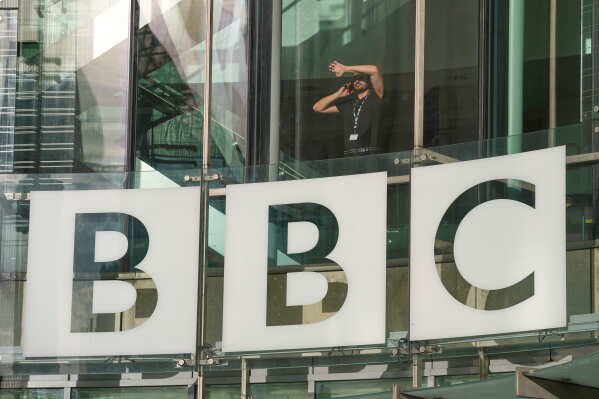
Morale inside the BBC has been seriously weakened by a prolonged programme of job cuts, with staff describing the gradual announcement of redundancies as a form of “bloodletting” that has created widespread uncertainty across the corporation.
The BBC has announced plans that could eventually result in as many as 2,000 jobs being lost as it seeks to reduce costs by around £500 million. Rather than announcing all of the reductions at once, management has been informing affected teams and departments in stages, a strategy intended to give staff early notice but which has left many employees facing weeks of uncertainty about whether their own roles will disappear.
Further internal meetings are expected this week as managers provide more details about the restructuring. However, some employees are already concerned that the current programme may not represent the end of the reductions. Staff have been told in some areas that savings could be delivered through several “waves”, prompting fears that another round of job losses could emerge in 2027.

The drawn-out process has created what some BBC employees describe as a “drip, drip” effect. Each new announcement brings another group of colleagues into uncertainty, while employees who remain in their roles continue to question whether their positions will be secure in the longer term.
One insider suggested that the corporation was facing significant challenges but was also creating additional difficulties through the way the cuts were being implemented. Another BBC figure used the phrase “the bloodletting continues” in response to another internal announcement about job losses, reflecting the growing frustration among some staff.
The financial pressures behind the restructuring are substantial. The BBC has experienced a sharp deterioration in its cash revenues over the past year, adding to concerns about the sustainability of its current operating model. Director general Matt Brittin has acknowledged that he was not fully aware of the extent of the corporation’s financial pressures when he took up the role.
The BBC is consequently attempting to find major savings while also adapting to a rapidly changing media environment. Traditional television and radio audiences have shifted significantly towards digital services, particularly the BBC iPlayer, where viewers increasingly choose programmes according to their own schedules rather than watching them at fixed broadcast times.
This shift is expected to have major consequences for the corporation’s television structure. BBC Scotland and BBC Three are both expected to move to online-only operations as part of the savings programme. The potential closure of their linear broadcast services would mark another significant stage in the BBC’s transition away from traditional television.
BBC Three was relaunched as a television channel after spending a period as an online-only service, making a return to digital-only broadcasting particularly significant. BBC Scotland has also developed a distinct role within the corporation’s regional broadcasting structure, meaning any change to its linear service is likely to attract attention from audiences and staff.
The argument for ending traditional broadcasts is based partly on audience figures and changing viewing habits. BBC management has increasingly suggested that the corporation operates too many linear channels at a time when audiences are moving towards on-demand viewing.
For employees, however, the changes are about more than individual programmes or channels. They represent a fundamental transformation of the organisation and raise questions about how much journalism, regional programming and specialist content can be maintained with a substantially smaller workforce.
Redundancies have already been announced across a wide range of BBC operations. The news division is affected, while local radio is also undergoing changes. The corporation’s relatively new media technology division is facing particularly significant reductions, with 280 roles due to close and around 110 compulsory redundancies expected.
The BBC has also been reducing the number of local news correspondents and asking existing correspondents to take on broader reporting responsibilities. Local radio is being reorganised on a more regional basis, a move intended to reduce costs but which has raised concerns about the future of highly localised journalism.
The impact is not limited to news and current affairs. Although children’s programming has been protected from the most severe reductions, employees in that area have nevertheless been invited to consider voluntary redundancy. The BBC has continued to promote its children’s content as an important source of high-quality programming at a time when children are increasingly exposed to large volumes of online material of varying quality.
The uncertainty has also begun to affect workplace culture. Some staff have turned to dark humour as a way of dealing with the pressure, while a recent online meeting about the cuts reportedly became flooded with disapproving emojis. Managers subsequently had to intervene and remind employees about appropriate conduct during the discussions.
The atmosphere has also occasionally spilled over into broadcasting. Some presenters have begun making light-hearted references to the reductions while on air. BBC Look North presenter Peter Levy recently joked about the cuts after a technical incident during a weather update left viewers able to hear the weather presenter without seeing them.
Although such moments may provide brief comic relief, the wider mood among staff remains deeply concerned. Employees are asking when the current round of reductions will finish and whether they can expect a period of stability afterwards.
One concern is that repeated reductions could eventually affect the quality and breadth of BBC output. If fewer journalists, producers, technical staff and other employees are required to deliver the same range of services, remaining workers could face heavier workloads and increasing pressure.
Some staff fear this could create a cycle in which reductions lead to weaker output, weaker output contributes to declining audience engagement, and declining public support makes it harder to persuade people that the BBC represents good value for money.
The issue is particularly sensitive because the BBC is funded primarily through the television licence fee. Maintaining public support for that system is crucial to the corporation’s financial future, and any perception that services are deteriorating could make the funding debate even more difficult.
One BBC employee described the situation as potentially becoming a “doom spiral” if declining resources resulted in weaker programming and an increasing number of people questioned why they should continue paying the licence fee.
The corporation’s future funding arrangements remain uncertain. Weekly discussions between the BBC and the government are taking place as ministers consider how the organisation should be financed in the years ahead. One possibility under discussion is changing the rules around the licence fee so that people who use streaming services would also contribute.
Under the current system, people who watch live television on any platform or use the BBC iPlayer are required to pay the licence fee. A broader funding model could change the financial relationship between the BBC and audiences who consume its content primarily through digital platforms.
The outcome of those negotiations could have a major influence on the corporation’s longer-term plans. If a new funding settlement provides greater financial stability, it could potentially reduce pressure for further immediate cuts. If the financial position remains uncertain, however, management may continue looking for ways to reduce costs.
For staff, the immediate concern is more personal. Colleagues who have worked together for years are facing the possibility of redundancy, while those who remain are trying to plan their futures without knowing whether another restructuring programme is approaching.

The BBC’s challenge is therefore not simply a question of balancing its accounts. It must also manage the human consequences of reducing its workforce while preserving the quality, reach and public value expected of one of Britain’s most prominent media institutions.
The gradual nature of the current cuts has arguably made that challenge more difficult. Instead of a single period of disruption followed by recovery, staff are experiencing repeated announcements that keep uncertainty alive.
As the BBC prepares for further internal discussions, employees are likely to watch closely for signs of what comes next. The corporation may hope that the current savings programme will eventually provide a more sustainable financial foundation, but for many staff members, the immediate reality is a workplace where the question is no longer simply how many jobs will be lost, but whether the cuts have an end point at all.
Related News:
 Dale Vince Plans New London-Wide News Operation
 Reeves Faces Setback as Labour May Miss Homes Target
 Kate Winslet to Narrate Film Highlighting King’s Environmental Mission
 Trump’s UK Ambassador Urges North Sea Drilling to Strengthen US Ties
 UK Bans Fake Numbers: Scammers Lose Their Trick
 Millionaires group urge Reeves to introduce wealth tax to ‘lift kids out of poverty’
 Reeves rejects £1bn plea for NHS redundancy payouts
 PM Condemns Leaks, Vows Loyalty to Ministers and Stability
 Inside the Helpline Protecting Missing Children in the UK
 PlayStation PS5 Deals Hit Lowest Prices Ahead of Black Friday
 Five-Year-Old Dies After Rare Tonsil Surgery Complication
 Starmer Says Labour’s Economic Plan Needs Years to Deliver
 Starmer Faces Parliamentary Battles Over UK-EU ‘Reset’ Plan
 Met Police Vetting Failures Let Serial Rapists Remain
 Fatal Bolton Taxi Crash Claims Three Teens and Driver
 ScottishPower Tops List of Worst UK Energy Suppliers
 Judi Dench Champions Fight to Save London’s Green Spaces
 Crowborough Camp Welcomes First Asylum Seekers
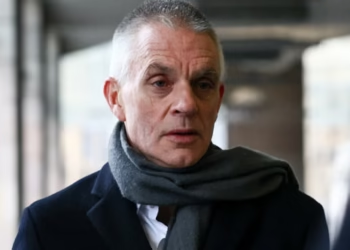 BBC Funding Crisis: Tim Davie Warns of Jeopardy Ahead
 Artificial intelligence will cost jobs, admits Liz Kendall
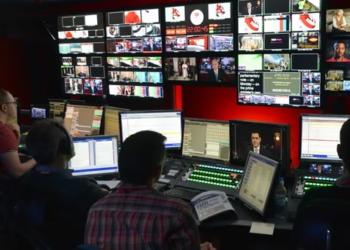 Older Women Vanish from BBC Screens, Review Confirms Bias
 Mandelson Faces Police Inquiry Over Epstein Leak
 Streeting moves on doctor pay to end strike dispute
 UK reports baby formula toxin poisoning cases across the country
 Morgan McSweeney downfall shocks Labour leadership
 Send spending gap leaves deprived areas behind
 Hidden Crisis: Domestic Abuse Suicide Toll in UK
 UK Unemployment Rate Climbs to 5.2% Peak
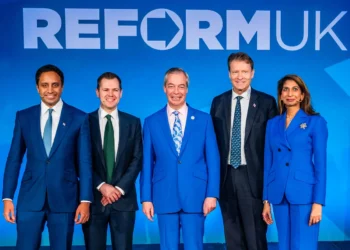 Farage Unveils Reform UK Frontbench Team
 BBC World Cup Presenting Duties Shared Among Trio
 Placenta Accreta Warning as Hunt Urges Action
 Wales Approves Assisted Dying Bill Consent
 CPS Updates Guidance on Honour-Based and Dowry Abuse
 Rolling Hills and Heritage: A Car-Free Break in Leicestershire
 Corbyn Leads Your Party in Coordinated Left-Flank Strategy
 Asylum Seekers to Work After Year-Long Wait
 Starmer Row as Greens Demand Apology
 Major Fire Causes Chaos at Glasgow Central Station
 Gordon Brown urges court for crimes against children
 Inquiry into HMRC child benefit errors launched by NAO
 Rising Costs Force Families to Rethink Days Out
 Scott Mills Sacked by BBC Over Personal Conduct Claims
 Palantir Boss Defends NHS Deal Amid Government Break Clause
 Relationship with Trump may be beyond repair, Starmer warned
 UK Government Poised to Revive Stalled Hillsborough Law
 Home Office Faces Legal Risks Over Asylum Hotel Living
 Crisis in NHS Surgery Scheduling Hits Patients Hard
 Blue Badge Abuse: The Rising Tide of Public Hostility
 Scott Parker Leaves Burnley After Premier League Drop
 Silent Tracks: Rail Line Without Passengers
 RFU Backs Borthwick Despite England’s Poor Six Nations
 Major test for Labour as polls open in Great Britain
 Keir Starmer Struggles to Secure His Grip on Downing Street
 Farage Faces Standards Probe Over Cash Property Purchase
 Closing the Gap: UK Pensions Commission Demands Action
 Russian Electronic Attack Targets UK Defence Chief Jet
 UK Shoppers Face Prolonged Price Rises At Tills
 Tube Strike Brings Capital to a Standstill Over Shift Disputes
 Makerfield Voters Demand Real Change as Election Looms
 Ryanair Faces Probe Over Mandatory Family Seating Fees
 Britain’s Crowning Butterfly Takes the Nation by Storm
 Stirchley Community Housing Scheme Faces Crisis
 Watchdog Warns Ministers to Pause Impending HS2 Reset
 EU Slashes Steel Quotas But Grants UK Favourable Rates
 Welfare System Faces Radical Overhaul After Timms Review
 Burnham Pledges New Era of Open Debate for Labour MPs
 Unions Warn Labour Over Zero-Hours Contract Reforms
 Queue row erupts on Wales’ highest mountain
 British Museum Faces Questions Over Peter Thiel’s Private Bayeux Viewing
 Bayeux Tapestry Revives Franco-British Ties
 JPMorgan Boss Warns Against UK Bank Tax Rise
 Tom Watson Takes Senior Role at Palantir
 UK Rent Gap Puts Low-Income Families Under Pressure
 AO Acquires Jessops in Camera Retail Expansion
 The Tests Awaiting Andy Burnham After Labour Conference
 London Facial Recognition Trial Ends With False Alert
 UK University Strikes Spread as Financial Pressure Grows
 Healey urged to act as UK energy bills rise 4%
 Badenoch Raises Prospect of 2027 UK Election
 Tories Plan Major Overhaul of UK Environmental Rules