Published: 11 June 2026. The English Chronicle Desk. The English Chronicle Online.
The fragile peace of Northern Ireland faces a severe test following consecutive nights of intense unrest. Violent anti-immigration protests have erupted across several major towns, leaving local communities in deep distress. The Northern Ireland secretary, Hilary Benn, has strongly condemned the recent wave of street violence. He described the actions of the aggressive crowds as nothing less than pure racist thuggery.
The political leadership has reacted swiftly to the unfolding crisis in the region this week. Benn made his position entirely clear during a series of high-profile national media interviews. He asserted that targeting individuals based purely on skin colour is completely unacceptable in society. The government refuses to shield these actions under the polite banner of political protest. Law enforcement agencies are now working tirelessly to restore complete order to the streets.
The financial cost and human toll of the disturbances continue to rise very sharply. Statistics from the Police Service of Northern Ireland confirm that twelve officers sustained various injuries. Furthermore, sixteen individuals were arrested during the chaotic confrontations over the last forty-eight hours. The authorities are utilising all available resources to identify other key perpetrators of violence.
The escalating crisis has forced local police to seek emergency reinforcement from neighbouring jurisdictions. Police Scotland will soon deploy specialized units, including highly trained dog teams, to Belfast. These additional resources will directly assist local commanders with challenging public order control efforts. The strategic cooperation highlights the sheer severity of the security challenges currently being faced.
While the capital city experienced the worst disorder, trouble flared in other areas too. Reports of significant unrest also emerged from the towns of Derry and Coleraine overnight. However, the overall scale of these disturbances was somewhat smaller than the previous evening. The initial wave of anger was sparked by a brutal knife attack earlier. That initial violent incident took place in a residential area of north Belfast.
The victim of that shocking original assault has been identified publicly as Stephen Ogilvie. He suffered severe physical injuries and remains under close medical supervision in a hospital. In response to the subsequent riots, the Ogilvie family released a poignant public statement. They expressed utter disgust that his misfortune is being used to justify racial violence. They have urged for calm and requested that the community allow justice to proceed.
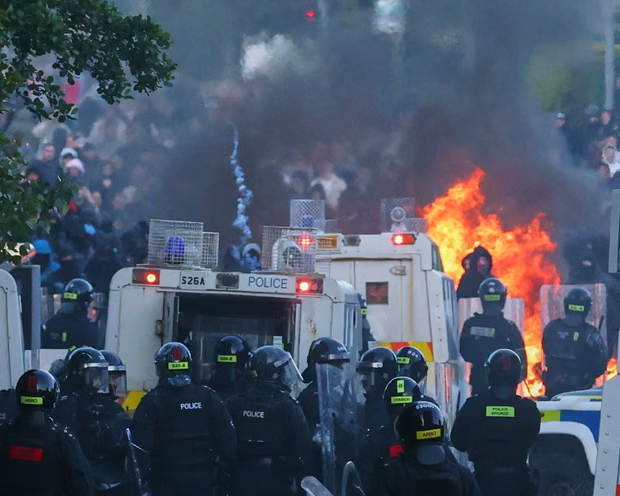
Despite their pleas, the violence spread into residential neighbourhoods like Newtownabbey in north-west Belfast. A Department for Infrastructure vehicle was targeted and set completely ablaze by rioters there. Crowds gathered near the busy Sandyknowes roundabout to confront lines of heavily armored police. They used bricks, paving stones, and petrol bombs to assault the defending law enforcement.
The rioters also attempted to set fire to an empty, derelict commercial property nearby. Numerous wheelie bins were dragged into the middle of roads and ignited as blockades. Meanwhile, police in Derry reported that various items were set alight on Ardmore Road. These coordinated actions demonstrate a troubling level of pre-planned disruption by localized criminal elements.
The political fallout from these terrifying events is reverberating through the Northern Ireland assembly. John Blair, an Alliance member for South Antrim, shared his deep concerns on national radio. He described the aggressive crowds as a lawless mob on a rampage of destruction. Blair emphasized that ordinary citizens are suffering the most from this sudden, intense instability.
The politician painted a harrowing picture of vulnerable families being driven from their homes. Some residents had to be escorted away safely inside secure police vehicles for protection. Blair noted that he has spoken directly with many affected individuals over two days. They are currently living in a state of sheer terror regarding their future safety.
Many residents are now terrified of simply traveling to their places of daily employment. They worry that they might not be able to return home safely after shifts. Even inside their own houses, people of colour feel exposed to immediate physical danger. This pervasive fear is damaging the social fabric of these traditionally close-knit northern communities.
The legal system is moving quickly to address the incident that triggered this unrest. On Wednesday afternoon, a suspect appeared before the magistrates court located in central Belfast. Hadi Alodid, a thirty-year-old Sudanese national, faces several incredibly serious criminal charges. He stands accused of the attempted murder of Stephen Ogilvie during the initial confrontation.
Additionally, Alodid is charged with making threats to kill an NHS radiographer that day. The prosecution has also leveled a charge of illegal possession of an offensive weapon. The court proceedings are being monitored closely by both the public and political figures. The gravity of these specific charges has intensified the ongoing national debate surrounding migration.
Political tension has mounted over reports regarding the asylum status of the accused man. Rumours suggest that Alodid may have been fast-tracked through the system during 2023. This controversial process allowed applicants to complete paper forms rather than undergo detailed interviews. Critics argue this method compromised the overall security and integrity of the immigration system.
Hilary Benn defended the current administration by contextualizing when that specific policy was used. He noted that the fast-track system was introduced entirely by the previous conservative government. The current leadership has already abolished that specific administrative mechanism to ensure greater scrutiny. Benn emphasized that net migration figures have actually dropped eighty-two percent from their peak.
The government is focused on processing all outstanding asylum claims much more efficiently now. The secretary stated that ministers are working hard to get a firm grip on immigration. They desire a system that remains fundamentally fair to British taxpayers and local communities. However, the nation must also honour its legal obligations to those fleeing genuine persecution.
The delicate political balance in Northern Ireland requires unity from its leadership during crises. The deputy first minister, Emma Little-Pengelly, has also spoken out regarding the recent rioting. She acknowledged that many ordinary citizens hold genuine concerns regarding national immigration levels. However, she strongly condemned those using violence to manipulate these very real frustrations.
Little-Pengelly argued that criminal elements are exploiting public anxiety for their own dark motives. She stated clearly that engaging in street violence is absolutely wrong under any circumstances. The political executive remains entirely united in calling for an immediate end to disorder. The focus must shift toward peaceful dialogue and constructive political engagement across communities.
The coming days will be crucial for restoring lasting peace to Northern Ireland. Community leaders are working alongside police to defuse tensions and prevent further nightly escalations. The resilience of the local population will be tested as they rebuild damaged neighborhoods. Ultimately, the region must find a way to address complex social issues without violence.
Related News:
 Reeves Faces Setback as Labour May Miss Homes Target
 Kate Winslet to Narrate Film Highlighting King’s Environmental Mission
 Trump’s UK Ambassador Urges North Sea Drilling to Strengthen US Ties
 UK Bans Fake Numbers: Scammers Lose Their Trick
 Millionaires group urge Reeves to introduce wealth tax to ‘lift kids out of poverty’
 Reeves rejects £1bn plea for NHS redundancy payouts
 PM Condemns Leaks, Vows Loyalty to Ministers and Stability
 Inside the Helpline Protecting Missing Children in the UK
 PlayStation PS5 Deals Hit Lowest Prices Ahead of Black Friday
 Five-Year-Old Dies After Rare Tonsil Surgery Complication
 Starmer Says Labour’s Economic Plan Needs Years to Deliver
 UK unemployment rises to four-year high of 5.1% before budget
 Wiltshire Police Use Lasso to Catch Rampaging Village Goat
 Coasting Drinks: The Trend Redefining Alcohol Enjoyment This New Year
 Rising Hate Crimes Threaten Safety on UK Public Transport
 Starmer Faces Parliamentary Battles Over UK-EU ‘Reset’ Plan
 Met Police Vetting Failures Let Serial Rapists Remain
 Google Employee Claims Redundancy After Harassment Report
 Fatal Bolton Taxi Crash Claims Three Teens and Driver
 ScottishPower Tops List of Worst UK Energy Suppliers
 Judi Dench Champions Fight to Save London’s Green Spaces
 Crowborough Camp Welcomes First Asylum Seekers
 BBC Funding Crisis: Tim Davie Warns of Jeopardy Ahead
 Storm Chandra floods Somerset, triggers major incident declaration
 Artificial intelligence will cost jobs, admits Liz Kendall
 Older Women Vanish from BBC Screens, Review Confirms Bias
 Mandelson Faces Police Inquiry Over Epstein Leak
 Streeting moves on doctor pay to end strike dispute
 UK reports baby formula toxin poisoning cases across the country
 Morgan McSweeney downfall shocks Labour leadership
 Send spending gap leaves deprived areas behind
 Hidden Crisis: Domestic Abuse Suicide Toll in UK
 UK Unemployment Rate Climbs to 5.2% Peak
 Farage Unveils Reform UK Frontbench Team
 BBC World Cup Presenting Duties Shared Among Trio
 Placenta Accreta Warning as Hunt Urges Action
 Wales Approves Assisted Dying Bill Consent
 CPS Updates Guidance on Honour-Based and Dowry Abuse
 Rolling Hills and Heritage: A Car-Free Break in Leicestershire
 Corbyn Leads Your Party in Coordinated Left-Flank Strategy
 Asylum Seekers to Work After Year-Long Wait
 Starmer Row as Greens Demand Apology
 Inquiry into HMRC child benefit errors launched by NAO
 Rising Costs Force Families to Rethink Days Out
 Scott Mills Sacked by BBC Over Personal Conduct Claims
 Palantir Boss Defends NHS Deal Amid Government Break Clause
 Relationship with Trump may be beyond repair, Starmer warned
 UK Government Poised to Revive Stalled Hillsborough Law
 Home Office Faces Legal Risks Over Asylum Hotel Living
 Crisis in NHS Surgery Scheduling Hits Patients Hard
 Blue Badge Abuse: The Rising Tide of Public Hostility
 Scott Parker Leaves Burnley After Premier League Drop
 Silent Tracks: Rail Line Without Passengers
 RFU Backs Borthwick Despite England’s Poor Six Nations
 Major test for Labour as polls open in Great Britain
 Keir Starmer Struggles to Secure His Grip on Downing Street
 Farage Faces Standards Probe Over Cash Property Purchase
 Closing the Gap: UK Pensions Commission Demands Action
 Russian Electronic Attack Targets UK Defence Chief Jet
 UK Shoppers Face Prolonged Price Rises At Tills
 Tube Strike Brings Capital to a Standstill Over Shift Disputes
 Labour Denies Benefit Tax Hike Amid Mandelson Leak
 Makerfield Voters Demand Real Change as Election Looms
 US Condemns ‘Two-Tier’ UK Policing After Student Murder
 Millions in British Charity Funds Linked to Illegal Settlements
 Ryanair Faces Probe Over Mandatory Family Seating Fees
 Clean Air Initiatives Spark Major Fall in London Hospital Admissions
 United Kingdom Politics Worse Now Than Before Brexit, Warns MP
 Russian Tanker Captain Remanded in UK Court After Channel Seizure
 Shocking Zoo Incident Sparks Attempted Murder Probe
 The Hybrid School Revolution Defying the Social Media Ban
 UK Care Crisis: Row Explodes Over New Visa Settlement Rules
 Sainsbury’s Boss Optimistic As Grocery Inflation Eases
 NHS Urges Investigation For Irregular Periods
 US Airman Avoids British Court in Indecent Exposure Case
 Farage Warns Sky News Following Financial Inquiry
 Ann Widdecombe, Formidable Political Figure, Dies at 78
 UK Schools Struggle as Classrooms Top 40C
 Westminster Council Threatens Charing Cross Soup Kitchen
 Former Diplomats Urge UK and France to Act on Palestine