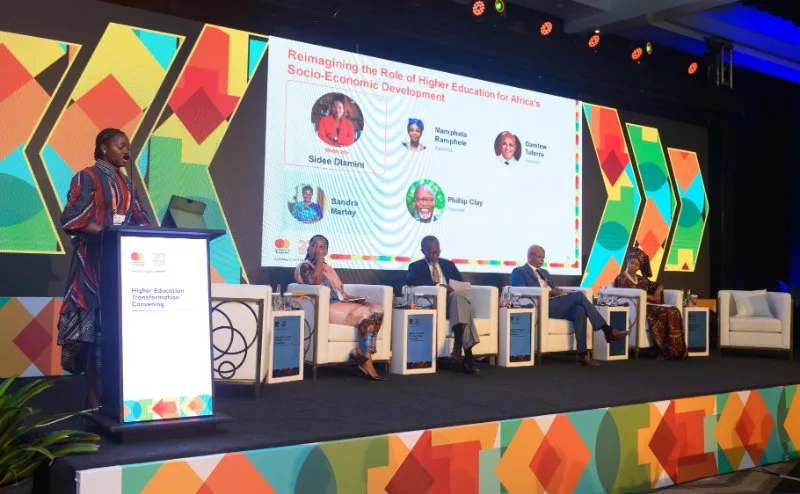
Published: 25 September 2026. The English Chronicle Desk. The English Chronicle Online
Africa must make a major investment in its universities and rethink the way higher education prepares students for employment, research and public service if the continent is to fully benefit from its rapidly growing young population, public health expert Dr John Nkengasong has said.
Nkengasong, a Cameroonian virologist and veteran public health policymaker, argues that universities across Africa need to move beyond education systems that remain heavily focused on theory and examinations and instead develop graduates capable of responding to the continent’s economic, technological, health and social challenges.
His comments come as African countries face the opportunities and pressures created by one of the world’s youngest populations. About 70% of Africa’s population is under the age of 30, creating the potential for a large and increasingly skilled workforce. Yet the expansion of higher education has not always been matched by improvements in graduate employability, research capacity or connections between universities and employers.
Nkengasong believes this disconnect is one of the continent’s most important long-term challenges. He argues that higher education should be treated as a strategic national investment rather than simply another area of public spending.

“No modern or ancient country has developed without a strong higher education system driving research, innovation and critical thinking,” he has said, stressing that universities should be directly connected to the problems governments and societies are attempting to solve.
Africa’s higher education sector has expanded considerably over the past two decades. The proportion of people receiving higher education remains below the global average, but the share of graduates increased significantly between 2000 and 2021. That expansion is expected to continue as demand for university education grows alongside the continent’s population.
The challenge, however, is ensuring that more university graduates are equipped to find sustainable employment and create economic opportunities.
Research cited in discussions about Africa’s workforce has highlighted the gap. Surveys of students and employers have found that only around half of employers rate recent graduates’ employability as very good or excellent. Other research tracking African tertiary graduates has shown that only a relatively small proportion moved smoothly from education into stable employment.
For Nkengasong, the figures point to a structural problem rather than a lack of ability among African students. He believes many young people have considerable potential but are not being given the practical, entrepreneurial and policy-oriented skills required to turn their education into long-term careers.
Graduates often find themselves combining further study with informal work, business activities, family farming or other efforts to generate income. Such experiences demonstrate determination and adaptability, but they also reveal the difficulty many young people face in moving directly from university into secure employment.
Nkengasong argues that universities should therefore work more closely with employers and governments to understand the skills that economies actually require. Science graduates, for example, should not only understand scientific principles but should also learn how research can influence public policy and how evidence can be communicated to decision-makers.
The approach would represent a broader transformation of higher education, with universities becoming centres for research, innovation and public problem-solving rather than institutions primarily focused on delivering academic qualifications.
He points to countries such as Singapore and South Korea as examples of states that invested heavily in education, research and human capital while transforming their economies. His argument is not simply that African countries should reproduce those models, but that governments can learn from the way education and national development were connected to wider economic strategies.
The continent is already seeing efforts to encourage such changes. A new higher education initiative has recognised five African universities for work aimed at transforming education, strengthening innovation, improving routes into employment and increasing research focused on local challenges. The programme aims to channel hundreds of millions of dollars into universities across Africa over the next decade.
Such funding could provide universities with opportunities to strengthen research facilities, improve teaching, develop partnerships with businesses and create programmes that prepare students for emerging industries.
But investment alone, Nkengasong argues, will not be enough. Political leadership will also be required to maintain long-term support for higher education, particularly when governments face competing demands on limited public resources.
He says countries should view universities as part of their national development infrastructure. Roads, electricity networks, railways, dams, manufacturing plants and other major projects all depend on engineers, scientists, managers, researchers, policymakers and other skilled professionals.
In that sense, investment in universities becomes an investment in the human capital required to build and operate the wider economy.
The historical development of African education systems is also central to Nkengasong’s argument. He says many university curricula continue to reflect structures inherited from the colonial period and have not been sufficiently adapted to the needs of modern African societies.
The issue is broader than changing individual courses. It involves reconsidering what universities are expected to achieve and whose economic and social problems they are designed to address.
Nkengasong describes the continent’s education system as having remained too dependent on older approaches while many African economies and societies have undergone profound changes. He believes a stronger process of educational reform should allow universities to develop knowledge and solutions that are rooted in African circumstances.
Funding pressures have added another layer of difficulty. Many governments in sub-Saharan Africa have faced high levels of debt, restricting the resources available for education and research. According to figures cited in recent discussions about development spending, countries in the region are spending substantially more on debt obligations than on education.
For universities, the consequences can include limited research budgets, inadequate laboratories, insufficient technology and difficulties retaining highly skilled academics. These challenges can also encourage talented researchers to seek opportunities elsewhere, further reducing the capacity of domestic institutions to develop advanced research programmes.
Nkengasong believes public health provides a particularly clear example of why Africa needs stronger research capacity.
The continent continues to face infectious diseases and other health challenges that require rapid access to diagnostics, vaccines, epidemiological expertise and public policy. He argues that Africa should have stronger research and development centres capable of producing technologies designed for diseases and conditions affecting its own populations.
The experience of Ebola has reinforced that argument. During outbreaks, African countries can require urgent access to diagnostic equipment, vaccines and specialist expertise, while much of the research and development capacity remains located outside the continent.
Nkengasong believes that universities should help change that imbalance by producing scientists who can work alongside governments, international organisations and pharmaceutical companies while developing research capacity within Africa.
However, scientific training alone is not enough, he argues. Public health professionals also need to understand diplomacy, economics and policymaking because scientific evidence does not automatically become government policy.
A scientist working on disease control, for example, may need to persuade a government facing significant debt that spending on healthcare is not simply a social obligation but an investment in economic stability, national security and long-term productivity.
That requires graduates to understand how evidence is translated into policy and how complex decisions are made in political and economic environments.
The wider argument extends beyond healthcare. Technology, agriculture, manufacturing, climate adaptation, infrastructure and financial services all require graduates capable of combining specialist knowledge with practical problem-solving.
For Africa’s rapidly expanding youth population, the stakes are significant. A generation entering universities and labour markets in large numbers could provide an important source of innovation and economic growth if educational institutions are able to prepare them effectively.
But without sufficient investment and reform, the expansion of higher education could leave many graduates with qualifications that do not translate easily into employment or entrepreneurial opportunities.
Nkengasong acknowledges that transforming universities cannot happen quickly. Building research institutions, training academics, establishing partnerships and developing strong education systems can take decades.

His own experience in global public health has reinforced that lesson. He argues that meaningful institutional change often requires a generation of sustained commitment rather than short-term programmes.
The immediate challenge for African governments is therefore to begin building that long-term foundation while responding to the needs of today’s students and graduates.
For universities, the transformation could mean stronger relationships with employers, more locally relevant research, greater emphasis on entrepreneurship and practical skills, and closer links between scientific knowledge and public policy.
For governments, it means treating higher education as part of national economic planning rather than viewing it solely through the lens of social expenditure.
And for young Africans, the success of such reforms could determine whether the continent’s demographic transformation becomes a source of sustained opportunity.
Africa already has a large and increasingly educated generation. The central question is whether its universities, governments and economies can create the systems needed to turn that human potential into research, innovation, employment and solutions to the continent’s most pressing challenges.
Related News:
 How Bringing Forests Into Preschools Boosts Children’s Health
 No link found between paracetamol in pregnancy and autism
 New Bacteria Discovery Offers Hope Against Noma
 WHO approves first malaria drug for babies
 Ebola outbreak in DRC overwhelms health system as cases surge
 Study Launches Into Brain Injury Risks in Women’s Rugby
 UK Water Firms Ordered to Act Over ‘Forever Chemicals’ Threat
 England Curriculum Review Recommends Major Changes
 Mortgages and AI Set to Feature in English Schools
 Experts Urge Legal Right to Timely Cancer Care
 Patients to Test Health at Home to Ease NHS Winter Pressure
 London’s Childlessness Crisis: Schools Closing as Families Shrink
 North Sea oil workers must lose weight or face job loss
 Government urges schools to ban phones to curb classroom disruption
 NHS frontline staff forced to cover gaps as managers remain scarce
 England schools to receive AI-generated attendance targets
 New Research Explains Severe Diabetes in Children
 Working-Class Men with Prostate Cancer Left Behind by NHS
 Higgs Donates Nobel Medal to His Beloved University
 New AI tool could cut wasted efforts in organ transplants
 From Baby Teeth to Bioengineering: The Future of Self-Healing Teeth
 Healthy Habits in Your 30s That Boost Life in Your 70s
 Scottish Families Take Legal Action Over School CO Leak
 Coffins Now Too Large to Cremate Amid Rising Obesity Crisis
 Thinktank Urges Smaller Hospitals to End NHS ‘Permacrisis’
 NHS paediatric leave parents waiting months for answers
 Ban Social Media for Under-16s, Teachers Demand Action
 Google Removes Some AI Health Summaries Over Safety Concerns
 AI Transforms Lung Cancer Detection in NHS Trial
 Genes May Hold the Secret to Long Life, Scientists Find
 AI breast screening cuts later cancer diagnoses by 12%, study finds
 Autistic Girls Often Missed in Childhood Diagnoses, Study Finds
 Baby rhythm sense found in newborn brains
 Most Statin Side-Effects Are Not Caused by Drugs, Study Confirms
 Reading Habits Linked to 40% Lower Dementia Risk
 Mind AI inquiry sparks mental health safety debate
 Ayahuasca Psychedelic DMT Shows Potential as Depression Therapy
 US Accused of Exploitation Over Zambia Health Aid
 Zorevunersen Breakthrough for Dravet Syndrome
 Cancer Death Rate in Britain Falls by Nearly a Third
 Taking Multivitamins Daily Could Slightly Slow Ageing, Study Finds
 Social Media Giant Trial Reaches Final Jury Decision
 ‘Drinking from a Fetid Pond’: Superbug Genes in Lough Neagh
 Sperm Struggles in the Final Frontier of Space
 School Plate Revolution: England Bans Fried Menu Classics
 Gene Therapy Wins Major Prize for Restoring Vision
 Canadian astronaut French words ease language row
 NHS Safety Fears as Nurses Cover Doctor Gaps
 Older Than Dinosaurs: Secrets of Mayfly Dance Revealed
 Germany to Return Rare Irritator Dinosaur Skull to Brazil
 FDA Chaos Deepens as Trump Eyes Makary Exit
 UK to Expand Prostate Cancer Trials for Black Men
 NHS Approves Landmark Ovarian Cancer Drug
 Tech Trends and the Battle Against Exam Hall Cheating
 The Mystery Behind Why Humans Prefer Walking Anticlockwise
 Failing Systems: The UK Stem Cell Crisis Exposed
 Oura Ring 5 Review: A Massive Leap for Smart Rings
 Deadly H5 Bird Flu Reaches Australia’s East Coast
 UK Schools Struggle as Classrooms Top 40C
 Weight-Loss Drugs Offer Food Savings Mainly to High Earners
 DRC Ebola Outbreak Peaks as New Infections Slow
 English Hospitals Face Shortage of Health Play Staff
 Headteachers Warn New Ofsted System Is Harming Wellbeing
 Tropics May Wait Longest for Net-Zero Climate Benefits
 Super El Niño Threatens Hundreds of Thousands of Lives
 Sundar Pichai Cautions on AI Hype and Market Risks
 Five-Year-Old Dies After Rare Tonsil Surgery Complication
 ABC Facebook Page Briefly Hacked, Adult Photos Posted
 Meta trial over child exploitation claims begins
 Streeting moves on doctor pay to end strike dispute
 Send spending gap leaves deprived areas behind
 Stewart Brand on Musk, Bezos and a Life of Long Thinking
 New Zealand Covid Response Praised Despite Lingering Scars
 Wes Streeting faces narrow road to Labour members’ favour
 Maldives Cave Diving Tragedy Raises Safety Alarm
 Trump Faces Backlash Over $2bn Earnings Since Return
 Breakthrough NHS Tests for Endometriosis Patients
 Tom Watson Takes Senior Role at Palantir
 British Columbia Sues OpenAI Over School Shooting
 Trump gives Xi red-carpet welcome as trade truce extends