Published: ২৭ October 2025. The English Chronicle Desk. The English Chronicle Online.
In a quiet field near Great Bardfield in Essex, the echoes of a long-forgotten tragedy are being carefully unearthed. Over 80 years ago, on 26 January 1944, 23-year-old US Air Force pilot 2nd Lieutenant Lester Lowry embarked on a routine training flight in his P-47 Thunderbolt, a powerful warplane nicknamed “Lucky Boy.” Tragically, the aircraft spiraled out of control in dense cloud, crashing violently into the Essex countryside. Lowry never bailed out, and his body was never recovered. Since that fateful day, he has been officially listed as missing in action, leaving a lingering void in the annals of wartime history.
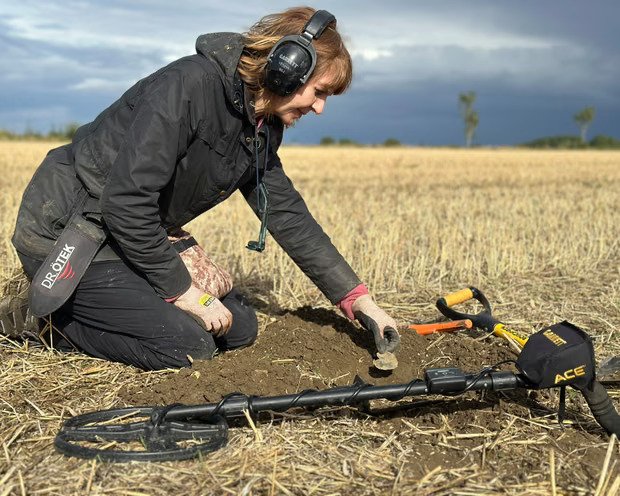
Today, archaeologists and military investigators are meticulously recovering the remnants of Lowry’s plane, seeking both closure and a deeper understanding of the circumstances surrounding his death. The operation is being jointly conducted by the US Department of Defense’s Defense POW/MIA Accounting Agency (DPAA), the UK Ministry of Defence, and the renowned Cotswold Archaeology. Beyond the historical and technical significance of the excavation, there is a profoundly human dimension: honoring a young pilot whose life was cut short while training for the battle against fascism during the Second World War.

Lester Lowry was a member of the 487th Fighter Squadron, a unit that regularly escorted bomber missions over Europe, risking life and limb against German Luftwaffe forces. On that January morning, Lowry took off from his RAF base at Bodney, Norfolk, unaware that his training flight would be his last. The plane, despite being named “Lucky Boy,” ended in tragedy, its wreckage scattered across fields, a silent testament to the perilous nature of wartime aviation.
The current excavation has revealed thousands of pieces of the aircraft, from engine components such as cylinder heads, pistons, and valves, to fragments of the fuselage and wings. Armament remnants, including parts of M2 Browning machine guns, have also been recovered. Inside the cockpit, archaeologists have found sections of the instrument panel, defrost and vent controls, and, poignantly, the clips of Lowry’s parachute harness—items symbolizing both his preparation and the tragic irony that he never had the chance to use them.
Sam Wilson, lead archaeologist from Cotswold Archaeology, described the emotional impact of the finds: “The most moving elements are those directly linked to Lowry himself, like the parachute harness clips. You can almost feel the connection to him as he piloted his aircraft in those final moments. The sheer volume of wreckage was far greater than I anticipated—thousands upon thousands of fragments.”
The excavation and its findings will be featured in an episode of More4’s documentary series Hidden Wonders, premiering on 4 November. Co-presented by broadcaster and archaeologist Sandi Toksvig, the series seeks to illuminate stories lost to time. Toksvig emphasized the significance of this project, noting: “We are piecing together the untold story of a young man who never made it home. It is a deeply human story, connecting viewers to the sacrifice and courage of a pilot whose life ended far from home.”
Lowry’s personal history underscores the poignancy of the recovery effort. Orphaned at nine, he was raised by an aunt, who would later receive the tragic telegram informing her of his disappearance. The pilot’s wartime record reveals that he had accumulated only 47 hours of flight training—less than half of the standard requirement for new pilots. During the Second World War, however, the urgent demand for airmen often meant that young men were rushed into combat with minimal preparation. Despite this, eyewitness accounts and local oral histories suggest that Lowry’s crash may not have been due to inexperience.
Sandi Toksvig recounts an encounter with Peter Morris, a 90-year-old Essex resident, who remembered the crash vividly. “Peter believes that Lester might have intentionally avoided crashing into the schoolyard full of children that day. This insight reframes our understanding of the young pilot. Perhaps he wasn’t inexperienced at all; maybe he was quietly heroic, making split-second decisions that saved lives even in his final moments.”
The DPAA, responsible for accounting for US personnel missing in action worldwide, plays a crucial role in the excavation. Every piece recovered is meticulously catalogued and later analyzed in the DPAA laboratory in Nebraska. Items will eventually be divided between UK and US museums, allowing both nations to honour the sacrifice of the pilot and educate future generations about the human cost of war.
The Essex excavation is part of Cotswold Archaeology’s third consecutive year collaborating with the DPAA and Operation Nightingale, a UK-based initiative launched in 2011. Operation Nightingale integrates veterans and military personnel into archaeological projects, using physical labor and historical research to support recovery missions while aiding rehabilitation and therapy for participants. Sam Wilson explained the deeper significance of this partnership: “Recovering Lester Lowry’s plane is more than just an archaeological project. It’s a tribute to countless young men who lost their lives in training accidents, a category of sacrifice often overlooked in wartime narratives. The bravery of these pilots, who risked everything simply by stepping into the cockpit, deserves recognition equal to that of those on the front lines.”
Among the finds, the cockpit fragments and personal effects offer a tangible connection to Lowry as a human being, rather than just a name in military records. Items like instrument panel components and the parachute harness clips allow researchers and the public alike to visualize the young pilot’s final moments. “There’s an intense human connection that you don’t experience in other forms of archaeology,” said Wilson. “Seeing photographs of Lowry and learning about his service history brings the person to life. It’s as if he’s not just a casualty of war but a real individual whose courage and choices mattered.”
The tragedy of Lowry’s short life is amplified by the context in which it unfolded. World War II demanded rapid mobilization, and many young Americans were sent to training schools abroad with minimal hours of flight experience. The lack of adequate training hours, combined with the harsh conditions of wartime Europe, meant that accidents were sadly common. Yet Lowry’s story reminds us that behind each statistic lies a life of ambition, courage, and sacrifice.

As the excavation continues, archaeologists sift through the debris to recover every possible artifact. Engines, control surfaces, armament fragments, and personal items are carefully catalogued and preserved. The painstaking work ensures that each artifact retains its historical and emotional significance, offering researchers a rare opportunity to reconstruct the last moments of a pilot who never returned home.
The recovery also resonates with the local community. Residents like Peter Morris offer oral histories that provide context and nuance, revealing how the event was perceived and remembered by those who witnessed it. Such accounts enrich the excavation, turning it into a narrative not only about war and machinery but also about human memory, heroism, and loss.
Ultimately, this archaeological dig serves as a testament to the countless young men whose lives were abruptly cut short during training exercises, often overshadowed by the heroics of battlefront engagements. As Sam Wilson noted, “The sacrifice is no less than someone killed on the front line. Everyone was doing their duty, whether in combat or training.” By uncovering and documenting Lester Lowry’s story, the project honors both his individual courage and the broader legacy of young pilots who risked everything in service to their countries.
The Essex dig, the forthcoming documentary, and the ongoing efforts of the DPAA and Cotswold Archaeology collectively ensure that these stories are not lost to time. For Lowry’s family, the historical community, and the public, the project offers a sense of closure and recognition long overdue, bridging the gap between wartime sacrifice and contemporary remembrance.
Related News:
 New Zealand mother and young son endure harrowing US detention over visa confusion
 British Grandmother to Return Home After Death Sentence in Bali
 Second world war veterans honoured as King leads Remembrance Sunday
 Thousands at Risk in Gaza Amid Winter Flooding
 Forgotten War, Shattered Lives: Sexual Violence Devastates Women in Ethiopia
 South African Women Call Purple Protest Over Gender Violence
 Rare shark attack kills woman, injures man at remote NSW beach
 Northern Ireland Family of Three Shot Dead in Maguiresbridge Home Incident
 MPs Warn Thousands Still Face Poverty Despite Labour’s Welfare Reform Retreat
 Southport Stabbing Survivor Speaks Out: ‘I Thought I Was Going to Die’
 Seventeen Dead as Russia Targets Ukrainian Prison in Devastating Airstrike
 FBI and NSPCC Sound Alarm Over Alarming Surge in Child Sextortion Cases Online
 English Backpacker Pleads Guilty to Causing Death of Perth Father in Drunken E-Scooter Crash
 Alarming rise in abusive teen relationships in the UK sparks urgent warnings
 Failed New Mexico Candidate Sentenced to 80 Years for Drive-By Shootings at Lawmakers’ Homes
 Shock and Anger as Child Sexual Exploitation Victims Excluded from Government’s Violence Against Women Strategy
 Dream Dog Scam: Woman Loses £500 to Fake Online Breeder’
 EuroMillions Record-Breaking £210m Jackpot Won by Lucky Lottery Ticket Holder
 Akinwale Arobieke Found Dead at Liverpool Home
 Lisbon’s Historic Funicular Turns to Tragedy: The Elevador da Glória Derailment
 British Couple Among Victims in Lisbon Funicular Tragedy
 Madeleine McCann Case: German Woman at Centre of Hit-and-Run Theory Speaks Out
 UK Doctors Guilty of Sexual Misconduct Continue Practising Amid Weak Sanctions, Research Finds
 Northern Ireland Faces Fears of Prolonged Race Riot “Permacrisis”
 Zarah Sultana Seeks Legal Action After Bitter Clash with Jeremy Corbyn Over Party Membership Funds
 Anti-Immigration Protesters and Counter-Protesters Clash in Glasgow
 Channel Crossings Surge: Over 1,000 People Arrive in the UK in Small Boats in a Single Day
 Police Appeal for Witnesses After Woman Raped in Oxfordshire Churchyard
 A Third of EU Citizens in UK Report Discrimination by Public Bodies Post-Brexit
 Jailed Georgian Opposition Leaders Warn UK of Iranian Links to Ruling Party
 Majority of UK Men Would Opt for Prostate Cancer Screening, Survey Finds
 Massive London Poundland Fire Engulfs High Street
 Cooper Unveils £4m Cyber Plan Against Russian Hackers
 Ambulance Worker Fired After Flinging Amputee from Wheelchair and Offering Bribe
 Madeleine McCann Detectives to Testify Against Woman Accused of Stalking the Family
 Kosovo agrees to host Britain’s refused asylum seekers
 Nearly 48,000 Zombie Knives Removed from UK Streets in a Year
 Mass Stabbing on Doncaster to London Train Leaves Ten Injured
 Trump Speaks on Prince Andrew’s Royal Scandal Fallout
 Experts Warn on Home Birth Risks, Call for Skilled Midwives
 UK University Faces Counter-Terror Probe Over China Pressure
 World Whisky Tour: 9 Global Gems
 Just Stop Oil Protesters Convicted Amid Climate Defence Row
 Jailed UK climate protesters face extremist-style restrictions
 Boris Johnson accused of undermining BBC leadership
 How to get help when a child goes missing – call 999 urgently
 ‘Reckless’ cuts to victims’ services will cost more than they save
 BBC’s Tim Davie to Address Staff Amid Trump $1bn Threat
 Ukraine-Russia war latest: Putin’s troops exploit bad weather to force Kyiv withdrawal from multiple towns
 Leading doctors issue warning amid ‘bad’ flu season
 New Epstein Files Spark Political Clash in Washington
 South Korea’s Jeju Island Faces Rising Tide of Illicit Drugs
 New review urges UK to repatriate Shamima Begum, others from Syria
 Victims’ commissioner Baroness Newlove dies aged 63
 Newly released emails reveal Epstein kept close eye on Trump
 Truck Crashes into South Korean Market, 2 Dead, Dozens Hurt
 Oklahoma Governor Grants Last-Minute Clemency to Death Row Inmate
 US Pushes Global Effort to Stop Arms Flow to Sudan RSF Forces
 Israel Confirms Returned Hostage as Meny Godard
 Mum Calls for New Licence Rules After Teen Road Death
 Tragedy Strikes Indian Pilgrims in Saudi Bus Accident
 Mother Watches in Horror as Teen Daughter Dies on Tracks
 Agency Workers Vote to Join Picket Lines Amid Dispute
 Irish Hero Parrott Says Goal Brought First Tears in Years
 Scotland Fans Reflect on France ’98 as World Cup Looms
 Convicted Killer Challenges Vegemite Ban Behind Bars
 Newport Man Left Injured After Electric Bike Collision
 Podcaster Faces Abuse Charges Over Controlling Behaviour
 WhatsApp Messages Expose Nathan Gill’s Bribery
 Venezuela Threatens Nobel Winner Machado with Fugitive Status
 DWP to Reassess Hundreds of Thousands in Carer Allowance Scandal
 Trump Envoy to Discuss Ukraine Peace at Kremlin
 Twenty-Four Nigerian Schoolgirls Freed After Abduction
 Sudanese Family Vows to Stay After Racist Graffiti
 Two National Guard Soldiers Critically Injured Near White House
 Southern Lebanon reels as Israeli strikes shatter communities
 Video shows Israeli troops kill Palestinians after surrender
 Families wait in agony for missing after Hong Kong tower blaze
 Guinea-Bissau President Flees After Military Coup
 A Colourful Cultural Escape in Mexico’s Querétaro