Published: 06 July 2026. The English Chronicle Desk. The English Chronicle Online.
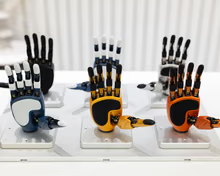
Human hands are incredible, nerve-filled tools that remain the most flexible part of our skeleton. Tasks we take for granted, like tying shoelaces or buttoning shirts, require complex neurological choreography. Throughout human history, no machine has ever truly managed to replicate this vital human tool. Now, as artificial intelligence races forward, some companies believe they are closing this final gap. Most of these ambitious firms are currently operating within the borders of modern China.
A new wave of Chinese start-ups is leveraging the nation’s manufacturing prowess and government enthusiasm. Beijing is aggressively pushing what officials call embodied AI to build fully dextrous robotic hands. These components are essential to transform humanoid robots from dancing stage gimmicks into useful products. Since Unitree’s troupe of dancing humanoids performed at the 2025 Spring Gala, China has surged. Technologists view advanced robotics as the key to unlocking future economic potential for the nation.
China currently grapples with an ageing population and a shrinking workforce that threatens economic growth. Marketing materials from these robotic companies show machines performing tasks that humans might soon avoid. Robots are depicted folding laundry, cooking dinner, or even performing precise tasks like cutting hair. Beijing has repeatedly emphasized the importance of embodied AI within its national strategic development plans. In May, the party’s theoretical journal noted that these robots are opening massive new markets.
Although China is deploying more automatons than any other nation, actual humanoid utility remains low. The International Federation of Robotics noted last September that multipurpose humanoids are still quite far off. This reality exists because tasks useful in daily settings require extremely sophisticated, human-like robotic hands. Creating these appendages is widely considered the most difficult hurdle in the entire robotics field. Even Elon Musk admitted that hands represent the majority of engineering difficulty for his robots.
Inside an office brimming with floating robotic hands, the founder of LinkerBot explains the challenge. Zhou Yong says making a robotic hand is one hundred times harder than building a humanoid. Its dexterity is ten times that of other body parts, yet it occupies less space. Like many entrepreneurs, Zhou draws inspiration from American greats like the late Steve Jobs. He decided to focus exclusively on hands, launching his dedicated firm during early 2023.
His company currently manufactures about five thousand hands monthly with plans to double that figure. LinkerBot is chasing a valuation of six billion dollars as it refines this critical technology. Zhou believes that human hands represent the most important functional ability of all living beings. Among his ambitious goals is making mass-market prosthetics for amputees at a much lower cost. He aims to eventually drop the price of these sophisticated devices to just one thousand dollars.
Manufacturing these advanced parts requires solving both complex hardware and daunting software engineering problems simultaneously. Thanks to a sophisticated and nimble supply chain, Chinese companies are racing ahead on hardware. The rise of the electric vehicle industry has created a perfect environment for robotic parts. Many firms can now produce components at scale, from lithium-ion batteries to highly miniaturized motors.
Pan Yunzhe, the founder of Wuji Technology, says sourcing parts in China is extremely easy. He graduated in the United States but chose to start his company in Shenzhen instead. Pan notes that doing hardware in the United States felt impossible due to supply constraints. He often had to ask his father to mail him basic parts from overseas. Returning to China allowed his business to thrive within a highly efficient industrial ecosystem.
Zhou and Pan are among thousands of entrepreneurs betting heavily on China’s current robotics hype. China has registered over one million robotic companies, with registrations rising forty percent last year. The niche industry focused specifically on hands is growing rapidly and reached huge valuation milestones. Pan decided to focus on hands because physical manipulation is more important than simple locomotion. Humanoids can move through space, but they are useless until they can grasp real tools.
The more challenging problem remains the software needed to teach hands how to function properly. Nathan Lepora, a professor of robotics at the University of Bristol, notes the remaining difficulty. He suggests that controlling these complex devices is an entirely different and difficult game today. Nobody currently knows how to perfectly program a robotic hand for every single human task.
Anyone who has used a claw machine knows that controlling a mechanical device is quite difficult. This process, known as teleoperation, is being used by start-ups to harvest massive training data. Unlike large language models trained on endless text, high-quality three-dimensional data is incredibly scarce. Researchers are now looking toward more seamless methods to capture the nuance of human touch. One of Wuji’s flagship products is a sensor-filled glove that collects vital movement information.
That kind of data is intuitive to humans and allows us to perform delicate tasks. We can crack an egg on a pan without crushing it, which is currently alien territory. Capturing how a human moves and what they feel is a super complicated, unsolved problem. China’s entrepreneurs are betting they will be the ones to finally solve these mysteries soon. LinkerBot’s founder dreams of a factory where robotic hands build more robotic hands quite independently.
Such a self-perpetuating loop would require very minimal input from human workers in the future. With the right hands, robots might eventually become fully capable and reliable household helpers. Zhou maintains that these companies are not creating robots to simply replace all human labour. Instead, he believes the goal is to create tools for a better, more prosperous life. This vision drives the intense innovation currently sweeping through the Chinese robotics sector today.
Related News:
 Virgin Trains Moves Closer to Challenging Eurostar Monopoly
 UK Bans Fake Numbers: Scammers Lose Their Trick
 Vibe coding’ named Collins dictionary’s word of the year
 Patients to Test Health at Home to Ease NHS Winter Pressure
 Britain deploys RAF specialists to assist Belgium with drone threats
 Stop using ChatGPT to write speeches, AI minister tells MPs
 Northern Lights may illuminate UK skies this week
 New laws to bolster UK’s defences against cyber attacks on NHS, transport and energy
 Hitler’s DNA Confirms He Truly Had Only One Testicle
 Working-Class Men with Prostate Cancer Left Behind by NHS
 New AI tool could cut wasted efforts in organ transplants
 How Cultures Interpreted the Aurora Through History
 From Baby Teeth to Bioengineering: The Future of Self-Healing Teeth
 Sundar Pichai Cautions on AI Hype and Market Risks
 Google Chief Urges Caution: Don’t Trust AI Blindly
 US Judge Says Meta Did Not Hold Illegal Social Media Monopoly
 Healthy Habits in Your 30s That Boost Life in Your 70s
 Coffins Now Too Large to Cremate Amid Rising Obesity Crisis
 AI Actress Creator Says Tilly Norwood Won’t Replace Actors
 AI Grok Sparks Child Safety Alarm in the UK
 Google Removes Some AI Health Summaries Over Safety Concerns
 US Clears Nvidia AI Chip Sales to China in Policy Shift
 Amazon Milton Keynes closure sparks concern for UK warehouse workforce
 Astronomers Prepare for First-Ever Movie of a Black Hole
 MPs warn AI financial risks threaten UK stability
 MPs warn AI financial risks threaten UK stability
 Pornhub blocks new UK users over age checks dispute
 Amazon mistakenly signals new global layoffs to employees
 AI breast screening cuts later cancer diagnoses by 12%, study finds
 UK Launches First Rapid-Charging Battery Train This Weekend
 UK New Car Discounts Near £6,000 as Prices Are Slashed
 Most Statin Side-Effects Are Not Caused by Drugs, Study Confirms
 BT Names New Openreach Chief Amid Major Fibre Expansion
 AI fears hit UK wealth and comparison sites
 Tech Trends Set to Transform Life in 2026
 Starmer Targets AI Chatbots Over Child Safety Concerns
 How Ancient Scottish Rocks Challenge ‘Snowball Earth’ Theory
 Ayahuasca Psychedelic DMT Shows Potential as Depression Therapy
 Stewart Brand on Musk, Bezos and a Life of Long Thinking
 Facial Recognition Error Leads to Wrongful Arrest in Milton Keynes
 Social Media Trial: Woman Says Addiction Began at Six
 Zorevunersen Breakthrough for Dravet Syndrome
 Revealed: UK AI Push Faces Phantom Investment Claims
 Ministers Urged to Act Faster on Deepfakes Threat
 Tesla Enters British Energy Market Following Ofgem Approval
 Social Media Giant Trial Reaches Final Jury Decision
 Cern Prepares First-Ever Antimatter Transport Test
 The Molten Mystery of L98-59d: A New Class of Liquid Planet
 House of Lords Backs Landmark Social Media Ban for Youth
 Charity Watchdog Warns Alan Turing Institute Over Conduct
 The Woman Guarding Earth From the Threat of Asteroids
 California Defies Trump With Strict New AI Standards
 New Gmail Feature Ends Era of Embarrassing Email Names
 Tech Giants Condemn EU Over Lapse in Child Abuse Laws
 Elon Musk’s xAI Sues Colorado Over New AI Regulations
 Heavier SUVs Accelerate Britain’s Pothole Crisis
 Canadian astronaut French words ease language row
 Humanoid Robots Join Haneda Airport Baggage Teams
 Disneyland Adds Facial Recognition at Entrances
 Older Than Dinosaurs: Secrets of Mayfly Dance Revealed
 Vodafone Seeks Full Control of UK Mobile in £4.3bn Deal
 Tatooine Dreams: 27 New Worlds Found With Double Suns
 Shivon Zilis Takes the Stand in Landmark OpenAI Trial
 Cambridge South Signals New Era for British Rail Travel
 Trump Lands in Beijing for High-Stakes Summit with Xi
 Gotta Catch an MP! The New Political Craze Sweeping Britain
 Court Upholds Landmark Win for Transgender Rights
 A Massive Legal Triumph Reshapes the Future of AI
 UN Issues Urgent Warning: Imminent Return of El Niño
 NHS Approves Landmark Ovarian Cancer Drug
 Tech Trends and the Battle Against Exam Hall Cheating
 Starmer Issues Tech Giants Ultimatum on Child Phone Protection
 SpaceX Prepares for Historic Valuation Launch
 Silicon Valley Shifts South as AI Boom Transforms City Housing
 AI to Help Botanists Win the Critical Race Against Extinction
 Cambridge Recreates Historic 336-Year-Old Garden
 MPs Demand Immediate Horizon Compensation From Fujitsu
 Trump Faces Backlash Over $2bn Earnings Since Return
 South Korea’s AI Chip Boom Sparks Wealth Inequality Debate
 Tesla Rebounds as Sales Surge Past Quarterly Targets