Published: 20 July 2026 | The English Chronicle Desk | The English Chronicle Online
Several facilities linked to Russian online retail giant Wildberries have reportedly been struck in a new wave of Ukrainian drone attacks, according to Russian regional officials and local media reports. The incidents come as Ukraine continues to expand the range and frequency of its long-distance drone operations targeting infrastructure deep inside Russian territory.
Russian authorities said emergency services responded quickly to the affected sites, while investigations into the extent of the damage were launched. There were no immediate reports confirming fatalities, although officials indicated that assessments of the affected facilities were continuing.
The reported attacks represent another example of how the conflict between Russia and Ukraine is increasingly affecting logistics networks and commercial infrastructure far from the front lines.
Regional authorities said several warehouses and distribution facilities associated with Wildberries were affected during overnight drone activity.

While officials confirmed that emergency teams were dispatched to the locations, they provided limited details regarding the scale of the damage.
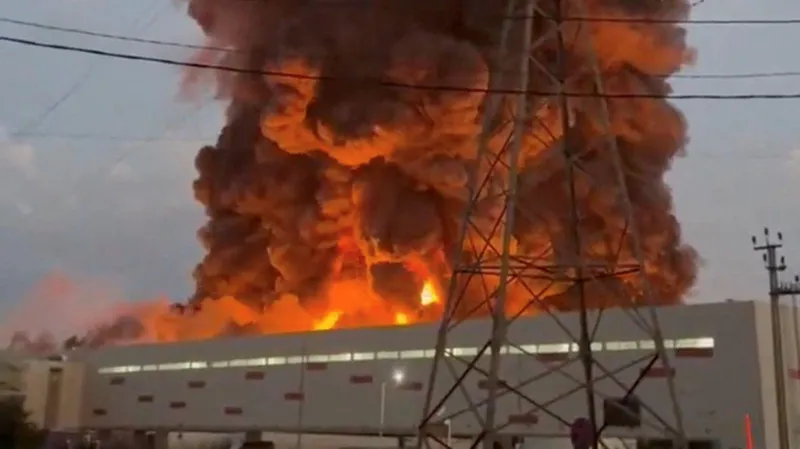
Videos circulating on Russian social media appeared to show smoke rising from industrial buildings, although their authenticity could not be independently verified.
Wildberries has not immediately released a comprehensive statement regarding the reported incidents.
Wildberries is one of Russia’s largest online retail platforms, operating an extensive network of warehouses and delivery centres across the country.
Its facilities play a critical role in processing millions of orders each month, serving consumers in Russia and several neighbouring countries.
Any disruption to major logistics hubs has the potential to delay deliveries, interrupt supply chains and increase operational costs.
Industry analysts say repeated attacks on commercial infrastructure could create additional challenges for businesses already operating under wartime conditions.
Russian officials condemned the reported drone strikes, describing them as attacks on civilian infrastructure.
Authorities said air defence systems had intercepted numerous drones across multiple regions overnight but acknowledged that several reached their intended targets.
Emergency crews worked to secure the affected areas while investigators assessed structural damage.
Officials also reiterated that protective measures around strategic facilities would continue to be strengthened.
Ukraine has increasingly relied on domestically developed long-range drones to strike targets inside Russia.
Kyiv has argued that such operations are aimed at weakening military logistics, industrial capabilities and infrastructure supporting Russia’s war effort.
Ukrainian authorities rarely comment directly on individual drone operations but have consistently maintained that military-related targets inside Russia are legitimate objectives.
Independent verification of specific targets and damage remains difficult because of wartime restrictions on information.
Although military installations remain the primary focus of many long-range attacks, commercial infrastructure has also been affected as the conflict evolves.
Warehouses, transport facilities, fuel depots and industrial complexes have all experienced disruptions in recent months.
Security experts note that many logistics centres also support wider supply chains that can have strategic significance during wartime.
However, attacks involving civilian businesses continue to raise concerns about broader economic consequences.
Repeated disruptions to logistics infrastructure could increase costs for retailers and consumers alike.
Companies may be required to reroute deliveries, repair damaged facilities or strengthen security around warehouses.
Economists say persistent attacks on commercial networks can reduce operational efficiency and create uncertainty for businesses and investors.
Large retailers often depend on extensive distribution systems, meaning damage to individual hubs may have wider effects across regional supply chains.
Russian authorities continue investing heavily in air defence systems designed to intercept drones targeting critical infrastructure.
Despite these efforts, Ukrainian drone technology has demonstrated increasing range and sophistication throughout the conflict.
Military analysts believe both sides are engaged in a rapidly evolving contest involving drone development, electronic warfare and air defence capabilities.
The growing importance of unmanned aerial systems has transformed many aspects of the conflict.
Major Russian companies have increasingly introduced additional security measures to protect warehouses and production facilities.
Some businesses have expanded emergency planning, strengthened surveillance systems and adjusted operational procedures in response to the evolving security environment.
Industry observers believe companies operating across Russia will continue reviewing contingency plans as long-range drone attacks become more frequent.
The reported strikes on additional Wildberries facilities illustrate how modern warfare increasingly extends beyond traditional military targets, affecting commercial infrastructure and economic activity.
While Russian authorities continue reinforcing air defences and investigating the latest incidents, Ukraine’s long-range drone campaign shows no signs of slowing.
As both sides adapt their military strategies, businesses operating within affected regions are likely to face continued uncertainty, highlighting the growing economic dimension of a conflict that continues to reshape daily life far beyond the battlefield.
Related News:
 UK Must Act with Courage and Clarity on Israel-Palestine Conflict, Says Foreign Affairs Committee Report
 Radioactive Leak at UK’s Nuclear Warhead Base Sparks Outcry Over Safety and Secrecy
 Mutual Inconvenience: Why Alaska Was Chosen for the Trump-Putin Summit on Ukraine
 Terence Stamp, ’60s British Film Legend and Star of Superman, Dies at 87
 Where Is Prince William and Kate Middleton’s New House? Inside the Historic Lodge Set to Become Their ‘Forever Home’
 FIFA Eyes Biennial Club World Cup from 2029, Plans Possible Expansion
 Is the UK Ready to Put Boots on the Ground in Ukraine? Assessing Military Capacity and Challenges
 Shein UK Faces Allegations of Shifting Majority of Profits to Singapore to Reduce UK Tax
 British Couple Among 16 Killed in Lisbon Funicular Tragedy
 Protests Expected as Israeli Arms Firms Join Global Defence Trade Fair in London
 Thousands Gather in London to Protest Donald Trump’s Second UK State Visit
 Liverpool Vs outhampton Set for Carabao Cup Clash at Anfield
 A Third of EU Citizens in UK Report Discrimination by Public Bodies Post-Brexit
 Public Trust in SNP Hits Historic Low Amid NHS Concerns
 Cooper Unveils £4m Cyber Plan Against Russian Hackers
 Johnson Suggests Mandelson Linked to China Spy Controversy
 Rachel Reeves signals welfare reform ahead of key budget
 Johnson Approved China’s London ‘Super-Embassy’ in 2018
 Top Christmas Books Reads: Classics to Cozy Romcoms
 Just Stop Oil Protesters Convicted Amid Climate Defence Row
 I’m a Celebrity 2025 line-up revealed: Osbourne joins
 Palace May Restore Hyphen to Andrew Mountbatten-Windsor’s Name
 Royal Navy Shadows Russian Warships Entering the Channel
 Starmer China visit raises human rights pressure on Beijing
 UK New Car Discounts Near £6,000 as Prices Are Slashed
 Starmer Weighs Fast-Tracking Defence Boost
 Snow and Rain Warnings as Cold Snap Continues in the UK
 Dual Nationals Face Scramble for UK Passports as New Rules Come Into Force
 Trump and Chagos Deal Rift Over Iran Strikes
 Australian PM Says Former Prince Andrew Has Suffered ‘Extraordinary Fall’ but That Won’t Prompt Republic Referendum
 Farage Chagos Islands Row Sparks Fury
 US Will Not Back Out of Tariff Deals with UK and Others, Says Trump Trade Representative
 Storm Hernando: Edinburgh Airport Flights Cancelled in US Travel Chaos
 ‘We’ve been paying for happy endings for Andrew for years’: inside the royal disgrace, biographer says
 RAF Responding to Suspected Drone Strike at UK Cyprus Base
 Islanders Advised on Travel to Middle East Amid Escalation
 Brit ‘in Good Spirits’ Amid Dubai Missile Attacks, Stranded but Safe
 Trump rebukes Starmer over Iran strikes
 Stranger ‘On Drugs’ Stabbed Saudi Student to Death in Cambridge
 Minister Meets Crews Who Will ‘Take Out’ Iranian Drones
 ‘We Must Finish This’: Israelis Rally Behind War Effort as Iran Strikes Tel Aviv
 UK Prepares Aircraft Carrier for Middle East Crisis
 UK–US Tensions Ease as Starmer and Trump Hold First Call Since Iran Row
 Yvette Cooper: UK Must Follow Principles, Not US Pressure
 Iran War Warning: Starmer Backs Ukraine Visit
 UK Wage Growth Slows as Jobs Market Holds Firm
 Australia Imposes Sudden Travel Ban on Iranian Visitors
 UK Forces Ready to Seize Russian Shadow Fleet Vessels
 Net Closes on Lyons Clan: Partner Arrested in Dubai as Crime Boss Snared in Bali
 ‘Better Off Not Planting’: UK Farmers Face 36% Fertiliser Spike as Gulf Crisis Bites
 ‘The Final Word’: Kathleen Stock’s Polemic Against Assisted Dying Reshapes the UK Debate
 The ‘Career Ceiling’: One in Five High Earners Say £100k Tax Trap is ‘Ruining’ Their Ambition
 Open Justice Prevails as Court Rejects Bondi Gunman’s Family Anonymity Bid
 The Banbridge Rescue: 300 Sheep Saved from Massive Hay Shed Inferno
 Debt Relief or Drop in the Ocean? UK Caps Student Loan Interest at 6%
 ‘The £100,000 Hammer’: War in Iran Forces UK Businesses to Absorb Historic Fuel Hikes
 “Three-Wheeled Triumph”: Mayor of Erewash Completes 2,000-Mile European Charity Run
 The “Charles Charm” Offensive: Did the Royals Find Their Mojo in D.C.?
 “An Endurance Test for the Mind”: British Couple Sentenced to 10 Years in Tehran
 Premier League drama defines crucial weekend
 “The Cost of Conviction”: Palestine Action Activists Found Guilty Over ‘Clinical’ Factory Damage
 “The Local Gavel”: Polls Open Across Hampshire and Isle of Wight in Delayed ‘Milestone’ Vote
 “The Blue Light Intersection”: Seventeen-Year-Old Critically Injured in ‘Nasty’ Police Pursuit Crash
 “The Fractured Frontier”: Sir John Curtice Declares the ‘Sacred’ Two-Party Era Over After ‘Milestone’ Results
 The Pathogen Protocol”: Third British National Monitored for ‘Nasty’ Suspected Hantavirus
 “The Reality Reckoning”: Government Demands Accountability as Channel 4 Pulls Married at First Sight UK Over Grave Sexual Assault Allegations
 “I’ve Been Cheated”: Andrew Malkinson Lambasts the ‘Accountability Rot’ of the British Justice System Following True Perpetrator’s Conviction
 “A Thorn in the Side”: Farage Faced with Fresh Financial Scrutiny as Corporate Accounts Challenge Reality TV Defense
 Tragedy in the Maldives: Inside the Deep Sea Rescue
 “The Iron Chancellor of the North”: Andy Burnham’s High-Stakes U-Turn to Prevent a Truss-Style Gilt Market Meltdown
 “The London Lockdown”: Tube Strikes and Engineering Works Create a Transport Perfect Storm Across the UK
 “A Historic Tumble”: Lost 1930s Film Reel Reveals the Untamed Origins of Gloucestershire’s Legendary Cheese-Rolling
 “The Pragmatic Pivot”: UK Eases Sanctions on Russian Energy Amid Escalating Global Fuel Crisis
 Farage and Reform UK Reshape British Politics
 UK Faces Most Dangerous Era, Military Chief Warns
 Son Urges Iran Prisoner Exchange for Jailed British Pair
 Weekly Quiz Explores Royal Challenges, Global Headlines and the Stories Behind the News
 UK Government Cancels Higher Education Programme for Women and Girls
 Pizza Express Probed Andrew’s Woking Pizza Claim
 Violent London Clash After World Cup Semi-Final Match