Published: 24 August 2026 | The English Chronicle Desk | The English Chronicle Online
The football used by Diego Maradona to score one of the most controversial and memorable goals in World Cup history has sold for $3.3m (£2.5m) at auction in the United States.
The Adidas Azteca ball was used during Argentina’s 2-1 quarter-final victory over England at the 1986 World Cup in Mexico, a match that became inseparable from Maradona’s legacy.
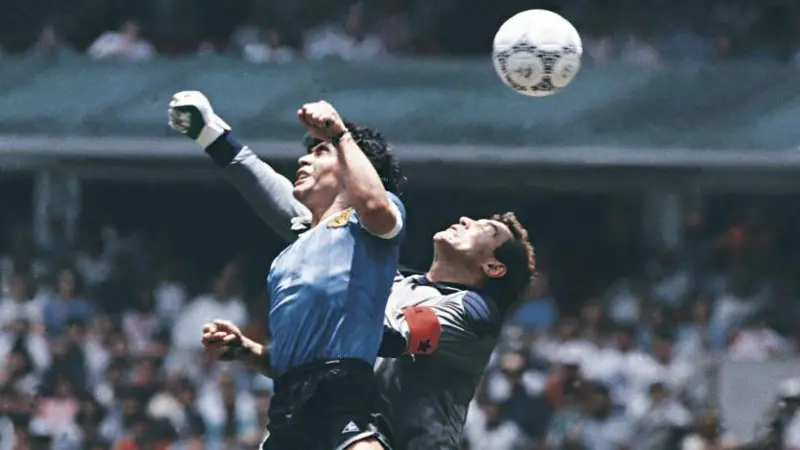
The first of his two goals that afternoon was scored when the Argentina captain appeared to punch the ball over England goalkeeper Peter Shilton and into the net. The goal was allowed to stand despite protests from the England players.
Maradona later described the moment with one of football’s most enduring phrases, saying the goal had been scored “a little with the head of Maradona and a little with the hand of God”.

Almost four decades later, the ball itself has become a valuable piece of sporting history.
Heritage Auctions sold the football on Saturday, although the final price was considerably below expectations. The ball had been estimated to attract a price closer to $10m (£7.3m), meaning the winning bid fell substantially short of the anticipated valuation.
Despite the lower-than-expected result, the sale confirms the extraordinary financial value attached to objects connected with defining moments in football history.
The ball behind football’s most famous controversy
The quarter-final between Argentina and England on 22 June 1986 remains one of the most discussed matches in World Cup history.
With the score level, Maradona challenged Shilton for a high ball inside the England penalty area. Maradona, considerably shorter than the England goalkeeper, reached the ball first with his left hand and directed it into the goal.
The referee and his officials failed to identify the handball, and the goal was awarded.
England players immediately protested, but the decision stood.
The controversy would eventually become one of the defining episodes of Maradona’s career and a lasting part of the rivalry between Argentina and England.
Yet the match was not remembered solely for the disputed goal.
Only minutes later, Maradona produced an extraordinary individual effort that was later voted the “goal of the century”. He collected the ball in his own half, embarked on a spectacular run and dribbled past five England players before beating Shilton.
Argentina won the match 2-1 and went on to win the World Cup, with Maradona playing the central role in their triumph.
The contrast between the two goals has helped make the match uniquely significant: one became famous for controversy and deception, while the other became a benchmark for individual footballing brilliance.
Referee kept the historic ball
The ball’s journey through football history is almost as unusual as the match itself.
Tunisian referee Ali Bin Nasser officiated the quarter-final and collected the Adidas Azteca ball at the final whistle.
He kept it for more than 30 years before eventually selling it.
In 2023, Bin Nasser signed a letter confirming that the ball was the only one used during the match. Further independent authentication subsequently supported its connection to the historic game.
That authentication was particularly important because memorabilia associated with major sporting events can attract enormous prices, making provenance a crucial part of an item’s value.
The confirmation provided buyers with evidence that the ball was genuinely the one involved in Maradona’s famous goal rather than simply an identical model from the same tournament.
‘The most significant soccer item’
The importance of the ball was emphasised before the auction by Mike Provenzale, a specialist auctioneer at Heritage Auctions.
“It’s a true one-of-one item. Arguably the most significant soccer item that exists,” he told Reuters.
The description reflects the unusual combination of sporting importance and physical provenance attached to the ball.
Football memorabilia can include shirts, medals, trophies, boots and photographs, but relatively few objects can be directly connected to a single, universally recognised moment.
The ball has that connection.
It was present during a match that involved one of the sport’s greatest players, one of its most famous controversies and one of its most celebrated goals.
Its significance also extends beyond Argentina and England. The 1986 World Cup is widely regarded as one of the defining tournaments in Maradona’s career and helped establish him as one of football’s greatest ever players.
Previous sale and failed auction
The ball has already changed hands several times.
Bin Nasser sold it in 2022 for $2.37m (£1.74m). Its subsequent owner attempted to sell it again at auction in 2023, but the ball failed to meet the minimum price required for a successful sale.
Its latest auction therefore represents another chapter in the unusual commercial history of one of football’s most recognisable artefacts.
The $3.3m result is higher than its previous recorded sale, although it remains well below the $10m figure that had reportedly been anticipated before the latest auction.
The difference highlights the unpredictable nature of the sports memorabilia market, where estimates can be influenced by rarity, provenance, timing and the number of wealthy collectors competing for an object.
Maradona’s shirt remains more valuable
The ball is not the only object from the match to command a multimillion-pound price.
The shirt worn by Maradona during the same Argentina-England quarter-final sold for £7.1m at auction in 2022.
That price was significantly higher than the amount paid for the football, underlining the particular appeal of items directly worn or used by legendary athletes.
The shirt also carries an unusual history because England midfielder Steve Hodge exchanged it with Maradona after the match.
For years, the shirt was displayed at the National Football Museum in Manchester before being sold.
The football, meanwhile, has a different form of historical significance because it was the physical object involved in the “Hand of God” incident.
A moment that still divides opinion
The sale comes years after Maradona’s death in November 2020, but interest in his career remains enormous.
The “Hand of God” goal continues to provoke conflicting emotions.
For many Argentines, it represents a moment of revenge and sporting triumph following the political and military tensions surrounding the Falklands War.
For England supporters, it remains one of the most painful examples of a refereeing error at a major tournament.
The controversy has nevertheless become part of football’s cultural history.
Maradona’s own explanation transformed the incident into a phrase that became known around the world, while the extraordinary second goal in the same match ensured that the game was remembered not simply as a controversial victory but as a demonstration of his unique ability.
The physical ball now provides collectors with a tangible link to that afternoon.
Sporting history becomes valuable memorabilia
The auction also demonstrates the growing commercial market for historic sports memorabilia.
As legendary sporting moments become increasingly distant, objects with authenticated connections to those events can become highly sought after.
For collectors, the appeal is not simply the object itself but the story attached to it.

In this case, the Adidas Azteca ball represents a single moment that changed the history of a World Cup match and became part of Maradona’s mythology.
Its latest sale for £2.5m may have fallen short of expectations, but the price remains a remarkable sum for a football that, before June 1986, was simply another match ball.
Today, it is one of the most recognisable physical artefacts associated with football’s history.
The “Hand of God” remains a subject of debate almost 40 years after the goal was scored. But regardless of whether it is remembered as genius, cheating, divine intervention or one of the game’s greatest controversies, the ball used that day has now acquired a financial value that reflects its extraordinary place in sporting history.
Related News:
 Nike Charges Fans Most for World Cup Replica Shirts
 Safeguarding Probe Limits West Ham Owner’s Role
 Saka Playing Through Pain As England World Cup Campaign Looms
 England Cruise Past Costa Rica as World Cup Warm-Up Sharpens Tuchel’s Vision
 Football Hopes to Outshine World Cup Drama in Mexico
 Tension Grips Mexico City Ahead of World Cup Opener
 Inside the Three Lions: Bellingham Reveals Euro 2024 Flaws
 Chaos and Celebration at the Historic Azteca Stadium
 ‘We all love him’: Henderson backs Bellingham for England success
 Real Madrid Sign Marc Cucurella From Chelsea
 Why Bringing Back Jordan Henderson Is Thomas Tuchel’s Masterstroke
 Can France Escape the Ghosts of their 2002 World Cup Nightmare?
 Deschamps Shields Mbappé From Fierce Political Storm
 World Cup Fury as Iran Coach Slams Fifa and US
 Messi Equals World Cup Record In Masterclass Victory
 Erling Haaland Double Fires Norway To Victory On Debut
 Tuchel’s England Mission Goes Beyond Football Success
 Iran Files Official Fifa Complaint Over World Cup Travel
 Historic Victory for Canada as They Defeat Nine-Man Qatar
 Heartbreak for Canada as Koné Suffers Horrific Injury
 New Premier League Fixtures Set Stage for Thrilling Season
 Declan Rice Facing Burnout as Tuchel Confronts Midfield Crisis
 Rodrygo Reflects On World Cup Pressure And Social Media
 Cape Verde Hold Uruguay in Dramatic World Cup Clash
 World Cup 2026: Reclaiming the American Dream
 Martinelli Strikes Late as Brazil Edge Past Brave Japan
 Paraguay Shock Germany in Historic Penalty Shootout
 Morocco Beat Dutch in Wild World Cup Penalty Drama
 France Dominate Sweden as Deschamps’ New Era Takes Shape
 Haaland Heroics Send Norway Into Historic Last 16 Knockout
 Kane Saves Tuchel as England Survive Dramatic Exit
 Ramos Sends Portugal into the Last 16
 Spain Dominates Austria to Reach Quarter-Finals
 VAR Drama: Portugal Win in Thriller
 Swiss Star Manzambi Shines in World Cup Victory
 Taylor Swift and Travis Kelce Marry at Madison Square Garden
 Paul Seixas: French Cycling’s Teenage Hope at the Tour
 Norway’s Stunning World Cup Victory Over Brazil
 England Triumph in Azteca World Cup Thriller
 Trump’s Red-Card Intervention Hurts the US World Cup
 Trump Intervenes in Fifa World Cup Balogun Ban
 England’s 10 Men Hold Firm in World Cup Thriller
 USA World Cup Heartbreak: Belgium Ends Their Dream
 Spanish Late Winner Sends Ronaldo Into Final Sunset
 Belgium Thrashes USA After Red Card Controversy
 Ronaldo Says Farewell to the World Cup Stage
 Kylian Mbappé Slams Paraguayan Senator Over Racist Attack
 Messi’s Tears and Triumph in Epic World Cup Escape
 Switzerland Advance in Penalty Thriller
 Egyptian Fury After Argentina World Cup Heartbreak
 World Cup 2026 Power Rankings: England on the Rise
 World Cup Racism Reflects Growing Abuse Patterns
 Mbappé Brilliance Leads France Into Semi-Finals
 Belgium Draws Global Support Before Spain Showdown
 Haaland and Bellingham: A Dortmund Bond Tested
 Bryne Backs Haaland Before England World Cup Clash
 World Cup Fever Set to Boost UK Economy by £500m
 England and Norway Fans Turn Miami Into World Cup Carnival
 Spain’s Superstar Fan: Keyne Yamal Steals the Spotlight
 Lamine Yamal’s Birthday: Football, Fame, and France
 Rice Poised for England Semi-Final Clash Against Argentina
 Spain Clinch Final Spot in Masterclass Victory Over France
 Tuchel Backs England Stars to Overcome Messi’s Argentina
 Saka Solidifies Role as Tuchel’s Key England Lieutenant
 Tiny Curacao Makes History as Smallest Nation to Reach World Cup
 Australia Face Big Changes as Cummins and Lyon Ruled Out of Ashes
 Aston Villa Remain Arsenal’s Key Obstacle in Title Pursuit
 Ben Stokes injury joke after brutal ball strike
 BBC World Cup Presenting Duties Shared Among Trio
 English Cricket Faces Moral Crisis Over Indian Investment
 Scott Parker Leaves Burnley After Premier League Drop
 Arteta urges Arsenal to step up in Atlético semi-final
 RFU Backs Borthwick Despite England’s Poor Six Nations
 Infantino Defends Soaring World Cup 2026 Ticket Costs
 England Call Up Janse van Rensburg for Nations Campaign
 Guardiola to Exit Man City; Maresca Lineup Nears
 Alice Capsey Sparks England Win With Brilliant Fifty
 Man City Threaten Legal Action Over Haaland Real Madrid Shirt
 Fifa Official Under Investigation Over Hand Gesture Controversy
 Canada Secure Historic Last 16 Spot with Late Goal