Published: 08 September 2025 | The English Chronicle Online
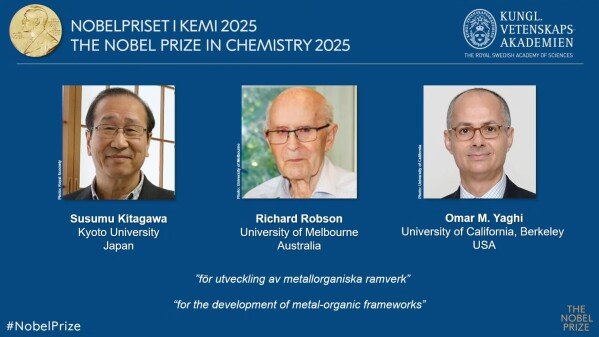
The 2025 Nobel Prize in Chemistry has been awarded to three groundbreaking scientists — Susumu Kitagawa, Richard Robson, and Omar M. Yaghi — for their pioneering work in developing metal-organic frameworks (MOFs), a new class of materials that could help solve some of the planet’s most pressing environmental challenges.
Their discovery, which the Nobel Committee described as “molecular architecture,” allows chemists to design structures with microscopic pores capable of trapping and storing gases, including harmful pollutants like carbon dioxide and toxic industrial chemicals. Experts say this breakthrough could transform the fight against climate change and environmental pollution, opening new frontiers in sustainable technology.
Upon receiving the news, Professor Kitagawa of Kyoto University expressed his gratitude and characteristic humility, telling reporters, “I’m deeply honoured and delighted, thank you very much,” before adding with a smile, “How long do I have to stay here? Because I have to go out for a meeting. “The trio will share the prize money of 11 million Swedish kronor (£872,000).

At the core of the trio’s work lies the concept of building molecular structures with vast internal spaces — intricate frameworks where gases and chemicals can pass, interact, and be selectively captured. These “molecular rooms” have the potential to store or neutralize substances that threaten human health and the planet, including carbon dioxide emissions and the notorious “forever chemicals,” known as PFAS.
Their research began independently during the 1970s and 1980s, long before the environmental applications were fully understood. Professor Richard Robson of the University of Melbourne, in an early experiment, reportedly asked technicians to drill holes into laboratory worktops so that he could connect wooden balls and rods to model the bonds between atoms — an ingenious representation of what would later become a revolutionary concept in chemistry.
Meanwhile, Professor Omar M. Yaghi, currently at the University of California, has been widely celebrated for expanding the scope of MOFs, showing how their vast internal surface areas could be tailored to capture specific molecules or even break down hazardous gases used in nuclear weapons.
Although MOFs are still used mainly at small scale, industries worldwide are investing in large-scale production. Research teams are exploring their potential to capture carbon dioxide directly from power plants, industrial facilities, and even the air itself — a technology that could significantly reduce greenhouse gas emissions.
Companies are also studying how MOFs can help clean up chemical waste and purify water. Scientists believe that this innovation may one day help combat both air and ocean pollution, offering new hope for global sustainability.
Professor Sheila Rowan, vice-president of the Royal Society in the UK, praised the trio’s contribution, saying, “Together, they have helped lay the foundations and set the direction for one of the fastest-growing areas of modern chemistry.”
Her sentiments were echoed by Dr Annette Doherty, president of the Royal Society of Chemistry, who noted that the award highlights the vital role of chemistry in addressing humanity’s greatest challenges. “Every year,” she said, “we see Nobel Prizes given to chemists who seek solutions to the biggest problems our global society faces from healthcare and clean energy to food security and environmental protection.”
The three laureates come from vastly different backgrounds, united by their shared curiosity about the building blocks of matter.
Professor Kitagawa, who has long been inspired by the principle of “the usefulness of useless,” drew upon the teachings of the ancient Chinese philosopher Zhuangzi, who believed that even seemingly impractical ideas could hold immense future value.
Professor Yaghi’s story is equally inspiring. Born in Amman, Jordan, he grew up in a modest home without electricity or running water. His fascination with molecular structures began in childhood, and at just 15, he left for the United States to pursue his dream of scientific discovery — a journey that would eventually reshape modern chemistry.
This year’s Chemistry Nobel marks the third major science prize of the week. On Tuesday, physicists John Clarke, Michel H. Devoret, and John M. Martinis received the Nobel Prize in Physics for their pioneering research in quantum mechanics, which paved the way for the development of quantum computing. Earlier, on Monday, three immunologists were honoured with the Nobel Prize in Medicine for their breakthroughs in understanding how the immune system fights infections.

The announcement of the Chemistry Prize was made by the Royal Swedish Academy of Sciences at a news conference in Stockholm. The selection reinforces the continuing importance of scientific exploration in solving global problems and ensuring a sustainable future for humanity.
As the laureates prepare to receive their medals and deliver their Nobel lectures later this year, their work stands as a testament to human creativity and perseverance — proof that even the most complex molecular puzzles can yield solutions that benefit all of humankind.
Related News:
 Kinnock’s Rebuke Echoes Loudly as Corbyn Allies Launch Left-Wing Breakaway: “A Gift to Farage”
 Tories in Turmoil as Sir Jake Berry’s Defection to Reform Sparks Fears of Further Exodus
 UK and Norway Forge Stronger Ties Through Joint Sanctions and Enhanced Defence Cooperation
 Trump Administration Dismisses 17 Immigration Judges, Sparking Debate Over Judicial Independence
 Lammy Condemns Israel’s Targeting of Starving Palestinians: Sanctions Threatened Amid Global Outrage
 Northern Ireland Family of Three Shot Dead in Maguiresbridge Home Incident
 Netanyahu Announces Plan to Take Over Gaza City, Escalating Conflict Further
 Prominent Al Jazeera Journalist Anas al-Sharif Among Five Reporters Killed in Israeli Airstrike on Gaza
 High-Stakes Diplomacy: Trump and Putin Head to Alaska for Historic Peace Talks
 Manchester City Announce Their Return in Style with Haaland Double and Debut Goals at Wolves
 Where Is Prince William and Kate Middleton’s New House? Inside the Historic Lodge Set to Become Their ‘Forever Home’
 Los Angeles’ Alleged ‘Ketamine Queen’ Agrees to Plead Guilty in Connection with Matthew Perry’s Death
 Costa Blanca Holiday Horror as Food Poisoning Outbreak Hits Four-Star Hotel
 Lisbon’s Historic Funicular Turns to Tragedy: The Elevador da Glória Derailment
 Lisbon Funicular Disaster Claims 17 Lives in Shocking Crash
 France Recognises Palestinian State as Trump Prepares to Address UN General Assembly
 Public Executions in Gaza City Captured on Video Amid Ongoing Conflict
 Macron Phones Trump Over Traffic Jam in New York
 Denmark Investigates Professional Drone Incursions Across Multiple Airports, No Evidence of Russian Involvement
 Nicolas Sarkozy Sentenced to Five Years in Jail in Libya Campaign Financing Case
 Sir Sadiq Khan Accuses Trump of Racism and Islamophobia Following UN Remarks
 Comey Indictment Deepens Fears of Political Retribution Under Trump
 Trump Imposes Sweeping Tariffs on Pharmaceuticals, Trucks and Furniture Imports
 Assumption Island Dispute Dominates Seychelles Election as Environment, Economy and Geopolitics Collide
 Trump Unveils Gaza Peace Plan Amidst Deep-Seated Challenges
 “It Was Very Tough, But I Love Life”: Former Israeli Hostage Rebuilds Life After Family Killed by Hamas
 Bournemouth Stun Fulham with Dramatic Comeback in Premier League Thriller
 Misinformation and Political Pressure Force Weston-super-Mare to Abandon Refugee Sanctuary Plan
 Chaos at Ibrox as Martin’s Rangers Era Comes to an End
 Arsenal Showcase Depth and Flexibility as Arteta Eyes Title Challenge
Trump Presses for Urgent Progress as Cairo Talks Aim to Halt Gaza War
Arsenal Showcase Depth and Flexibility as Arteta Eyes Title Challenge
Trump Presses for Urgent Progress as Cairo Talks Aim to Halt Gaza War
 Nobel Peace Prize Officials Probe Suspicious Online Bets
 Hope Amid Heartbreak: The Stories Behind the Freed Israeli Hostages
 Zelensky to Urge Missile Aid as Trump and Putin Plan Summit
 Barnes Inspires Newcastle to Champions League Triumph Over Benfica
City shine with PlayStation-style football to overwhelm Villarreal
Barnes Inspires Newcastle to Champions League Triumph Over Benfica
City shine with PlayStation-style football to overwhelm Villarreal
 Fabio Wardley stuns Joseph Parker to earn Usyk title shot
 US Super-Rich Are Draining Planet’s Safe Climate Space
 Tragedy on Lizard Island: Cruise Passenger Dies
 Fed Cuts US Interest Rates Again Amid Labour Market Uncertainty
 UK Charters Emergency Flights to Evacuate Britons from Jamaica
 Hurricane Melissa Leaves Devastation Across Jamaica as Death Toll Rises
 Mikie Sherrill Elected New Jersey’s Governor in Key Win
 US Senate Passes Funding Bill to End Historic Shutdown
 BBC’s Tim Davie to Address Staff Amid Trump $1bn Threat
 Thailand Suspends Cambodia Border Peace Deal Amid Tensions
 Hannibal Gaddafi Freed After Nearly a Decade in Lebanon
 Fog Aids Russian Forces in Deep Push into Pokrovsk
 Hitler’s DNA Confirms He Truly Had Only One Testicle
 Victoria Signs Historic Treaty with Indigenous Peoples
 US Justice Department Files Lawsuit Against California Over Partisan Voting Maps
 Israel Confirms Returned Hostage as Meny Godard
 Orban Says Ukraine Has ‘No Chance’ as EU Support Continues
 Israeli Strike Kills 13 Near Palestinian Camp in Lebanon
 Zelensky Meets US Envoy in Turkey to Push Ukraine Peace Talks
 Congress Approves Release of Epstein Files, Trump Expected to Sign
 Haiti Qualifies for World Cup Despite Coach Never Visiting Country
 Rama Rebukes Mahmood for Targeting Albanian Families
 Russian Vessel Used Lasers on RAF Pilots, UK Claims
 Scotland Fans Celebrate Historic World Cup Qualification
 Pentagon Officials in Ukraine to Discuss War End
 Vietnam Battles Deadly Floods as Rains Continue
 WhatsApp Messages Expose Nathan Gill’s Bribery
 Venezuela Threatens Nobel Winner Machado with Fugitive Status
 At Least Three Dead in Bangladesh Earthquake
 Texas Governor Faces Lawsuit From CAIR
 Israel Confirms Hamas Returned Dror Or’s Body
 Trump Envoy to Discuss Ukraine Peace at Kremlin
 Twenty-Four Nigerian Schoolgirls Freed After Abduction
 Two National Guard Soldiers Critically Injured Near White House
 Pope Leo XIV Begins Historic Trip to Turkey and Lebanon
 Mbappe Scores 4 as Real Madrid Edge Olympiakos
 Man City Lose, Champions League Risk
 Sri Lanka Floods Leave 56 Dead, Dozens Missing
 India’s Labour Law Overhaul Sparks Fierce Debate
 Video shows Israeli troops kill Palestinians after surrender
 Trump to Recheck Green Cards from 19 Nations After DC Attack
 Chinese & Japanese Boats Clash Near Disputed Islands
 Indonesia to Repatriate Two Dutch Drug Convicts
 Global campaign launched to free Palestinian leader Barghouti