Published: 1 May 2026. The English Chronicle Desk. The English Chronicle Online
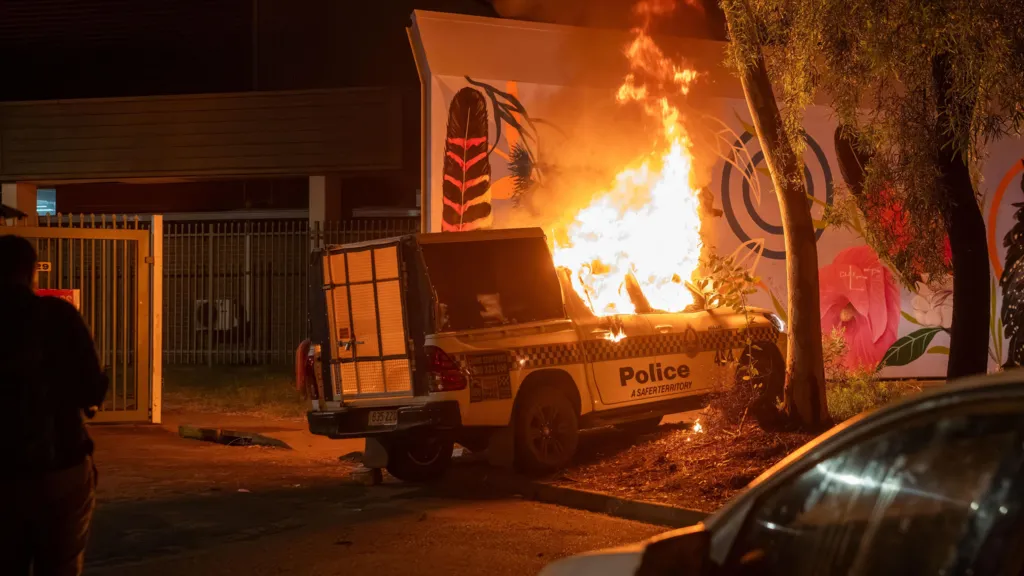
A remote Australian town has been plunged into a “state of civil emergency” after a night of violent rioting followed the arrest of a 32-year-old man in connection with the murder of a local schoolgirl. Police in Alice Springs were forced to deploy tear gas and specialized riot squads as hundreds of protesters besieged the local police station and several government buildings, fueled by what local leaders describe as “generations of ignored trauma.”
The unrest highlights a growing “accountability rot” in regional justice systems, mirroring the social tensions seen in the UK’s own Golders Green crisis and the antisemitism national security emergency.

The violence followed the discovery of the body of a 14-year-old girl, reported missing earlier this week. The arrest of a man—reportedly known to the victim—acted as a lightning rod for long-standing frustrations over community safety.
The Siege: Shortly after the arrest was announced, a crowd of approximately 300 people converged on the Alice Springs police station. Rocks, bottles, and commercial-grade fireworks were hurled at officers.
The Damage: Several local businesses were looted, and the windows of the local courthouse were shattered. Northern Territory (NT) Police have confirmed that 12 officers were injured during the skirmishes.
The Curfew: A strict “High-Risk Public Safety Order” has been implemented, effectively placing the town under a 6:00 PM to 6:00 AM curfew for the next 72 hours.
Northern Territory Chief Minister Eva Lawler has called for calm, but acknowledged that the violence is a symptom of a much deeper “resilience deficit” in the outback.
The “Dopamine Desert” of Isolation: Much like the teens trialling life without social media, youth in remote Australia often face a “dopamine desert” of limited opportunity, leading to high-risk behaviors and a rapid escalation of social friction.
The Justice Gap: Protesters have cited a “two-tier” justice system, claiming that crimes against Indigenous girls do not receive the same level of “time, effort, and resources” as those in major cities like Sydney or Melbourne.
The Alcohol Factor: The riots have reignited the fierce debate over alcohol restrictions in the NT. Authorities have moved to “immediately suspend” all takeaway liquor sales in the region to prevent further escalation.
The events in Alice Springs are being analyzed by international sociologists as part of a global trend of “authority rejection” in 2026.
The Digital Wildfire: Much like the surge in digital fraud syndicates, misinformation regarding the suspect’s identity spread via “shadow” social media accounts, bypassing government moderation and inciting the initial mob.
The “Shadow” of the Past: The violence occurs as the King concludes his Washington visit, where he spoke of “reconciliation and the rule of law” across the Commonwealth. In Alice Springs, those words feel a world away from the reality of the streets.
As the RHS Wisley wisteria provides a sanctuary of peace in the UK and the Southbank Centre celebrates 75 years of progress, Alice Springs remains a fractured landscape.

The Murder Inquiry: Despite the unrest, the murder investigation continues. Detectives have urged the community to let the legal process take its course, reminding them that “justice has no expiry date.”
Federal Intervention: Prime Minister Anthony Albanese has not ruled out sending in the Australian Federal Police to bolster local ranks if the “national security emergency” at the town’s borders continues to deteriorate.
For the family of the young victim, the night of fire and anger has only added a layer of chaos to an unimaginable tragedy. In the “new world” of 2026, the distance between a quiet town and a war zone can be bridged in a single night of grief-turned-rage.
Related News:
 Father’s Tip Leads to Arrest in Charlie Kirk Murder Case
 Charlie Kirk Killing Used to Mobilise UK’s Largest Far-Right Rally in Decades
 Jailed Georgian Opposition Leaders Warn UK of Iranian Links to Ruling Party
 Emails Show Epstein Funded Mandelson’s Husband After Jail
 Nine Arrested in France Over Death of Far‑Right Student
 How Much Could Andrew’s Arrest Hurt the Royal Family?
 Ecuador Deploys 75,000 Forces in Anti-Gang Drive
 Belarus Leader Gifts Rifle to Kim Jong Un
 Justice in Limbo: Top Australian Soldier to Remain on Remand for War Crimes
 The “Friendly Federal Assassin”: 31-Year-Old Californian Identified in Press Dinner Attack
 Cartel crackdown raises fears of fresh violence
 Trump Administration Dismisses 17 Immigration Judges, Sparking Debate Over Judicial Independence
 Tasers Introduced in UK Prisons to Combat Rising Violence and Protect Staff
 Northern Ireland Family of Three Shot Dead in Maguiresbridge Home Incident
 Police Advised to Disclose Ethnicity of Suspects in High-Profile Cases
 Channel Crossings Surge: Over 1,000 People Arrive in the UK in Small Boats in a Single Day
 Kosovo agrees to host Britain’s refused asylum seekers
 Johnson Approved China’s London ‘Super-Embassy’ in 2018
 French Taxi Driver Cleared in David Lammy Theft Case After Fare Dispute
 UK University Faces Counter-Terror Probe Over China Pressure
 Just Stop Oil Protesters Convicted Amid Climate Defence Row
 Ukraine-Russia war latest: Putin’s troops exploit bad weather to force Kyiv withdrawal from multiple towns
 Trump Urges Herzog to Grant Netanyahu Full Pardon
 US Justice Department Files Lawsuit Against California Over Partisan Voting Maps
 Oklahoma Governor Grants Last-Minute Clemency to Death Row Inmate
 Indian authorities demolish Kashmir home linked to Red Fort blast
 Greene Pushes Epstein Files Amid Trump Fallout
 Trump Deploys DHS to Charlotte in Major Arrest Operation
 South African Detained After Neo-Nazi Rally in Australia
 Venezuela Threatens Nobel Winner Machado with Fugitive Status
 Trump Envoy to Discuss Ukraine Peace at Kremlin
 Video shows Israeli troops kill Palestinians after surrender
 Files Link Andrew to Epstein Dinner After Prison Release
 Police Probe Mandelson Over Alleged Epstein Leak
 Last‑ditch Call to Save Police Front Counters in London
 South Korea’s Ex-President Faces Death Penalty in Insurrection Trial
 Epstein Eyed Record Label Investment to Access Women, Files Suggest
 Epstein Files Could Be Just Tip of the Iceberg for Andrew Investigation
 Man Guilty of XL Bully Offence After Fatal Attack
 Sydney kidnapping mystery deepens as grandfather’s remains found after mistaken abduction
 US ‘Suitcase Murderer’ Deported From Bali After 11 Years in Jail
 American Citizen Killed in Cuba Boat Shooting, U.S. Officials Say
 Hillary Clinton Tells House Panel She Had No Idea of Epstein’s Crimes
 US Senate Vote Fails to Rein in Trump War Powers on Iran
 Labour MP’s Partner Arrested on Suspicion of Spying for China
 Police Scotland Pays £8m Compensation to Staff
 Alleged Bondi gunman seeks order to suppress family’s identity
 Istanbul Mayor Faces Corruption Trial Amid Political Storm
 Point-Blank Gunshot Misses Indian Politician
 Queensland Protest Laws Spark Free Speech Backlash
 Chinese National Arrested Over Attempt to Smuggle 2,000 Queen Ants From Kenya
 Missing Cuba-Bound Aid Ships Spark Urgent Search
 Israel Enacts Death Penalty Law for Palestinians Following 12-Hour Debate
 “The Monster of Hull”: Funeral Director Admits to Preventing 30 Burials and Stealing Charity Cash
 Report Says Pezzullo Acted ‘Recklessly’ in Dealings
 National Icon in Custody: Ben Roberts-Smith Arrested Over Alleged War Crimes in Afghanistan
 ‘I Will Not Abandon Him’: Pauline Hanson Stands by Ben Roberts-Smith After War Crime Charges
 ‘Ghost Offences’: Data Reveals No Children Charged with New ‘Adult Crime’ Laws in 11 Years
 The Fallen Icon: Ben Roberts-Smith Charged with Five War-Crime Murders
 The $100 Billion Peace: Trump’s ‘Grand Bargain’ Ends Iran Conflict at a Staggering Cost
 The Prediction Prohibition: White House Staff Barred from Betting on Political Markets
 California fireworks blast: murder charges filed in case
 Mass Arrests at London Palestine Protest Spark Debate
 The Frozen Frontier: Why Frostbite is the Least of Concerns for Canada’s Arctic Forces
 The Masked Frontier: Allegations of Greek Police Using Proxies for ‘Seismic’ Border Pushbacks
 The ‘Big Fish’ Lands: Marcos Confirms Arrest of Key Figure in Flood-Control Scandal
 Harmeet Dhillon Faces Scrutiny in DOJ Role Debate
 ‘Diplomatic Turbulence’: Taiwan President Cancels Landmark Africa Tour Amid Airspace Lockout
 Justice and Deceit: High Court Convicts Woman in Hong Kong Blackmail Plot
 “War Crime”: Lebanon Condemns Death of Journalist in Targeted Strike
 Judicial Whiplash: Virginia Court Pauses Redistricting 24 Hours After Public Vote
 Border Breakthrough: UK and France Finalize New £662m Small Boats Deal
 OpenAI CEO Apologizes After Canada Shooting Case
 Return of the “Skiffs”: Threat Level Raised as Somali Pirates Seize Second Vessel in a Week
 “Terrorism Suspect” Arrested in Devon as Investigation into London Jewish Site Attacks Widens
 Tragedy in the Red Centre: Outback Search Ends in Discovery of Missing Girl’s Body
 The “Invisible” Tape: Leaked Video Contradicts Police Denial in Brutal Arrest Case
 US Court Ruling Reshapes Voting Rights Landscape
 US states redraw maps after voting rights ruling