
Published: 5 May 2026. The English Chronicle Desk. The English Chronicle Online
Four years after China Eastern Flight MU5735 fell from the sky in a near-vertical dive, a newly released report from the U.S. National Transportation Safety Board (NTSB) has provided the most chilling evidence to date regarding the disaster’s cause. According to data retrieved from the aircraft’s flight data recorder (FDR) and released under a Freedom of Information Act request, the fuel supply to both engines was manually cut off while the Boeing 737-800 was cruising at 29,000 feet.

The revelation—which supports a long-standing theory of intentional pilot action—marks a major “milestone” in a case that has been shrouded in “clinical silence” by the Civil Aviation Administration of China (CAAC), which has yet to release its own final accident report.
The NTSB data provides a technical minute-by-minute breakdown of the moments before the jet impacted a hillside in Guangxi, killing all 132 people on board.
Manual Intervention: The report states that the fuel control switches for both engines moved from the “run” position to “cut-off.” On this aircraft model, these switches are physical controls that a pilot must lift and pull by hand—an action that cannot be performed by accident or through a software glitch.
The Powerless Plunge: Immediately following the fuel cut-off, engine speeds decreased rapidly. The aircraft entered a nose-down attitude so severe that it reportedly approached the speed of sound before impact.
No Restart Attempt: Critically, the NTSB found no evidence that the switches were ever returned to the “on” position, indicating there was no attempt to restart the engines during the two-minute descent.
The release of this data has intensified scrutiny of the CAAC’s refusal to finalize the investigation.
Transparency Deficit: International aviation guidelines typically require a final report within one year. China’s four-year delay, justified by “national security and social stability” concerns, has led to accusations of an “accountability rot” within the state’s aviation oversight.
The “Struggle” in the Cockpit: While the NTSB summary does not name a perpetrator, previous leaks from the cockpit voice recorder (CVR) suggest a struggle between the pilots may have occurred, with one reportedly forcing the nose down while the other attempted to counter the input—a “human-machine coordination” failure of the most tragic kind.
The “Medication Desert” of Facts: Families of the victims have long lived in a “dopamine desert” of information, with the CAAC’s only updates being brief statements in 2024 confirming the plane was technically sound before takeoff.
As King Charles concludes his Washington visit, where he and U.S. leaders discussed “global stability,” the MU5735 report is being viewed as a “national security emergency” for the aviation industry.
The “Hormuz” of Data: Just as the Strait of Hormuz blockade has forced a trade reset, this report is forcing a reset on pilot mental health monitoring and cockpit security protocols globally.
The “Golden Tone” of Truth: Aviation experts argue that by confirming the fuel cut-off, the NTSB has provided a “golden tone” of clarity that the Chinese government can no longer ignore.

As the RHS Wisley wisteria blooms and the Southbank Centre celebrates 75 years of resilience, the families of MU5735 are finally seeing the “invisible” cause of their grief made public.
“The data doesn’t lie,” said one aviation safety analyst. “This was not a mechanical failure; it was a deliberate choice.” With the King’s Speech on May 13 expected to emphasize “International Cooperation,” the pressure is now on Beijing to break its “clinical silence” and address the human factor that led to China’s deadliest air disaster in decades.
Related News:
 British AI Startup Outshines Human Forecasters in Global Prediction Contest
 UK Fighter Jet Purchase Could Breach Nuclear Treaty, Warns CND
 Google at 27: The Untold Story of Ruth Kedar, the Woman Behind the Iconic Logo
 Russia repeatedly targets UK military satellites, warns Space Command chief
 Cooper Unveils £4m Cyber Plan Against Russian Hackers
 Experts Warn Russia’s Burevestnik Missile Could Destabilise Arms Control
 Britain deploys RAF specialists to assist Belgium with drone threats
 Hitler’s DNA Confirms He Truly Had Only One Testicle
 Pokémon to open world’s first theme park in Japan next year
 Poll Reveals China Leads World in Trusting AI Technology
 US Clears Nvidia AI Chip Sales to China in Policy Shift
 Iran Signals Permanent Break From Global Internet, Activists Warn
 UK New Car Discounts Near £6,000 as Prices Are Slashed
 Musk Wants City on the Moon Within 10 Years
 Indian University Kicked Out of AI Summit for Claiming Chinese Robot Dog as Its Own Invention
 China Shows Off Nunchuck‑Wielding Humanoid Robots for Lunar New Year
 The Chinese AI App Sending Hollywood Into a Panic
 How Do You Modernise Mango Farming? India’s Growers Urged to Innovate as Climate Change Hits
 Bill Gates Pulls Out of India’s AI Summit Over Epstein Files Controversy
 Zuckerberg Defends Meta in Landmark Social Media Addiction Trial
 Etsy Sells Second‑Hand Fashion App Depop to eBay for $1.2bn
 Musk Cuts Starlink Access for Russian Forces – Giving Ukraine an Edge at the Front
 Social Media Trial: Woman Says Addiction Began at Six
 Instagram Investigating AI Profiles ‘Fetishising’ Disabled People
 Anthropic Boss Rejects Pentagon Demand to Drop AI Safeguards
 Why Russia Controls Its People With a Flick of a Switch
 The US Now Has the Medicine for Cheap Swarming Drone Attacks
 Boy George Says He’s Using ChatGPT to Help Write New Songs
 Satellite Images Show Iranian Navy and Nuclear Sites Hit by US‑Israeli Strikes
 Protesters Rally in San Francisco Against OpenAI Deal With Pentagon
 We Have More Privacy Controls Yet Less Privacy Than Ever — The Paradox of Digital Life
 Regulator Contacts Meta Over Workers Watching Intimate AI Glasses Videos
 Study Says Only Two Nations May Survive Nuclear War
 Baba Vanga’s Chilling World War 3 Prediction and Russia’s New Leader
 Tiny Possum and Glider Thought Extinct for 6,000 Years Found in Remote West Papua
 Musk’s xAI Permit Sparks Fury Over Power Plant Expansion
 GPS Jamming: The Invisible Battle in the Middle East
 The Kill Line: A Shifting Vision of the American Dream
 One Ant for $220: The New Frontier of Wildlife Trafficking
 How and When to See April’s Full Pink Moon
 Trump Considers Military Operation to Seize Iran’s Uranium
 Jim Ratcliffe’s £3.5bn Chemical Plant Delayed with Parts Stranded in the Gulf
 Trump Building ‘Massive’ Military Bunker Under White House Ballroom
 The ‘Simpler Recycling’ Era: England’s New Bin Rules Face a Patchy Rollout
 ‘The Counting of a Nation’: India Launches World’s Largest Census Amid Tech Revolution
 ‘At the Doorstep of the Future’: Florida’s Space Coast Braces for Historic Artemis II Launch
 ‘We Go for All Humanity’ — Artemis II Returns Humans to the Lunar Vicinity
 The Orion Capsule: A High-Stakes Vigil in Earth’s Orbit
 A Name for the Nameless: DNA Finally Links 1974 Utah Murder to Ted Bundy
 7.4-Magnitude Earthquake Jolts Eastern Indonesia; Tsunami Warning Lifted
 Breaking the Horizon: Blind Runner to Tackle Brighton Marathon with Smart Glasses
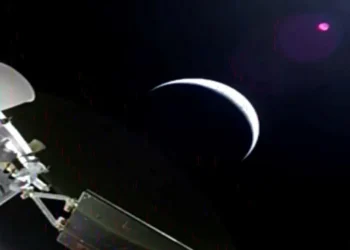 Lunar Bound: Artemis II Leaves Earth’s Orbit for Historic Deep-Space Journey
 “Homo Sapiens are All of Us”: Artemis II Crew Sends Emotional Message of Unity from Deep Space
 Apple at 50: Three Products That Changed How We Live
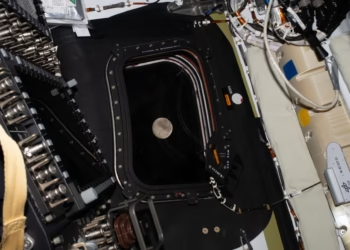 Lunar Crossing: Artemis II Enters Moon’s “Sphere of Influence” as Earth Recedes
 Inside the “Justice Factory”: BBC Enters the Seized Scam Compound with Fake Global Police Stations
 Voices of the Vanguard: ‘Audio Time Capsule’ of Disability Rights Pioneers Discovered
 Beyond the Far Side: Artemis II Restores Contact After 40-Minute Silence
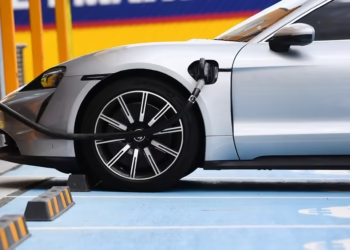 Electric Shock: Australians Buy Record Number of New EVs as Fuel Crisis Bites
 War, Windfalls, and the Carbon Trap: The Iran Conflict’s Brutal Energy Math
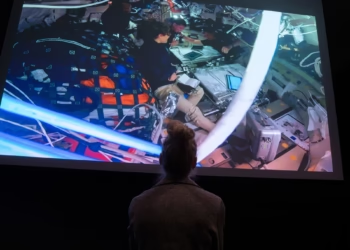 ‘We Will Always Choose Each Other’: Five Defining Moments of Artemis II’s Lunar Flyby
 Beyond the Flyby: What Artemis II Tells Us About the Next Giant Leap
 The Great Chokehold: Why the Strait of Hormuz is the Epicenter of the 2026 Crisis
 The Academic Chill: Beijing Condemns ‘Hostile’ US Questioning After Researcher’s Death
 Moldova River Crisis Exposes War’s Hidden Cost
 Artemis II Returns After Historic Moon Flyby
 Market Shock: Oil Surges Past $100 as US Initiates Naval Blockade
 The Outback Squeeze: ‘Out of Control’ Diesel Prices Threaten Australia’s Freight Arteries
 The Sinking Heritage: The Dutch Village at Risk of Being Demolished
 The Frozen Frontier: Why Frostbite is the Least of Concerns for Canada’s Arctic Forces
 Canadian astronaut French words ease language row
 Tsunami Alerts Eased After Magnitude 7.7 Earthquake Rattles Northern Japan
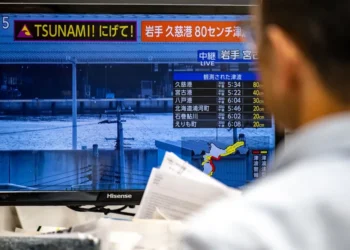 ‘A Week of Fear’: Japan Braced for Magnitude 8.0 Megaquake After Sanriku Jolt
 ‘The End of the Quiet Era’: Japan Relaxes Arms Export Rules in Historic Pivot From Pacifism
 Rations and Rides: Global Responses to the 2026 Fuel Crisis
 Chornobyl Still at Risk 40 Years After Disaster
 Beyond the Swoosh: Anta Sports Overtakes Rivals to Become Global Top Three
 “Grounded”: Beijing Implements Total Ban on Drone Sales Citing Capital Security
 Canadian Fiddler Sues Google Over AI Defamation Claim
 “The Floating Fever”: WHO Confirms Second Hantavirus Case as Cruise Outbreak Death Toll Reaches Three