Published: 20 May 2026. The English Chronicle Desk. The English Chronicle Online.
Suited and booted in a navy twinset tracksuit, Wang Runguo is working hard today. He darts across the gleaming floors of his cavernous automobile showroom with great energy. The forty-five-year-old salesman comes from one of the poorest provinces in mainland China. He is currently closing yet another lucrative deal with an eager foreign buyer. It is all in a day’s work for this ambitious automotive manager. His personal salary has more than doubled over the past twelve prosperous months. He owes this spectacular financial success to a very well-timed career pivot lately. He moved from growing corn to selling cars to the northern neighbour. His focus shifted rapidly from domestic markets to buyers across the icy border.
This time last year, Wang was working for a traditional agricultural enterprise. That local firm grew corn and soya beans for the steady domestic market. Now he is a manager at Xingyun International Automobile Export corporation. This company was founded in August 2025 to serve a booming sector. It caters exclusively to the new car export industry in Suifenhe city. This small urban hub sits in northeast China right against Russia’s frontier. Recently, China and Russia have been moving much closer together in business. As the nations move closer, more vehicles are going across the border. A manager at Suifenhe Hengchi International Trade confirms this very bold reality. He says the ongoing Ukraine war has been an excellent business opportunity.
As Russia’s president visits China, Moscow hopes for continued mutual economic benefits. Local businesspeople on the border say they are unconcerned by western sanctions. China routinely rejects western sanctions and claims they violate established international law rules. Earlier this month, the Chinese embassy in London lodged some stern representations. This was over British sanctions applied to Chinese firms supplying military goods. A Chinese government spokesperson defended normal exchanges and cooperation between these enterprises. Ties between the two countries have deepened since the February 2022 invasion. Bilateral trade has soared to record highs, to the chagrin of westerners. Western leaders accuse Beijing of providing an economic lifeline to the Kremlin.
Beijing has bought billions in Russian fossil fuels since the war started. This massive purchasing far outstrips the energy volumes bought by any other nation. Chinese companies have jumped to fill gaps left by exiting western businesses. Last year, exports to Russia from Heilongjiang province increased by twenty-two percent. Experts note that this economic dependency is mutual but asymmetric between them. China now buys nearly thirty percent of all available Russian export goods. However, only about three percent of Chinese exports flow back to Russia. Yet in certain industries, Russia plays a massive role for Chinese fortunes. One such trade is cars, a sector struggling with domestic oversupply. Vehicles have quickly become one of Suifenhe’s main profitable export goods.
Between 2021 and 2024, Chinese brands expanded their northern market share significantly. Their share of the Russian car market increased from seven to sixty percent. In 2024, China sold more than one million vehicles to Russian buyers. This made Russia the biggest destination for Chinese vehicles for some time. It has since dropped to second place behind the nation of Mexico. Further volumes have come from the export of foreign-branded vehicles made inside China. Despite sanctions, tens of thousands of western cars still enter Russia annually. Brands like BMW, Honda, and Volkswagen move through third-party Chinese dealerships. Wang’s used BMW model sold for one hundred and twenty thousand yuan. That price is remarkably cheap compared with retail prices found in Moscow.
The buyer was a Russia-based businessman who praised the excellent deal value. Wang notes that these models are currently too expensive for ordinary Chinese consumers. This creates a perfect win-win situation for businesses on both sides. Russian rubles are currently sustaining many parts of the sluggish Chinese economy. China remains heavily reliant on exports while domestic consumers are hesitant to spend. Gao Bin, the boss of Hengchi Trade, pivoted to Russia three years ago. The first car they shipped across the border was a Toyota Camry. After the war started, there was immediate and massive demand in Russia. Last year, his firm sold more than seven thousand cars to Russia. Meanwhile, their domestic sales have basically come to a complete halt now.
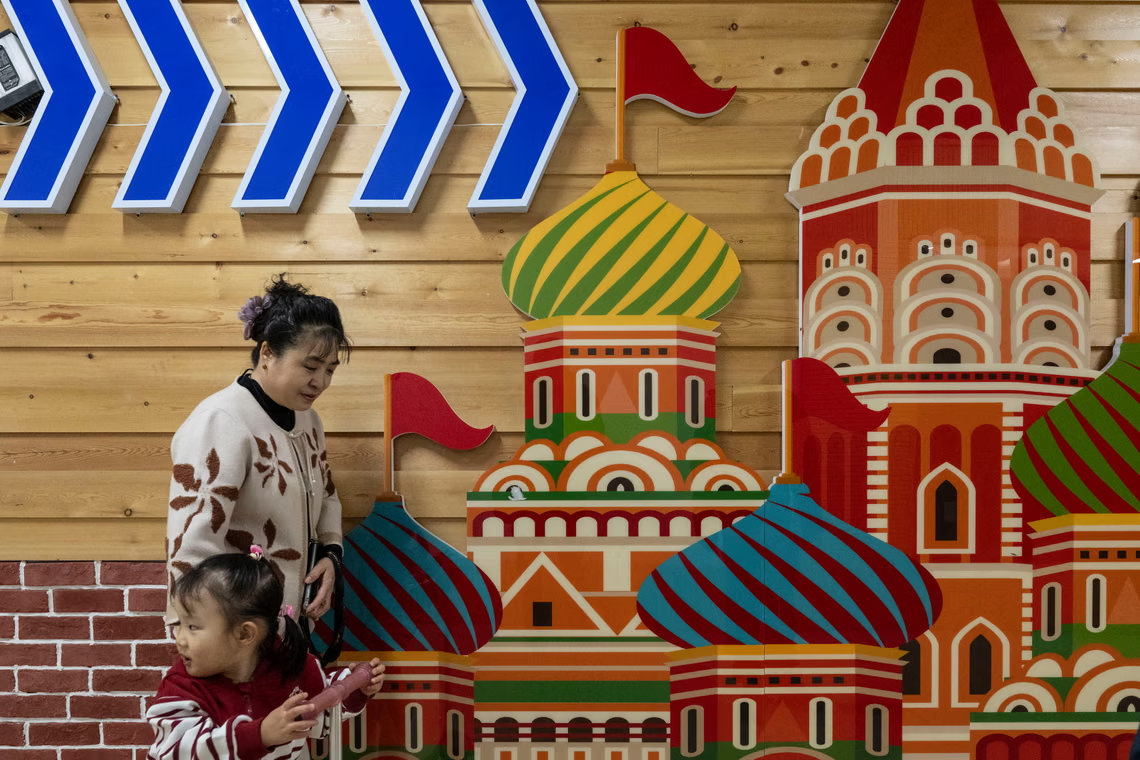
Suifenhe is a small border city of sixty thousand residents total. It serves as a perfect microcosm of this evolving international trading relationship. Cyrillic signs are visible everywhere and prices are advertised openly in rubles. However, many local shops are boarded up due to general domestic stagnation. From certain hilltops, you can peer easily into barren Russian border villages. An observation tower designed for tourists has been left abandoned for years. Suifenhe was the first Chinese place to allow rubles as legal tender. It has long hosted a large community of active Russian businessmen. A visa-free regime introduced last September boosted tourism numbers very significantly. The town is located just two hours from Vladivostok by train.
Local businesspeople note that Russian visitors are the only ones spending money. Ning Qiang runs a beauty salon catering exclusively to these foreign clients. He says customer numbers increased by fifty percent after the visa rules changed. By late afternoon on Tuesday, he had already received three wealthy clients. When relations are good, life is much better for ordinary working people. Locals in Suifenhe do not have the cash to buy much today. Heilongjiang received a sixty percent boost in visitors from Russia recently. This boom occurred during the first six months of the visa-free policy. Experts say the difficulty in procuring European visas drives Russians eastward instead. They return home fascinated and willing to visit the Chinese mainland again.
One Russian spending money here is Mariia Publichuk, aged thirty-six years. She moved from Vladivostok to Suifenhe with her young eight-year-old daughter. Publichuk relocated last year so her daughter could study the Chinese language. The pair spend mornings at a local school surrounded by Chinese children. Evenings are spent dancing happily in Suifenhe’s bustling central urban square. She believes English is the most useful language in the modern world. She adds that Chinese is surely the second most useful language today. But for anyone relying entirely on yuan, times are very tough. The manager of a local logistics hub reports his worst financial year. He has handled cross-border and domestic freight for six years now.
The war in the Middle East has pushed up fuel prices. His truck operating costs are rising while total orders are down significantly. He claims that even during the pandemic, business was never this bad. This year, demand in China is decreasing across almost every single industry. It is simply that ordinary people do not have money to spend. National statistics definitely tell a very similar story about the wider economy. The ongoing trade war pushed American tariffs on Chinese goods quite high. Despite this, Chinese goods continue to be shipped overseas at astonishing rates. Last year, China’s total trade surplus reached a record trillion-dollar figure. In early 2026, exports rose fifteen percent compared to last year.
Meanwhile, domestic retail sales grew by less than two percent that month. The American president left Beijing last week after a two-day summit. He promised fantastic trade deals but made few public announcements on tariffs. China’s ministry of commerce said both sides would discuss future tariff reductions. China’s long-term goal is making the economy less reliant on foreign exports. The nation must adhere to the strategic basis of expanding domestic demand. Structural problems like an ageing population make this transition very hard execute. A depressed real estate sector and low consumer confidence hinder progress significantly. Exporting cheap goods utilizing discounted Russian energy is a lot easier now.
Beijing still holds the best cards in this complex bilateral relationship. China has many options for international trade that Russia simply lacks today. Reports show ninety percent of Russia’s sanctioned technology comes from China. With a new administration in Washington, Xi faces less pressure over Putin. The war in Ukraine barely featured in the recent superpower summit meeting. The American request for Chinese peace contributions is not a serious push. Xi does not feel he is on the hook for that. In Suifenhe, even the most ardent Russophiles see Russia declining. On the town outskirts, a house built like a Russian cottage stands out. Its inhabitant is Song Lu, a sixty-seven-year-old retired local artist. His family has happily lived in Suifenhe for many successive generations. He builds models of traditional Russian wooden carriages in his spare time. He has even built a blue tubular sauna in his garden. Russians might find it hard to admit, but China is the big brother.
Related News:
 Capitol Attack Anniversary Sparks Deep Political Divide
 Saudi Officials Report Zubaidi Flee Before Yemen Peace Talks
 UK Targets in New York Bomb Threat Hoax: Man Jailed
 Gambia Supreme Court Hears Case to Overturn FGM Ban
 Trump targets Iran trade with 25% tariff warning
 US Senate rejects resolution limiting Trump military powers
 Gulf states warn Trump Iran strikes risk wider Middle East war
 Machado Trump medal gesture reshapes Venezuela power struggle
 Geopolitical football: Iran, Trump and the World Cup clash
 Canada-China trade gains momentum in new strategic partnership
 Syria President Declares Victory as Ceasefire Reached with SDF
 Shinzo Abe’s killer receives life sentence in Japan
 China General Under Investigation Amid Leadership Purge
 Philippines ferry disaster leaves 15 dead, dozens missing
 Cambridge Faces Scrutiny Over Arms Investment Transparency
 Epstein UAE Emails Shake British Royal Andrew’s Legacy
 Christchurch gunman seeks to vacate guilty plea
 Infantino Faces Russia Threat and Trump Concerns at Uefa Congress
 Concerns rise for Canberra boy amid Iran detention fears
 Ukraine Sends Drone Experts to Defend US Bases in Jordan
 Abramovich Chelsea Sale Cash Faces Jersey Probe
 Yvette Cooper: UK Must Follow Principles, Not US Pressure
 Jury Rules Meta and YouTube Liable for Addictive Design
 Saudi Arabia Urging US to Keep Up Iran Attacks
 The Woman Guarding Earth From the Threat of Asteroids
 Germany Grapples With AI Abuse Following TV Star Scandal
 Exiled Tycoon Warns of New Russian Attacks on UK Soil
 LA 2028: Millions of Affordable Olympic Tickets Announced
 Trump Slams Europe as Transatlantic Tensions Boil Over
 Inside the Deceptive Machine: A Former Producer Speaks Out
 Spain Faces Backlash Over Xenophobic Chants in Egypt Draw
 A Global Voice For Justice: Stephen Lewis Dies At Age 88
 Hope and Fear as Iranians Flee Across the Turkish Border
 Reform UK Pledges To Halt Visas Over Reparations Demands
 US and Iran Agree to Two-Week Provisional Ceasefire
 Starmer visits Gulf as US and Iran agree ceasefire
 Gaza Child Arrives in UK for Life-Changing Care
 Pakistan Brokers Historic Peace Deal Amid Rising Tensions
 UK Holds Firm on Strait of Hormuz Amid Trump Pressure
 Trump Signals Hope for New Iran Talks as Ceasefire Fades
 Reeves Slams Trump Over Iran War Lack Of Exit Plan
 US and Iran Pursue Extension of Ceasefire via Pakistan
 Trump’s Islamabad Gamble: The High Stakes of a New Iran Deal
 Ian Katz to Step Down as Channel 4 Content Chief
 The General’s Gambit: Pakistan’s New Role in Global Peace
 Mexico, Spain and Brazil call for Cuba dialogue amid crisis
 Pakistan’s Ambitious Bid for Middle East Peace
 Trump Starts $166bn Tariff Refund Process
 Israeli Soldiers Jailed Over Vandalism of Lebanese Statue
 Trump Weighs Sending Afghan Allies to the Congo
 Timor-Leste Faces Tough Questions Over Resort Proposal
 Pentagon Shakes Up Navy Leadership Amid Hormuz Blockade
 Trump Threatens UK With Big Tariff Over Tech Tax
 Prominent Voices Challenge Palestine Action Ban
 Security Scrutiny After Washington Shooting Incident
 Merz Criticises US Approach in Iran Conflict
 UK Envoy Sparks Controversy Over Special Relationship Claims
 Ukraine Urges UK to Seize Russian Oil Tankers
 US Calls Australia Media Law “Foreign Extortion”
 The Billionaire’s Secretary and the £1m Fraud
 Questions Remain Over The Tragic Bondi Massacre
 Ukraine strikes Tuapse as oil disaster worsens
 Brewing Tension: Taiwan Baristas Rebrand for World Stage
 Tensions Emerge in Netanyahu-Trump Alliance
 Mission to the World’s Edge: A Heroic Rescue in Tristan
 US and Mexico Face Heatwave as Floods Batter South Africa
 Mexico’s Missing: State Complicity in a Growing Crisis
 French Patient Told Hantavirus Was Just Anxiety
 The Long Way Home: Australia’s High-Stakes Virus Mission
 Putin Signals War End as Russian Momentum Stalls
 Romania’s Judicial Crisis: A System Under Siege
 Lee Lai Makes History with Landmark Stella Prize Victory
 Philippine Senator Flees After Days Under Senate Siege
 Alberta Separatist Bid Blocked by Canadian Court
 Canadian Court Blocks Alberta Independence Referendum Bid
 Big Tobacco Under Fire Over Controversial New Ad Campaign
 Bolsonaro Son Tape Scandal Sparks Massive Brazil Backlash
 Court Upholds Landmark Win for Transgender Rights
 Tragedy in the Maldives: Inside the Deep Sea Rescue
 Liberal Senator Criticises Immigration Rhetoric