Published: 24 August 2026 | The English Chronicle Desk | The English Chronicle Online
A fatal traffic accident in Hanoi has developed into an unexpected test of public accountability in Vietnam after young people turned a roadside tree into a symbol of their demand for answers.
The case centres on 18-year-old Do Ngoc Phuong Thuy, who died after a BMW crossed into oncoming traffic and struck the motorcycle she was travelling on with her father in May 2025. More than a year later, the authorities publicly confirmed that former National Assembly deputy Nguyen Sy Cuong had been driving the BMW, while also announcing that he would be exempted from criminal liability.
The announcement did little to settle the controversy. Instead, it intensified questions online about why the circumstances of the crash had remained largely unexplained for so long and why the former politician would not face criminal prosecution.

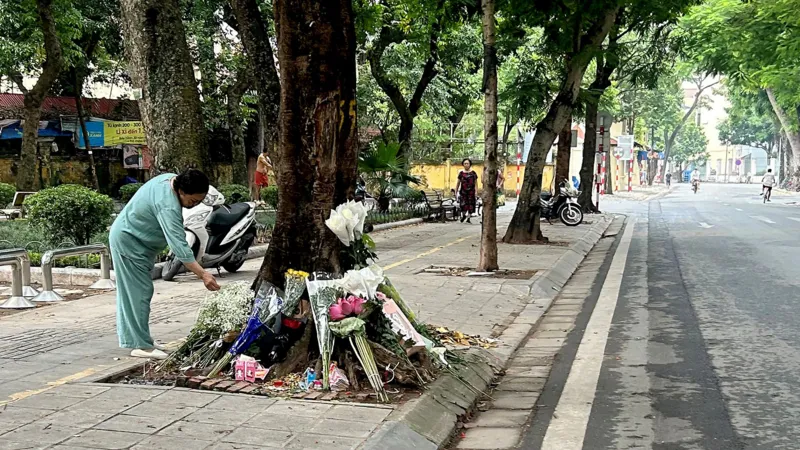
In August, Vietnamese Gen Z users began turning the site of the crash into what has become known as the “Justice Tree”. Flowers were placed beneath the tree, online memorials were created and millions of social media posts drew attention to the case. The movement has remained largely decentralised, with participants using anonymous accounts, digital tributes and symbolic gestures rather than large public demonstrations.
The episode has now grown beyond a single traffic accident. It has become a wider discussion about transparency, political influence, online expression and the growing willingness of Vietnam’s younger generation to challenge official narratives.
A crash that remained largely unexplained
The accident happened on Nguyen Huy Tu Street in Hanoi on 30 May 2025.
The BMW crossed into the opposite lane and struck a motorcycle carrying Do Viet Hung and his daughter Phuong Thuy. The impact severely injured the teenager, including an injury that resulted in the loss of her right leg. She died in hospital days later.
Her father survived with serious injuries.
At the time, Vietnamese media reported the crash but identified the BMW driver only by initials. The case subsequently faded from public attention, with no widely publicised criminal prosecution or detailed explanation of the investigation.
That information vacuum became central to the later controversy.
Social media users began linking the initials reported at the time with Nguyen Sy Cuong, a former National Assembly deputy. The speculation continued for months, but the connection was not officially confirmed publicly until the authorities addressed the case in August 2026.
The tree becomes a symbol
The tree at the site where the crash occurred had previously been an ordinary part of Hanoi’s streetscape.
It changed after young people began leaving flowers there in memory of Phuong Thuy.
Authorities removed some of the flowers, but the action had the opposite effect to that intended. More people began discussing the site online, and a virtual version of the memorial was created so people could continue leaving messages even when physical gatherings were discouraged.
The tree subsequently became known as the “Justice Tree”, while online users also referred to the location through the number 55 associated with the site. Social media users used photographs, artwork, poems and other forms of digital expression to commemorate the teenager and demand greater transparency.
The movement was notable partly because participants did not need to organise a conventional protest.
Instead, people could participate by posting a tribute, changing a profile picture, visiting the tree individually or sharing information anonymously.
That made the campaign considerably harder to contain than a traditional street demonstration.
Social media fills an information vacuum
The controversy illustrates how quickly online communities can fill gaps created when official information is limited.
As discussion grew, users began examining old reports, photographs and fragments of information surrounding the crash. Some claims circulated widely without independent verification, including allegations that authorities had deliberately suppressed information because of political connections.
Those allegations should be treated cautiously.
What is established is that the authorities eventually confirmed Nguyen Sy Cuong was driving the vehicle and that he would not face criminal liability. Other claims circulating online remain disputed or unverified.
The distinction has become increasingly important because the case has attracted enormous attention across multiple platforms.
According to Vietnamese social-media reporting, more than one million posts connected to Nguyen Sy Cuong had appeared on Threads by 12 August.
The sheer volume of discussion transformed what had once been a relatively obscure traffic case into a national controversy.
The government’s extraordinary admission
The turning point came on 17 August, when state broadcaster Vietnam Television publicly named Nguyen Sy Cuong as the driver.
Authorities said the investigation had established that his vehicle had crossed into the wrong lane and caused the fatal collision.
However, prosecutors concluded that he qualified for an exemption from criminal liability.
The reasons cited included his admission of responsibility, the steps he took to remedy the consequences of the accident and a request from the victim’s family asking that he be exempted from prosecution.
The legal basis for the decision has become another source of debate.
Vietnamese authorities have presented the outcome as lawful, but critics online have questioned whether the public received enough information about the investigation and the decision-making process.
The controversy therefore shifted from “Who was driving the BMW?” to a more complicated question: why did the authorities take so long to explain what happened and how was the decision not to prosecute reached?
The victim’s family asks for an end to the debate
One of the most striking elements of the official broadcast was the appearance of Phuong Thuy’s father, Do Viet Hung.
He expressed appreciation for the public sympathy and indicated that the family accepted the authorities’ findings.
He also asked people to stop pursuing the matter on the family’s behalf.
That has created a difficult situation for the online campaign.
Many young people say their concern is not simply about the family’s wishes but about the wider principle of equal treatment under the law. Others argue that continued online pressure risks turning a private tragedy into a political confrontation.
The disagreement illustrates the tension between individual grief and a broader public demand for accountability.
Authorities warn of attempts to stir unrest
Vietnamese security officials have also expressed concern about the online campaign.
A senior police official said hostile groups and “reactionary” forces were attempting to exploit the case to create unrest and disorder.
The Ministry of Public Security urged people, particularly young people, to remain vigilant about information circulating online.
Such warnings are familiar in Vietnam, where authorities closely monitor political dissent and have previously accused overseas or anti-government groups of attempting to exploit public grievances.
For many participants in the Justice Tree campaign, however, those accusations have only reinforced their determination to distinguish their movement from organised political opposition.
They argue that they are not attempting to overthrow the government. They say they want answers about a fatal accident and assurance that political status does not result in preferential treatment.
A broader generational frustration
The case has nevertheless tapped into wider frustrations among young Vietnamese.
Online discussions have expanded into questions about government transparency, police powers, land issues, education scandals and restrictions on digital communication.
Vietnam remains a one-party state, and public political protest is tightly constrained.
That makes the methods adopted by the Justice Tree campaign particularly significant.
Instead of gathering thousands of people in one place, participants have used dispersed and often anonymous forms of expression.
Flowers can be removed, but photographs of flowers can be shared thousands of times. A physical memorial can be cleared, but a virtual memorial can be recreated elsewhere.
That has given the campaign a resilience that conventional authorities may find difficult to manage.
Vietnam’s online generation tests the limits
The Justice Tree controversy comes as youth-led movements have emerged elsewhere in Asia, where younger generations have increasingly used social media to challenge corruption, inequality and political institutions.
Vietnam’s circumstances are different, and there is currently no clear evidence that the Justice Tree movement represents an organised attempt to create a nationwide political uprising.
The comparison is nevertheless being made online.
Some posts have even referred to the possibility of a “colour revolution”, drawing parallels with protest movements elsewhere. Authorities have responded by warning against what they describe as attempts by hostile actors to manipulate young people.
But the government’s response also reveals the sensitivity of the issue.
A traffic accident involving a former politician would ordinarily be a legal and public-safety matter. The fact that the case has evolved into a national conversation about political accountability demonstrates how quickly an unresolved grievance can acquire a much wider meaning.
A test of trust
The most important question may ultimately be whether the official explanation is enough to restore public confidence.
Authorities have now identified the driver and explained why he was exempted from criminal liability.
Yet the intensity of the online reaction suggests that many people are not satisfied with the information provided.
The controversy is no longer solely about the death of one teenager. It is about whether citizens believe institutions will investigate sensitive cases transparently, particularly when influential individuals are involved.
That is why the Justice Tree has become so powerful as a symbol.
For supporters, it represents a demand for fairness rather than a call for political revolution.
For authorities, the campaign represents a potential channel through which misinformation and dissent could spread.
Between those two interpretations lies a generation increasingly accustomed to using digital platforms to scrutinise public institutions.
What happens next?
The immediate campaign may eventually lose momentum, particularly if authorities continue to insist that the legal process was properly followed.

But the questions raised by the case are unlikely to disappear as quickly.
The story has demonstrated the ability of Vietnam’s young internet users to transform a relatively obscure incident into a national conversation without relying on a formal political organisation.
It has also shown that attempts to control information can sometimes intensify public curiosity rather than suppress it.
Phuong Thuy’s death began as a tragic road accident. Fifteen months later, the tree at the crash site has become a symbol of a much broader struggle over transparency and accountability.
Whether the Justice Tree becomes a short-lived digital phenomenon or a lasting symbol of Vietnam’s emerging youth activism remains uncertain.
What is already clear is that a generation raised with social media is finding new ways to ask questions in a political system where conventional avenues for public protest remain tightly restricted.
And for Vietnam’s authorities, the challenge may no longer be simply how to manage one controversial traffic case, but how to respond when an entire generation decides that silence is no longer an acceptable answer.
Related News:
 Maldives Cave Diving Tragedy Raises Safety Alarm
 Israeli Strike in Southern Lebanon Kills Seven
 Five Years of Taliban Rule Leave Afghanistan in Crisis
 Nine Killed in Karachi Consulate Protest
 North Korea Fires Missiles Amid US-South Korea Drills
 Anti-Regime Iranians Turn Anger Toward Trump
 Iran Crisis Tests Trump’s Global Leadership
 Ben Roberts-Smith Denies War Crime Allegations in First Statement
 Black Forest Tragedy Remembered 90 Years On
 Chornobyl Still at Risk 40 Years After Disaster
 Southeast Asia Turns to Russia Amid Energy Crisis
 Escobar’s Hippos May Be Moved to India Zoo
 Cartel crackdown raises fears of fresh violence
 US states redraw maps after voting rights ruling
 China Fireworks Factory Blast Kills 21 in Hunan
 Australia pushes Pacific security pact amid China tension
 BJP Sweeps West Bengal in Historic Breakthrough
 US ‘Narco Boat’ Strikes Draw Global Outcry
 Search Intensifies for Missing Hiker on WA Bibbulmun Track
 US Awaits Iran Reply on New Ceasefire Proposal
 One Nation Stuns Australia With Historic Farrer Win
 Hormuz Talks Near Critical Stage
 China mine blast death toll rises to 90
 Discontent grows around Putin amid war strain
 Millions Gather for Khamenei’s Six-Day State Funeral
 New Footage Revives Peter Falconio Mystery
 Venezuela Quake Death Toll Surpasses 4,000
 Houthis Strike Saudi Arabia as Middle East Tensions Rise
 Taliban global ties grow as rights fears mount
 Seoul proposes historic peace talks to replace Korean War armistice
 Powerful 7.7-Magnitude Earthquake Hits Eastern Indonesia
 Is America Ready for an AOC Presidential Run?
 UK Must Act with Courage and Clarity on Israel-Palestine Conflict, Says Foreign Affairs Committee Report
 Tottenham Takes On Newcastle
 Radioactive Leak at UK’s Nuclear Warhead Base Sparks Outcry Over Safety and Secrecy
 Terence Stamp, ’60s British Film Legend and Star of Superman, Dies at 87
 Hong Kong Summons UK and Australian Envoys Following Asylum Grants to Democracy Activists
 Is the UK Ready to Put Boots on the Ground in Ukraine? Assessing Military Capacity and Challenges
 Yvette Cooper Signals Global Momentum Towards Gaza Peace Deal Amid Humanitarian Crisis
 Chaos at Ibrox as Martin’s Rangers Era Comes to an End
 Russia’s Latest Push to Win US Favors Shows Deep Desperation
 BBC to Apologise Over Edited Trump Speech Amid Backlash
 Greene Pushes Epstein Files Amid Trump Fallout
 Zelenskyy Signs Fighter Jet Deal Amid Russian Drone Attacks
 Shadow Fleet at Sea: Europe’s Battle Against Illicit Oil Shipping
 US Suspends Afghan Immigration After White House Shooting
 ‘Extinct’ Antelope Returns to Sahara, Bringing Hope
 Irish Beach Tragedy: Irish Drown at Whitehaven Beach in Australia
 Sanctioned oil tankers sail Channel amid Russia scrutiny
 Greenland Crisis Forces Europe to Draw a Line With Trump
 South Korea Jails Ex-President in Martial Law Ruling
 Pentagon Signals Reduced Role in Deterring North Korea
 UK and US Drop in Global Corruption Index Rankings
 SA Police Intensify Search in Gus Lamont Case
 Canberra Poster Seizure Sparks Free Speech Row
 Evo Morales Returns After Mysterious Absence
 Jacinda Ardern Moves To Australia Following Her US Fellowships
 Jacinda Ardern Move Sparks Kiwi Reflection
 Middle East Airspace Crisis Strands Thousands
 Nick Greiner Warns Over Election Review Fallout
 Kelly Wilkinson Inquest Reveals Bail Failure
 Princess Eugenie steps down as patron of anti-slavery charity
 Tehran Strikes Mark War’s Most Devastating Night
 Injured Mojtaba Khamenei Elevated as Iran Leader
 The Kill Line: A Shifting Vision of the American Dream
 Air Canada CEO Faces Outcry Over Recent Language Misstep
 Extreme Weather: Europe Shivers as Cyclone Narelle Hits
 Asia Turns Back to Coal Amid Middle East Energy Crisis
 Relationship with Trump may be beyond repair, Starmer warned
 Trump’s Six-Week Iranian War: The High Cost of Ignorance
 RFU Backs Borthwick Despite England’s Poor Six Nations
 Trump Rejects Tehran Peace Plan as Regional Truce Crumbles
 Trump Sends 5,000 More US Troops to Poland
 NDIS Overhaul Sparks Intense Clash Across Australia
 Britain’s Crowning Butterfly Takes the Nation by Storm
 Fifa Official Under Investigation Over Hand Gesture Controversy
 Grief and Devotion Amidst the Rubble of Nabatieh
 Canada Secure Historic Last 16 Spot with Late Goal
 England and Norway Fans Turn Miami Into World Cup Carnival
 Olympus Awaits Unesco Heritage Recognition