Published: 09 June 2026. The English Chronicle Desk. The English Chronicle Online.
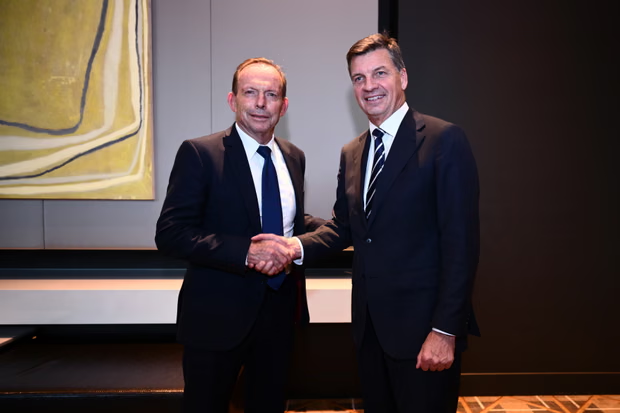
The landscape of Australian politics is experiencing a profound transformation as the newly appointed Liberal federal president, Tony Abbott, has openly endorsed making formal preference deals with Pauline Hanson’s rightwing populist One Nation party. This strategic declaration signals a deliberate shift away from the centrist strategies of the past, with the former prime minister asserting that the conservative Coalition cannot hope to secure a victory at the next federal election by merely positioning itself as a slightly less progressive alternative to the ruling Labor government.
This dramatic recalibration of the conservative movement comes at a time of severe internal reflection following the landslide victory of the Australian Labor Party under Prime Minister Anthony Albanese in May 2025. That decisive election result severely depleted the Liberal parliamentary ranks and eventually led to a leadership vacuum, causing historic shifts within the party structure. Following the electoral defeat, the subsequent short leadership tenure of Sussan Ley concluded when the prominent rightwing faction figure, Angus Taylor, successfully mounted a leadership challenge in early 2026. With Taylor assuming the role of opposition leader and Abbott taking the organizational helm as federal president, the Liberal Party has firmly consolidated its leadership around a traditional, unyielding conservative philosophy.
In his latest address to party faithful, Abbott made his intentions clear by stating that the party must stop acting as slaves to focus groups and reject the notion of being just a little less woke than Labor. This sharp critique highlights a growing consensus among the new leadership that the path back to governance requires a sharp ideological distinction rather than a cautious appeal to the political center. The strategy represents an explicit attempt to reengage with a traditional rightwing voting base that has increasingly defected to minor populist parties over recent election cycles.
The current federal opposition leader, Angus Taylor, has strongly mirrored this pragmatic approach by leaving the door wide open for formal collaboration with Pauline Hanson. When questioned directly about the potential for preference sharing, Taylor did not hesitate to confirm his willingness to cooperate with any political entity that shares the goal of removing the current administration. He described the incumbent government as a rotten Labor administration that is consistently taking the country in the completely wrong direction, reflecting a widespread and growing anger among sections of the Australian electorate.
This shift in stance breaks completely with the foundational political principles established during the era of former Prime Minister John Howard, who famously insisted that mainstream conservative parties must completely reject and marginalize One Nation candidates. For decades, the established rule of Australian conservative politics was to place rightwing populist groups at the absolute bottom of preference voting forms to protect the moderate, mainstream reputation of the Liberal Party. By abandoning this long held boundary, the current leadership is fundamentally redefining what it means to build a viable rightwing coalition in the modern political arena.
The immediate necessity for this strategic alliance has been brought into sharp focus by a succession of recent national opinion polls, which have delivered historic results for Pauline Hanson. For the first time in the history of the organization, the latest Newspoll placed One Nation ahead of the major political parties on primary support, marking the second consecutive week where data indicated they are the most popular singular political movement in the nation. This unprecedented surge in popularity poses a direct threat to the traditional dominance of the Liberal and National parties, effectively forcing them to choose between open warfare or direct cooperation with the populist wave.
Tactical alignment between these political forces has already begun to manifest on the ground across several critical electoral contests over the past year. During the recent high stakes Farrer byelection, Liberal officials actively encouraged their local supporters to direct their crucial preferences toward the One Nation candidate rather than backing a strong independent challenger. Similar cooperative decisions were quietly implemented during the South Australian state election and across multiple key electorates during the 2025 federal campaign, illustrating that the strategy is already transitioning from a theoretical debate into standard operational policy.
However, this rapid shift toward the populist right has triggered significant alarm and deep unease among the remaining moderate factions within the Liberal Party. These internal critics argue that formalizing a political relationship with Hanson will severely alienate urban professionals and socially progressive voters in major metropolitan areas. They fear that this strategy will make it nearly impossible for the party to ever reclaim the vital affluent city seats that were lost to the centrist teal independents and Labor during recent electoral cycles.
Defending his position against internal opposition, Abbott noted that conservative forces are simply adopting the same long term tactical playbook that leftwing parties have successfully utilized for decades. He pointed out that the Labor Party and the Greens have consistently and strategically directed preferences toward each other to maximize their collective legislative power and secure government. According to Abbott, it is standard common sense for parties occupying the right side of the political spectrum to cooperate in an identical manner to secure a change of government.
In an extensive email dispatched directly to grassroots Liberal members, Abbott sought to reassure skeptical party faithful that this dramatic shift in direction is both necessary and thoroughly calculated. He emphasized that the new executive team possesses a collective determination to work constructively with any outside political groups that share their core desire to bring down the Albanese government. To build momentum for this traditional conservative revival, the former member for Warringah announced plans to conduct an extensive tour of local branches, encouraging members to bring friends and family to open community discussions.
The ruling Labor government has watched these developments closely, using the shift to frame the entire opposition coalition as increasingly extreme. Prime Minister Anthony Albanese quickly seized on the remarks, declaring that the ideological boundaries have vanished and that the Liberals, Nationals, and One Nation are now entirely indistinguishable from one another. Albanese argued that by attempting to mimic the rhetoric and policies of a populist movement, the official opposition leader risks losing his distinct identity, which could ultimately drive voters directly toward the authentic populist alternative.
Despite the prime minister’s sharp public warnings, other senior figures within the Labor apparatus have publicly dismissed the long term electoral viability of the populist movement. The veteran federal trade minister, Don Farrell, downplayed the threat entirely by stating that populist political movements in Australia historically experience brief moments of ascendancy before quickly fading away. Farrell insisted that the labor movement has absolutely nothing to fear from the rise of Pauline Hanson, describing the phenomenon as a temporary cycle rather than a permanent realignment of voter loyalties.
As the political landscape reshapes itself ahead of the next federal election scheduled for 2028, the entire Australian electoral system is entering unchartered territory. The decision by the Liberal leadership to embrace preference deals with populist forces represents a high stakes gamble that could either successfully unite the fractured right wing electorate or permanently fracture the traditional conservative base. With Tony Abbott managing the party machine and Angus Taylor leading the parliamentary assault, the coming years will definitively test whether a purely populist conservative alliance can successfully dismantle the historic majority currently held by the Labor government.
Related News:
 UK Banks Granted Reprieve as BoE Delays Basel III Capital Rules Until 2028
 Singapore Corruption Scandal: Details Emerge on Iswaran’s Luxury Flight and Ties to Tycoon Ong Beng Seng
 Corfu Beyond the Crowds: Discovering Serenity in Southern Villages and Hidden Taverns
 Zelenskyy Signs Fighter Jet Deal Amid Russian Drone Attacks
 Sundar Pichai Cautions on AI Hype and Market Risks
 Shadow Fleet at Sea: Europe’s Battle Against Illicit Oil Shipping
 Snow and Ice Cause Travel Chaos in North Yorkshire
 Director Michael Caton-Jones Reflects on Career and Beginnings
 Inside the Helpline Protecting Missing Children in the UK
 PlayStation PS5 Deals Hit Lowest Prices Ahead of Black Friday
 US Suspends Afghan Immigration After White House Shooting
 Five-Year-Old Dies After Rare Tonsil Surgery Complication
 Starmer Says Labour’s Economic Plan Needs Years to Deliver
 ‘Extinct’ Antelope Returns to Sahara, Bringing Hope
 IndiGo Cancels Hundreds of Flights Amid Pilot Shortages
 Young Britons Face Heaviest Burden from Ageing Population, Lords Warn
 U‑Turn on Farmers’ Inheritance Tax Sparks Political Firestorm
 Aston Villa Remain Arsenal’s Key Obstacle in Title Pursuit
 Irish Beach Tragedy: Irish Drown at Whitehaven Beach in Australia
 Starmer Faces Parliamentary Battles Over UK-EU ‘Reset’ Plan
 Met Police Vetting Failures Let Serial Rapists Remain
 Federal Immigration Shift: Officers Leave Louisiana for Minneapolis
 Fatal Bolton Taxi Crash Claims Three Teens and Driver
 Australia grants Asio powers to designate hate groups under new laws
 Friedman Uninvited From 2024 Adelaide Writers’ Week
 ScottishPower Tops List of Worst UK Energy Suppliers
 Judi Dench Champions Fight to Save London’s Green Spaces
 Crowborough Camp Welcomes First Asylum Seekers
 BBC Funding Crisis: Tim Davie Warns of Jeopardy Ahead
 ABC Facebook Page Briefly Hacked, Adult Photos Posted
 Artificial intelligence will cost jobs, admits Liz Kendall
 Older Women Vanish from BBC Screens, Review Confirms Bias
 Meta trial over child exploitation claims begins
 Streeting moves on doctor pay to end strike dispute
 Ben Stokes injury joke after brutal ball strike
 UK and US Drop in Global Corruption Index Rankings
 Send spending gap leaves deprived areas behind
 Hidden Crisis: Domestic Abuse Suicide Toll in UK
 UK Unemployment Rate Climbs to 5.2% Peak
 Canberra Poster Seizure Sparks Free Speech Row
 BBC World Cup Presenting Duties Shared Among Trio
 Wales Approves Assisted Dying Bill Consent
 CPS Updates Guidance on Honour-Based and Dowry Abuse
 Stewart Brand on Musk, Bezos and a Life of Long Thinking
 English Cricket Faces Moral Crisis Over Indian Investment
 Wes Streeting faces narrow road to Labour members’ favour
 Keir Starmer Struggles to Secure His Grip on Downing Street
 Trump and Xi Convene in Beijing for Historic High-Stakes Summit
 Farage Faces Standards Probe Over Cash Property Purchase
 Closing the Gap: UK Pensions Commission Demands Action
 Reality TV Under Scrutiny Following Serious Allegations
 UK Eases Russian Oil Sanctions as Fuel Costs Soar
 Alice Capsey Sparks England Win With Brilliant Fifty
 Maldives Cave Diving Tragedy Raises Safety Alarm
 Russian Electronic Attack Targets UK Defence Chief Jet
 UK Shoppers Face Prolonged Price Rises At Tills
 Tube Strike Brings Capital to a Standstill Over Shift Disputes
 Makerfield Voters Demand Real Change as Election Looms
 Man City Threaten Legal Action Over Haaland Real Madrid Shirt
 Celestial Waltz: Venus and Jupiter Meet at Twilight
 Saving the Scalloped Hammerhead: The Pacific Battle
 Stolen Mobiles Could Soon Become Useless Bricks
 Clean Air Initiatives Spark Major Fall in London Hospital Admissions
 Fearless Pioneer of Investigative Journalism Dies Aged 83
 Trump Urged to Condemn UFC Fighter Over Obama Slurs
 The Fear Gap: Why Europe Feels Less Safe Than It Is
 US Military Pacific Boat Strike Kills Three People
 Dettol Apologises for ‘Toxic Men’ Advert Backlash in China
 UK Care Crisis: Row Explodes Over New Visa Settlement Rules
 Sainsbury’s Boss Optimistic As Grocery Inflation Eases
 US Advance Past Bosnia in World Cup Thriller
 Trump’s Mount Rushmore Speech: A Divisive Anniversary
 Trump’s Red-Card Intervention Hurts the US World Cup
 US Airman Avoids British Court in Indecent Exposure Case
 Britain’s Mini Fan Craze Sparks Major Waste Crisis
 Trump Swaps Planes Amid Iran Tensions
 Ann Widdecombe, Formidable Political Figure, Dies at 78
 UK Schools Struggle as Classrooms Top 40C
 Yemen Accuses Iran of Violating National Sovereignty
 Houthis Strike Saudi Arabia as Middle East Tensions Rise