Published: 29 June 2026. The English Chronicle Desk. The English Chronicle Online.
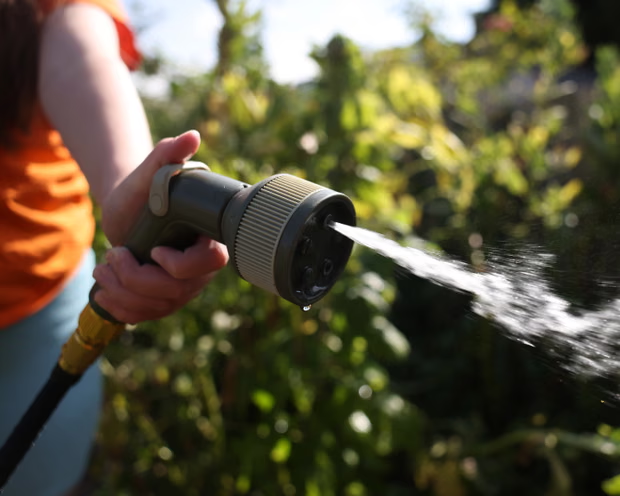
The United Kingdom is currently emerging from a period of unprecedented and record-breaking summer temperatures. Experts widely attribute these extreme weather events to the ongoing and rapidly accelerating global climate crisis. In response, a massive nationwide campaign will launch this week to encourage significant water reduction. This unprecedented initiative represents the largest public awareness drive ever witnessed across the entire nation. The ambitious publicity project will receive seventy-five million pounds in funding over four consecutive years. Known officially as Let’s Save Water, the campaign aims to alter deep-rooted public perceptions fundamentally. Organisers are urging every single citizen to treat water as an incredibly precious natural resource. The primary objective is reducing individual daily consumption by exactly twenty-eight litres across the country. This specific reduction amount is roughly equivalent to two large buckets of water every day. Currently, the average person in the United Kingdom consumes about one hundred and forty litres.
A powerful partnership of major environmental organisations and water regulators is backing this collective effort. This coalition includes water companies, the water regulator Ofwat, and the prominent Environment Agency. The Met Office and Natural Resources Wales are also playing crucial roles within this partnership. Private water utility companies will entirely fund the seventy-five million pound budget over four years. Statistics reveal that water consumption in England and Wales remains among the highest across Europe. For comparison, citizens in Germany and the Netherlands average only one hundred and twenty litres. To ensure genuine success, a dedicated team of behavioural psychologists is actively advising the campaign. These specialists are focusing heavily on shifting traditional public attitudes towards daily water consumption habits. Professor Thomas Webb is a prominent social psychologist currently working at the University of Sheffield. He explained that the critical issue involves making people truly believe water is highly valuable.
Webb noted that changing fundamental assumptions is absolutely necessary to achieve long-term conservation goals. The campaign must make people fully aware of exactly how much water they use daily. It should help individuals view this vital conservation effort as an important and collective mission. Furthermore, citizens should feel genuinely proud of their personal contributions to saving national water supplies. Serious water shortages in England are currently predicted to reach five billion litres every day. Experts anticipate this severe shortfall could become a harsh reality by the year twenty fifty-five. This massive daily deficit is equivalent to approximately two thousand full Olympic-sized swimming pools daily. These alarming predictions result directly from severe climate breakdown combined with steady regional population growth. Additionally, the rapid expansion of water-intensive industries like large datacentres exacerbates the growing problem. However, fresh research conducted for the campaign reveals a shocking lack of public awareness.
Most people actually have absolutely no idea how much water they consume each day. Studies show that average citizens typically underestimate their true daily usage by about five times. On average, individuals believe they only use around thirty litres of water every single day. This stands in stark contrast to their actual recorded average usage of one hundred forty. A strict hosepipe ban officially came into effect across Kent early on Friday morning recently. This restrictive measure was introduced just days after South East Water issued an urgent warning. The utility provider strongly urged its customers to use water sparingly during the intense heatwave. This plea followed a massive surge in public demand for water during the hot weather. Professor Lizzie Kendon serves as the strategic head of climate processes at the Met Office. She stated that global climate change is driving increasingly extreme weather patterns across the country.
These changing patterns include much wetter winters alongside significantly drier summers for the British Isles. The country is also experiencing far more intense and sudden bursts of localized rainfall events. When heavy rain falls on dry and hardened ground, it cannot easily soak into soil. The soil is precisely where this rainwater would be most valuable for the natural environment. Instead, the precious water simply runs off the hard surface and is completely lost forever. Because of these complex factors, Kendon emphasized that there is an urgent need for action. The new campaign is actively calling for the public to make small everyday habit changes. These minor adjustments can successfully reduce overall domestic water use without causing major lifestyle disruptions. Recommended actions include taking shorter showers and installing water butts within beautiful suburban gardens. Homeowners are also being strongly encouraged to fix any dripping taps around their properties promptly.
Standard showers typically consume an estimated ten litres of water during every single minute used. Replacing an old shower head with an efficient model can reduce water use significantly. These specialized water-saving models can successfully lower household water consumption by up to fifty percent. This smart upgrade also provides the added benefit of lowering expensive monthly domestic energy bills. Professor Ian Walker is currently the head of psychology based at prominent Swansea University. As an academic adviser to the campaign, he believes people need empowerment to act. Walker suggested an ideal system would extract real-time data directly from household smart meters. This automated system would then feed information directly back to households in real time seamlessly. It would combine this raw data with highly meaningful advice on practical steps to take. He explained that making simple one-off changes represents the easiest type of behavioural adjustment.
Examples include purchasing a highly efficient washing machine or a water-saving modern shower head. However, changing deep-seated habitual behaviours remains a significantly harder challenge for the campaign organizers. These daily habits actually constitute the vast majority of total water consumption across most households. Campaign organizers openly acknowledge that public trust in water companies is at an all-time low. This widespread public skepticism stems from record levels of sewage pollution entering local rivers. Serious drinking water outages in south-east England have also severely damaged the industry’s reputation. Furthermore, major companies like Thames Water are burdened with incredibly high levels of debt. Many of these struggling utility providers are routinely failing to meet their basic legal duties. Consequently, asking the British public to cut water usage might prove a very difficult sell. Leaks by water companies currently account for a staggering nineteen percent of total water demand.
Remarkably, no new reservoirs have been constructed in England by water companies for thirty years. In response, the water industry has recently pledged to construct ten brand new regional reservoirs. This massive construction project is part of a wider one hundred four billion pound investment. This enormous financial investment will be deployed across the country over the next five years. James Wallace, the chief executive of River Action, warmly welcomed the new conservation initiative. He explained that every saved litre reduces pressure on rivers, the lifeblood of the nation. However, Wallace insisted that primary responsibility for saving water still lies with the companies. Since privatization, seventy-eight billion pounds has been paid to shareholders while leaking pipes persist. Baroness Shas Sheehan emphasized that water companies must actively lead by example going forward now.
Related News:
 ‘Extinct’ Antelope Returns to Sahara, Bringing Hope
 Norfolk Coastal Graves at Risk as Erosion Deepens Family Anguish
 Eden Project Founder Celebrates 25 Years of Nature’s Hope
 Winter plant bloom signals climate breakdown in UK
 Avocado Crisis: The Hidden Violence Behind Exports
 Smaller farms funding prioritised in England nature plans
 Storm Goretti leaves Cornwall homes without power
 Wildlife Targets at Risk in England and Northern Ireland
 BP’s Influence Sparks Controversy in UK STEM Education
 Polycrisis Anxiety Leaves Many Feeling Trapped in the Present
 Kent Residents Continue Facing Water Supply Disruptions
 No Gas Boiler Ban as UK Warm Homes Plan Backs Heat Pumps
 Judi Dench Champions Fight to Save London’s Green Spaces
 Half the World’s Largest Cities Face Rising Water Stress
 Record-Breaking Heat Looms Over South-East Australia as Catastrophic Fire Risk Escalates
 UK joins North Sea wind grid pact with nine European nations
 Devon hosts first high-density hydro power system
 US-Style Pickup Trucks Surge on UK Roads
 Storm Chandra floods Somerset, triggers major incident declaration
 Reform UK Taps Boris Ally to Shape Party Nature Agenda
 James Valentine Retires from ABC After Cancer Battle
 UK Pfas Action Plan Faces Criticism From Environmentalists
 Wigan Dump Crisis Sparks Health and Safety Alarm
 Norway’s Petrol Car Sales Hit Record Low Amid EV Surge
 Fish disco plan could save 90% of fish at Hinkley C
 Santos Wins Landmark Greenwashing Case in Court
 Gentoo Penguins First Birds on Australian Territory Hit by Bird Flu
 Flood risk homes surge across England builds
 Chikungunya Spread in Europe Climbs as Climate Warms
 Deer Shooting England: New Plan to Protect Woods
 Illegal Waste Dumping: New Drone Unit Launched
 Scotland’s Emissions Plans Face Criticism for Over-Reliance on Technology
 Germany Faces Backlash Over Scrapped Renewable Heating Mandate
 Group Expands Legal Claim Over South West Water Pollution
 Scotland’s Climate Plans Face Scrutiny Over ‘Science Fiction’ Targets
 Ancient Stepwells Revived Amid India’s Deepening Water Crisis
 Greenpeace $345m Ruling Sparks Appeal Battle
 Wood burner legal threats spark council row
 Net Zero Cheaper Than One Fossil Fuel Crisis, UK Told
 Musk’s xAI Permit Sparks Fury Over Power Plant Expansion
 London Considers New SUV Charges to Improve Road Safety
 MPs Slam Agency Over Failing Fight Against Waste Dumping
 Middle East Deluge: Freak Storms Bangle Desert Nations
 Evacuations Ordered as California Wildfires Spread Fast
 UK Records Earliest Spring as Nature Awakens Fast
 Tragic End to Outback Search as Floods Claim a Life
 UK Fossil Fuel Expansion Risks Global Climate Collapse
 Miles Jupp: How the Magic of the Ashes Sparked a Bold Blag
 RSPB Urges Summer Bird Feeder Removal to Curb Disease
 The Toxic Scent Destroying Life in a Lancashire Town
 Britain Facing Sharp Decline in Rare Butterfly Species
 15 Million Oysters Set to Revive UK Marine Ecosystems
 Fuel Prices Drop Despite Geelong Refinery Blaze
 Big Tech Lobbies EU to Hide Massive Datacentre Emissions
 Medellín’s Green Revolution: A Global Climate Blueprint
 Celestial Magic: The Lyrid Meteor Shower Returns
 Nature Watchdog Accused of Halting Vital Site Protections
 Fury in Cornwall over herbicide plan to tackle weeds
 Governments Fail Murray-Darling River Projects
 Renewable Energy as a Strategic Shield for UK Security
 Escobar’s Hippos May Be Moved to India Zoo
 Capitalism ‘Suicidal’, Warns Petro at Climate Summit
 UK Firm Faces Backlash Over US Oil Advertising Deals
 The Lion Guard: How One Woman Heals the Zambezi Valley
 Record May Heat to Cold Front in Eastern Australia
 Ukraine strikes Tuapse as oil disaster worsens
 The Campaign To Save Britain’s Original Bramley Apple Tree
 EU Deal May Force UK Ban on Cancer-Linked Weedkiller
 Stolen Hives: The Great Australian Bee Heist
 Charities Demand Labour Deliver Urgent New Clean Air Act
 UN Faces Crucial Vote on Landmark ICJ Climate Ruling
 Man killed in shark attack on Great Barrier Reef
 Hope for mountain bongos returns to Kenya
 Saving Our Lost Rainforests: The Battle for Dartmoor
 Outcry Over Kushner’s Albanian Resort
 Painted Lady Invasion: Millions of Orange Butterflies Head to UK
 Whitehall Steps In: The Battle Over Thames Water Deepens
 Cambridge Recreates Historic 336-Year-Old Garden
 Australia Investigates Suspected Mainland H5N1 Case
 Green Lawsuits Surge as AI Expansion Strains Planet