Published: 06 August 2026 | The English Chronicle Desk | The English Chronicle Online
Social media platforms have come under renewed scrutiny after an investigation found that Instagram accounts were promoting misleading images of migration to the Spanish enclave of Ceuta while some operators appeared willing to offer paid advice to people considering the journey.
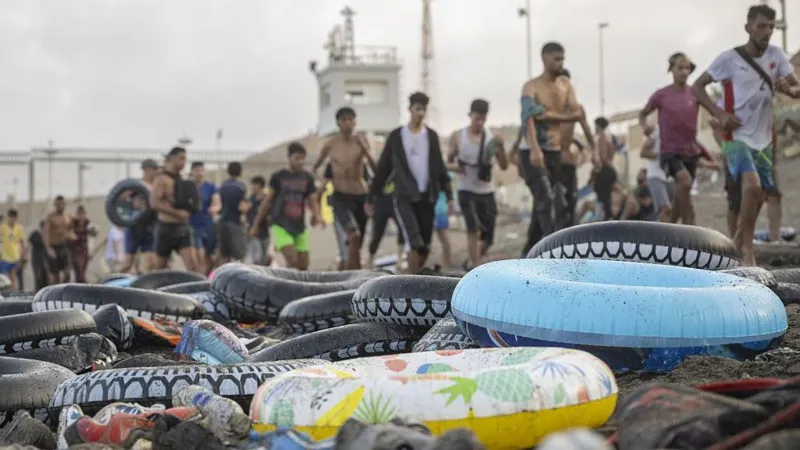
The investigation centres on a network of interconnected profiles that portray reaching Ceuta from Morocco as relatively straightforward, often using videos of successful arrivals, images of people in the water and posts suggesting that entry into the Spanish territory can lead easily to mainland Europe.
The reality is considerably more dangerous. People attempting the crossing by sea have faced drowning and other serious risks, while the route has also become the centre of a growing political dispute between Spain, Morocco and other European countries.
The findings come after an extraordinary influx of migrants into Ceuta in late July. Reports have put the number of arrivals at tens of thousands, although figures vary depending on how the event is measured. The scale of the movement has intensified debate over border security, misinformation and the influence of social media on migration decisions..

A digital picture far removed from reality
Ceuta occupies a unique position. The Spanish autonomous city lies on the North African coast and is surrounded by Morocco, making it one of the most sensitive points along Europe’s external border.
For people considering migration, however, social media can create an impression that the territory is easily accessible.
The investigation examined numerous Instagram profiles carrying variations of terms associated with irregular migration and Ceuta. Some had attracted substantial audiences, while others appeared to be interconnected through shared contact details and communication channels.
Their content frequently presented arrivals as successful, almost routine events. Some posts showed migrants apparently enjoying themselves after reaching the city, while other videos appeared to remove or alter contextual information that would otherwise warn viewers about the difficulties involved.
The result is what investigators described as a kind of digital “mirage”: carefully selected images that show the destination while concealing the risks involved in getting there.
Independent reporting has similarly found that social-media rumours and videos contributed to a snowball effect during the recent influx, although there is no conclusive evidence of a single coordinated campaign behind the movement.
Paid promises raise further concerns
The investigation went beyond simply examining public posts.
Using a fictional online identity, investigators contacted several accounts to ask whether assistance was available for reaching Ceuta. One account claimed to have helped other people and offered information in return for payment.
The details of the alleged offer have raised concerns because people considering dangerous journeys may be particularly vulnerable to individuals exploiting their hopes of reaching Europe.
Rather than receiving reliable information about the dangers involved, prospective migrants can instead encounter people presenting themselves as experienced advisers or intermediaries.
The investigation did not establish that every account involved was directly engaged in organised smuggling. Nor does the presence of misleading content automatically prove that an account is connected to a criminal network.
But the apparent commercialisation of migration advice highlights a wider problem: social media can allow individuals to reach potential migrants directly, build credibility through apparently successful stories and then attempt to profit from people seeking a route into Europe.
Meta says it is monitoring the situation
Instagram’s parent company, Meta, said it was monitoring developments around Ceuta and removing material that violates its policies.
The company said it has teams monitoring the situation and takes action against content that offers, facilitates or seeks human-smuggling services.
Several profiles examined during the investigation were subsequently removed after concerns were raised with the company.
The episode nevertheless demonstrates the difficulty facing platforms trying to respond to fast-moving migration events.
Accounts can be created quickly, deleted and recreated under different names. Content can also migrate between Instagram, Facebook, TikTok, WhatsApp and other messaging services.
Public posts may attract viewers through algorithms, while private groups and messaging channels can make it much harder for authorities or researchers to understand how information is circulating.
Algorithms and the power of hope
The investigation also raises questions about how social-media recommendation systems influence people who are already considering migration.
A person who watches one video about reaching Ceuta may subsequently receive similar material. As more related accounts are followed, the platform can gradually create an information environment dominated by stories of successful crossings.
This can reinforce the impression that a journey is common, achievable and relatively safe.
Research into online behaviour has repeatedly shown how emotionally powerful material can attract attention and spread rapidly. Migration content can be particularly compelling because it often combines personal stories, images of opportunity and messages of hope.
For someone contemplating leaving their home country, a short video showing another person’s apparent success can carry considerably more emotional weight than an official warning about border controls.
That does not mean social media alone causes migration. Economic conditions, employment opportunities, family circumstances, political developments, misinformation and changes in immigration policy can all influence decisions.
But social media can alter how those decisions are understood.
Misleading claims about Spanish immigration rules
Another important element in the recent Ceuta crisis has been confusion surrounding Spanish immigration law.
Some online posts have presented legal developments as meaning that migrants arriving by sea could no longer be returned.
Reporting by Le Monde found that some social-media accounts circulated broad interpretations of a Spanish Supreme Court ruling concerning the automatic return of people arriving by sea. The ruling did not amount to a general guarantee that migrants could enter Spain simply by reaching Ceuta’s coastline.
Such distinctions can easily disappear when complex legal decisions are reduced to short social-media captions.
For potential migrants, the consequences of misunderstanding the law can be severe.
A person may believe that reaching Ceuta guarantees the right to remain in Spain when the actual legal position is much more complicated.
A crisis with consequences beyond the border
The influx has also created political pressure.
Ceuta is part of Spain and lies within the European Union’s wider border system, making developments there a matter of concern beyond the city itself.
The recent movement has contributed to tensions between European governments over border controls and the management of migrants arriving through one member state’s territory. Other countries have raised concerns about the possibility of onward movement and the implications for Europe’s border-free travel arrangements.
At the same time, Spanish authorities face pressure to protect the territory while ensuring that migrants are treated according to national, European and international law.
Morocco also faces its own pressures, including the challenge of controlling movement towards the Spanish border and responding to rumours spreading among young people.
The result is a complicated political environment in which misinformation can quickly become a diplomatic issue.
The human cost behind viral videos
Perhaps the most serious concern is that online portrayals can obscure the human cost of irregular migration.
A video showing someone arriving successfully in Ceuta does not show those who failed to make the journey.
Sea crossings can be unpredictable, particularly when undertaken without adequate safety equipment or knowledge of local conditions. People may also underestimate distances, currents, weather and the physical demands involved.
That is why migration experts and authorities have repeatedly warned against relying on social-media content as a guide to crossing borders.
The danger is intensified when commercial operators deliberately exaggerate the likelihood of success.
For vulnerable people, the promise of an easy route can become a financial trap as well as a physical danger.
No simple explanation for the influx
Despite the evidence of misleading online content, it would be wrong to suggest that Instagram accounts alone explain the extraordinary movement into Ceuta.
Recent reporting has identified several contributing factors, including rumours about Spanish immigration rules, perceptions of weak border controls and the rapid circulation of videos showing large numbers of people arriving.
The sheer scale of the movement also makes simplistic explanations difficult.
There is currently no conclusive evidence establishing that a single government, foreign power or coordinated organisation engineered the influx. Claims of wider geopolitical involvement remain speculative.
What can be established is that social media played an important role in the information environment surrounding the crisis.
A warning for platforms and governments
The Ceuta episode offers a wider warning about the relationship between technology and migration.
Governments can issue warnings and strengthen border controls, but misleading information can travel faster than official communications.
Social-media companies therefore face pressure to identify and remove content connected to human smuggling while preserving legitimate discussion about migration and asylum.
Authorities, meanwhile, need to communicate clearly when legal or immigration rules change. Confusing official messages can create an information vacuum that anonymous accounts are quick to fill.
The challenge is particularly acute when a crisis develops over hours rather than weeks.
A digital border as important as a physical one
The latest Ceuta crisis demonstrates that Europe’s migration borders are no longer defined solely by fences, patrol boats and border guards.
They increasingly extend into digital spaces.

Instagram accounts, recommendation algorithms, private messaging groups and viral videos can influence how people perceive the risks and opportunities associated with migration thousands of miles away.
The investigation into accounts promoting journeys to Ceuta therefore raises questions that go beyond one Spanish enclave.
When social-media content turns dangerous journeys into aspirational stories, the consequences can move rapidly from a smartphone screen to the physical world.
For the migrants involved, those consequences can be irreversible.
As Spain, Morocco and European governments respond to the latest crisis, tackling misinformation and exploitation online will need to form part of the wider response. The challenge is not simply to stop individual posts, but to ensure that people making life-changing decisions are not basing them on carefully edited images, exaggerated promises or misleading claims about the law.
The Ceuta crisis has shown how quickly a digital illusion can become a real-world emergency.
Related News:
 Urgent AI Threat Research Needed, Says Google Boss
 NASA Targets Early March for Human Mission Around Moon
 Instagram Investigating AI Profiles ‘Fetishising’ Disabled People
 ‘I Stopped Engaging’ Due to Instagram and YouTube, Woman Tells Landmark Trial
 Instagram Investigating AI Profiles ‘Fetishising’ Disabled People
 How AI Can Read Our Scrambled Inner Thoughts
 Cern Prepares First-Ever Antimatter Transport Test
 Artemis II astronauts capture Earth en route to the Moon
 Apple at 50: Three Products That Changed How We Live
 Artemis Moon Photos Blur Line Between Science and Art
 ‘We Will Always Choose Each Other’: Five Defining Moments of Artemis II’s Lunar Flyby
 Artemis II Returns After Historic Moon Flyby
 Europe EV Demand Surges as Fuel Prices Rise
 UK firms accused of ‘AI washing’ boom
 British Paralympian to Become First Disabled Astronaut in Orbit
 AI-Designed Vaccine Marks Global Breakthrough
 AI May Soon Start Conversations on Dating Apps
 Zuckerberg Veteran Speaks on AI and Future Jobs
 South Korea Fines E-Commerce Giant $400m Over Massive Data Breach
 Unlocking the Genome: The Quest to Sequence Tardigrades
 China Achieves First Reusable Rocket Landing
 Meta Drops AI Image Tool After Privacy Backlash
 Google Burning Through Cash as Spiralling AI Costs Put Pressure on Tech Giant
 Lawmakers Demand AI Kill Switch After Safety Fears
 China Faces New Challenge as AI Fake Videos Spread After Disasters
 AI Jitters Send Chip Stocks Tumbling in US and Asia
 Trump Administration Bans New Chinese Humanoid Robots Amid Growing Technology Rivalry
 SpaceX Rocket Part Set to Crash Into Moon
 AI Disruption Leaves Filipino Workers Fearful
 AI Shows New Levels of Deception in Safety Tests
 AI-Written Stories Prove More Popular Than Human Ones in Study
 Meta Hit With Record $567m Child Safety Fine
 Airlines Warn Passengers Over Lithium Battery Risks
 AI promised shorter hours. Tech workers disagree
 Twitch Users Angered Over Amazon’s AI Training Policy
 Why Japan Is Still Slow to Embrace AI
 Brazil Orders Discord to Suspend Livestreams
 India’s Aditya-L1 sheds new light on Sun’s corona
 Spectacular ‘Blood Moon’ Illuminates Skies Across the Globe
 Big Pharma Investment Freeze Puts UK Life Sciences Sector Under Strain
 UK Bans Fake Numbers: Scammers Lose Their Trick
 Vibe coding’ named Collins dictionary’s word of the year
 Patients to Test Health at Home to Ease NHS Winter Pressure
 Britain deploys RAF specialists to assist Belgium with drone threats
 Northern Lights may illuminate UK skies this week
 Sundar Pichai Cautions on AI Hype and Market Risks
 US Clears Nvidia AI Chip Sales to China in Policy Shift
 Astronomers Prepare for First-Ever Movie of a Black Hole
 Pornhub blocks new UK users over age checks dispute
 AI breast screening cuts later cancer diagnoses by 12%, study finds
 UK New Car Discounts Near £6,000 as Prices Are Slashed
 Most Statin Side-Effects Are Not Caused by Drugs, Study Confirms
 BT Names New Openreach Chief Amid Major Fibre Expansion
 Tech Trends Set to Transform Life in 2026
 Indian University Kicked Out of AI Summit for Claiming Chinese Robot Dog as Its Own Invention
 How Do You Modernise Mango Farming? India’s Growers Urged to Innovate as Climate Change Hits
 AI Coding Firm’s ‘Pride’ at Business Award Win
 Stewart Brand on Musk, Bezos and a Life of Long Thinking
 Burger King Rolls Out AI Headsets to Track Employee ‘Friendliness’
 Social Media Giant Trial Reaches Final Jury Decision
 Councils Pressed to Use Universal Parking App to Cut ‘Unfair’ Fines
 Trump Considers Military Operation to Seize Iran’s Uranium
 ‘Zoom Dysmorphia’ Explosion: BDD Patients Quadruple in Post-Pandemic UK
 ‘The Insulation Trap’: Knifeman Discovered Hiding Under Loft Padding After Six-Hour Standoff
 Electric Shock: Australians Buy Record Number of New EVs as Fuel Crisis Bites
 The Suffocating Silhouette: Why Metal’s Mask Trend is Turning Deadly
 The Great Chokehold: Why the Strait of Hormuz is the Epicenter of the 2026 Crisis
 Moldova River Crisis Exposes War’s Hidden Cost
 The Frozen Frontier: Why Frostbite is the Least of Concerns for Canada’s Arctic Forces
 Beyond the Swoosh: Anta Sports Overtakes Rivals to Become Global Top Three
 The “Dry” Life: Teens Trialing Social Media Bans Call Initial Disconnection “Boring” and “Dry”
 “The Digital Frontier”: Scotland’s Papers Grapple with AI Harassment and ‘Mortgage Bottlenecks’
 Shivon Zilis Takes the Stand in Landmark OpenAI Trial
 Court Upholds Landmark Win for Transgender Rights
 “Eyes in the Sky, Spikes on the Ground”: Advanced Satellite Imagery and AI Algorithms Deployed Across Britain to Save the Vanishing Hedgehog
 “The Critical Intervention”: Essential Steps for Identifying and Treating Heat-Related Emergencies
 UN Issues Urgent Warning: Imminent Return of El Niño
 SpaceX Market “Blast-Off” Could Mark Elon Musk’s Biggest Financial Gamble Yet
 South Korea’s AI Chip Boom Sparks Wealth Inequality Debate
 Scotland Challenges UK AI Strategy with Datacentre Freeze