**Published: 01 September 2026. The English Chronicle Desk. The English Chronicle Online**
Novak Djokovic has spent much of his career making predictions about his decline look premature. Whenever age, injury or a changing generation appeared to threaten his place among tennis’s elite, the Serbian responded with another remarkable run, another Grand Slam challenge or another reminder of why he belongs among the greatest players in the history of the sport.
But his latest defeat in New York has raised questions that are harder to dismiss.
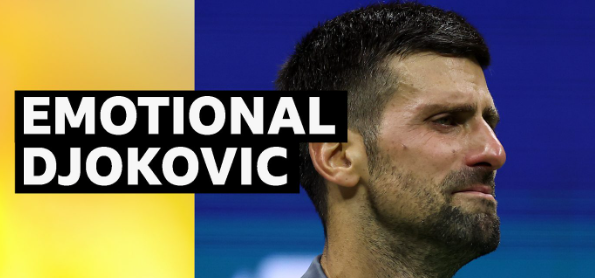
The 39-year-old suffered a shock first-round defeat at the US Open, losing 7-6 (7-5) 5-7 4-6 6-2 6-1 to Argentina’s Mariano Navone. Djokovic fought through more than four and a half hours of tennis but appeared physically exhausted during the contest, at one point becoming emotional and struggling to contain his tears.
The defeat marked the first time in two decades that Djokovic had been eliminated in the opening round of a Grand Slam. It also ended a remarkable record of 78 consecutive first-round victories at major tournaments and his perfect 37-0 record in the opening two rounds at the US Open.
Most significantly, the result means Djokovic will fall outside the world’s top 10 for the first time since July 2018.
For a player who has repeatedly resisted the passage of time, the defeat felt like a potentially important moment in the final stage of an extraordinary career.
Djokovic himself offered little certainty about what comes next.

“I despised every moment I spent on the court for that,” he said after the match, describing his physical condition and the experience of competing as particularly difficult.
“When it comes to the match itself, and the overall feeling of how I felt with my body and playing, it was really not enjoyable.”
Yet he also expressed gratitude towards the spectators who continued to support him.
“From the perspective of the crowd and support, it was incredible,” he said. “I’m very sorry that I didn’t perform as well as I should have, could have, or wanted – for them.”
The contrast between Djokovic’s disappointment and the crowd’s affection underlined his extraordinary standing in the sport.
His career has been defined by overcoming moments when his future appeared uncertain. In 2018, questions surrounded his ability to challenge for major titles after he slipped outside the world’s top 20 and endured a prolonged period without a Grand Slam triumph.
The response was extraordinary.
Djokovic won four of the next five Grand Slam tournaments and accumulated 12 major titles over the following six years. He eventually established himself as the men’s record holder with 24 Grand Slam singles titles.
Even in his late 30s, he continued to compete against the younger generation represented by Jannik Sinner and Carlos Alcaraz.
At this year’s Australian Open, Djokovic produced one of the defining performances of his recent career when he defeated Sinner in a five-set comeback. He then took a set from Alcaraz in the final before eventually losing in four sets.
At Wimbledon, he again demonstrated his ability to challenge players considerably younger than himself, defeating Felix Auger-Aliassime in a five-set quarter-final that became the longest quarter-final in the tournament’s history.
Those performances helped maintain the belief that Djokovic could still win another major title.
But his recent results have complicated that argument.
Early exits in Paris and New York have followed his Australian Open run, while physical problems have increasingly become part of the conversation surrounding his career.
Djokovic recently disclosed that he has been dealing with an ongoing health condition that can cause particular difficulties in hot and humid conditions. At the Cincinnati Masters in August, he suffered a surprise second-round defeat in similarly demanding conditions, dropping to his hands and knees and requiring a medical timeout.
Conditions in New York became less relevant after the roof was closed early in his match against Navone. Nevertheless, Djokovic was already struggling.
During the contest, he vomited and suffered cramping, later describing the sensation as though his “whole body starts to collapse”.
The physical demands of modern professional tennis are considerable, particularly for a player approaching 40. Former Wimbledon champion Pat Cash suggested after Djokovic’s defeat that a reduced tournament schedule could itself have contributed to the problem.
“You can’t substitute matchplay,” Cash said on BBC Radio 5 Live. “You can’t be walking into a Grand Slam on a hot and humid day and expect to get through a five-set match.”
“I know he’s super-human in many ways but it’s going to catch up with you.”
Djokovic has deliberately reduced the number of tournaments he plays in order to concentrate on the Grand Slams. In 2026, he has competed in only seven tournaments, consisting of four majors and three Masters 1000 events.
His 21 Tour-level matches this season represent his lowest total since 2004.
The strategy has been understandable. Djokovic has increasingly focused on the biggest prizes, particularly after achieving another major career ambition at the Paris 2024 Olympics.
Winning Olympic gold completed the so-called career Golden Slam for Djokovic, placing him among a very small group of players to have won all four Grand Slam tournaments and an Olympic singles title.
That achievement came only two months after knee surgery and three weeks after he had lost to Alcaraz in the Wimbledon final.
Since then, his primary objective has been clear: to break his tie with Margaret Court’s record of 24 major singles titles.
That pursuit has provided an additional reason to continue despite the physical demands of the sport.
Djokovic has previously spoken about his desire to play until the 2028 Olympic Games in Los Angeles. If he reaches those Games, they could provide a fitting setting for the final chapter of his career.
They would also come exactly a decade after doubts first intensified about whether he could remain competitive at the highest level.
His relationship with retirement has always been complicated. Djokovic first announced his retirement from international competition in 2016 after Argentina defeated Serbia in the Copa America final? No, in tennis terms, his decision came after a difficult period following his defeat by Chile in the 2016 Copa America final? Actually, Djokovic’s first international retirement was from tennis-related competition and the source context indicates a previous decision to step away after a major disappointment. The broader point remains that he has previously reconsidered his future.
In his recently released documentary, Djokovic addressed retirement directly.
“Why would I talk about retirement when I still keep proving to myself that I can still win?” he asked.
That philosophy has driven much of his longevity.
However, the latest defeat has changed the nature of the question. It is no longer simply whether Djokovic can occasionally produce a spectacular victory over a younger opponent. The issue is whether his body can consistently withstand the physical demands required to win seven best-of-five matches at a Grand Slam.
The distinction is important.
Djokovic remains one of the most accomplished players in tennis history. His 24 major titles, Olympic gold medal, record-breaking longevity and sustained rivalry with Rafael Nadal and Roger Federer have already secured his place among the sport’s greatest figures.
Nadal, a 22-time Grand Slam champion, retired at 38 in 2024. Federer, who won 20 majors, retired at 41 in 2022. Djokovic, who will turn 40 next May, is now the last remaining member of that defining generation.
All three won their final Grand Slam titles at the age of 36.
The changing landscape of men’s tennis therefore makes Djokovic’s position even more significant. Sinner and Alcaraz have emerged as the leading forces of a younger generation, while Djokovic’s ability to challenge them has represented one of the final links to the era that dominated the sport for nearly two decades.

His defeat in New York does not automatically mean retirement is imminent.
Djokovic has proved repeatedly that writing him off can be a mistake. A difficult tournament can be followed by a resurgence, and one poor physical performance cannot erase decades of evidence that he can recover from setbacks.
But this defeat was different because of the circumstances surrounding it.
The tears, the exhaustion, the physical distress and the unusually early exit all provided a stark reminder that even Djokovic cannot indefinitely escape the limits of age.
His next decision will therefore be watched closely. He may continue his pursuit of a 25th major title, adjust his schedule further or eventually begin preparing for the final stage of his career.
For now, the uncertainty is part of the story.
Djokovic has spent years proving that he can continue when others believed his time had passed. His latest defeat does not prove that those days are over.
It does, however, suggest that the question of when they will end has become considerably more difficult to ignore.
Related News:
 Peretz Targets FA Cup Upset Amid War Concerns
 Bryne Backs Haaland Before England World Cup Clash
 England and Norway Fans Turn Miami Into World Cup Carnival
 England’s Euro Odyssey: A Tale of Grit, Glory and the Lionesses’ Miraculous March to the Final
 Raducanu’s Resurgence and Venus’s Record-Breaking Feat Highlight Washington Showdowns
 Tottenham Takes On Newcastle
 Manchester City Announce Their Return in Style with Haaland Double and Debut Goals at Wolves
 FIFA Eyes Biennial Club World Cup from 2029, Plans Possible Expansion
 Brazil Dominate Chile 3-0 to Secure Second Place in World Cup Qualifiers
 Serbia Humiliated 0-5 by England in World Cup Qualifier
 Haaland Hits Five as Norway Crush Moldova 11-1 in World Cup Qualifier
 Gabriel Martinelli’s Spark Ignites Arsenal’s Champions League Campaign with Victory at Athletic Bilbao
 Dembélé and Bonmatí Shine as Ballon d’Or Winners in Glittering Paris Ceremony
 Hannah Hampton Makes History as First Winner of Women’s Yashin Trophy at Ballon d’Or Awards
 Liverpool Vs outhampton Set for Carabao Cup Clash at Anfield
 Dramatic Derby: Sorloth Strikes as Atletico and Real Madrid Share the Spoils
 ICC Women’s World Cup 2025: India to Host as Pakistan Fixtures Moved to Neutral Venues
 Bournemouth Stun Fulham with Dramatic Comeback in Premier League Thriller
 Chaos at Ibrox as Martin’s Rangers Era Comes to an End
 Arsenal Showcase Depth and Flexibility as Arteta Eyes Title Challenge
 Ferguson Fires Scotland to Dramatic Comeback Win Over Greece
 Ruben Neves Strikes Late as Portugal Beat Ireland
 Tuchel Criticises ‘Silent Wembley’ After England Win
 Kane’s Double Seals England’s World Cup Qualification
 Barnes Inspires Newcastle to Champions League Triumph Over Benfica
City shine with PlayStation-style football to overwhelm Villarreal
Barnes Inspires Newcastle to Champions League Triumph Over Benfica
City shine with PlayStation-style football to overwhelm Villarreal
 Fabio Wardley stuns Joseph Parker to earn Usyk title shot
 Tension and Turmoil at Aston Villa v Maccabi Match
 Lando Norris Dominates Brazil GP to Strengthen F1 Title Bid
 Ronaldo Confirms Final World Cup and Plans Retirement
 England Maintain Perfect World Cup Qualifying Record with Win Over Serbia
 Irish Hero Parrott Says Goal Brought First Tears in Years
 Scotland Fans Reflect on France ’98 as World Cup Looms
 Nigeria Misses World Cup Again After Play-Off Loss
 Tiny Curacao Makes History as Smallest Nation to Reach World Cup
 Haiti Qualifies for World Cup Despite Coach Never Visiting Country
 Scotland Fans Celebrate Historic World Cup Qualification
 Barcelona Returns to Camp Nou vs Athletic Bilbao
 Mbappe Scores 4 as Real Madrid Edge Olympiakos
 Man City Lose, Champions League Risk
 Trump to attend 2026 FIFA World Cup draw in Washington
 Egypt and Iran urge Fifa to block Pride event at 2026 World Cup
 Hindu Man’s Stand Sparks Hope in India
 India T20 World Cup Triumph Seals Historic Title Defence
 Iranian Captain Departs Australia Amid Asylum Tension
 Teen Admits Filming Westfield Chair Prank
 TikTok effect draws younger crowds to Grand National
 Moldova River Crisis Exposes War’s Hidden Cost
 Black Forest Tragedy Remembered 90 Years On
 Ukraine Urges UK to Seize Russian Oil Tankers
 Escobar’s Hippos May Be Moved to India Zoo
 Two Dead in Adelaide Airport Plane Crash Fire
 John Terry Faces Backlash Over Political Posts
 $13bn World Cup Set to Break All Revenue Records
 Premier League drama defines crucial weekend
 China Fireworks Factory Blast Kills 21 in Hunan
 RFU Backs Borthwick Despite England’s Poor Six Nations
 Miami Upgrades Shake Up F1 Title Fight
 Infantino Defends Soaring World Cup 2026 Ticket Costs
 FIFA Confirms Global Ban for Benfica Star Prestianni
 France Faces Record Presidential Crowded Race Amid Far-Right Surge
Chasing Glory: The Quest for a New World Cup Champion
France Faces Record Presidential Crowded Race Amid Far-Right Surge
Chasing Glory: The Quest for a New World Cup Champion
 Tuchel Boldly Reshapes England Squad for World Cup Glory
 Pope Meets Families in Italy Toxic Waste Zone
 Farage and Reform UK Reshape British Politics
 Starmer Leadership Under Pressure After Setbacks
 Knicks Clinch Historic Comeback in Thrilling NBA Finals
 Fifa Official Under Investigation Over Hand Gesture Controversy
 Canada Secure Historic Last 16 Spot with Late Goal
 Mexico World Cup Joy Turns to Tragedy as Two Die in Crowds
 Le Pen’s Popularity Holds Despite Conviction
 Dreyfus Statue Finally Gets Permanent Paris Home
 Lamine Yamal’s Birthday: Football, Fame, and France
 Olympus Awaits Unesco Heritage Recognition
 Is America Ready for an AOC Presidential Run?
 Grafström sounded out over challenge to Infantino
 Ghent Professors Questioned Cofnas Appointment
 Australia Races to Find Tourists Missing in Nepal
 France Eases Cheese Rules as Drought Hits Farms
 Nepal Flood Death Toll Tops 300 as Second Flood Feared