Published: 25 September 2026. The English Chronicle Desk. The English Chronicle Online
A major community-led regeneration plan in Frome has suffered a significant setback after Somerset council selected a London-based property investment company as the preferred bidder for the town’s long-contested Saxonvale site.
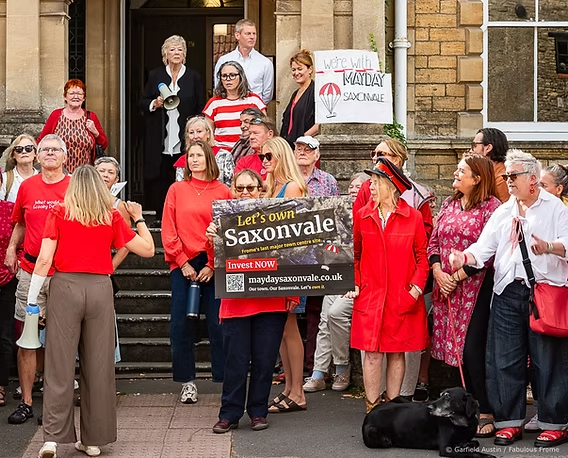
More than 1,000 local residents had backed the Mayday Saxonvale project, collectively helping to raise almost £1 million towards a plan that sought to transform the five-hectare brownfield site in the centre of Frome. The proposed development included new homes, workspaces, public open space, a riverside park and a lido, with supporters presenting it as a model for community-led regeneration.
Instead, Somerset council has chosen Newcore Capital as the preferred bidder for the site. The decision was announced at a meeting at Frome town hall attended by a large number of residents and supporters of the Mayday proposal. The announcement prompted anger and disappointment among people who had spent years working on the community-backed scheme.
Some residents shouted objections as the successful bidder was revealed, while others expressed concerns about the future of the site. Several people involved in the Mayday campaign for years were visibly emotional after the decision.

The dispute centres on more than the ownership of a piece of land. For many people in Frome, Saxonvale has become a test of whether local communities can have meaningful influence over the redevelopment of major sites in their towns.
The Mayday proposal was built around the idea that local residents should have a direct role in determining what happens to the site. Supporters wanted a development that would provide homes accessible to local people, employment opportunities and public facilities while making better use of a large brownfield area close to the town centre.
Frome has developed a reputation for independent community initiatives and a strong local civic culture. Supporters of Mayday argued that the project represented that tradition by bringing residents together to invest financially and participate in a long-term development plan.
Sara Butler, a Frome town councillor, described the council’s decision as devastating for those who had worked on the project. She said the effort had become a town-wide initiative involving people who wanted the site developed in a way that reflected local priorities.
Fiona Barrows, leader of Frome town council, said the objective of the Mayday proposal had been to create homes that local residents could afford while providing places for people to work. She indicated that the town council would engage with the prospective owners but questioned how the sale process had been handled.
Barrows argued that Saxonvale was too important to Frome to be treated simply as an ordinary disposal of council-owned land. Her comments reflect wider concerns among residents about whether the community will retain meaningful influence over the final development.
The scale of local financial support for Mayday has been one of the strongest arguments made by its supporters. Residents and other local backers contributed close to £1 million to the project, demonstrating a substantial level of community investment.
Mayday also secured £1.2 million from the social impact investment organisation Resonance. The funding represented the largest investment the organisation had made through the relevant initiative. Mayday said it had also attracted interest from additional potential investors.
The council, however, argued that it could not establish with sufficient certainty that Mayday had secured all the funding required to complete the proposed development. The estimated value of the land sale was understood to be around £3 million.
The funding question became particularly important because the council was responsible for determining which proposal represented the most credible route for taking the site forward. While Mayday had secured substantial financial backing, the council ultimately selected Newcore Capital.
The decision has raised concerns about whether the new owner will deliver the kind of development originally envisioned by local campaigners. Some residents fear that the site could ultimately contain expensive riverside properties or commercially attractive accommodation for older people rather than a development dominated by affordable homes and community facilities.
Those concerns remain speculative, however, because Newcore has not yet finalised its development plans.
The company has said it intends to work closely with Frome residents and local organisations to understand their priorities and identify the opportunities and constraints associated with the site. It has indicated that emerging proposals could include different forms of housing, intergenerational accommodation, community facilities, space for artists, open areas and additional car parking.
Newcore’s existing projects provide some indication of the types of developments it has pursued elsewhere. The company’s portfolio includes brownfield redevelopment projects incorporating housing alongside community and commercial facilities.
One of its projects in east London involves plans for more than 1,000 homes together with a supermarket, community health centre and childcare facilities. Another project in Cambridge involves care and retirement accommodation on a brownfield site.
For residents of Frome, however, the key question will be whether the future development reflects the particular needs of their town.
Paul Oster, an executive director of the Mayday Saxonvale community benefit society, said the decision represented the loss of an opportunity to create what could have become one of the UK’s largest community-led regeneration projects.
The Mayday campaign had developed over several years, with supporters investing their own money and devoting considerable time to planning the proposed development. Its backers argue that the community’s financial commitment demonstrated more than simple public interest in the project.
Jon Rolls, head of developing communities at Resonance, said there was a risk that the site could become another regeneration project delivered to a community rather than developed by and with the community.
The concern highlights a wider debate across Britain about the role of local communities in major development decisions. Brownfield regeneration can bring new housing, jobs, public spaces and infrastructure, but disputes frequently arise over who determines the priorities and how the benefits are distributed.
Community-led schemes often place greater emphasis on local ownership, affordability and long-term social benefits. Commercial developers, meanwhile, may have greater access to capital and development expertise, allowing them to take on large and complex sites that require substantial investment.
The challenge for local authorities is to balance those considerations while ensuring that public land is sold through a process that is financially responsible and capable of delivering viable development.
In Frome, some residents have questioned the transparency of the process. There has been suspicion among campaigners that the council’s preferred bidder had effectively been selected before the public meeting at which residents made final appeals.
The circumstances surrounding the announcement intensified those concerns. The identity of Newcore Capital was revealed at the end of an emotional meeting, after which the council quickly issued a statement about the decision. Newcore subsequently published its own statement outlining its intentions for the site.
The council has said that the sale is unconditional, while also expressing hope that the prospective owners will engage with Frome residents as the development moves forward.
That distinction is important for the future of the project. Community involvement may continue, but residents will no longer be seeking to develop the site themselves through Mayday. Instead, they will be engaging with a private investment company that will ultimately determine how its development proposals are formulated within the planning system.
The future of Saxonvale will therefore depend on a combination of commercial viability, planning decisions, local consultation and the priorities of the new owner.
Affordable housing is expected to remain one of the most closely watched issues. Frome, like many towns in England, faces pressure to provide additional housing while ensuring that new homes are accessible to people living and working locally.
Public space and community facilities are also likely to be central to the debate. Mayday supporters had envisaged a riverside park and lido alongside homes and workspaces, while Newcore has referred more broadly to open space and community facilities.
The final shape of the site is likely to emerge through further planning and consultation. Until detailed proposals are produced, it remains unclear how closely the eventual development will resemble either the Mayday vision or the expectations of residents who supported it.
For the people who contributed financially to Mayday, the council’s decision marks the end of a long campaign to secure local ownership of the site. For Somerset council, the decision represents a choice to proceed with another development partner after concluding that its proposal offered the stronger route for taking Saxonvale forward.

For Frome, the debate is now entering a new phase. The immediate question is no longer whether the community can buy the site, but how much influence residents will have over what is built there.
The Saxonvale site has remained a prominent development opportunity for years, and its future could reshape an important part of Frome’s town centre. The coming planning process will determine whether the project ultimately delivers the homes, employment space, public facilities and open areas that residents have long sought.
What is clear is that the decision has left a substantial section of the local community disappointed, while placing considerable attention on Newcore Capital and its next steps. The company has promised collaboration with residents. The extent to which that commitment translates into the final design and use of Saxonvale will be closely watched by the people who have spent years campaigning for a different future for the site.
Related News:
 Rising Costs Force Families to Rethink Days Out
 Reform UK funding: mystery billionaire revealed
 Public Confidence in University Degrees Plummets in the UK
 Burnham unveils £65m drought aid for farmers
 UK Households Could Save £173 on Fixed Energy Deals
 Green Leader Targets Starmer’s Former Seat
 UK Subsidence Claims Surge After Record-Breaking Summer
 UK House Prices Fall as Mortgage Rates Rise
 UK retailers plan 100,000 placements for young people
 Councils spend £125m on illegal children’s care
 Thames Water Revises Oxfordshire Mega-Reservoir Plan
 UK Retailers Accused of Breaking Refund Laws
 UK Rent Gap Puts Low-Income Families Under Pressure
 Labour Apprenticeship Scheme Faces Slow Start
 Thinktank Calls for Abolition of UK State Pension
 Reeves Faces Setback as Labour May Miss Homes Target
 Trump’s UK Ambassador Urges North Sea Drilling to Strengthen US Ties
 M&S Profits More Than Halve After Cyber-Attack
 Tony Blair think tank warns Rachel Reeves must cut taxes if manifesto broken
 Millionaires group urge Reeves to introduce wealth tax to ‘lift kids out of poverty’
 Global markets drop amid tech sell-off and China slowdown
 Mossmorran Plant Closure Hits Cowdenbeath Hard
 Starmer Says Labour’s Economic Plan Needs Years to Deliver
 Virgin Media Fined £23.8m Over Telecare Safety Failures
 Rising Water Bills Lift Troubled Thames Back to Profit
 Starmer Faces Parliamentary Battles Over UK-EU ‘Reset’ Plan
 Phoenixism Costs UK Taxpayers Millions in Recruitment Sector
 ScottishPower Tops List of Worst UK Energy Suppliers
 City & Guilds pay surge sparks backlash amid £22m cuts
 UK Government Borrowing Drops to £11.6bn in December
 AI job losses UK: Britain faces sharper employment shock
 UK Unemployment Rate Climbs to 5.2% Peak
 UK shelves £110m border project amid trade strain
 Switching Energy Deal Can Save £200 as Price Cap Falls
 Rachel Reeves Faces Middle East Conflict Test
 Grocery Inflation Rises Amid War Fears
 BrewDog sold Highland estate for knockdown price after abandoning reforestation plans
 UK Energy Reform Could Cut Bills by £200
 M&S Demands Urgent Action on Rising Violent Retail Crime
 Aegon Sells Historic UK Arm to Standard Life for £2bn
 UK Staycations Rise as Travel Fears Grow
 Silent Tracks: Rail Line Without Passengers
 Greens Face Internal Row Over Antisemitism Claims
 Barrister Criticises Trial After Suicide Case Verdict
 Lotus Boss Pledges Future to Norfolk and Seeks State Support
 UK Firms Freeze Spending as Iran Conflict Bites
 Summer Shock: British Energy Bills Set for Grim July Hike
 Reeves to Fast-Track Clean Energy Amid Iran Crisis
 Farage and Reform UK Reshape British Politics
 Starmer Leadership Under Pressure After Setbacks
 Tube Strike Brings Capital to a Standstill Over Shift Disputes
 Tube Strike Brings Capital to a Standstill Over Shift Disputes
 BP Stands Firm on Amanda Blanc Amid Boardroom Storm
 UK House Prices Drop For Third Month Due To War Fears
 Top Chefs Back Andy Burnham to Save UK Hospitality Sector
 AI Scams Push UK Investment Fraud Past £220m
 EU Slashes Steel Quotas But Grants UK Favourable Rates
 Sainsbury’s Boss Optimistic As Grocery Inflation Eases
 British Teens in EU Face Soaring UK University Fees
 UK Schools Struggle as Classrooms Top 40C
 Westminster Council Threatens Charing Cross Soup Kitchen
 Unions Warn Labour Over Zero-Hours Contract Reforms
 Queue row erupts on Wales’ highest mountain
 RAF Barnham Protests Fuel Tensions in Norfolk Town
 British Museum Faces Questions Over Peter Thiel’s Private Bayeux Viewing
 London Launches First Self-Driving Taxis
 Billionaire Chris Rokos poised to leave UK
 UK plans tougher Israel stance with settlement trade ban
 JPMorgan Boss Warns Against UK Bank Tax Rise
 UK Pay Growth Slows to 3.9% as Rate Decision Nears
 UK Heatwaves Set to Worsen Pothole Damage, RAC Warns
 Mayors Could Gain Greater Powers Over Water Firms
 Entain Plans 400 Job Cuts After Profit Update
 Tom Watson Takes Senior Role at Palantir
 Mahmood Warns Far Right Over Asylum Protests
 Calls Grow to Expand UK National Wealth Fund
 Headteachers Warn New Ofsted System Is Harming Wellbeing
 MPs Defend UK Economic Watchdog Against Critics
 Roman Finds Reveal Bath’s Suburban Past
 AO Acquires Jessops in Camera Retail Expansion