Published: 20 May 2026. The English Chronicle Desk. The English Chronicle Online.
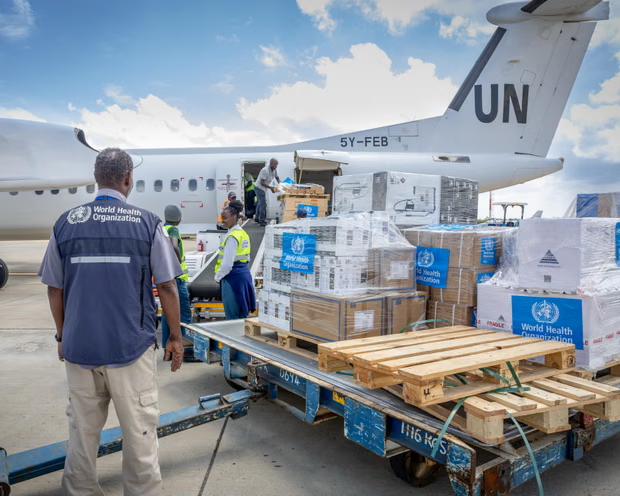
The Democratic Republic of the Congo faces a sudden and deeply concerning health crisis today. A major outbreak of the deadly Ebola virus is spreading rapidly through the region now. Global health leaders are meeting urgently to discuss how to manage this growing situation. They are considering the use of experimental vaccines that are still in development stages. These unapproved medicines could provide a vital line of defense against the current surge. The head of the World Health Organization expressed his profound worry about the virus. He noted that both the speed and the scale of infections are truly alarming. Officials are working around the clock to coordinate an effective international medical response plan.
The statistical data regarding the infection rates has increased dramatically over the past week. Health officials have already recorded at least five hundred suspected cases of Ebola so far. Tragically, the virus has also caused about one hundred and thirty suspected deaths already. These numbers represent a massive jump from the statistics reported just a few days ago. When the official announcement was made on Friday, there were only two hundred cases. At that time, the recorded death toll stood at sixty-five individuals across the area. This rapid doubling of figures indicates that the infection is moving very quickly indeed. Medical teams are trying to track the movement of the virus across communities.
Aid organizations on the ground are painting a bleak picture of the unfolding crisis. A senior health director from the International Rescue Committee shared his grim observations today. He stated that the current known cases likely represent just the tip of an iceberg. Most of these infections have been reported in the remote Ituri Province of the country. This particular region faces massive challenges due to its geographic isolation and ongoing conflict. The true extent of the virus may be much larger than official numbers suggest. Healthcare workers are struggling to reach remote villages to conduct accurate testing and tracking. Without comprehensive testing, the full scale of the disaster remains hidden from view.
Experts fear the deadly disease will soon cross the porous international border nearby. The virus could easily enter South Sudan because border security is quite relaxed there. The health director warned that such a cross-border spread is a matter of time. He noted that South Sudan possesses a very weak public health infrastructure right now. This lack of medical facilities means that authorities are essentially flying blind there. They do not have the tools necessary to monitor incoming travelers for symptoms. A major outbreak in South Sudan could overwhelm their fragile medical system very quickly. International agencies are trying to bolster border screening measures before it is too late.
The International Rescue Committee continues to provide vital humanitarian relief across the affected region. Their teams are offering direct support to local health clinics under immense pressure today. However, medical workers face a severe shortage of basic protective equipment right now. Doctors and nurses desperately need protective gloves, face masks, and proper safety goggles. They require these items when examining patients who show symptoms of the viral disease. Without proper gear, front-line healthcare workers face a very high risk of infection. Several medical staff members have already expressed serious fears for their personal safety. Delivering these essential supplies to isolated clinics remains an absolute priority for charities.
Medical professionals emphasize that Ebola remains an exceptionally deadly disease for human populations. The specific viral strain causing this outbreak carries a very high mortality rate today. Statistically, between thirty percent and fifty percent of infected patients will likely die. This grim survival estimate assumes that professional medical care is fully available to them. When proper medical care is not accessible, the situation becomes significantly more dangerous. Patients who arrive at clinics too late face a much higher risk of mortality. Early intervention and supportive therapy are absolutely critical for saving lives during an outbreak. Unfortunately, many infected people live hours away from the nearest operational hospital.
The current situation is further complicated by the specific genetic biology of the virus. Scientists have identified that the Bundibugyo strain is entirely responsible for this active outbreak. This specific strain presents a major challenge because it has no approved vaccine yet. Furthermore, there is currently no licensed medical treatment available for this particular variation. Medical teams must rely on basic supportive care to help patients fight the infection. This lack of specialized tools makes the containment effort much more difficult for doctors. Researchers are looking at experimental drugs that showed promise in past laboratory trials.
In a positive development, scientists have successfully mapped the virus’s genetic structure. Experts from the Congo and Uganda published the complete genome online on Monday night. Virologists who examined this genetic data offered some important insights into the outbreak. They believe the current crisis was sparked by a recent animal spillover event. This means a human initially contracted the virus through contact with an infected animal. Since that initial event, the virus has been spreading rapidly from human to human. Understanding the origin helps scientists determine if the virus is mutating over time.
Prominent virologists believe this genetic information is incredibly useful for the containment response. A professor from the University of Bristol commented on the latest scientific findings today. He explained that the outbreak can potentially be traced and interrupted by medical teams. This strategy has successfully stopped similar Ebola outbreaks in the African region before. However, repeated independent spillovers from animal sources would complicate these containment efforts significantly. If animals are continuously infecting humans, stopping the spread becomes a massive logistical nightmare. Therefore, confirming a single source allows teams to focus entirely on human contact tracing.
A local World Health Organization official offered a realistic perspective on the timeline. She warned that the current outbreak could take a long time to control. The representative stated that operations will likely last much longer than two months. She spoke to reporters in Geneva during the annual World Health Assembly meeting. To support her point, she referenced a historical outbreak that lasted two years. That devastating historical event occurred between the years of 2018 and 2020 in Congo. Nearly twenty-three hundred people lost their lives during that dark period of history. It remains the deadliest and most challenging Ebola outbreak the nation has ever seen.
International health committees are reviewing every available medical option to save lives now. They are evaluating candidate vaccines that are currently undergoing various stages of clinical trials. Officials want to see if any experimental treatments could be useful right now. Desperate situations sometimes require the use of innovative and unapproved medical interventions on patients. Ethical committees must balance the potential risks against the extreme danger of the virus. The World Health Organization is consulting with international experts to create a framework. If approved, these experimental drugs could be deployed to high-risk zones very soon.
Neighboring countries are already taking strict preventative measures to protect their own citizens. In Uganda, authorities have explicitly told the public to avoid hugging each other. Citizens are also being urged to refrain from holding hands in public spaces. Furthermore, the government has officially cancelled the upcoming annual Uganda Martyrs’ Day celebrations. This massive religious event usually attracts millions of people to the country every June. Gathering such a large crowd would create an ideal environment for viral transmission. While the cancellation is economically damaging, leaders believe it is absolutely necessary for safety. Public awareness campaigns are running on television and radio stations across Uganda now.
The international response has sparked some disagreement regarding travel restrictions and border closures. The World Health Organization strongly recommends rigorous health screening at all major border crossings. However, the global agency urged foreign states not to restrict international travel or trade. Despite this advice, several countries have already implemented strict bans on regional travelers. The United States has placed severe restrictions on individuals arriving from the affected area. Meanwhile, Rwanda has taken the dramatic step of closing its borders with Congo. These border closures can disrupt the delivery of essential humanitarian aid and medical supplies.
The emergency medical response is severely complicated by an ongoing regional armed conflict. A senior official from Médecins Sans Frontières highlighted these extreme operational difficulties today. He explained that active fighting prevents teams from accessing vulnerable communities in Ituri. Healthcare workers cannot safely establish treatment centers in zones controlled by rebel groups. This lack of security means many sick people are left entirely without aid. Humanitarian convoys require armed escorts or complex negotiations to pass through dangerous territory safely. The combination of a deadly virus and civil warfare creates a humanitarian catastrophe.
The World Health Organization chief emphasized that official statistics will continue to fluctuate daily. He explained that numbers change as field operations scale up across the province. Medical teams are actively strengthening local surveillance and conducting extensive contact tracing now. Laboratory testing capabilities are also being expanded to provide quicker diagnoses for patients. Currently, only thirty cases in Ituri have been definitively confirmed by laboratory tests. Additionally, officials have confirmed one positive case and one death in Kampala, Uganda. A citizen of the United States has also tested positive for the virus. This patient has been medically evacuated and transferred to a specialized hospital in Germany.
Related News:
 Capitol Attack Anniversary Sparks Deep Political Divide
 Saudi Officials Report Zubaidi Flee Before Yemen Peace Talks
 UK Targets in New York Bomb Threat Hoax: Man Jailed
 Gambia Supreme Court Hears Case to Overturn FGM Ban
 Trump targets Iran trade with 25% tariff warning
 US Senate rejects resolution limiting Trump military powers
 Gulf states warn Trump Iran strikes risk wider Middle East war
 Machado Trump medal gesture reshapes Venezuela power struggle
 Geopolitical football: Iran, Trump and the World Cup clash
 Canada-China trade gains momentum in new strategic partnership
 Syria President Declares Victory as Ceasefire Reached with SDF
 Shinzo Abe’s killer receives life sentence in Japan
 China General Under Investigation Amid Leadership Purge
 Philippines ferry disaster leaves 15 dead, dozens missing
 Cambridge Faces Scrutiny Over Arms Investment Transparency
 Epstein UAE Emails Shake British Royal Andrew’s Legacy
 Christchurch gunman seeks to vacate guilty plea
 Concerns rise for Canberra boy amid Iran detention fears
 Ukraine Sends Drone Experts to Defend US Bases in Jordan
 Abramovich Chelsea Sale Cash Faces Jersey Probe
 Yvette Cooper: UK Must Follow Principles, Not US Pressure
 Slovenia Election: A Nation at a Crossroads
 Jury Rules Meta and YouTube Liable for Addictive Design
 Saudi Arabia Urging US to Keep Up Iran Attacks
 The Woman Guarding Earth From the Threat of Asteroids
 IMF Predicts Global Economic Crisis Due to Gulf Unrest
 Germany Grapples With AI Abuse Following TV Star Scandal
 Exiled Tycoon Warns of New Russian Attacks on UK Soil
 LA 2028: Millions of Affordable Olympic Tickets Announced
 Trump Slams Europe as Transatlantic Tensions Boil Over
 Inside the Deceptive Machine: A Former Producer Speaks Out
 Spain Faces Backlash Over Xenophobic Chants in Egypt Draw
 A Global Voice For Justice: Stephen Lewis Dies At Age 88
 Hope and Fear as Iranians Flee Across the Turkish Border
 Reform UK Pledges To Halt Visas Over Reparations Demands
 US and Iran Agree to Two-Week Provisional Ceasefire
 Starmer visits Gulf as US and Iran agree ceasefire
 Gaza Child Arrives in UK for Life-Changing Care
 Pakistan Brokers Historic Peace Deal Amid Rising Tensions
 UK Holds Firm on Strait of Hormuz Amid Trump Pressure
 Trump Signals Hope for New Iran Talks as Ceasefire Fades
 Reeves Slams Trump Over Iran War Lack Of Exit Plan
 US and Iran Pursue Extension of Ceasefire via Pakistan
 Trump’s Islamabad Gamble: The High Stakes of a New Iran Deal
 Ian Katz to Step Down as Channel 4 Content Chief
 The General’s Gambit: Pakistan’s New Role in Global Peace
 Mexico, Spain and Brazil call for Cuba dialogue amid crisis
 Pakistan’s Ambitious Bid for Middle East Peace
 Israeli Soldiers Jailed Over Vandalism of Lebanese Statue
 Trump Weighs Sending Afghan Allies to the Congo
 Pentagon Shakes Up Navy Leadership Amid Hormuz Blockade
 Trump Threatens UK With Big Tariff Over Tech Tax
 Prominent Voices Challenge Palestine Action Ban
 Security Scrutiny After Washington Shooting Incident
 Merz Criticises US Approach in Iran Conflict
 UK Envoy Sparks Controversy Over Special Relationship Claims
 Ukraine Urges UK to Seize Russian Oil Tankers
 US Calls Australia Media Law “Foreign Extortion”
 The Billionaire’s Secretary and the £1m Fraud
 Ukraine strikes Tuapse as oil disaster worsens
 Brewing Tension: Taiwan Baristas Rebrand for World Stage
 Tensions Emerge in Netanyahu-Trump Alliance
 Mission to the World’s Edge: A Heroic Rescue in Tristan
 US and Mexico Face Heatwave as Floods Batter South Africa
 Mexico’s Missing: State Complicity in a Growing Crisis
 French Patient Told Hantavirus Was Just Anxiety
 The Long Way Home: Australia’s High-Stakes Virus Mission
 Putin Signals War End as Russian Momentum Stalls
 Romania’s Judicial Crisis: A System Under Siege
 Lee Lai Makes History with Landmark Stella Prize Victory
 Philippine Senator Flees After Days Under Senate Siege
 Alberta Separatist Bid Blocked by Canadian Court
 Canadian Court Blocks Alberta Independence Referendum Bid
 Big Tobacco Under Fire Over Controversial New Ad Campaign
 Bolsonaro Son Tape Scandal Sparks Massive Brazil Backlash
 Court Upholds Landmark Win for Transgender Rights
 Tragedy in the Maldives: Inside the Deep Sea Rescue
 Liberal Senator Criticises Immigration Rhetoric
 Senate Moves to Restrict Trump’s War Powers on Iran
 ICC Arrest Warrant Threat Sparks West Bank Retaliation