Published: 26 May 2026. The English Chronicle Desk. The English Chronicle Online.
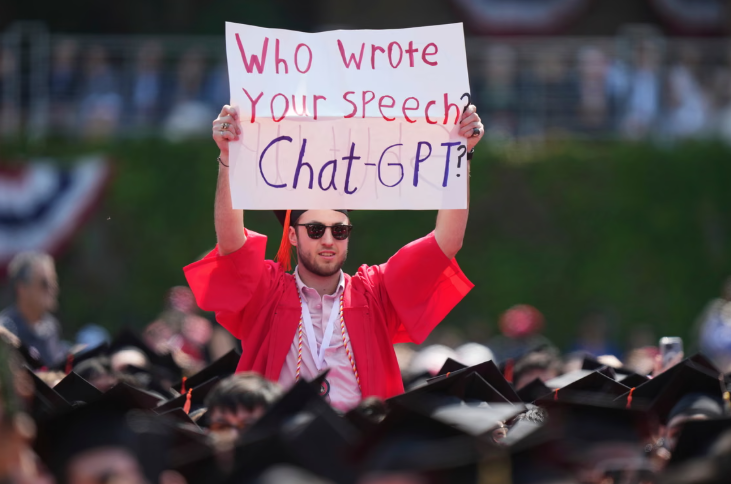
When Jacob Pagel graduated from Middle Tennessee State University this spring, predictions about artificial intelligence already had him questioning the value of his degree. Then a music executive started preaching about AI’s transformative power during a commencement speech. This industry will change on you in a heartbeat, it has already changed more in the last decade than in the fifty years prior, said Scott Borchetta, chief executive of the record label Big Machine. He noted that artificial intelligence is actively rewriting production as we sit here. After a few stray boos from graduates, he doubled down and told them to deal with it. The students’ jeering grew louder, but Borchetta barreled through his prepared remarks. You can hear me now or you can pay me later, then do something about it, he told the crowd. He called it a tool and told them to make it work for them. He then continued by telling them that the things they learned in their first year may already be obsolete.
Borchetta’s remarks were like a knife to the chest, says Pagel, who studied political science and human development family sciences. He felt the boos reflected how annoyed students were about what they saw as out-of-touch executives downplaying their anxieties about automation. A 2025 Harvard poll of young people in the United States found that a majority see artificial intelligence as a threat to their career prospects. Pagel and his peers are entering a job market where efficiency is already being used to justify mass layoffs. While it is unclear which jobs may be entirely replaced, and whether technology could eventually create more career pathways than it destroys, recent graduates are feeling deeply betrayed. We have been pushed our entire lives to get our diplomas, Pagel says. Then you pulled the rug out from underneath us, he adds. He notes that students spent four years learning specific things that executives now claim are no longer needed. We can get a computer to do it for two-thirds of the price, he laments.
Borchetta’s speech is one of several at commencement ceremonies this spring that have revealed a disconnect between the executives championing automation and students. This has elicited derision in real time even for Google’s former chief executive officer. Recent graduates at the University of Central Florida and the University of Arizona booed speakers who compared the advent of artificial intelligence to historical events. They compared it to the Industrial Revolution and the development of the laptop and smartphone. Sarah Kreps, a Cornell University professor who has studied societies’ reactions to new technology, offered her perspective on the current cultural climate. These tech executives are not reading the room, she says. These kids have spent hundreds of thousands of dollars on a degree that they do not know will serve them well, she notes. The students at these ceremonies are a mouthpiece for the population at large, Kreps adds.
While they may feel these disruptive effects acutely as entry-level job seekers, artificial intelligence has proved unpopular among the general public. A national survey conducted for NBC News earlier this year polled one thousand registered voters regarding their perspectives. It found only twenty-six percent view artificial intelligence positively and forty-six percent view it negatively. The technology scored worse than United States Immigration and Customs Enforcement, Donald Trump, and Kamala Harris on the same poll. However, it did score better than the Democratic party and the nation of Iran. Anger against automation is palpable across the country. This ranges from communities protesting against datacenters powering the tech boom, to workers disputing claims that computers can effectively replace them. Pagel is considering a career in helping children undergoing medical treatment, or entering politics. He might run for office, or work as a liaison for federal agencies. That sphere depends on human face-to-face interaction, he says. No computer can take that, he adds, calling AI-generated campaign ads the cheap route. Pagel is not an absolutist though. He does use Grammarly, he says, because he cannot spell. Dyslexia for the win, he adds.
Borchetta did not respond to a request for comment. But the university said in a statement that it understands and remains compassionate about students’ concerns and questions about technology affecting their careers. Chief executives’ graduation speeches about automation have become a preventable public relations disaster, according to Parry Headrick. Headrick is the founder of Crackle PR, a technology public relations agency that has worked with many startups. Executives should have acknowledged and reassured students’ anxieties, while also advising them to adapt. That is the nature of the speech, versus telling the kids to buckle up, he says. What in the heck is anybody who is young and in school supposed to do, Headrick asks. He wonders how they can listen to executives beating their chests about the next Industrial Revolution when they cannot afford groceries or rent. Nearly half of college students said their financial stress made it hard to concentrate on their coursework, according to a recent report from Trellis Strategies.
At the University of Arizona, twenty-year-old Arian Chavez was angry about his school’s decision to let former Google chief executive Eric Schmidt speak. Chavez, a junior studying chemical engineering, is part of a campus group called Students for Socialism. He helped them organize an online petition to remove Schmidt as a commencement speaker. Activists mainly took issue with sexual assault allegations against Schmidt from a former business partner. Schmidt has vehemently denied those allegations. Patricia Glaser, an attorney representing Schmidt, said in a statement that the claims are a desperate and destructive effort to publish false statements. She noted it was an attempt to escape accountability from an existing arbitration over a business dispute. In Schmidt’s graduation speech last week, he compared the rise of automation to the invention of the computer. There were already some boos as he began speaking, with a few students giving a thumbs down as the camera panned onto them.
Chavez, who was booing from the start, said some graduating students had their backs turned on Schmidt during the ceremony. He noted that others were confused by the initial jeers before Schmidt began talking about automation. But as his speech progressed, many more students joined the booing. I know what many of you are feeling about that, I can hear you, Schmidt said amid a chorus of boos. There is a fear in your generation that the future has already been written, he acknowledged. He noted their fears that machines are coming, jobs are evaporating, the climate is breaking, and politics is fractured. You are inheriting a mess that you did not create, and I understand that fear, he told the crowd. Schmidt’s reassurances did not win Chavez over. They are putting the wants and needs of billionaires over us, he says. He wished companies would use technology to make workers’ lives easier, instead of using it to extract more profit or replace them. It is up to us as engineering students to use our knowledge for the service of the planet, he says. Chavez wants to work in the environmental regulation of chemical plants. A representative for Schmidt said the former Google chief executive has tremendous respect for differences of opinion but believes the best way to address these challenges is to talk about them.
At Glendale Community College in Arizona, it was not a graduation speaker that drew students’ ire. Instead, it was the automated machine reading out their names. Turns out, it missed some. College president Tiffany Hernandez apologized and told graduates towards the end of the ceremony about the situation. Here is what is happening, we are using a new automated system as our reader, she said as boos roared through the arena. Hernandez paused for a few seconds and let out a few nervous laughs. That is a lesson learned from us, she admitted to the audience. Aidan Benjamin, who is graduating from Glendale Community College this summer with an associate’s degree in accounting, was at the ceremony to support his cousin. He thought she would be walking the stage. She never did, because the automated announcement system never called her name. I was booing because I was like, this sucks, Benjamin said. This is such a big moment for students, he noted. Benjamin said they both laughed about the malfunction afterwards. But it just did not feel good at the end of the day, he says. It should not have happened that way, he concludes.
Related News:
 UK Banks Granted Reprieve as BoE Delays Basel III Capital Rules Until 2028
 Singapore Corruption Scandal: Details Emerge on Iswaran’s Luxury Flight and Ties to Tycoon Ong Beng Seng
 Corfu Beyond the Crowds: Discovering Serenity in Southern Villages and Hidden Taverns
 Peter Andre Praises Son Junior’s ‘Quiet Season’ Amid Ongoing Family Dispute
 Massive 641-Mile Storm Set to Batter UK with 15 Hours of Rain and Strong Winds
 Jeremy Clarkson’s Pub: A Sunday Lunch Like No Other
 Scottish Government Mandates Single-Sex Toilets and Changing Facilities in Schools
 Reeves Faces Setback as Labour May Miss Homes Target
 Kate Winslet to Narrate Film Highlighting King’s Environmental Mission
 Trump’s UK Ambassador Urges North Sea Drilling to Strengthen US Ties
 Federal Immigration Shift: Officers Leave Louisiana for Minneapolis
 Fatal Bolton Taxi Crash Claims Three Teens and Driver
 Australia grants Asio powers to designate hate groups under new laws
 Friedman Uninvited From 2024 Adelaide Writers’ Week
 ScottishPower Tops List of Worst UK Energy Suppliers
 Judi Dench Champions Fight to Save London’s Green Spaces
 Crowborough Camp Welcomes First Asylum Seekers
 BBC Funding Crisis: Tim Davie Warns of Jeopardy Ahead
 ABC Facebook Page Briefly Hacked, Adult Photos Posted
 Artificial intelligence will cost jobs, admits Liz Kendall
 Older Women Vanish from BBC Screens, Review Confirms Bias
 Meta trial over child exploitation claims begins
 Streeting moves on doctor pay to end strike dispute
 Ben Stokes injury joke after brutal ball strike
 UK and US Drop in Global Corruption Index Rankings
 Send spending gap leaves deprived areas behind
 Hidden Crisis: Domestic Abuse Suicide Toll in UK
 UK Unemployment Rate Climbs to 5.2% Peak
 Canberra Poster Seizure Sparks Free Speech Row
 BBC World Cup Presenting Duties Shared Among Trio
 Wales Approves Assisted Dying Bill Consent
 CPS Updates Guidance on Honour-Based and Dowry Abuse
 Stewart Brand on Musk, Bezos and a Life of Long Thinking
 English Cricket Faces Moral Crisis Over Indian Investment
 Jacinda Ardern Move Sparks Kiwi Reflection
 Middle East Airspace Crisis Strands Thousands
 Kelly Wilkinson Inquest Reveals Bail Failure
 Asylum Seekers to Work After Year-Long Wait
 Princess Eugenie steps down as patron of anti-slavery charity
 New Zealand Covid Response Praised Despite Lingering Scars
 Injured Mojtaba Khamenei Elevated as Iran Leader
 The Kill Line: A Shifting Vision of the American Dream
 Inquiry into HMRC child benefit errors launched by NAO
 Family of Alleged Bondi Gunman Seeks Name Suppression
 Rising Costs Force Families to Rethink Days Out
 Air Canada CEO Faces Outcry Over Recent Language Misstep
 Extreme Weather: Europe Shivers as Cyclone Narelle Hits
 Scott Mills Sacked by BBC Over Personal Conduct Claims
 Palantir Boss Defends NHS Deal Amid Government Break Clause
 Asia Turns Back to Coal Amid Middle East Energy Crisis
 Relationship with Trump may be beyond repair, Starmer warned
 Trump’s Six-Week Iranian War: The High Cost of Ignorance
 US and Iran Agree to Two-Week Provisional Ceasefire
 Battle of Britain Tower to House Tourists and Bats
 The Challenger: Will Péter Magyar End the Orbán Era?
 UK Government Poised to Revive Stalled Hillsborough Law
 Democrats Move to Impeach Defense Secretary Pete Hegseth
 Security Alert Near Israeli Embassy as Police Investigate
 Ben Roberts-Smith Denies War Crime Allegations in First Statement
 Home Office Faces Legal Risks Over Asylum Hotel Living
 US-Iran Standoff: Will Trump Deploy Ground Troops?
 Crisis in NHS Surgery Scheduling Hits Patients Hard
 Investigation Into Anti-Trump Motives After Gala Shooting
 Dubai Assets Linked to Sudan’s RSF Militia Exposed
 Blue Badge Abuse: The Rising Tide of Public Hostility
 The Fear Gap: Why Europe Feels Less Safe Than It Is
 US Military Pacific Boat Strike Kills Three People
 Dettol Apologises for ‘Toxic Men’ Advert Backlash in China
 UK Care Crisis: Row Explodes Over New Visa Settlement Rules
 Sainsbury’s Boss Optimistic As Grocery Inflation Eases
 US Advance Past Bosnia in World Cup Thriller
 Trump’s Mount Rushmore Speech: A Divisive Anniversary
 Trump’s Red-Card Intervention Hurts the US World Cup
 US Airman Avoids British Court in Indecent Exposure Case
 Britain’s Mini Fan Craze Sparks Major Waste Crisis
 Trump Swaps Planes Amid Iran Tensions
 Ann Widdecombe, Formidable Political Figure, Dies at 78
 UK Schools Struggle as Classrooms Top 40C
 Yemen Accuses Iran of Violating National Sovereignty
 Houthis Strike Saudi Arabia as Middle East Tensions Rise