Published: 27 August 2026. The English Chronicle Desk. The English Chronicle Online
A catastrophic flash flood and mudslide along the Nepal-Tibet border has killed at least 270 people and left nearly 1,400 others missing, with a large proportion of those unaccounted for believed to be tourists and pilgrims.
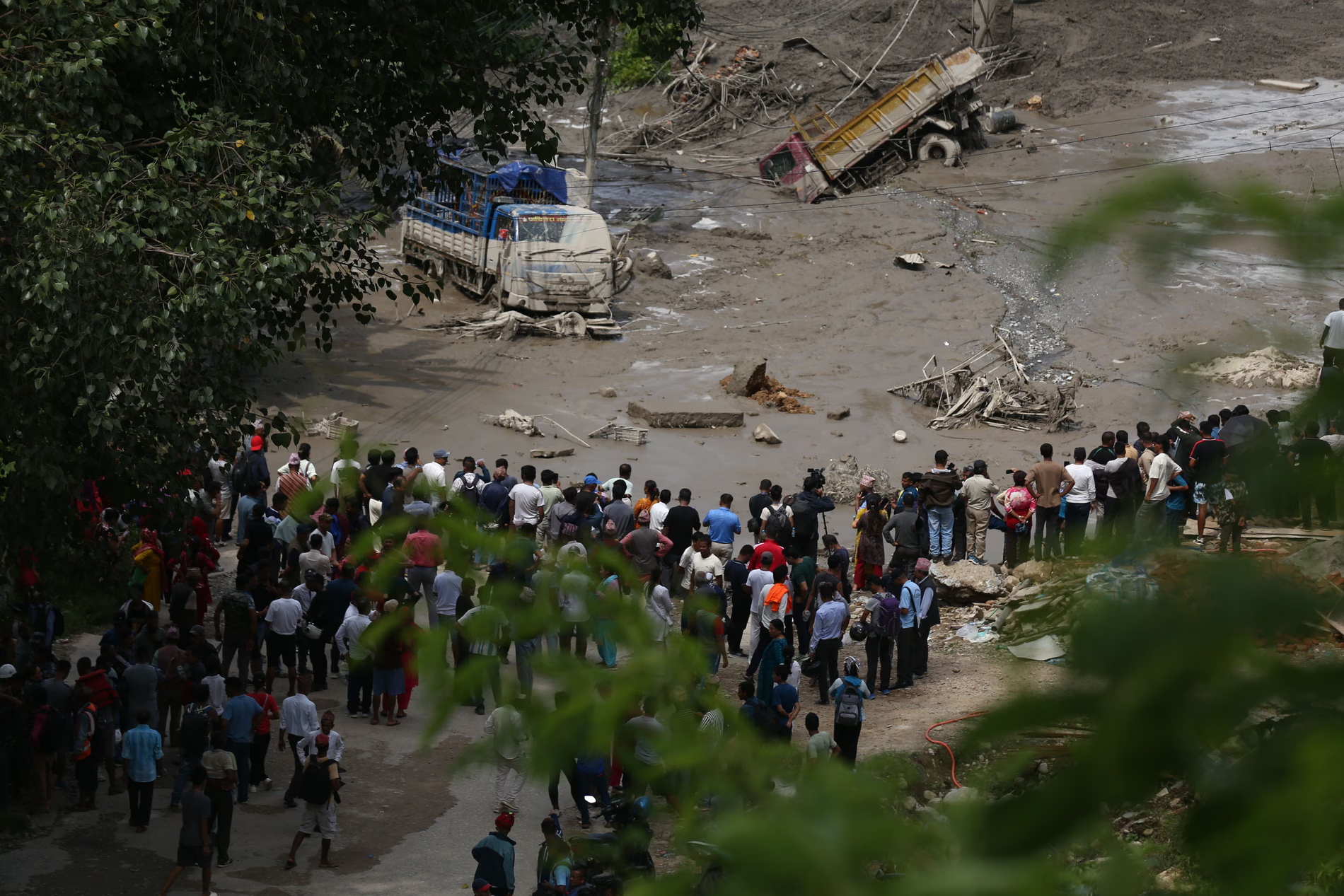
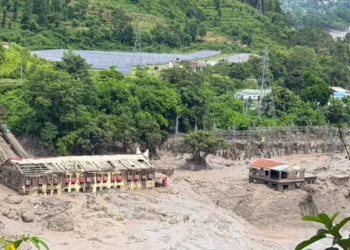
The disaster struck on Wednesday after a sudden collapse of ice and rock in the Himalayas sent an enormous surge of water, mud and debris down mountain valleys. Entire settlements were swept away, while roads, bridges, vehicles, homes and power infrastructure were destroyed across parts of northern Nepal and Tibet.
By Thursday, rescue teams were still struggling to reach many of the worst-affected areas because the disaster had severed vital transport links. Nepalese authorities reported that dozens of bridges and about 40km of roads had been damaged, leaving some communities isolated and making the search for survivors exceptionally difficult.

The scale of the missing-persons crisis has continued to change as officials receive information from remote communities and tourism operators. In Nepal alone, authorities reported 826 people missing, including 579 tourists. Of those tourists, 466 were foreign nationals.
Chinese state media separately reported 558 people missing on the Tibet side of the border, including about 260 foreign nationals. Taken together, the figures explain why the overall number of missing people has approached 1,400.
Among those unaccounted for are nationals from India, the United States, Australia, Britain, Canada and several other countries. The Nepal Tourism Board reported dozens of missing Indian, American, Australian, Ukrainian, British and Canadian tourists, while governments around the world have been trying to establish whether their citizens are safe.
Many of the missing were travelling through the Himalayan region for trekking, tourism or religious pilgrimages. The area is particularly important for pilgrims travelling towards Mount Kailash and Lake Manasarovar in Tibet, sites revered by Hindus, Buddhists and followers of other faiths.
The suddenness of the flood left people with almost no time to escape.
Videos recorded during the disaster showed an immense wall of water and debris moving through the border region as residents and travellers attempted to flee. Trucks were overturned, buildings disappeared beneath mud and water, and roads that normally connect Nepal with the Tibetan border were destroyed within minutes.
Survivors have described the torrent as resembling an earthquake because of the force and vibration produced by the rapidly moving mass of water, rock and ice.
Bibek Kumal, a labourer working downstream from the worst-hit Rasuwa district, said he began running when the flood arrived. He was swept downstream but survived by holding onto a mango tree.
The tree, he said, saved his life.
Another survivor, 68-year-old Keshav Prasad Baral, described watching a huge wall of mud approach his home. He tried to take his wife to safety, but she was swept away before they could reach higher ground.
His account illustrates the devastating human cost behind the rapidly rising death toll. Many families remain unable to establish what happened to relatives who were living or travelling in the affected valleys.
In Nepal’s Nuwakot and Dhading districts, people gathered outside a Nepalese Army training centre that has become a base for helicopter rescue operations. Relatives waited for information about missing family members while police recorded names.
With electricity disrupted by damage to hydroelectric infrastructure, some people used mobile phone torches as they waited through the night.
The village of Soley in Nuwakot, which was home to about 25 families, was reported to have been almost completely destroyed. The disaster has therefore left not only a search-and-rescue emergency but also an enormous challenge of determining who survived in communities where homes, records and communications infrastructure were swept away.
Nepalese security forces have mobilised helicopters to reach isolated areas. More than 100 people had been rescued by helicopter by Thursday morning, while other rescue teams were searching riverbanks and downstream areas for survivors and bodies.
The difficult terrain has significantly complicated the operation. Mountain valleys can be narrow and steep, while destroyed roads and bridges prevent conventional rescue vehicles from reaching many locations.
There is also concern that further rainfall could create additional hazards, including unstable slopes and potentially dangerous water accumulation upstream.
Authorities on the Tibetan side have mounted a major emergency response of their own. Chinese state media reported that hundreds of emergency workers, vehicles, rescue dogs and boats had been deployed. Chinese Premier Li Qiang travelled to the affected China-Nepal border area to oversee rescue efforts.
International assistance has also begun to emerge. The United Nations said its teams and partners were mobilising supplies and personnel to support affected communities, while the United States announced $500,000 in emergency assistance.
The disaster’s origins have become clearer since the first reports emerged.
Initial reports from Nepal suggested that an earthquake might have caused a section of glacier to collapse. However, the US Geological Survey subsequently clarified that the seismic signal initially interpreted as an earthquake was generated by the collapse of glacial rock and ice and the movement of debris.
In other words, there was no conventional earthquake behind the disaster.
Satellite imagery indicated that a landslide involving ice and rock triggered the debris-filled flood in the Lhende River, roughly 20km northeast of the Rasuwagadhi border crossing. The collapse sent a huge volume of material into the river, producing the devastating surge downstream.
The event has renewed concerns about climate-related hazards in the Himalayas. Scientists have warned that rising temperatures are changing mountain environments, accelerating glacier loss and increasing the potential for sudden ice, rock and water failures.
The Himalayas are particularly vulnerable because of their extreme topography. Large amounts of ice and rock can accumulate at high altitude, while steep valleys provide a natural channel through which water and debris can travel at extraordinary speeds.
Experts have increasingly warned that communities downstream from glaciers and unstable mountain slopes need better monitoring and early-warning systems.
The latest disaster also highlights the vulnerability of Nepal’s growing tourism industry. The affected region attracts international visitors because of its spectacular mountain landscapes, trekking routes and proximity to religious sites.
For tourism operators, the disaster has created a difficult situation in which passenger manifests and missing-person reports are being assembled while communication remains disrupted.
Himalayan Glacier, a tour company operating in the region, said 47 people from one of its groups were missing, including Australians, Canadians, Nepalis, Americans, Britons, Singaporeans and a dual Russian-American citizen.
The Australian government has said it is working to establish the status of its citizens, while families in several countries continue to wait for information.
The scale of the tragedy is likely to become clearer only as rescuers gain access to isolated areas and authorities reconcile overlapping lists of missing residents, workers and tourists.

For now, the priority remains finding survivors.
Helicopters are continuing to operate where weather and terrain permit, while ground teams search through mud, debris and damaged settlements. Downstream searches have also recovered bodies far from the original disaster zone, demonstrating how powerful the floodwaters were.
The tragedy has left entire communities facing the loss of homes, livelihoods and family members while governments confront one of the most challenging rescue operations in the region in years.
As the search continues, the Nepal-Tibet disaster is becoming both a humanitarian emergency and a warning about the growing risks faced by communities living beneath a rapidly changing Himalayan landscape.
The immediate task is to locate the missing and provide medical assistance to survivors. The longer-term challenge will be rebuilding roads, bridges, power infrastructure and communities while improving systems capable of warning people about sudden glacial collapses and floods.
For hundreds of families across Nepal and around the world, however, the most urgent concern remains much more personal: finding out whether their missing loved ones are alive.
Related News:
 Venezuela Quake Death Toll Surpasses 4,000
 Powerful 7.7-Magnitude Earthquake Hits Eastern Indonesia
 Nine Killed in Karachi Consulate Protest
 North Korea Fires Missiles Amid US-South Korea Drills
 Anti-Regime Iranians Turn Anger Toward Trump
 Southeast Asia Turns to Russia Amid Energy Crisis
 Escobar’s Hippos May Be Moved to India Zoo
 China Fireworks Factory Blast Kills 21 in Hunan
 Australia pushes Pacific security pact amid China tension
 BJP Sweeps West Bengal in Historic Breakthrough
 US Awaits Iran Reply on New Ceasefire Proposal
 One Nation Stuns Australia With Historic Farrer Win
 Hormuz Talks Near Critical Stage
 China mine blast death toll rises to 90
 Maldives Cave Diving Tragedy Raises Safety Alarm
 Discontent grows around Putin amid war strain
 Millions Gather for Khamenei’s Six-Day State Funeral
 Houthis Strike Saudi Arabia as Middle East Tensions Rise
 Wildfires Force Mass Evacuations in France And Spain
 Taliban global ties grow as rights fears mount
 Seoul proposes historic peace talks to replace Korean War armistice
 Israeli Strike in Southern Lebanon Kills Seven
 Five Years of Taliban Rule Leave Afghanistan in Crisis
 Wildfires rage across Europe as hundreds arrested in France
 Vietnam Youth Rally Behind Hanoi ‘Justice Tree’
 China Probes Alleged Formaldehyde Use on Cabbages
 Shein targets $27bn valuation in Hong Kong debut
 Heavy Casualties Feared as Flash Flood Sweeps Nepal-Tibet Border
 UK Must Act with Courage and Clarity on Israel-Palestine Conflict, Says Foreign Affairs Committee Report
 Tottenham Takes On Newcastle
 Radioactive Leak at UK’s Nuclear Warhead Base Sparks Outcry Over Safety and Secrecy
 Terence Stamp, ’60s British Film Legend and Star of Superman, Dies at 87
 Hong Kong Summons UK and Australian Envoys Following Asylum Grants to Democracy Activists
 Is the UK Ready to Put Boots on the Ground in Ukraine? Assessing Military Capacity and Challenges
 Channel Crossings Surge: Over 1,000 People Arrive in the UK in Small Boats in a Single Day
 Yvette Cooper Signals Global Momentum Towards Gaza Peace Deal Amid Humanitarian Crisis
 Chaos at Ibrox as Martin’s Rangers Era Comes to an End
 Russia’s Latest Push to Win US Favors Shows Deep Desperation
 BBC to Apologise Over Edited Trump Speech Amid Backlash
 Greene Pushes Epstein Files Amid Trump Fallout
 Zelenskyy Signs Fighter Jet Deal Amid Russian Drone Attacks
 Shadow Fleet at Sea: Europe’s Battle Against Illicit Oil Shipping
 US Suspends Afghan Immigration After White House Shooting
 ‘Extinct’ Antelope Returns to Sahara, Bringing Hope
 Irish Beach Tragedy: Irish Drown at Whitehaven Beach in Australia
 Sanctioned oil tankers sail Channel amid Russia scrutiny
 Greenland Crisis Forces Europe to Draw a Line With Trump
 South Korea Jails Ex-President in Martial Law Ruling
 Pentagon Signals Reduced Role in Deterring North Korea
 UK and US Drop in Global Corruption Index Rankings
 SA Police Intensify Search in Gus Lamont Case
 Canberra Poster Seizure Sparks Free Speech Row
 Evo Morales Returns After Mysterious Absence
 Jacinda Ardern Moves To Australia Following Her US Fellowships
 Jacinda Ardern Move Sparks Kiwi Reflection
 Middle East Airspace Crisis Strands Thousands
 Nick Greiner Warns Over Election Review Fallout
 Kelly Wilkinson Inquest Reveals Bail Failure
 Tehran Strikes Mark War’s Most Devastating Night
 Injured Mojtaba Khamenei Elevated as Iran Leader
 Gordon Brown urges court for crimes against children
 The Kill Line: A Shifting Vision of the American Dream
 Pakistan Targets Militant Hideouts in Afghanistan
 ICE detention warning sparks fear among immigrants
 Air Canada CEO Faces Outcry Over Recent Language Misstep
 Extreme Weather: Europe Shivers as Cyclone Narelle Hits
 Asia Turns Back to Coal Amid Middle East Energy Crisis
 Relationship with Trump may be beyond repair, Starmer warned
 Trump’s Six-Week Iranian War: The High Cost of Ignorance
 Ben Roberts-Smith Denies War Crime Allegations in First Statement
 RFU Backs Borthwick Despite England’s Poor Six Nations
 Trump Rejects Tehran Peace Plan as Regional Truce Crumbles
 Trump Sends 5,000 More US Troops to Poland
 NDIS Overhaul Sparks Intense Clash Across Australia
 Britain’s Crowning Butterfly Takes the Nation by Storm
 Fifa Official Under Investigation Over Hand Gesture Controversy
 Grief and Devotion Amidst the Rubble of Nabatieh
 Canada Secure Historic Last 16 Spot with Late Goal
 England and Norway Fans Turn Miami Into World Cup Carnival
 Olympus Awaits Unesco Heritage Recognition