Published: 22 May 2026. The English Chronicle Desk. The English Chronicle Online.
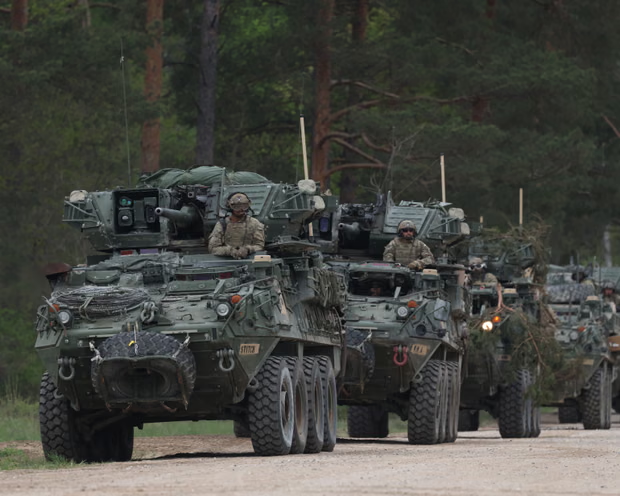
The global security landscape experienced a significant shift late yesterday evening as United States President Donald Trump announced a major expansion of American military presence on the eastern flank of Europe. In a move that caught international diplomats by surprise, the American leader pledged to deploy an additional five thousand military personnel to Polish territory. This abrupt announcement has sent ripples across western capitals because it represents a dramatic reversal of standard defense policy established by the American government just days ago. The sudden policy shift has reignited intense debate regarding the consistency of American strategic planning within the North Atlantic Treaty Organisation framework.
This sweeping military declaration was delivered through a public statement on the social media network Truth Social where the American president linked the decision directly to foreign political developments. Trump explicitly stated that the deployment was a reward for the recent democratic success of the newly elected conservative president of Poland. The American leader noted that his personal endorsement of the new head of state had fostered a deep bond which directly influenced this massive troop commitment. Observers note that this highly personal approach to international defense agreements highlights the unconventional foreign policy methods favoured by the current Washington administration.
Military analysts are currently working to understand the exact logistical parameters of this newly proposed detachment of American forces. It remains completely unclear whether these five thousand incoming soldiers will be stationed on a permanent basis or if they will form part of a temporary rotational framework. Furthermore, defense experts are questioning whether this deployment is tied to previous executive orders which removed an identical number of personnel from bases inside Germany. The introduction of these forces will dramatically alter the regional security equation considering that approximately ten thousand American troops are already stationed across various installations in Poland.
The unexpected decree represents a remarkable turnaround from the strategic directives issued by the Pentagon earlier during the week. Military officials had previously announced a controversial freeze on a long-planned rotation of four thousand soldiers from an elite armoured brigade combat team. That initial decision to delay the arrival of the first cavalry division was presented as an essential component of a comprehensive reassessment of global defense commitments. The sudden cancellation of that delay has exposed deep coordination issues between the civilian leadership in the White House and senior military planners working within the defense establishment.
Before this dramatic reversal occurred, high-ranking members of the American administration had spent days vigorously defending the original decision to freeze troop movements. Vice President JD Vance had publicly dismissed international concern over the delay by characterizing the situation as a minor administrative matter. Speaking to European journalists, the vice president emphasized that western European nations must take greater individual responsibility for their own collective defense infrastructure. Vance argued that the Warsaw government possessed ample domestic capability to secure its borders provided it maintained basic logistics support from Washington.
However, that initial decision to halt the deployment caused immediate and profound anxiety throughout the political corridors of eastern Europe. Senior leadership in Warsaw expressed deep concern that a reduced American presence would leave the region highly vulnerable to regional aggression. The ongoing conflict in neighbouring Ukraine has heightened local sensitivities regarding any perceived reduction in western security guarantees along the sensitive border zone. The apparent lack of prior consultation before the original freeze also drew sharp condemnation from prominent lawmakers within the United States Congress.
The timing of this dramatic policy shift has placed intense pressure on diplomatic delegations currently gathering for crucial security talks. US Secretary of State Marco Rubio is scheduled to attend a pivotal ministerial gathering involving major western allies in Sweden. The international conference follows several weeks of exceptionally high diplomatic tension stemming from disagreements over separate military operations in the Middle East. European leaders have consistently resisted pressure to become directly entangled in the expanding conflict involving Iranian forces, creating a notable rift within the historic trans-Atlantic partnership.
Shortly before boarding his flight to Scandinavia, the chief American diplomat expressed deep frustration regarding the current level of cooperation from European partners. Rubio stated that the president felt deeply let down by specific alliance members who refused to grant landing rights for ongoing military campaigns. The secretary of state explicitly criticized the government of Spain for denying the American military access to strategic airbases located on its territory. Rubio questioned why nations should enjoy the collective security guarantees of mutual defense if they refuse to cooperate during active international crises.
The contentious rhetoric from the State Department reflects a broader pattern of dissatisfaction with traditional alliances expressed by the current White House. Trump has frequently accused international partners of failing to meet financial targets while relying heavily on American taxpayers for their national defense. The American leader has privately suggested that the United States might consider a formal withdrawal from mutual assistance treaties if contributions do not increase. These warnings have created a climate of deep uncertainty regarding the long-term viability of historic security pacts that have anchored western stability for generations.
Despite these overarching tensions, representatives from the central alliance have emphasized that European members were never formally requested to participate in the Middle Eastern campaign. Officials noted that the vast majority of member states have faithfully fulfilled their structural obligations by permitting the utilization of sovereign airspace. However, European confidence was further shaken earlier this year by an unexpected American diplomatic initiative to purchase the vast territory of Greenland. The aggressive pursuit of land belonging to a fellow member state created widespread unease regarding the administration’s respect for national sovereignty.
Throughout these shifting diplomatic currents, Poland has consistently sought to distinguish itself as the most reliable and dedicated American partner in continental Europe. The eastern European nation previously deployed its own military forces to support complex international stabilization campaigns in both Iraq and Afghanistan. Furthermore, Warsaw currently leads the entire alliance in terms of domestic defense spending relative to gross domestic product, far outperforming wealthier western European capitals. This substantial financial commitment to military modernization has earned the country unique praise from across the political spectrum in Washington.
The close alignment between the two nations has been significantly reinforced by the warm personal relationship developing between their respective heads of state. The newly inaugurated Polish leader secured an unexpected electoral victory last year following a high-profile reception at the White House during his campaign. Trump has repeatedly reminded public audiences of the pivotal role his personal endorsement played in securing that historic domestic political triumph. This close ideological connection appears to have created a direct pipeline of communication that bypasses traditional bureaucratic channels within the state department.
The official response from the Polish capital was immediate and overwhelmingly positive despite the late hour at which the troop deployment was made public. The president expressed profound gratitude for the enduring friendship shown by the American administration, noting that the practical benefits were now undeniably clear. The head of state pledged to remain a steadfast guardian of the bilateral alliance, describing it as an essential pillar of safety for local households. Similarly, the defense ministry welcomed the decision as definitive proof that the security partnership remains unbreakable in the face of shifting global challenges.
Related News:
 Capitol Attack Anniversary Sparks Deep Political Divide
 Saudi Officials Report Zubaidi Flee Before Yemen Peace Talks
 UK Targets in New York Bomb Threat Hoax: Man Jailed
 Gambia Supreme Court Hears Case to Overturn FGM Ban
 Trump targets Iran trade with 25% tariff warning
 US Senate rejects resolution limiting Trump military powers
 Gulf states warn Trump Iran strikes risk wider Middle East war
 Machado Trump medal gesture reshapes Venezuela power struggle
 Geopolitical football: Iran, Trump and the World Cup clash
 Canada-China trade gains momentum in new strategic partnership
 Syria President Declares Victory as Ceasefire Reached with SDF
 Shinzo Abe’s killer receives life sentence in Japan
 China General Under Investigation Amid Leadership Purge
 Philippines ferry disaster leaves 15 dead, dozens missing
 Cambridge Faces Scrutiny Over Arms Investment Transparency
 Epstein UAE Emails Shake British Royal Andrew’s Legacy
 Christchurch gunman seeks to vacate guilty plea
 Concerns rise for Canberra boy amid Iran detention fears
 Ukraine Sends Drone Experts to Defend US Bases in Jordan
 Abramovich Chelsea Sale Cash Faces Jersey Probe
 Yvette Cooper: UK Must Follow Principles, Not US Pressure
 Jury Rules Meta and YouTube Liable for Addictive Design
 Saudi Arabia Urging US to Keep Up Iran Attacks
 The Woman Guarding Earth From the Threat of Asteroids
 IMF Predicts Global Economic Crisis Due to Gulf Unrest
 Germany Grapples With AI Abuse Following TV Star Scandal
 Exiled Tycoon Warns of New Russian Attacks on UK Soil
 LA 2028: Millions of Affordable Olympic Tickets Announced
 Trump Slams Europe as Transatlantic Tensions Boil Over
 Inside the Deceptive Machine: A Former Producer Speaks Out
 Spain Faces Backlash Over Xenophobic Chants in Egypt Draw
 A Global Voice For Justice: Stephen Lewis Dies At Age 88
 Hope and Fear as Iranians Flee Across the Turkish Border
 Reform UK Pledges To Halt Visas Over Reparations Demands
 US and Iran Agree to Two-Week Provisional Ceasefire
 Starmer visits Gulf as US and Iran agree ceasefire
 Gaza Child Arrives in UK for Life-Changing Care
 Pakistan Brokers Historic Peace Deal Amid Rising Tensions
 UK Holds Firm on Strait of Hormuz Amid Trump Pressure
 Trump Signals Hope for New Iran Talks as Ceasefire Fades
 Reeves Slams Trump Over Iran War Lack Of Exit Plan
 US and Iran Pursue Extension of Ceasefire via Pakistan
 Trump’s Islamabad Gamble: The High Stakes of a New Iran Deal
 Ian Katz to Step Down as Channel 4 Content Chief
 The General’s Gambit: Pakistan’s New Role in Global Peace
 Mexico, Spain and Brazil call for Cuba dialogue amid crisis
 Pakistan’s Ambitious Bid for Middle East Peace
 Israeli Soldiers Jailed Over Vandalism of Lebanese Statue
 Trump Weighs Sending Afghan Allies to the Congo
 Pentagon Shakes Up Navy Leadership Amid Hormuz Blockade
 Trump Threatens UK With Big Tariff Over Tech Tax
 Prominent Voices Challenge Palestine Action Ban
 Security Scrutiny After Washington Shooting Incident
 Merz Criticises US Approach in Iran Conflict
 UK Envoy Sparks Controversy Over Special Relationship Claims
 Ukraine Urges UK to Seize Russian Oil Tankers
 US Calls Australia Media Law “Foreign Extortion”
 The Billionaire’s Secretary and the £1m Fraud
 Ukraine strikes Tuapse as oil disaster worsens
 Brewing Tension: Taiwan Baristas Rebrand for World Stage
 Tensions Emerge in Netanyahu-Trump Alliance
 Mission to the World’s Edge: A Heroic Rescue in Tristan
 US and Mexico Face Heatwave as Floods Batter South Africa
 Mexico’s Missing: State Complicity in a Growing Crisis
 French Patient Told Hantavirus Was Just Anxiety
 The Long Way Home: Australia’s High-Stakes Virus Mission
 Putin Signals War End as Russian Momentum Stalls
 Romania’s Judicial Crisis: A System Under Siege
 Lee Lai Makes History with Landmark Stella Prize Victory
 Philippine Senator Flees After Days Under Senate Siege
 Alberta Separatist Bid Blocked by Canadian Court
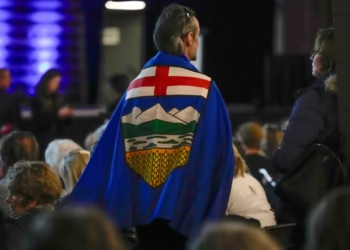 Canadian Court Blocks Alberta Independence Referendum Bid
 Big Tobacco Under Fire Over Controversial New Ad Campaign
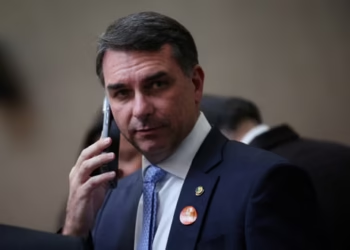 Bolsonaro Son Tape Scandal Sparks Massive Brazil Backlash
 Court Upholds Landmark Win for Transgender Rights
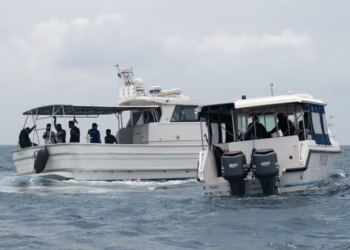 Tragedy in the Maldives: Inside the Deep Sea Rescue
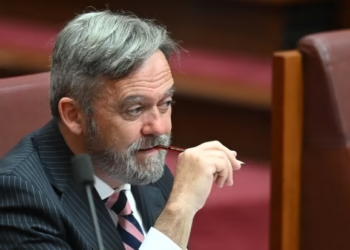 Liberal Senator Criticises Immigration Rhetoric
 Senate Moves to Restrict Trump’s War Powers on Iran
 ICC Arrest Warrant Threat Sparks West Bank Retaliation
 Uefa Transforms Men’s Major Tournament Qualification