Published: 15 September 2026. The English Chronicle Desk. The English Chronicle Online.
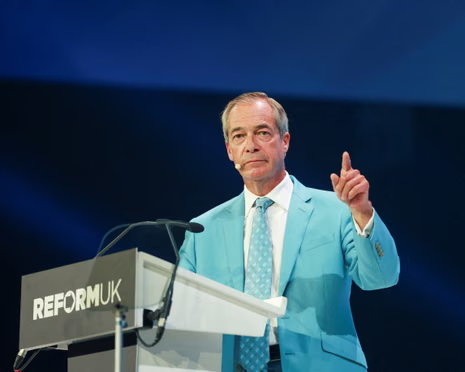
Reform UK leader Nigel Farage has warned that a future Reform UK government could move to prevent trade unions from financially supporting the Labour Party if proposed legislation blocks £72 million in donations announced for Reform UK.
Farage’s warning has intensified an increasingly heated dispute over political party financing in Britain, with the government considering tighter restrictions on large political donations. The controversy centres on substantial sums pledged to Reform UK by wealthy donors and the question of whether existing or proposed rules should limit the influence of large individual contributions on British politics.
The Reform UK leader has criticised proposed changes to political donation laws as unfair, particularly because the legislation is expected to apply retrospectively to donations dating from March 2026. Ministers believe the changes could prevent some or all of the £72 million in donations recently announced for Reform UK from being accepted under the new rules.
The government is also considering further amendments as the Representation of the People Bill progresses through the House of Lords. These amendments could impose additional restrictions on political donations and potentially determine whether some of the money pledged to Reform UK can legally reach the party.

Farage has responded forcefully, arguing that the proposed approach unfairly targets Reform UK and its donors. In an article published in the Daily Telegraph, he warned that if a future Reform government were elected after Labour restricted Reform’s funding, it would be prepared to introduce restrictions on trade union funding to Labour.
His threat marks a significant escalation in the debate surrounding political donations. Trade unions have traditionally been among Labour’s most important financial supporters, while Reform UK has increasingly attracted substantial backing from wealthy private donors.
Farage specifically pointed to Unite, saying the union had provided Labour with more than £50 million over recent years. He linked trade union donations to Labour with the party’s employment policies, including the Employment Rights Act and pay increases for bus drivers, arguing that unions also contribute financially with political objectives in mind.
The Reform leader said he did not want to introduce restrictions on union funding but warned that his party would be prepared to do so if the government proceeded with measures that prevented Reform’s donors from contributing.
The dispute has also brought attention to two prominent donors, Ben Delo and Christopher Harborne. Farage sought to distance Reform from suggestions that wealthy donors could receive political rewards in exchange for financial support. He said neither donor would receive a seat in the House of Lords, government favours or influence over policy.
Farage presented the issue as part of a broader argument that political parties should not be controlled by wealthy individuals or powerful organisations. He claimed Reform would operate differently from what he described as the established political parties.
The controversy has also prompted renewed debate within the trade union movement. Unions had previously opposed proposals to place tighter caps on individual political donations because of concerns that a future Conservative or rightwing government could use similar restrictions to limit the amount unions could give Labour.
However, the arrival of the £72 million donation controversy has reportedly caused some unions to reconsider their position. Union leaders were expected to address the issue publicly as the debate over political funding intensified.
The central disagreement is partly about whether large union contributions and large individual donations should be treated in the same way. Government ministers have rejected the comparison.
Jonathan Reynolds, the business secretary, argued that union donations to Labour should not be regarded as equivalent to very large contributions from individual billionaires or cryptocurrency entrepreneurs supporting Reform UK.
Speaking to Times Radio, Reynolds said union political donations represented the combined contributions of large numbers of ordinary workers. He emphasised that members could opt out of political funds and that trade unions were subject to rules governing political ballots and political funding.
His argument was that a union contribution should be viewed as money gathered through a voluntary system involving many members rather than as a single wealthy individual’s decision to provide millions of pounds to a political party.
The dispute therefore raises a wider question about how Britain should regulate political finance. Supporters of donation limits argue that extremely wealthy individuals should not be able to gain disproportionate influence over political parties simply because they have access to large amounts of money. Critics, including Reform UK, argue that retrospective restrictions risk undermining legitimate political participation and could unfairly target particular parties or donors.
The proposed legislation has become particularly contentious because ministers are considering rules that could apply from March 2026, rather than from the date on which the final legislation receives Royal Assent. That retrospective element is one of the main reasons Farage has described the proposed restrictions as unfair.
The issue is likely to remain politically sensitive as the bill moves through Parliament. Any changes affecting donations to Reform UK could have consequences for the party’s finances and its ability to compete with Labour and other established parties in future elections.
At the same time, the prospect of restricting trade union funding could create another major political confrontation. Labour has longstanding financial links with the trade union movement, and unions remain an important source of political support for the party.
Farage’s comments therefore amount to more than a criticism of proposed legislation. They represent a warning that attempts to restrict Reform UK’s access to major private donations could trigger reciprocal action against one of Labour’s traditional sources of funding if Reform eventually enters government.
The controversy comes as ministers and opposition parties face several other major political issues. First Secretary of State Louise Haigh was due to chair a political cabinet meeting and later address the Trades Union Congress, standing in for Greater Manchester mayor Andy Burnham following the death of his father.
Haigh was also expected to speak about artificial intelligence, with ministers being urged to take warnings from technology experts seriously while seeking to expand the UK’s role in the rapidly developing AI sector.
Elsewhere in Westminster, Justice Secretary Alex Norris was scheduled to face questions in the House of Commons, while Home Secretary Shabana Mahmood was due to appear before the Commons Home Affairs Committee.
Health Secretary Yvette Cooper was also expected to make a statement in Parliament following publication of an inquiry report concerning how nurse Lucy Letby was able to repeatedly kill babies at the Countess of Chester Hospital.
The day’s political agenda also included the publication of government figures concerning Personal Independence Payment claims and Universal Credit health claims.
Outside Westminster, residents of Piddlington, a small village in Oxfordshire, were holding a symbolic independence referendum in protest against plans to accommodate more than 1,000 asylum seekers at a nearby former military site. The event reflects the continuing political sensitivity surrounding migration and asylum policy in parts of England.

However, the dispute over political funding remains one of the most consequential issues for the future relationship between Reform UK, Labour and Britain’s established political financing system.
The £72 million in proposed Reform donations has placed the question of wealthy political donors at the centre of national debate. Whether Parliament ultimately permits the donations, restricts them or introduces a new framework for political contributions could have implications well beyond Reform UK.
For Labour, any attempt to restrict trade union funding could have significant consequences for one of its traditional financial relationships. For Reform UK, the issue is becoming a test of whether the party can secure major private financial backing under a changing regulatory framework.
As the legislation progresses through Parliament, the dispute is likely to remain a major dividing line between the government and Reform UK. Farage’s warning has also ensured that the consequences of the proposed restrictions will be framed not simply as a question about Reform’s donors, but as a wider battle over the future rules governing political money in Britain.
Related News:
 Reform Faces Questions Over £72m Donations
 UK Retailers Accused of Breaking Refund Laws
 David Lammy Faces Possible Legal Challenge Over Foreign Office Secondment Scheme
 Lucy Powell urged ministers to reconsider costly legal case for Labour donor’s firm
 Tories Push to Dilute Labour’s Workers’ Rights Bill
 BBC News Faces Deep Cuts in 2,000 Job Plan
 City & Guilds Faces Governance Crisis Over Sale
 Reeves Fights to Keep Treasury Role Amid Labour Turmoil
 Trump Refuses to Sign Housing Bill, But Law Takes Effect
 Unions Warn Labour Over Zero-Hours Contract Reforms
 Pubs and Hotels Face Business Rates Reform Review
 Burnham Faces Mounting Budget Challenges
 Reform Faces Fresh Financial Controversy
 Ukraine Moves to Seize Water Company
 Spire Healthcare Agrees £1bn Takeover by Toscafund
 Billionaire Chris Rokos poised to leave UK
 UK plans tougher Israel stance with settlement trade ban
 Oil nears $100 as Saudi attacks shake markets
 JPMorgan Boss Warns Against UK Bank Tax Rise
 John Lewis Losses Widen to £124m as Confidence Falls
 Reform UK Receives Record £36m Donation From Crypto Billionaire
 Thames Water Revises Oxfordshire Mega-Reservoir Plan
 Tasers Introduced in UK Prisons to Combat Rising Violence and Protect Staff
 Supreme Court Ruling on Car Finance Scandal Poised to Impact Millions of Motorists and Banks
 Police Advised to Disclose Ethnicity of Suspects in High-Profile Cases
 Chancellor Rachel Reeves Pushes for Sweeping Changes to Environmental Protections to Accelerate Development
 Angela Rayner Faces Scrutiny as Stamp Duty Row Deepens
 Tanni Grey-Thompson Faces Abuse Over Opposition to Assisted Dying Bill
 First “One In, One Out” Deportation Flight Departs Without Migrants Amid Legal Challenges
 Corbyn and Sultana Clash Over Membership Portal as Divisions Surface in New Leftwing Party
 Mahmood Pledges Reform of Modern Slavery Laws After Court Blocks Deportation Appeal
 Migrants in UK May Need to Contribute or Face Removal, Home Secretary Signals
 Jailed Georgian Opposition Leaders Warn UK of Iranian Links to Ruling Party
 Senior Tories Condemn Badenoch’s Vow to Repeal Climate Change Act as Catastrophic
 Digital ID Plans Ignite Debate Over £600m Treasury Tax Boost and Privacy Concerns
 Kemi Badenoch Unveils ‘Golden Rule’ to Halve Spending Cuts for Deficit Reduction at Tory Conference
 Johnson Approved China’s London ‘Super-Embassy’ in 2018
 Trump’s UK Ambassador Urges North Sea Drilling to Strengthen US Ties
 French Taxi Driver Cleared in David Lammy Theft Case After Fare Dispute
 MPs Press Rachel Reeves to Hike Gambling Taxes
 Millionaires group urge Reeves to introduce wealth tax to ‘lift kids out of poverty’
 Major Rent Reform Ends No-Fault Evictions in England
 Peers Flood Assisted Dying Bill with 942 Amendments
 UK Asylum Overhaul Sparks Debate Over Human Rights and Deportations
 Mahmood Defends Tough Overhaul of UK Asylum System
 PM Highlights UK Business at G20 in South Africa
 Peers Get Extra Time to Debate Assisted Dying Bill
 Starmer Says Labour’s Economic Plan Needs Years to Deliver
 Virgin Media Fined £23.8m Over Telecare Safety Failures
 UK Government Borrowing Drops to £11.6bn in December
 Tim Walz urges Trump to withdraw federal agents immediately
 Alarm Over Chinese CCTV Guarding Magna Carta Site
 UK and EU Signal Fresh Push for Defence Cooperation Talks
 UK shelves £110m border project amid trade strain
 Civil Service Pay: Union Urges Ministers to End ‘Barking Mad’ Limits
 Reeves Must Back Defence Plan or Face Dismissal, Says Unite Chief
 OBR Reform Row Deepens Before Spring Forecast
 Proposed Law Leaves Gap for Children of Convicted Paedophiles
 Farage Faces Backlash Over Crypto Cameo Endorsements
 UK Doubles Steel Tariffs to 50% to Protect Domestic Plants
 Student Loan Interest May Rise Despite 6% Cap
 City & Guilds Sale Sparks Fees and Pay Uproar
 Crackdown Backfires on UK Climate Protesters
 Millions Face Food Poverty as Consumer Confidence Hits Record Low
 Silent Tracks: Rail Line Without Passengers
 UK Inflation and Global Conflict Drive Up April Borrowing
 UK Urged to Build EU Rejoin Consensus, Says Miliband
 Nationwide Faces Governance Scrutiny Ahead of AGM
 Hungary Targets Oligarchs with Proposed Landmark Wealth Tax
 Andy Burnham Enlists Economic Heavyweights for Leadership Bid
 Burnham unveils £65m drought aid for farmers
 UK Risks Falling Behind in AI Race
 UK Subsidence Claims Surge After Record-Breaking Summer
 UK Cost Squeeze Deepens as Mortgages and Gas Rise
 Swedish Mining Push Puts Sami Land Rights Under Pressure
 Councils spend £125m on illegal children’s care
 Trump gives $45,000 holiday gifts to White House aides
 McLaren to Create 1,000 UK Jobs in £450m Investment
 Nats Boss Summoned as UK Flight Chaos Continues
 Iceland to Open First UK High Street Store in Falklands