Published: 11 August 2026 | The English Chronicle Desk | The English Chronicle Online
Ukrainian President Volodymyr Zelenskyy has accused Russia of using North Korean ballistic missiles during a deadly overnight wave of attacks on Ukraine, as Moscow continues to expand its long-range aerial campaign and Kyiv warns that North Korea is providing Russia with additional military support.
The strikes killed at least nine civilians across Ukraine, including six people in the southeastern city of Zaporizhzhia and three in the Dnipropetrovsk region, according to Ukrainian officials. Dozens of people were also reported injured.
Zelenskyy said the attack on Zaporizhzhia involved what he described as North Korean ballistic missiles alongside other Russian weapons, including Zircon missiles and guided aerial bombs. Ukrainian authorities said six people were killed and about 20 others wounded in the city.
The claim comes amid growing evidence and repeated Ukrainian allegations that North Korea has become an increasingly important military supplier to Moscow. Russia has previously been accused by Ukraine and Western governments of using North Korean ballistic missiles against Ukrainian targets, while Pyongyang has deepened its military relationship with Moscow.
The latest allegations have added another dimension to the war, highlighting how the conflict is increasingly dependent on weapons and military resources supplied by countries aligned with Russia.
Russia’s Defence Ministry gave a different account of the overnight operation. It said its forces had targeted military-related facilities, including logistics centres in Kyiv and a major steel plant in Zaporizhzhia. Moscow said the targets were connected to Ukraine’s military production and logistics networks.
Both sides have repeatedly denied deliberately targeting civilians.
The Russian ministry said its forces struck logistics facilities in Kyiv, including locations it claimed were being used to store components for drones, robotic systems and electronic warfare equipment. In Zaporizhzhia, it said the Zaporizhstal steelworks was targeted because of its alleged role in supplying materials for military purposes.
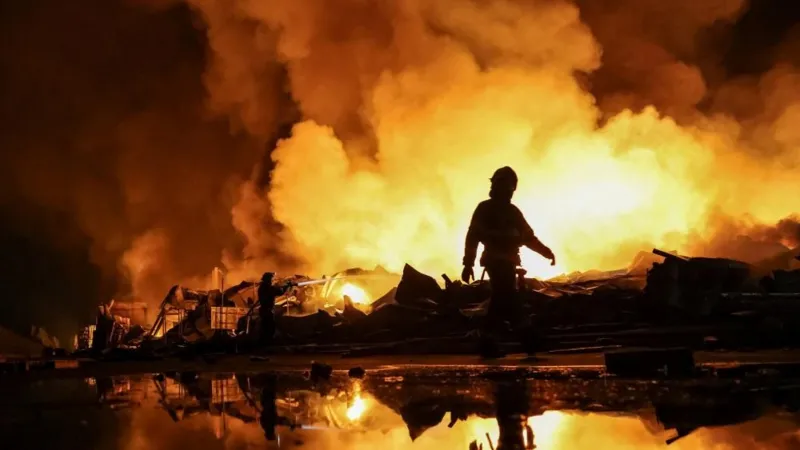
Ukrainian officials, however, reported damage and casualties in several areas, with fires breaking out in Kyiv and other locations.
The scale of the latest aerial assault also reflects the continuing intensity of Russia’s campaign against Ukraine. Ukrainian officials said the overnight barrage involved large numbers of drones and several types of missiles, while Russia said it had intercepted or destroyed hundreds of Ukrainian drones launched against Russian territory.
The exchange illustrates the increasingly reciprocal nature of long-range warfare. Russia continues to use missiles, drones and glide bombs against Ukrainian cities and infrastructure, while Ukraine has intensified its own drone operations against Russian military, industrial, logistics and energy targets.
For Ukraine, the alleged use of North Korean missiles is particularly significant because ballistic missiles are difficult to intercept and can place additional pressure on an already stretched air-defence system.
Ukraine has repeatedly appealed to Western allies for additional air-defence systems and interceptor missiles, particularly Patriot systems capable of countering some ballistic threats.
Zelenskyy has warned that shortages of interceptors could make Ukrainian cities more vulnerable as Russia increases the scale and complexity of its attacks.
The reported involvement of North Korean weapons also raises questions about the extent of military cooperation between Moscow and Pyongyang.
North Korea has supplied Russia with ballistic missiles and other military equipment, according to Ukrainian and Western assessments. Earlier this year, Kyiv said Russia could be preparing to receive further North Korean assistance, including additional personnel.
Zelenskyy has also claimed that Russia is preparing to involve tens of thousands of additional North Koreans in activities on Russian territory. Ukrainian officials have described the potential deployment as part of a broader military partnership between Moscow and Pyongyang.
The two countries have significantly strengthened their relationship since Russia launched its full-scale invasion of Ukraine in 2022.
North Korean ballistic missiles were previously identified among weapons used by Russia during the war. Investigations of missile debris recovered in Ukraine have linked some Russian attacks to North Korean-designed Hwasong-11-series missiles. International investigations have also examined the components and manufacturing characteristics of the weapons.
The latest allegations therefore come against an established background of reported North Korean military assistance to Russia, although individual battlefield claims can be difficult to independently verify immediately after an attack.
Zelenskyy’s office has said that preliminary evidence from recent attacks has pointed towards North Korean missile use. Ukrainian officials have previously stressed that technical examinations of missile fragments are required before conclusions can be confirmed. In a separate July case, Zelenskyy said preliminary information indicated that Russia had used a North Korean ballistic missile in a strike that killed members of a Ukrainian family. Further examination was expected to verify the weapon’s origin.
The continuing use of such weapons would have implications beyond the immediate battlefield.
North Korea is already subject to extensive international sanctions over its nuclear and missile programmes. The transfer of ballistic missiles to Russia has been cited by Ukraine and its allies as evidence that the war is creating a wider network of military cooperation between states challenging the existing international order.
Russia, meanwhile, has sought to strengthen relationships with countries willing to provide military supplies, diplomatic support or economic cooperation despite Western sanctions.
For Moscow, access to additional ballistic missiles could help sustain its ability to conduct large-scale strikes while preserving some of its own missile stocks.
For Pyongyang, military cooperation with Russia potentially provides economic, technological and strategic benefits. Western and Ukrainian officials have argued that North Korea may receive financial assistance, military technology or battlefield experience in exchange for its support.
The relationship has therefore become an increasingly important part of the strategic picture surrounding the war.
The latest attacks also came as diplomatic efforts to end the conflict remain uncertain.
Zelenskyy said the attacks demonstrated that Russia was preparing for further escalation rather than moving towards peace. His warning came as efforts by the United States and other international actors to encourage negotiations have struggled to produce a lasting ceasefire.
The continued use of long-range weapons makes any diplomatic progress more difficult, particularly when civilian casualties continue to rise.
In Zaporizhzhia, the latest attack brought the consequences of the conflict into sharp focus.
The city has repeatedly been exposed to Russian missile and drone strikes because of its proximity to the front line and its importance as an industrial centre.
The six deaths reported in the latest attack added to a growing civilian toll across Ukraine.
In Dnipropetrovsk, three more civilians were reported killed, while other areas experienced damage from falling debris, explosions and fires.
Kyiv was also affected. A children’s hospital was among the sites damaged during the overnight attacks, although no casualties were reported there.
The attacks demonstrate the continuing challenge faced by Ukrainian authorities as they attempt to protect major population centres while maintaining critical infrastructure.
Air-raid warnings have become a routine part of life for millions of Ukrainians, but the increasing sophistication and scale of Russian attacks continues to test the country’s air-defence network.
Ballistic missiles present a particular challenge because of their speed and flight characteristics, leaving defenders with less time to respond.
The alleged involvement of North Korean missiles could therefore become increasingly important if Russia receives larger quantities of such weapons.
At the same time, Ukraine continues to develop its own long-range strike capabilities.
Ukrainian drones have increasingly targeted Russian military facilities, oil infrastructure, logistics centres and industrial sites deep inside Russia. Moscow has reported large numbers of Ukrainian drones being intercepted across multiple regions.
The pattern suggests that both sides are adapting the conflict into a broader war of long-range precision and semi-precision strikes.
The battlefield is no longer confined to the areas immediately surrounding the front line.
Factories, warehouses, energy facilities and transport networks far from the fighting are increasingly becoming targets.
The international dimension is also becoming clearer.
Iran has previously been accused of supplying Russia with drones, while North Korea has emerged as an important source of ballistic missiles and other military assistance. Ukraine, meanwhile, relies heavily on weapons, ammunition, intelligence and air-defence support from Western allies.
The result is a war in which the military capacity of each side increasingly depends on international supply chains.
For Ukraine, the immediate priority remains protecting civilians and maintaining sufficient air-defence capacity to withstand future attacks.
For Russia, maintaining a steady supply of missiles and drones is central to its strategy of applying pressure to Ukrainian cities and infrastructure.
And for North Korea, its growing military relationship with Moscow has transformed it from a distant participant in the conflict into a significant factor in the war’s weapons equation.
Zelenskyy’s latest allegation will now be closely examined by Ukrainian and international investigators looking for evidence in missile fragments and impact sites.
Whether every weapon identified by Ukrainian officials can be conclusively attributed to North Korea will require technical verification.
But the broader issue is already well established: Russia’s war effort has become increasingly connected to external military suppliers, while Ukraine is attempting to counter the growing scale of attacks with limited air-defence resources and continued Western assistance.
As the war enters another period of intense aerial confrontation, the reported use of North Korean missiles underlines how far the conflict has evolved from a confrontation between two neighbouring countries.
Weapons, technology, personnel and resources are increasingly moving across borders, turning the war into a wider contest involving multiple governments and military industries.
For the people of Zaporizhzhia and other Ukrainian cities struck overnight, however, the geopolitical implications offer little comfort.
Their immediate reality is the loss of loved ones, damaged homes and infrastructure, and another night spent under the threat of missiles and drones.
The latest strikes serve as another reminder that despite continuing diplomatic efforts, the war remains highly active, increasingly international in character and capable of inflicting deadly consequences far from the battlefield.
Related News:
 Ukraine Negotiator Reveals What It Feels Like Facing Russia
 Mandelson Arrested Amid Political Turmoil as Ukraine Marks Four Years of Conflict
 Russian Troops Executed by Commanders, Soldiers Tell BBC
 Ukraine war briefing: Why Ukraine remains defiant and does not feel close to defeat
 ‘Anyone who runs is shot’: Russian soldiers describe killings of troops who refuse orders
 Ukraine remembers its dead as war enters a fifth year
 ‘Fear Is Everywhere’: Reports From Mexican City Turned Into War Zone by Drug Cartel Feud
 Orbán Accuses Ukraine of Disrupting Oil Supplies to Hungary
 Iran’s Regime Still Intact — Coming Days Will Test Its Survival
 Allies of US in the Gulf Bear Brunt of Iran Attacks
 Hopes and Fears as US Iranians Take to Streets After Toppling of Supreme Leader
 Retaliations Continue on Day Two of US-Israel Attacks on Iran
 Iran, the US, and a World Cup That Starts in Three Months
 Israeli Attacks Kill 31 in Lebanon, Iran Strikes Across Region, US Warplanes Crash in Kuwait
 In Maps: Strikes Across Iran and the Middle East
 Months of Planning Behind US‑Israeli Mission to Target Iran’s Supreme Leader
 UK Will Allow US to Use Bases to Strike Iranian Missile Sites, PM Says
 Cooper: Joining US Strikes on Iran ‘Not in Britain’s Interest’
 What Khamenei’s Death Means for Russia and China
 Tehran Makes New Threat to Gulf Shipping as US Says ‘Hardest Hits’ on Iran ‘Yet to Come’
 Trump’s Iran Endgame Unclear After Mixed Messaging on War Aims
 Did Trump Declare War and Did Congress Approve Iran Attacks? What to Know
 The Third Day of the US‑Israeli War With Iran
 Why the US and Israel attacked Iran
 Israel Launches Fresh Strikes on Tehran & Beirut; US Warns “Hardest Hits” Ahead
 Three Days In, This War’s End Is Still Unclear
 US Has ‘Enough Weapons for Forever War,’ Trump Says
 At Least 169 Killed in South Sudan ‘Surprise’ Attack
 Israel Strikes Lebanon After Hezbollah Rocket Fire as Iran Conflict Widens
 Amazon Says Drones Damaged Three Facilities in UAE and Bahrain
 Israel’s New Airstrikes on Tehran & Beirut After US Embassy in Riyadh Is Hit
 Israel Launches Ground Invasion of Lebanon Amid Widening Middle East War
 Iranian Rockets Are Testing the Resolve of Dubai’s Instagram Stars
 US Embassy in Riyadh Hit by Iranian Drones as Israeli Troops Enter Southern Lebanon
 Civilian Deaths in Iran Pass 700 Amid Fear of Bombs and Regime Clampdown
 US Senate Backs Trump War Powers Amid Iran Missile Barrage
 Russia Blames Ukrainian Naval Drones as Tanker Sinks
 US Submarine Sinks Iranian Warship in Indian Ocean, Hegseth Says
 ‘Every Day Feels Like a Month’: Iranians Describe Life Under ‘Constant’ US‑Israeli Strikes
 How Depleted Weapons Stockpiles Could Affect the Iran Conflict
 Azerbaijan Promises Retaliation After Iranian Drone Hits Airport
 UK Prepares Aircraft Carrier for Middle East Crisis
 Nine Days of Strikes Reshape the Middle East
 Video Analysis Suggests US Missile Hit Base Near Iran School
 Middle East crisis live: Supreme leader ‘safe’, Iran and Israel escalate conflict
 Ukraine War Becomes Flashpoint in Hungarian Election
 Busy International Airport Targeted by Iran in Latest Strikes
 Trump’s Call for an Iran Uprising Draws Historical Warning Over Iraq 1991
 What to Stockpile at Home Amid Iran War Fears
 Anti-Regime Iranians Turn Anger Toward Trump
 Trump’s Confidence Undimmed — But Every Iran Option Carries Risk
 Dozens Killed After Afghanistan Rehab Centre Struck
 Iran Says Intelligence Chief Killed in US-Israeli Strike as Trump Threatens ‘Hell’ Without Deal
 Ten Dead as Israeli Strikes and Internal Clashes Rock Gaza
 Freedom for a Fallen Hero? Roberts-Smith Granted Bail in War Crimes Case
 The 10-Day Window: Israel-Lebanon Ceasefire Holds as Trump Teases Iran ‘Mega-Deal’
 Ukraine Urges UK to Seize Russian Oil Tankers
 Aid Crisis Grows as Hormuz War Disrupts Supply
 Middle East Crisis Escalates as Oil Routes Shake Markets
 “The Trading Bonanza”: Shell Profits Soar to $6.9 Billion Amid Iran War ‘Volatility’
 “The Peace Dividend”: Oil Prices Plunge and Global Stocks Surge on Reports of Iran Ceasefire Deal
 “Blood and Granite”: Pyongyang Unveils ‘Milestone’ Memorial as Death Toll for North Korean Troops in Russia is Revealed
 “Double Trauma”: Iranian Activist Tells BBC How Fear of War Intensifies the ‘National Security’ Weight of Repression
 “Totally Unacceptable”: Trump Rejects Iran’s Peace Counter-Proposal as Ceasefire Frays
“Hold Off”: Trump Pauses ‘Scheduled’ Strike After 11th-Hour Appeal From Gulf Allies
“Totally Unacceptable”: Trump Rejects Iran’s Peace Counter-Proposal as Ceasefire Frays
“Hold Off”: Trump Pauses ‘Scheduled’ Strike After 11th-Hour Appeal From Gulf Allies
 “A Ghost in the Donbas”: Ex-British Soldier Trapped in Occupied Ukraine Accuses London of Total Abandonment
 European Allies Set Peace Terms for Ukraine
 Drone Attacks Overshadow Russia Economic Forum
 US President Says “Final Peace Negotiations” Under Way Despite Fresh Cross-Border Attacks
 Iran and Israel Pause Strikes but Warn Retaliation Will Follow Any New Breach
 Russia Faces Worsening Fuel Pressure as Ukraine Expands Strikes on Occupied Areas
 Israeli Air Strikes Hit Tyre as Regional Tensions Escalate After Iranian Warning
 First Round of US-Iran Talks Ends With ‘Encouraging Progress’, Mediators Say
 Russian Troop Build-Up Raises Fears for Strategic City in Eastern Ukraine
 US Launches New Strikes on Iran as Trump Issues Stark Warning to Tehran
 US Launches New Strikes as Iran Says Civilian Infrastructure Hit
 Iranian Airport and Bridges Hit as US Forces Board Ship Amid Ports Blockade
 US Renews Strikes on Iran as Trump Warns Underground Nuclear Sites Could Be Targeted
 ‘What Was Their Crime?’: Inside the Iranian School Where Strike Killed 120 Children
 Drone Strike Kills 13 in Russia’s Tatarstan