Published: 11 July 2026. The English Chronicle Desk. The English Chronicle Online.
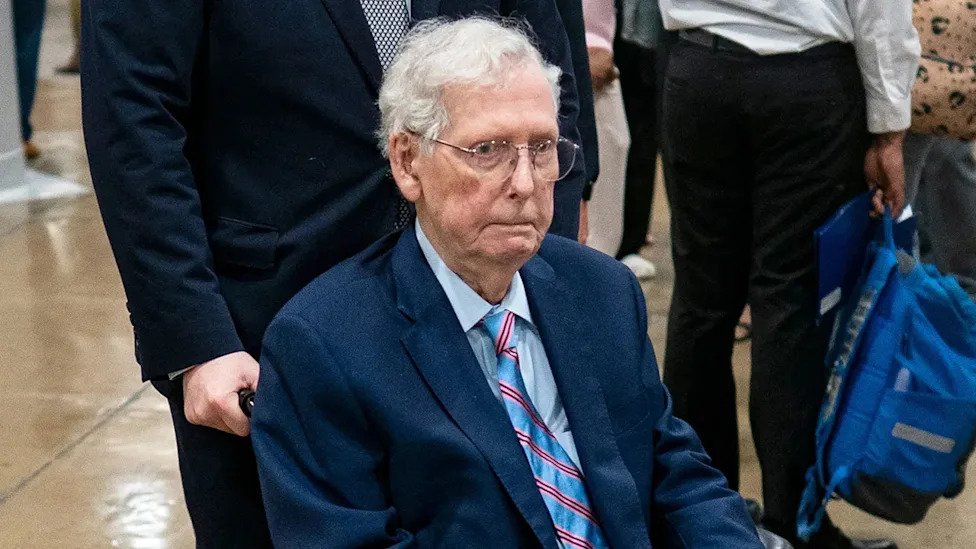
Questions surrounding the health of veteran Republican Senator Mitch McConnell continue to intensify as the United States Senate prepares to return from its summer recess, with the prolonged absence of one of Washington’s most influential political figures fuelling speculation across the political spectrum.
Nearly one month after the 84-year-old Kentucky senator was admitted to hospital in the Washington metropolitan area, his office has released only limited updates regarding his condition. The lack of detailed information has prompted growing concern among lawmakers, political observers and constituents, particularly as Congress faces a crucial legislative period dominated by defence funding, government spending and national security priorities.
McConnell, who has not appeared in public since 14 June, remains hospitalised. His staff have consistently stated that he is “continuing to improve” and remains actively engaged with Senate business. However, they have declined to disclose the nature of his illness, explain the circumstances surrounding his hospitalisation or provide any indication of when he might return to Capitol Hill.
The absence of official medical information has allowed speculation to spread rapidly, particularly following reports concerning the emergency response that led to his admission.

Emergency dispatch recordings obtained by several American media organisations reportedly indicate that paramedics responded to McConnell’s residence following reports of an unconscious individual and that cardiopulmonary resuscitation (CPR) was being administered before transport to hospital.
Further attention was drawn to the situation when CNN published video footage showing an unidentified individual being wheeled on a stretcher towards an ambulance. Because the person’s face was not visible, the footage did not independently confirm the individual’s identity.
McConnell’s office has neither confirmed nor denied the authenticity or relevance of those reports, choosing instead to maintain its limited public statements.
That silence has encouraged widespread discussion on television, social media platforms and political podcasts.
Former counterterrorism intelligence officer Malcolm Nance publicly speculated about McConnell’s condition during an interview with former Democratic Senate candidate Amy McGrath. Citing his previous experience as an emergency medical technician while serving in the military, Nance suggested that the reported emergency response raised serious concerns.
McGrath, who challenged McConnell in Kentucky’s 2020 Senate election, acknowledged the uncertainty but declined to endorse the speculation, noting that events would ultimately clarify the senator’s situation.
Despite the growing public debate, no official medical evidence has been released to support many of the claims circulating online.
The timing of McConnell’s continued absence has heightened political significance.
The Senate is scheduled to reconvene on Monday for a four-week legislative session expected to focus heavily on annual appropriations bills, military spending and efforts to prevent a federal government shutdown before the beginning of the new fiscal year on 1 October.
Republicans currently hold a narrow 53-47 majority in the Senate, meaning every vote carries considerable importance.
McConnell chairs both the Senate Rules Committee and a key defence appropriations subcommittee responsible for shaping Pentagon funding legislation. His absence reduces Republican voting strength while potentially complicating negotiations over spending measures that already face intense partisan disagreements.
Congressional leaders from both parties have indicated that another temporary funding agreement may ultimately be necessary to avoid a partial government shutdown if permanent appropriations cannot be completed before the deadline.
The lack of clarity surrounding McConnell’s health has also prompted concern from officials beyond Washington.
Kentucky Governor Andy Beshear, a Democrat, published an open letter urging the senator to provide reassurance to the people of Kentucky regarding his wellbeing and ability to continue serving in office.
Beshear argued that prolonged uncertainty benefits neither the senator nor the citizens he represents, stating that constituents deserve greater transparency about the condition of one of their elected representatives.
McConnell’s office responded only by thanking supporters for their messages of encouragement, reiterating that the senator remains involved in legislative matters while recovering.
Senior Republican leaders have attempted to calm concerns by confirming that they have spoken directly with McConnell.
Senate Majority Leader John Thune and Republican Whip John Barrasso both stated publicly that recent conversations suggested the senator remained mentally alert and actively discussing current political developments.
President Donald Trump, when questioned by reporters aboard Air Force One about McConnell’s condition, replied that he had no information regarding the senator’s health.
McConnell’s current hospitalisation follows several highly publicised health incidents over recent years.
In 2023, he suffered a concussion after falling during a private event and later experienced two separate episodes in which he suddenly froze while speaking during press conferences, raising widespread questions about his neurological health.
He also sustained a wrist injury following another fall and earlier this year spent more than a week in hospital receiving treatment for flu-like symptoms.
Although McConnell subsequently returned to work after each previous incident, concerns regarding his long-term health have steadily increased as he remains one of the oldest serving members of the United States Senate.
Political analysts note that the current situation echoes several recent episodes involving ageing American political leaders whose medical conditions became subjects of intense public scrutiny.
Observers have drawn comparisons with New Jersey Congressman Thomas Kean, who remained absent from Congress for several months before revealing he had been receiving treatment for depression.
Others point to former President Joe Biden and the late Senator Dianne Feinstein, whose declining health prompted broader national debate over age, transparency and leadership within American politics.
Reed Galen, president of the pro-democracy organisation JoinTheUnion.us, argued that prolonged uncertainty risks transferring effective decision-making authority to unelected political staff rather than elected representatives.
He suggested the situation reflects wider concerns about what critics describe as an ageing political establishment in Washington, where questions regarding the health of senior officeholders have become increasingly common.
Beyond the political implications, constitutional questions also arise if McConnell remains unable to fulfil his duties.
Unlike the House of Representatives during certain emergencies, Senate rules do not permit proxy voting. As a result, every absence effectively reduces the Republican Party’s voting strength by one member during legislative proceedings.

Should McConnell resign or die while in office, Kentucky law could create additional complications.
Legislation passed by the Republican-controlled Kentucky legislature in 2024 removed the governor’s authority to appoint an interim replacement to the United States Senate. Instead, any vacancy would require a special election.
Because the law has not yet been tested under these circumstances, legal experts suggest disputes could emerge regarding the timing of such an election. Depending on judicial interpretations and election scheduling, Kentucky’s Senate seat could potentially remain vacant until the next Congress convenes.
Political pollster John Zogby compared the uncertainty surrounding McConnell’s condition with historical periods in which governments delayed public acknowledgement of a leader’s declining health while broader political transitions remained unresolved.
For now, however, official information remains extremely limited.
Until McConnell’s office provides a comprehensive medical update or the senator returns to public view, questions surrounding one of America’s longest-serving and most influential Republican leaders are likely to persist. His health has become not only a personal matter but also an issue carrying significant implications for Senate operations, legislative negotiations and the balance of political power in Washington during a pivotal period for the United States government.
Related News:
 US Court Restores Abortion Pill Access Temporarily
 Thousands Protest ICE Operations in Nationwide US Day of Action
 US Court Ruling Reshapes Voting Rights Landscape
 US states redraw maps after voting rights ruling
 Judge halts deportation of Yemeni refugees in US
 Giuliani hospitalised in critical condition
 Trump warns Iran as Middle East tensions surge again
 FDA Chaos Deepens as Trump Eyes Makary Exit
 Trump’s Revenge Drive Deepens GOP Divide
 Former ICC prosecutor condemns US sanctions
 Gunman Killed After White House Security Shootout
 China-critical UK academics face ‘extremely heavy’ pressure from Beijing
 US Justice Department Files Lawsuit Against California Over Partisan Voting Maps
 Trump Deploys DHS to Charlotte in Major Arrest Operation
 Congress Approves Release of Epstein Files, Trump Expected to Sign
 Texas Governor Faces Lawsuit From CAIR
 US National Guard Member Killed in DC Shooting
 Trump to Recheck Green Cards from 19 Nations After DC Attack
 Chinese & Japanese Boats Clash Near Disputed Islands
 Putin Meets US Envoy Amid Key Ukraine Peace Talks
 US Defence Chief on Drug Boat Strike: “Did Not See Survivors”
 Trump Escalates Minnesota Immigration Surge Amid Rising Tensions
 Greenland Faces Pivotal Summit Over Arctic Power Struggle
 Trump Threatens Strong Action If Iran Executes Protesters
 Trump Receives Machado’s Nobel Medal in White House Meeting
 EU Says US Ties Have Suffered ‘Big Blow’ After Greenland Crisis
 Trump officials continue false claims after Alex Pretti shooting
 UK and EU Signal Fresh Push for Defence Cooperation Talks
 Partial US Government Shutdown Hits Homeland Security Funding
 Epstein Files Reveal Trump Officials’ Emails with Financier
 Thousands Protest ICE in New York Against Trump Deportation Campaign
 Trump Praises ‘Terrific’ Petro After White House Talks
 Sydney Protest Clash Triggers Police Probe
 Clinton Testimony Erupts in Fiery Exchange
 UK Prepares Aircraft Carrier for Middle East Crisis
 Pete Hegseth Iran War Remarks Spark Alarm
 Queensland Protest Laws Spark Free Speech Backlash
 Trump’s Harsh Rhetoric on Iran Sparks Global Alarm
 Report Says Pezzullo Acted ‘Recklessly’ in Dealings
 Hungary election: Orbán faces biggest test amid scandal
 Suspected Plot Targets Pipeline Before Hungary Vote
 Trump Faces Crisis as Iran Reopens Hormuz Tensions
 Harmeet Dhillon Faces Scrutiny in DOJ Role Debate
 Charles Faces Trump Test in High-Stakes US Visit
 UK Stands Firm on Falklands Amid US Rift
 Trump at Press Dinner Sparks Tension
 US Court Weighs Fate of TPS for Migrants
 Florida Redistricting Map Sparks Major US Political Battle
 US Voting Rights Ruling Sparks Celebration and Outcry
 Cartel crackdown raises fears of fresh violence
 Trump orders US troop pullout from Germany
 Trump likens US Navy actions to ‘pirates’
 White House Security Case Sparks Political Firestorm
 Trump approval plunges amid Iran war fears
 Ohio’s Battle for Trust: Democrats Vying to Flip the Buckeye State
 Trump Threatens UN Budget Cuts as US Pushes ‘Trade Over Aid’ Agenda
 US Supreme Court fast-tracks Voting Rights ruling
 US ‘Narco Boat’ Strikes Draw Global Outcry
 Indiana Republicans Defy Trump in Key Vote Test
 Ohio Primaries Set Stage for Crucial Midterms
 Afghan Families Left in Limbo Face Risk of Deportation
 Florida Surgeon ‘Devastated’ Over Fatal Surgery Error
 Tensions Emerge in Netanyahu-Trump Alliance
 US Awaits Iran Reply on New Ceasefire Proposal
 Immigration Judges Fear Pressure in Trump Era
 US green card applicants must apply from abroad, DHS says
 Tulsi Gabbard exits after turbulent intelligence tenure
 Hormuz Talks Near Critical Stage
 Trump Claims Iran Peace Deal Near Completion
 Irish Gangland Figure Fails in Dublin Election Bid
 Prosecutor Proposes Law to Combat Election Deceit
 US Midterm Primaries: Democrats Target Key Republican Seats
 House Curbs Trump’s War Powers in Rare Rebellion
 Le Pen’s Popularity Holds Despite Conviction
 Trump Refuses to Sign Housing Bill, But Law Takes Effect
 Senate Halts Defense Bill Over Iran Clashes
 Houthis Strike Saudi Arabia as Middle East Tensions Rise
 Trump Orders Signs Criticising Smithsonian Museum
 Is America Ready for an AOC Presidential Run?
 Trump dismisses concerns over 250-day carrier deployment