Published: 13 January 2026. The English Chronicle Desk. The English Chronicle Online.
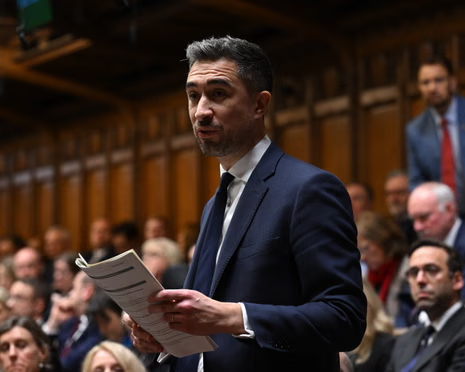
A controversy surrounding a Jewish MP school visit has drawn national attention after a planned appearance at a Bristol secondary school was cancelled following organised opposition. The incident, which occurred quietly in September, has resurfaced after senior political figures raised concerns about discrimination, free expression, and the safety of public debate within educational spaces. At the centre of the issue is Damien Egan, the Labour MP for Bristol North East, whose scheduled visit to Bristol Brunel Academy was called off just hours before it was due to take place.
The Jewish MP school visit had been arranged as part of routine constituency engagement, with the intention of discussing democracy, civic responsibility, and parliamentary life with students. According to sources familiar with the planning, the session aimed to encourage political participation and raise aspirations among pupils interested in public service. However, the school decided to postpone the visit after becoming aware of planned protests linked to local pro-Palestine activism.
The cancellation gained wider prominence after comments made by Steve Reed, the Communities Secretary, during a Jewish Labour Movement conference in north London. Speaking to party members, Reed described the case of a Jewish colleague who had been refused permission to visit a school in his own constituency. He said concerns had been raised that the MP’s presence could “inflame” teachers, a justification he described as unacceptable and deeply troubling. Although Reed did not name the MP, individuals close to Egan later confirmed that the comments referred to the Bristol incident.

Reed’s remarks reflected growing unease within government about the boundaries between political protest and discrimination. He told the conference audience that preventing an elected representative from engaging with students because of identity or perceived political views crossed a serious line. He added that those responsible for such decisions would be held accountable, stressing that schools should be environments where pluralism and respectful dialogue are upheld.
Following the cancellation, Bristol Palestine Solidarity Campaign publicly welcomed the decision. In a statement shared on social media, the group said concerns had been raised by National Education Union staff members, parents, and local residents. The statement claimed the outcome sent a clear message that politicians who support Israel’s military actions in Gaza were not welcome in schools. The group cited Egan’s role as vice-chair of Labour Friends of Israel and his recent visit to Israel as evidence of his stance.
Local representatives of the National Education Union also celebrated the postponement. On its own social media channels, the Bristol NEU described the cancellation as a victory for safeguarding and solidarity. The post praised the collective action of staff, parents, and campaigners, framing the decision as an example of effective grassroots organising within the education sector.
These reactions have intensified debate over whether the Jewish MP school visit was halted due to legitimate safety concerns or because of political and religious pressure. Critics argue that celebrating the exclusion of an MP from a school sets a dangerous precedent, particularly when identity and faith appear to be factors. Supporters of the cancellation maintain that schools must remain neutral spaces and avoid hosting figures associated with positions that some in the community find distressing.
Damien Egan has not commented publicly on the matter. Since his election, he has been a visible target for anti-Israel activism in Bristol, a city known for its strong protest culture. Egan is married to Yossi Felberbaum, an Israeli software developer, a fact that has occasionally been referenced in online criticism. Allies of the MP argue that such personal details should have no bearing on his ability to carry out constituency duties.
Further reporting by the investigative newsroom The Bristol Cable shed light on the extent of the opposition ahead of the scheduled visit. An NEU member at another local school described a period of intense organising, including discussions about staff and supporters wearing keffiyehs on the day of the visit. These plans, although peaceful in intent, raised concerns about disruption and student welfare.
In a statement, Bristol Brunel Academy said the visit had been postponed rather than permanently cancelled. The school explained that it became aware of plans for a public protest outside the premises on the evening before the scheduled appearance. Leaders decided to delay the visit to ensure that students, staff, and visitors would feel safe entering and leaving the school, and to avoid disruption to learning.
The school emphasised that the planned session was focused on democracy and the role of an MP, not foreign policy. It added that maintaining a calm and secure environment was its primary responsibility. The academy confirmed it had remained in contact with Egan and that an alternative date for the visit had been arranged. Police advice was sought and followed throughout the process.
Egan’s connection to the school community is longstanding. He is a former student of the Cabot Learning Federation, the multi-academy trust that includes Bristol Brunel Academy. Supporters argue this background underscores the educational value of his visit and makes the postponement particularly regrettable.

The episode has reignited broader discussion about how schools navigate politically sensitive issues during periods of international conflict. Since the outbreak of war in Gaza, tensions have risen across the UK, with protests, counter-protests, and heightened community sensitivities. Many educators report feeling caught between safeguarding obligations and the need to uphold democratic engagement.
Steve Reed acknowledged that the government had been slow to respond to some examples of anti-Israel extremism. He told conference delegates that Labour had reassessed its approach and would act more decisively when lines were crossed. His comments suggest a willingness to intervene where political activism risks undermining equality or access to public institutions.
For Jewish communities, the case has become emblematic of wider anxieties. Some fear that opposition to Israeli policy is increasingly spilling into hostility toward Jewish individuals, even when activities are unrelated to the Middle East conflict. Others caution against conflating criticism of Israel with antisemitism, warning that such accusations can stifle legitimate protest.
As discussions continue, the postponed Jewish MP school visit remains a focal point for these competing narratives. Whether the rescheduled appearance proceeds without incident may shape future decisions by schools facing similar pressures. The outcome is likely to influence how educational institutions balance safety, inclusivity, and democratic participation in an increasingly polarised climate.
Related News:
 Pressure mounts on No 10 over under-16s social media ban
 Six-Figure Tutors Teach Toddlers to ‘Be British’
 How Bringing Forests Into Preschools Boosts Children’s Health
 Is a two-week half-term a good deal? Some parents in England aren’t so sure
 Posthumous books are messy and fraught – but Virginia Giuffre’s gives her a voice
 The upcoming book-to-screen adaptations I’m most excited about
 Bridget Phillipson Vows to Confront Unions Over Reading Tests
 Children to Learn Local History in Major Curriculum Overhaul
 UK University Suspends Human Rights Research Following Pressure from China
 My standout favourite book of 2025: The Names
 UK University Faces Counter-Terror Probe Over China Pressure
 Top Christmas Books Reads: Classics to Cozy Romcoms
 England Curriculum Review Recommends Major Changes
 Mortgages and AI Set to Feature in English Schools
 Greta Thunberg Backs Student Facing UK Visa Revocation
 Audio Books deals and promo codes to explore in November 2025
China-critical UK academics face ‘extremely heavy’ pressure from Beijing
Audio Books deals and promo codes to explore in November 2025
China-critical UK academics face ‘extremely heavy’ pressure from Beijing
 Labour immigration crackdown could cost UK £4.4bn
 London’s Childlessness Crisis: Schools Closing as Families Shrink
 No link found between paracetamol in pregnancy and autism
 Government urges schools to ban phones to curb classroom disruption
 Stephen Fry backs SafeCall to protect missing children
 England schools to receive AI-generated attendance targets
 Nigeria’s $25m Museum Faces Political Storm Amid Benin Bronzes Debate
 Algeria Pardons French-Algerian Novelist Sansal After Year in Jail
 South Korea’s College Exam Tests Perseverance of Blind Students
 Phillipson Accused of Appeasing Unions by Diluting EBacc
‘I’ve Read 38 Books, but This Is My Standout Favourite’
Phillipson Accused of Appeasing Unions by Diluting EBacc
‘I’ve Read 38 Books, but This Is My Standout Favourite’
 England’s Special Needs Support Faces Breaking Point
 Nigerian Education Reversal: Mother-Tongue Teaching Scrapped
 Higgs Donates Nobel Medal to His Beloved University
 UK Schools Face Staff Exodus Amid Wellbeing Crash
 Ex-Harvard President Pauses Teaching Over Epstein Emails
 Scottish Families Take Legal Action Over School CO Leak
 Men Aren’t Vanishing From Fiction, But Misconceptions Persist
 Schools urged to trial four-day week to ease pressure on teachers in England and Wales
 Oxford Names ‘Rage Bait’ Word of the Year
 Youth Strategy Aims to End Decades of Political ‘Indifference’
 Starmer’s communications chief to outline media strategy overhaul
 Farm Inheritance Tax U‑Turn Eases Burden After Months of Protests
 U‑Turn on Farmers’ Inheritance Tax Sparks Political Firestorm
 UK to Launch Military ‘Gap Year’ Scheme to Boost Recruitment
 Starmer Allies Honoured in New Year Awards List
 Blair Pressured Officials Over Iraqi Detainee Case, Files Reveal
 Royal Documents Withheld Sparks Accusations of Cabinet Cover-Up
 European Court Questions UK Over Shamima Begum Case
 Polanski Burnham Reform Strategy Signals Green–Labour Divide
 Starmer Unveils Cost of Living Plan for 2026 Renewal
 UK Small Boat Crossings Surge Past 41,000 in 2025
 UK rails face crisis as calls to end “rail outsourcing racket” grow louder
 UK Govt Faces Backlash Over Focus on Freeing Activist Alaa Abd el-Fattah
 GMB Union Faces Turmoil Amid Female Leaders’ Claims
 UK MPs Challenge Ministers Over Venezuela Attack Response
 Labour Urged to Rebuild Voter Trust Amid Poll Warning
 MoJ Prison Leasing Scandal Triggers £100m Public Cost
 Smaller farms funding prioritised in England nature plans
 Election Deepfakes Pilot Launched for Scottish and Welsh Votes
 Reeves Pub Business Rates U-Turn Calms Labour Revolt
 Cambridge College Faces Backlash Over Private School Recruitment
 Reform UK council tax pledges face backlash over rising local bills
 Glasgow rector cleared by watchdog in antisemitism case
 Zarah Sultana Faces Scrutiny Over Your Party Membership Launch
 Wessex Water chiefs receive £50,000 extra despite government bonus ban
 UK Immigration Perception Divides Voters Despite Falling Numbers
 Elon Musk warns of UK clampdown on X free speech
 Lammy and Vance unite against AI abuse images on X
 Ban Social Media for Under-16s, Teachers Demand Action
 UK urges peaceful Iran transition amid escalating protests
 Labour MPs push ban on crypto political donations
 Slashing jury trials plan sparks UK justice reform debate
 UK Guantánamo Settlement Paid to Tortured Detainee
 Civil groups oppose new anti-protest powers in England and Wales
 Sikh Activist Warned Over Rising Security Threats in UK
Education Leaders Call for End to Compulsory GCSE Resits in English and Maths
Sikh Activist Warned Over Rising Security Threats in UK
Education Leaders Call for End to Compulsory GCSE Resits in English and Maths
 Thousands of New School Nursery Places to Be Rolled Out Across England
 White Low-Income Pupils in England Show Lowest Levels of School Engagement, Study Finds
 Reeves Faces Setback as Labour May Miss Homes Target
 Kate Winslet to Narrate Film Highlighting King’s Environmental Mission
 Trump’s UK Ambassador Urges North Sea Drilling to Strengthen US Ties
 UK Bans Fake Numbers: Scammers Lose Their Trick