Published: July 8, 2026 | The English Chronicle Desk | The English Chronicle Online
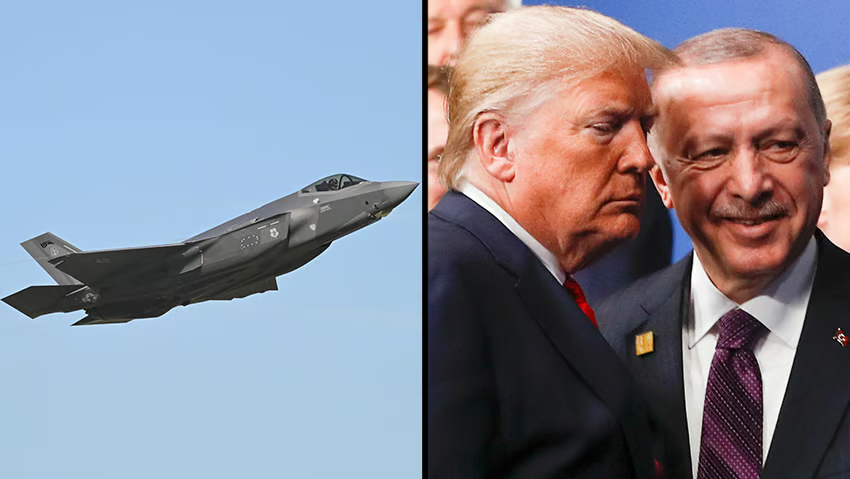
Tensions between two of the United States’ closest regional allies have intensified after reports that US President Donald Trump has expressed support for the potential sale of advanced stealth fighter jets to Turkey under President Recep Tayyip Erdoğan. The development has reportedly sparked concern within Israeli political and defence circles, where officials fear such a move could alter the military balance in the Middle East.
The reported backing for the possible transfer of fifth-generation fighter aircraft comes as Washington seeks to strengthen relations with Ankara following years of strained diplomatic ties. While no final agreement has been officially announced, the prospect of Turkey acquiring some of the world’s most advanced combat aircraft has already generated significant debate among policymakers, military analysts and regional allies.
Israeli officials have long maintained that preserving Israel’s qualitative military edge—a longstanding principle of US defence policy—is essential to maintaining stability in the region. Under that policy, Washington traditionally ensures that Israel retains superior military capabilities compared with neighbouring countries receiving American weapons systems.

Reports suggesting renewed momentum behind a potential stealth fighter sale have therefore prompted concerns that the longstanding strategic balance could face new challenges.
According to defence analysts, stealth aircraft represent a major leap in military capability. Designed with low radar visibility, advanced electronic warfare systems, sophisticated sensors and network-centric operational features, fifth-generation fighters are capable of conducting missions in heavily defended airspace while sharing real-time battlefield information with allied forces.
Such capabilities make them among the most strategically valuable military assets currently available.
Turkey has repeatedly expressed interest in modernising its air force through the acquisition of advanced combat aircraft. Ankara argues that as a long-standing NATO member located in a strategically important region, it requires cutting-edge equipment to address evolving security threats along its borders and to fulfil alliance commitments.
Turkish officials have consistently maintained that strengthening their armed forces contributes not only to national defence but also to NATO’s collective security.
The possibility of renewed defence cooperation between Washington and Ankara reflects broader efforts to improve bilateral relations after several years marked by disagreements over regional conflicts, defence procurement and sanctions.
Political observers note that recent diplomatic engagement has focused on rebuilding trust between the two governments while expanding cooperation on defence, trade and regional security issues.
However, the reported support for a fighter aircraft sale has introduced fresh complexity into America’s broader Middle East diplomacy.
Israeli security officials reportedly believe that any transfer of advanced stealth technology to regional powers must be evaluated carefully to ensure it does not undermine Israel’s long-established military superiority. Defence experts note that maintaining this advantage has been a consistent feature of US policy for decades regardless of changes in presidential administrations.
Military analysts emphasise that concerns surrounding advanced fighter exports extend beyond the aircraft themselves. Modern combat platforms are increasingly integrated with intelligence-sharing systems, electronic warfare capabilities, precision-guided weapons and secure communications networks that collectively enhance military effectiveness.
For this reason, any decision involving their export typically undergoes extensive strategic, technical and political review.
Supporters of closer US-Turkey defence cooperation argue that Ankara remains a critical NATO ally with one of the alliance’s largest armed forces. Turkey occupies a geographically significant position linking Europe, Asia and the Middle East while playing an important role in regional security operations.
Advocates contend that strengthening Turkey’s military capabilities could reinforce NATO’s southern flank at a time of growing geopolitical uncertainty.
They also argue that deeper defence cooperation may encourage closer political coordination between Washington and Ankara after several years of diplomatic tension.
Critics, however, caution that any major defence agreement should carefully consider regional dynamics and alliance relationships. Some analysts believe balancing the security interests of both Turkey and Israel remains one of the most delicate challenges facing American foreign policy.
The issue also highlights the increasingly complex nature of modern defence diplomacy, where military procurement decisions frequently carry broader geopolitical consequences.
In recent years, competition over advanced military technology has intensified as governments seek to modernise their armed forces in response to evolving security threats. Fifth-generation fighter aircraft have become particularly valuable due to their combination of stealth characteristics, artificial intelligence-assisted systems, high-performance sensors and multi-domain operational capabilities.
Alongside imports, Turkey has also accelerated development of its own indigenous defence industry. Projects such as the KAAN next-generation fighter programme demonstrate Ankara’s ambition to reduce dependence on foreign suppliers while expanding domestic aerospace manufacturing capabilities.
Nevertheless, acquiring additional advanced aircraft from international partners could significantly accelerate Turkey’s military modernisation efforts during the coming decade.
Meanwhile, Israeli defence planners continue investing heavily in air superiority, missile defence and advanced intelligence capabilities. Israel already operates sophisticated fifth-generation aircraft and maintains one of the region’s most technologically advanced air forces.
Security experts therefore caution against drawing premature conclusions regarding any potential shift in the regional military balance until specific details of any future agreement become publicly available.
Any proposed sale of advanced American military equipment would also require approval through established US government procedures, including congressional oversight where applicable. Defence export decisions typically involve extensive interagency consultations addressing security, technology protection and foreign policy considerations.
Diplomatic observers suggest that Washington will likely continue engaging both Ankara and Jerusalem in an effort to reassure each side regarding its broader regional security commitments.

For the United States, maintaining strong strategic partnerships with both Turkey and Israel remains an important component of its wider Middle East policy. Achieving that balance, however, often requires navigating competing security priorities among close allies.
As discussions continue, officials from all three countries are expected to remain engaged through diplomatic and defence channels. Whether the reported support ultimately results in a formal agreement remains uncertain, but the debate has already underscored how advanced military technology increasingly shapes international diplomacy as much as national defence.
With geopolitical tensions remaining high across several regions, decisions surrounding next-generation fighter aircraft are likely to remain closely watched—not only for their military implications but also for what they reveal about the evolving strategic relationships among key regional and global powers.
Related News:
 Trump’s Iran Endgame Unclear After Mixed Messaging on War Aims
 UK Prepares Aircraft Carrier for Middle East Crisis
 Trump orders US troop pullout from Germany
 Trump likens US Navy actions to ‘pirates’
 Trump to Recheck Green Cards from 19 Nations After DC Attack
 Russia losses Ukraine war peace talks intensify amid rising deaths
 Trump Escalates Minnesota Immigration Surge Amid Rising Tensions
 Trump Threatens Strong Action If Iran Executes Protesters
 Trump Receives Machado’s Nobel Medal in White House Meeting
 Greenland Crisis Forces Europe to Draw a Line With Trump
 Iran Cannot Be Bombed Into Democracy, Only Helped There
 EU Says US Ties Have Suffered ‘Big Blow’ After Greenland Crisis
 Trump Praises ‘Terrific’ Petro After White House Talks
 Fears of New Arms Race as US-Russia Nuclear Weapons Treaty Expires
 Starmer Weighs Fast-Tracking Defence Boost
 Macron Rebuked in Franco-German Defence Row
 New Nuclear Talks Between US and Iran Begin in Geneva
 ‘He Did It for Us’: US Soldier Recalls Jesse Jackson’s Efforts to Free Him and Two Other POWs
 Stephen Colbert Says CBS Spiked Interview With Democrat Over FCC Fears
 Japan Braces as Takaichi Begins New Term with Huge Mandate for Low‑Tax, Ultra‑Conservative Agenda
 US Urges Iran to Make Deal as Military Presence Rises
 US Build-Up of Warships and Fighter Jets Tracked Near Iran
 Billionaire Les Wexner Tells US Lawmakers He Was ‘Naive’ and ‘Conned’ by Epstein
 Musk Cuts Starlink Access for Russian Forces – Giving Ukraine an Edge at the Front
 Clinton Testimony Erupts in Fiery Exchange
 American Citizen Killed in Cuba Boat Shooting, U.S. Officials Say
 Hopes and Fears as US Iranians Take to Streets After Toppling of Supreme Leader
 Iran, the US, and a World Cup That Starts in Three Months
 Trump Faces Questions Over Iran Conflict Plan
 UK Will Allow US to Use Bases to Strike Iranian Missile Sites, PM Says
 Cooper: Joining US Strikes on Iran ‘Not in Britain’s Interest’
 The US Now Has the Medicine for Cheap Swarming Drone Attacks
 US Senate Backs Trump War Powers Amid Iran Missile Barrage
 US Senate Vote Fails to Rein in Trump War Powers on Iran
 Trump Removes Kristi Noem From Homeland Security Role
 Minister Meets Crews Who Will ‘Take Out’ Iranian Drones
 Pete Hegseth Iran War Remarks Spark Alarm
 UK–US Tensions Ease as Starmer and Trump Hold First Call Since Iran Row
 Iran War Puts Trump at Political Risk Amid Rising Prices
 Iran Rejects Ceasefire, Warns Trump With Chilling Message
 Trump’s Confidence Undimmed — But Every Iran Option Carries Risk
 Trump Seeks to Delay Meeting With Xi
 ‘Patriots, Carry On’: Hegseth Overrules Army to Reinstate Pilots After Kid Rock Flyover
 Trump’s Harsh Rhetoric on Iran Sparks Global Alarm
 The Academic Chill: Beijing Condemns ‘Hostile’ US Questioning After Researcher’s Death
 Charles Faces Trump Test in High-Stakes US Visit
 USS Gerald R Ford Ends Record Naval Deployment
 US Court Ruling Reshapes Voting Rights Landscape
 US states redraw maps after voting rights ruling
 Giuliani hospitalised in critical condition
 Trump Threatens UN Budget Cuts as US Pushes ‘Trade Over Aid’ Agenda
 Trump warns Iran as Middle East tensions surge again
 US Court Restores Abortion Pill Access Temporarily
 Ohio Primaries Set Stage for Crucial Midterms
 “The Pivot to Pakistan”: Trump Pauses ‘Project Freedom’ in Hormuz Amid Iran Deal Hopes
 “The Strait Scramble”: Inside Trump’s ‘Project Freedom’ and the Hormuz Naval Escort
 “The New Silk Road”: India and Vietnam Forge Strategic Maritime Alliance to Counter Regional Volatility
 Tensions Emerge in Netanyahu-Trump Alliance
 US Awaits Iran Reply on New Ceasefire Proposal
 Hormuz Talks Near Critical Stage
 Discontent grows around Putin amid war strain
 Former ICC prosecutor condemns US sanctions
 Gunman Killed After White House Security Shootout
 Trump Claims Iran Peace Deal Near Completion
 House Curbs Trump’s War Powers in Rare Rebellion
 Trump-Netanyahu Call Fuels Iran Talk Crisis
 Zelensky Invites Putin to Direct Peace Talks
 Republicans Defy Trump on Ukraine Aid Bill
 UK Faces Most Dangerous Era, Military Chief Warns
 Royal Navy Mourns Devastating Helicopter Loss
 Israel Strikes Iran After Missile Attack
 US Launches Strikes on Iran After Military Helicopter Downed Near Strait of Hormuz
 Trump Presidency Reignites America’s Founding Debate: How Much Presidential Power Is Too Much?
 China Missile Test Raises Pacific Security Concerns
 Trump Helps Clear Balogun for Belgium World Cup Clash
 UK Fighter Jets Intercept Russian Aircraft Over Norwegian Sea
 Why Some African Nations Are Rejecting Trump Aid
 Trump’s Major Recruitment Drive Targets Border Patrol Growth
 Trump’s New Vision for 250 Years of US Expansion
 NATO Unveils £37bn Joint Missile Defence Initiative